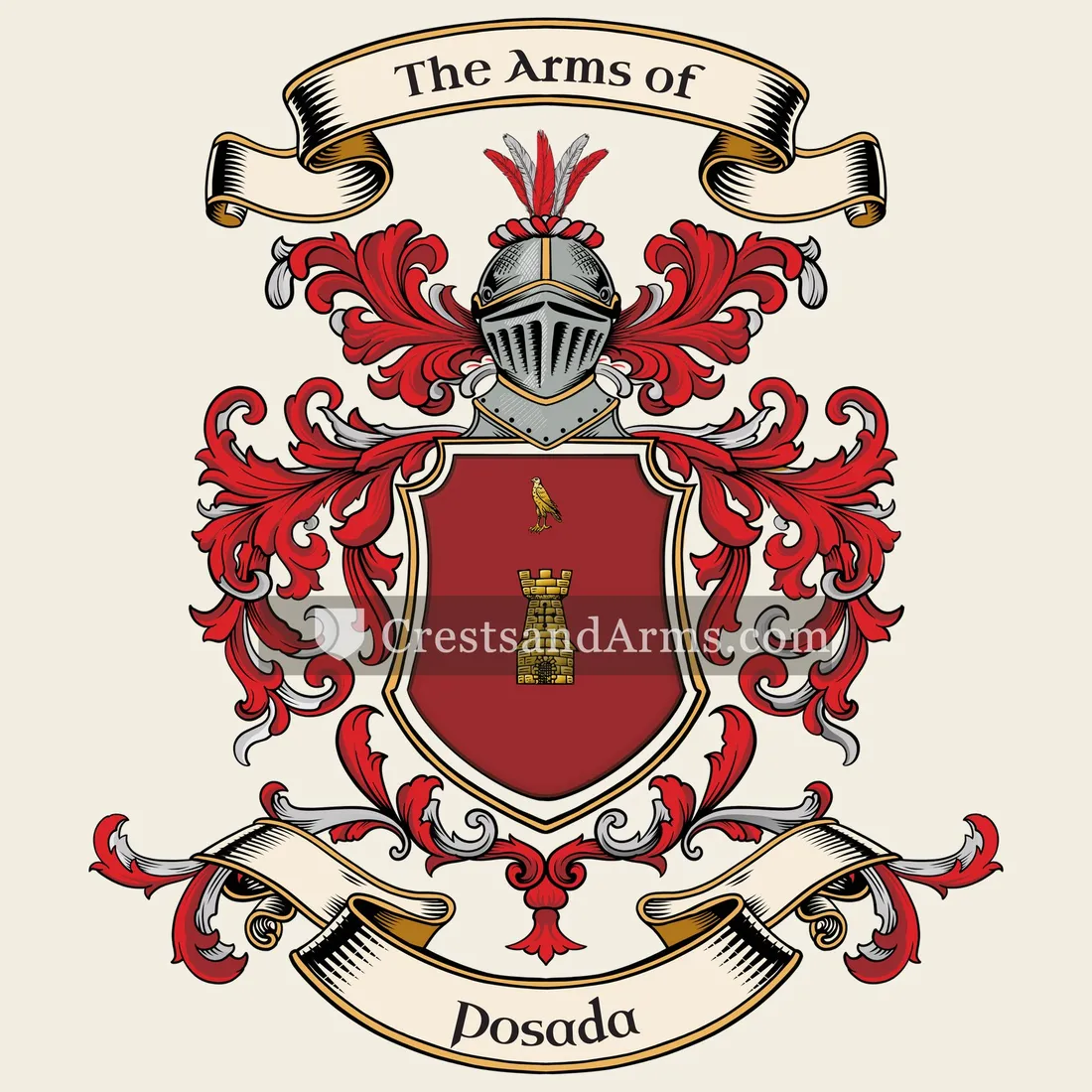
A record of documented arms, meaning and origin, researched for the Posada family of Spain.
Reg. 6635 · Spanish, P–S
Meaning of the Posada family crest colors & symbols
Symbols on this shield
towerGrandeur and solidity, and a stronghold defended
falconOne eager and quick in pursuit
Colours
Red (Gules)Means: Military strength
Gold (Or)Means: Generosity
Historical info
Source
J. B. Rietstap, Armorial Général, Gouda: G. B. van Goor Zonen, 1884–87
Blazon (the actual original written record)
“De gu. à une tour sommée d'une tourelle, accostée de deux fleurs-de-lis, et acc. d'un faucon posé sur une baguette en fasce qui sort de la fenêtre de la tourelle, vers le dextre, le tout d'or.”
SpainAsturies, c. 1722
Digital archive packCoat of arms PNG, gold border print PDF, vector SVG and the certificate of authenticity. Sent to your email in minutes.
Map of Spain showing where the Posada arms are recorded
The Posada arms were recorded in Asturies, c. 1722.
This is where the arms were entered in the register. Families often moved to other parts of the country, so the same name can turn up in more than one region.
The body that granted and recorded arms in Spain in this period.
Philip V of Spain
Sovereign of the period
Philip V of Spain
1714–1724
Reigning in Spain when the Posada arms are first recorded.
How Arms Worked in Spain
In Spain, a coat of arms was considered a form of property that belonged to the entire family line. These arms were passed down from a father to all his children equally. Younger branches of the family usually kept the original design without needing to add any special marks to distinguish their specific line.
Granting authority
The Cronista Rey de Armas was the official body that regulated and granted coats of arms throughout Spain.
How they got arms
Families often obtained their arms through royal grants or by proving their noble status to the official heraldic authority.
Where arms were recorded
Coats of arms were officially recorded in the registers of the Cronista Rey de Armas starting in 1496.
The family's standing
Recorded among the armigerous families of Spain.
Origin & History of the Posada Family in Spain
The surname Posada originates from the northern Spanish region of Asturias, a mountainous area known for its deep historical roots and rugged landscape. The name itself is topographical, derived from the Spanish word "posada," which refers to a resting place, an inn, or a lodging house. Historically, families who held this name were often associated with the local nobility or landholders who managed these essential stops along trade routes or pilgrimage paths. By the early 18th century, the Posada family was well-established within the social fabric of Asturias. Records from 1722 confirm their presence in the region, where they were deeply integrated into the local community and administrative life. Over time, the family expanded from these ancestral lands, eventually spreading their influence across Spain and into the Americas, carrying the legacy of their Asturian origins with them.
Posada Meaning & Related Branches
Root word
posada
Latin term for a place where one is placed or deposited.
This name
PosadaAn inn, lodging house, or a place providing shelter for travelers.
also spelled
Possada
Posado
Posad
Documented Sources
J. B. Rietstap, Armorial Général, Gouda: G. B. van Goor Zonen, 1884–87
Canseco, Vicente de Cadenas y, Repertorio de Blasones de la Comunidad Hispánica, 1987
Morgado García, Arturo, La nobleza asturiana en la Edad Moderna, 1996
Archivo Histórico de Asturias, Catálogo de la Sección de Protocolos Notariales, 1722
Digital archive packCoat of arms PNG, gold border print PDF, vector SVG and the certificate of authenticity. Sent to your email in minutes.


 towerGrandeur and solidity, and a stronghold defended
 falconOne eager and quick in pursuit
 towerGrandeur and solidity, and a stronghold defended
 falconOne eager and quick in pursuit