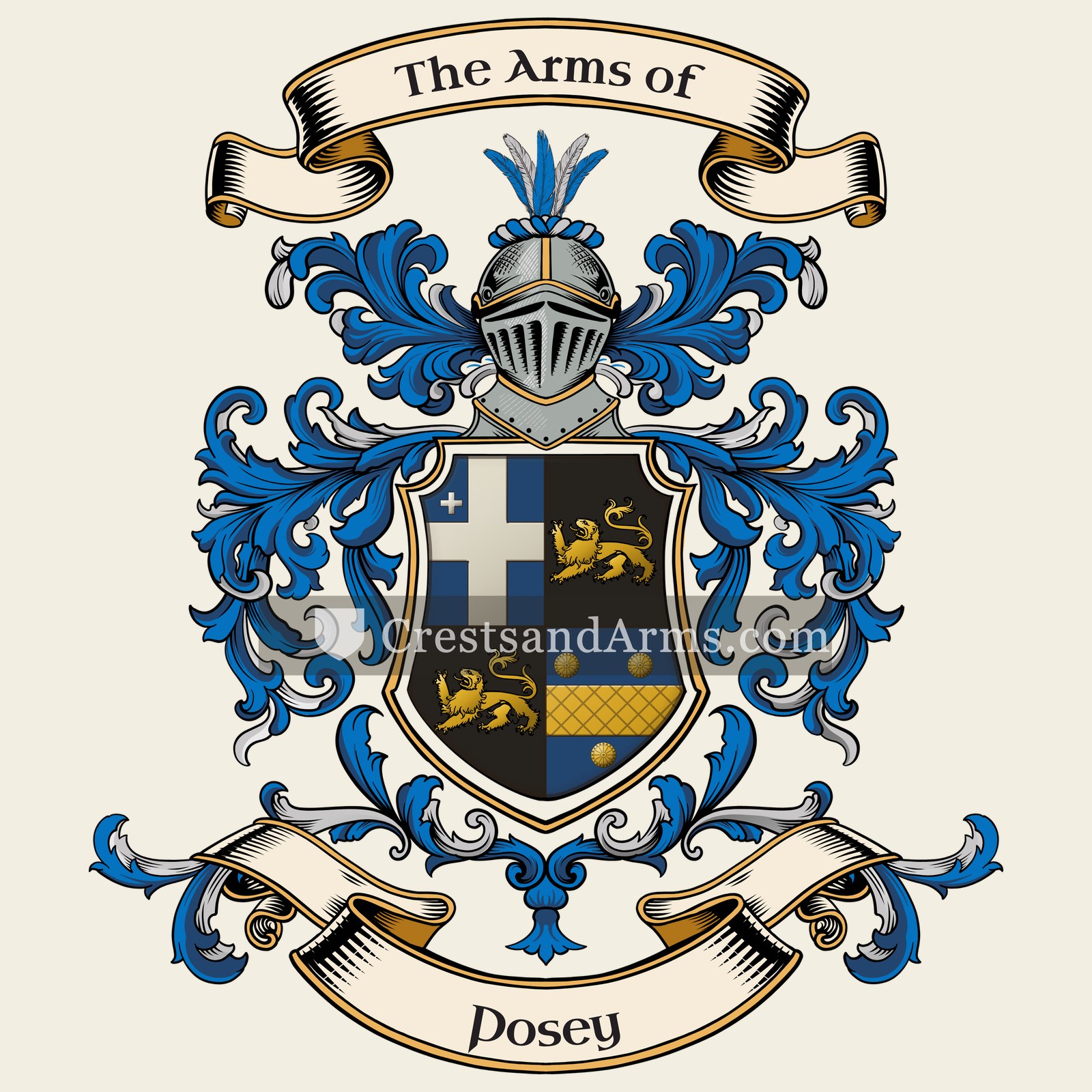
A record of documented arms, meaning and origin, researched for the Posey family of Germany.
Reg. 7331 · German, P–S
Coat of Arms & Family Crest Details
Symbols on this shield
cross symbolChristian faith and service
lionCourage, strength and royalty
roundelA coin, and one who has been to the crusades
Colours
Blue (Azure)Means: Loyalty and truth
Black (Sable)Means: Constancy
Silver (Argent)Means: Peace and sincerity
Gold (Or)Means: Generosity
Historical info
Source
J. B. Rietstap, Armorial Général, Gouda: G. B. van Goor Zonen, 1884–87
Blazon (the actual original written record)
“Ec.: au 1 d'azur à la croix patlée d'arg.; aux 2 et 3 de sa. au lion d'or, cour. du même, tenant entre ses pattes une boule écartelée d'or et d'or, divisé par un filet un croix de sa.; le lion du 3 cont.; au 4 coupé d'arg. sur azur, à trois boules écartelées d'or et d'or, divisé par un filet en croix de sa., posées 2 et 1. Cq. cour. C.: deux lions iss. et affr. d'or, cour. du même, supp. chacun d'une patte une boule pareille à celles des 2, 3 et 4, et posant ensemble l'autre patte sur une boule pareille, soutenue de la couronne. L.: à dextre d'or et de sa., à sen. d'arg. et d'azur.”
GermanyMisnie, c. 1725
Digital archive packCoat of arms PNG, gold border print PDF, vector SVG and the certificate of authenticity. Sent to your email in minutes.
Map of Germany showing where the Posey arms are recorded
The Posey arms were recorded in Misnie, c. 1725.
This is where the arms were entered in the register. Families often moved to other parts of the country, so the same name can turn up in more than one region.
The body that granted and recorded arms in Germany in this period.
Charles VI, Holy Roman Emperor
Sovereign of the period
Charles VI, Holy Roman Emperor
1711–1740
Reigning in Germany when the Posey arms are first recorded.
How Arms Worked in Germany
In the Holy Roman Empire, coats of arms were often granted to individuals by the Emperor or his representatives. These arms were then passed down through the generations to all legitimate descendants of the original holder. Younger branches of a family usually kept the same shield design without needing to change it, as the arms belonged to the entire lineage.
Granting authority
The Holy Roman Emperor held the sole power to grant new coats of arms throughout his vast imperial territories.
How they got arms
Families typically obtained their coats of arms through a formal imperial grant or by proving their noble status to the authorities.
Where arms were recorded
These grants were officially recorded in the Imperial Chancery registers, which began keeping formal records of such honors during the Middle Ages.
The family's standing
Recorded among the armigerous families of Germany.
Origin & History of the Posey Family in Germany
The history of the Posey name is deeply connected to the movement of families across European borders during the early eighteenth century. Records indicate that members of the family were established in Misnie, a historic region in present-day Saxony, by 1725. During this period, the area was part of the Electorate of Saxony, a region known for its complex social shifts and agricultural traditions. Families in Misnie often relied on the fertile lands near the Elbe River for their livelihood. As political and economic pressures grew in Central Europe, many individuals from this region sought new opportunities by migrating westward. This movement eventually led to the name appearing in colonial records in North America, where the family adapted to the challenges of frontier life. The name itself likely evolved from older linguistic roots common to the Germanic and Slavic populations of the region, reflecting the diverse cultural landscape of the time.
Related Branches & Arms
Root word
Poso
A Latin term referring to a drink or a refreshing draught.
This name
PoseyA habitational name derived from a location associated with a spring or well.
also spelled
Posse
Poze
Documented Sources
J. B. Rietstap, Armorial Général, Gouda: G. B. van Goor Zonen, 1884–87
Blaschke, Karlheinz. Bevölkerungsgeschichte von Sachsen bis zur industriellen Revolution. 1967


 cross symbolChristian faith and service
 lionCourage, strength and royalty
 roundelA coin, and one who has been to the crusades
 cross symbolChristian faith and service
 lionCourage, strength and royalty
 roundelA coin, and one who has been to the crusades