Map of France showing where the Poteete arms are recorded
The Poteete arms were recorded in Bourgogne, c. 1663.
Bourgogne was one of the richest parts of France, built on wine, wool and the roads that carried both. Wealth of that kind bought land, and land brought arms, so the region filled with armed families earlier than most of the country.
This is where the arms were entered in the register. Families often moved to other parts of the country, so the same name can turn up in more than one region.
The body that granted and recorded arms in France in this period.
Louis XIV of France
Sovereign of the period
Louis XIV of France
1643–1715
Reigning in France when the Poteete arms are first recorded.
How Arms Worked in France
In France, a coat of arms was a mark of honor that passed down through the male line to all legitimate descendants. Families often used the same shield without changes to show their shared heritage. If a branch wanted to stand out, they could add a small mark to their shield to show their specific place in the family tree.
Granting authority
The Juge d'armes de France acted as the official authority that regulated and verified coats of arms across the country.
How they got arms
Families typically inherited their arms from ancestors, though they could also receive them through royal grants or by proving their noble status.
Where arms were recorded
Coats of arms were officially recorded in the Armorial Général de France, which began its main collection in the year 1696.
The family's standing
Recorded among the armigerous families of Bourgogne.
Origin & History of the Poteete Family in France
The family name Poteete traces its roots back to the Bourgogne region of France, where records confirm the presence of family members as early as 1663. During this period, the name was likely associated with the rural landscape and the agricultural traditions of eastern France. Many families in this area were involved in viticulture or small-scale farming, which shaped their daily lives and social standing within their local parishes. As the family grew, they navigated the complex social changes of the seventeenth century, eventually moving beyond their original home in Bourgogne. This migration was often driven by the search for new land or the need to escape the political instability that frequently affected the French provinces. Over time, the name evolved in spelling as the family moved into different regions, eventually becoming the version recognized today.
Related Branches & Arms
Root word
pot
A vessel or container used for cooking or storage.
This name
PoteeteA diminutive occupational name for a maker or seller of earthenware pots.
also spelled
Potette
Pote
Documented Sources
J. B. Rietstap, Armorial Général, Gouda: G. B. van Goor Zonen, 1884–87
Departmental Archives of Côte-d'Or, Registres paroissiaux et d'état civil
Bouchard, Gérard, Quelques arpents d'Amérique: Population et économie du peuplement français au Canada, 1996
Garnier, Bernard, Les populations françaises au XVIIe siècle, 1990
Digital archive packCoat of arms PNG, gold border print PDF, vector SVG and the certificate of authenticity. Sent to your email in minutes.


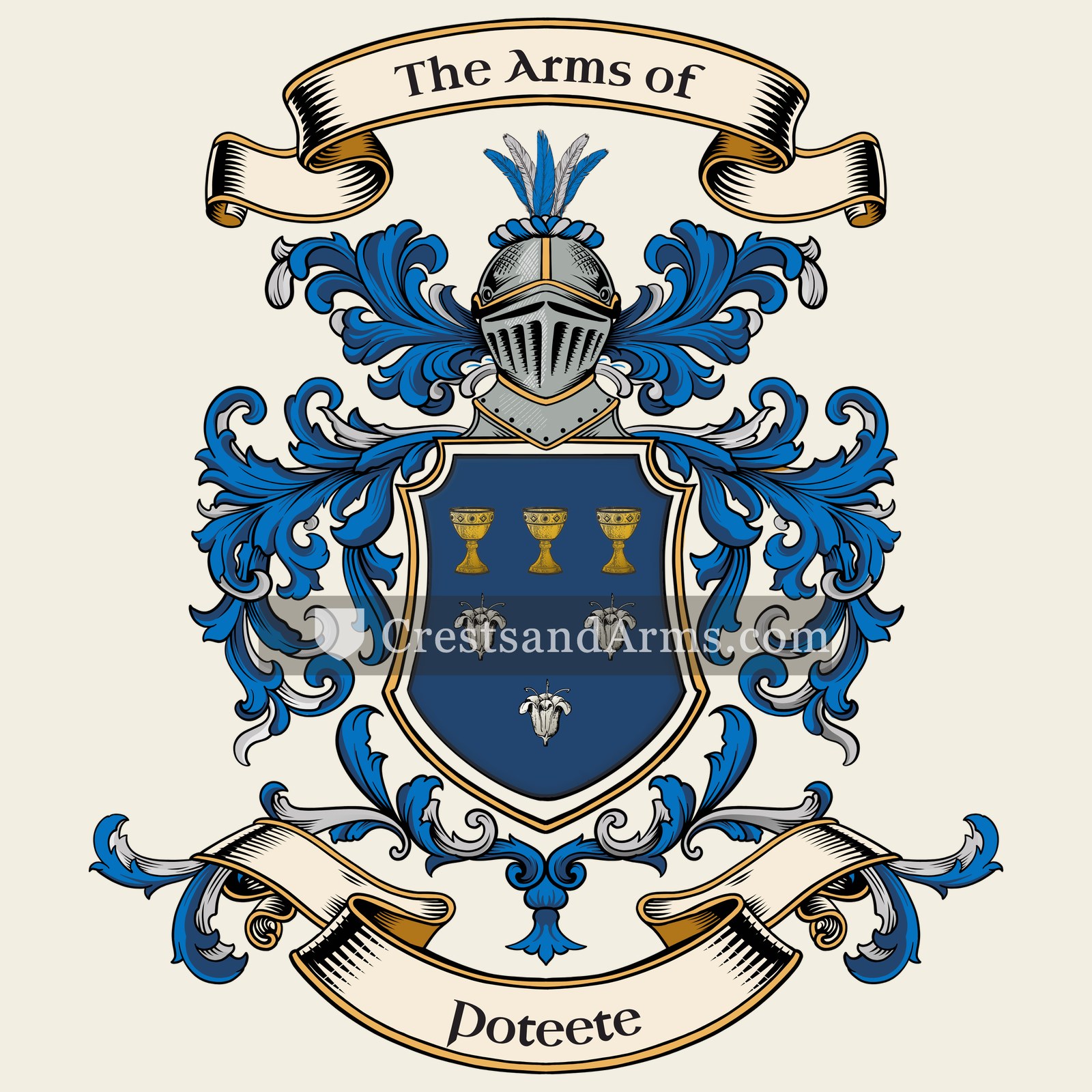
 cupFaith, office, and a trust discharged
 lilyPurity and the promise of resurrection
 cupFaith, office, and a trust discharged
 lilyPurity and the promise of resurrection