Map of France showing where the Poullard arms are recorded
The Poullard arms were recorded in Maine, c. 1663.
Maine was quiet farming country in western France, held in small manors by families who stayed for generations. Nothing about it was grand, but steady landholding is exactly what puts a name in the registers.
This is where the arms were entered in the register. Families often moved to other parts of the country, so the same name can turn up in more than one region.
The body that granted and recorded arms in France in this period.
Louis XIV of France
Sovereign of the period
Louis XIV of France
1643–1715
Reigning in France when the Poullard arms are first recorded.
How Arms Worked in France
In France, a coat of arms was a mark of honor that passed down through the male line to all legitimate descendants. Families often used the same shield without changes to show their shared heritage. If a branch wanted to stand out, they could add a small mark to their shield to show their specific place in the family tree.
Granting authority
The Juge d'armes de France acted as the official authority that regulated and verified coats of arms across the country.
How they got arms
Families typically inherited their arms from ancestors, though they could also receive them through royal grants or by proving their noble status.
Where arms were recorded
Coats of arms were officially recorded in the Armorial Général de France, which began its main collection in the year 1696.
The family's standing
Recorded among the armigerous families of Maine.
Origin & History of the Poullard Family in France
The family name Poullard carries deep roots that trace back to the early colonial period in North America. Historical records confirm that members of the family were established in the region of Maine as early as 1663. The name itself is of French origin and likely evolved from a descriptive nickname or a variation of occupational terms common in medieval France. Families bearing this name were part of the wave of settlers who navigated the harsh wilderness and coastal terrain of New England during the seventeenth century. These early ancestors played a role in the development of frontier settlements by participating in the local trade and agricultural life that defined the era. By settling in Maine, the Poullard family became part of the complex cultural landscape formed by the interaction between European arrivals and the native populations of the Northeast.
Related Branches & Arms
Root word
Pullus
Latin term meaning a young animal or chicken.
This name
PoullardA locative or occupational surname derived from a nickname for a breeder of poultry.
also spelled
Poularddelaboisnetiere
Poolar de la Bwanetyair
Poullard
Documented Sources
J. B. Rietstap, Armorial Général, Gouda: G. B. van Goor Zonen, 1884–87
Noyes, Sybil, Charles Thornton Libby, and Walter Goodwin Davis, Genealogical Dictionary of Maine and New Hampshire, 1928
Maine State Archives, Province and Court Records of Maine, 1663
Digital archive packCoat of arms PNG, gold border print PDF, vector SVG and the certificate of authenticity. Sent to your email in minutes.


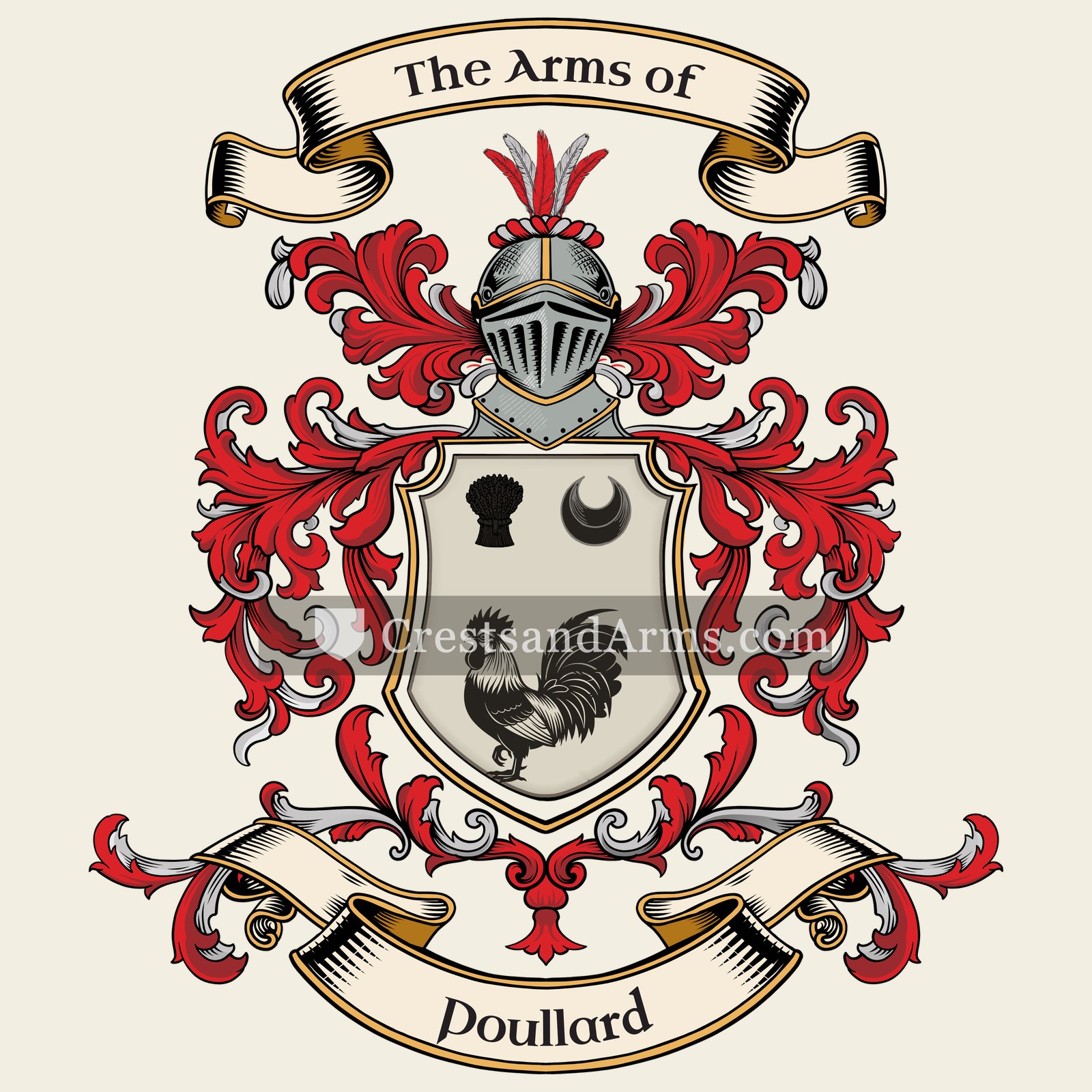
 cockCourage, vigilance and readiness for battle
 wheatsheafPlenty, and the harvest of one's own labour
 crescentHonour by the sovereign, and the second son
 cockCourage, vigilance and readiness for battle
 wheatsheafPlenty, and the harvest of one's own labour
 crescentHonour by the sovereign, and the second son