A record of documented arms, meaning and origin, researched for the Power family lines. Documented in 3 countries.
Reg. 6735 · French, P–S
Meaning of the Power family crest colors & symbols
Symbols on this shield
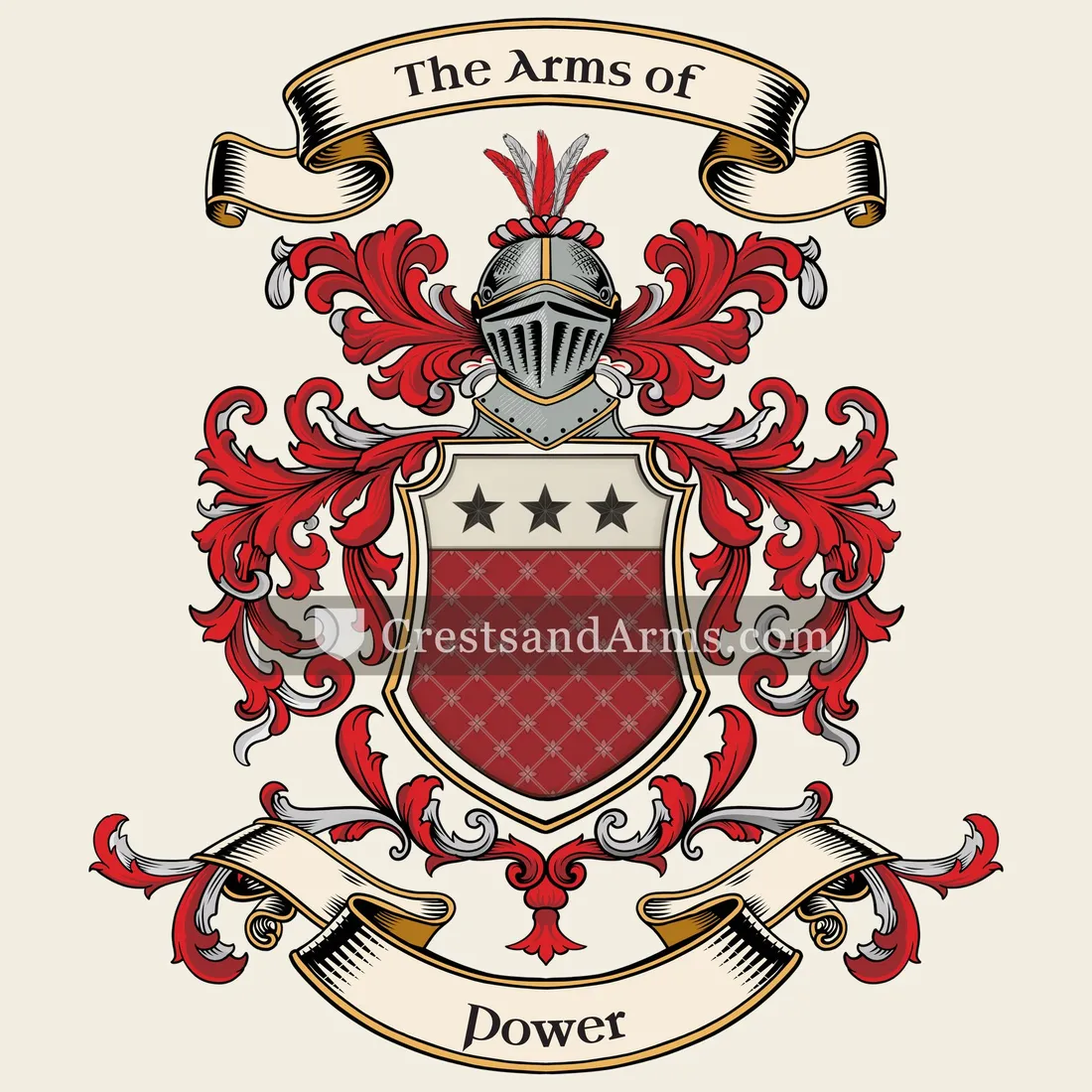
chiefAuthority, wisdom and dominion
mulletThe third son, and a divine quality from above
Colours
Red (Gules)Means: Military strength
Silver (Argent)Means: Peace and sincerity
Black (Sable)Means: Constancy
Historical info
Source
J. B. Rietstap, Armorial Général, Gouda: G. B. van Goor Zonen, 1884–87
Blazon (the actual original written record)
“De gu.; au chef d'arg., ch. de trois molettes de sa. C.: un cerf iss. de sa., ramé et onglé d'or. T.: deux anges, ailés d'or, hab. de dalmatiques d'arg. sur une jupe d'azur, ceints d'or, tenant chacun une épée. D.: ANGELIS SUIS PRÆCIPIET DE TE.”
Francec. 1642
Digital archive packCoat of arms PNG, gold border print PDF, vector SVG and the certificate of authenticity. Sent to your email in minutes.
Map of France showing where the Power arms are recorded
The Power arms were recorded in France, c. 1642.
Arms such as these were typically recorded in Bretagne.
More families held coats of arms in Bretagne than anywhere else in France. The land was divided into many small estates rather than a few large ones, so far more households counted as gentry, and each needed a shield of its own to be told apart.
This is where the arms were entered in the register. Families often moved to other parts of the country, so the same name can turn up in more than one region.
The body that granted and recorded arms in France in this period.
Louis XIII of France
Sovereign of the period
Louis XIII of France
1617–1643
Reigning in France when the Power arms are first recorded.
How Arms Worked in France
In France, a coat of arms was a mark of honor that passed down through the male line to all legitimate descendants. Families often used the same shield without changes to show their shared heritage. If a branch wanted to stand out, they could add a small mark to their shield to show their specific place in the family tree.
Granting authority
The Juge d'armes de France acted as the official authority that regulated and verified coats of arms across the country.
How they got arms
Families typically inherited their arms from ancestors, though they could also receive them through royal grants or by proving their noble status.
Where arms were recorded
Coats of arms were officially recorded in the Armorial Général de France, which began its main collection in the year 1696.
The family's standing
Recorded among the armigerous families of France.
Origin & History of the Power Family in France
The history of the Power family name in France is deeply connected to the coastal region of Brittany. By the year 1642, records confirm that family members were already established within this area. The name likely evolved from the Old French word "pohier," which was used to describe someone who possessed great strength or a commanding presence. During the seventeenth century, families in Brittany often lived in tight-knit rural communities where they worked as farmers or local tradespeople. Because Brittany maintained a distinct cultural identity separate from the rest of France, these early ancestors lived under unique regional laws and customs. Over time, the family became integrated into the local social fabric, leaving behind traces in parish registers that document their daily lives, marriages, and contributions to the development of their villages.
Meaning of the Power family crest colors & symbols
Symbols on this shield
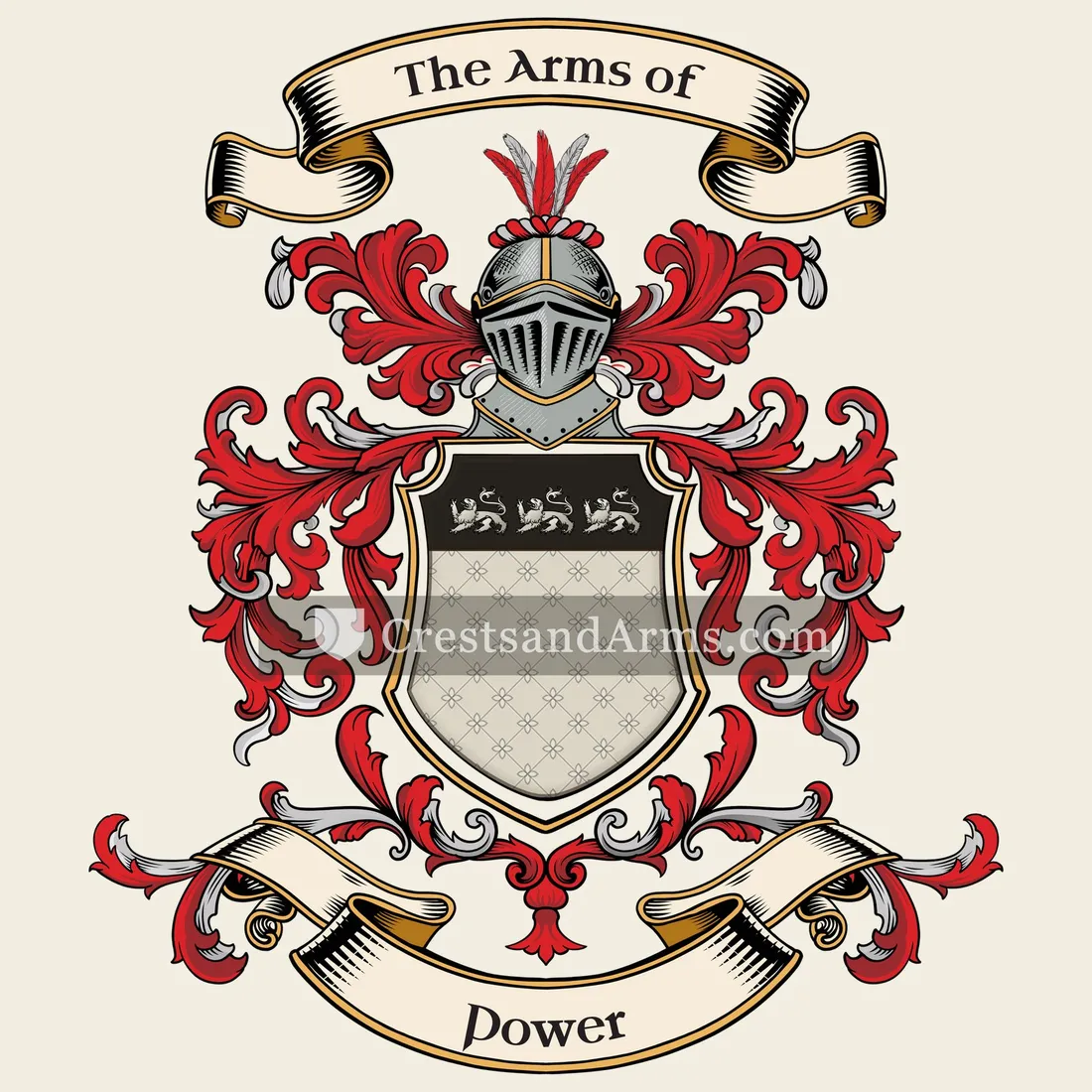
chiefAuthority, wisdom and dominion
lionCourage, strength and royalty
Colours
Silver (Argent)Means: Peace and sincerity
Black (Sable)Means: Constancy
Historical info
Source
Sir Bernard Burke, The General Armory of England, Scotland, Ireland and Wales, London: Harrison & Sons, 1884
Blazon (the actual original written record)
“Ar. on a chief indented sa. three lions ramp. of the first”
WaterfordDonhill · Waterford, c. 1273
Digital archive packCoat of arms PNG, gold border print PDF, vector SVG and the certificate of authenticity. Sent to your email in minutes.
Map of Ireland showing where the Power arms are recorded
The Power arms were recorded in Waterford, c. 1273.
Waterford was a port with good farming country behind it, settled early by Norman families. Merchants and landowners both prospered, and both sorts of family took arms.
This is where the arms were entered in the register. Families often moved to other parts of the country, so the same name can turn up in more than one region.
The body that granted and recorded arms in Ireland in this period.
Edward I of England
Sovereign of the period
Edward I of England
1272–1307
Reigning in France when the Power arms are first recorded.
How Arms Worked in Ireland
The Ulster King of Arms granted coats of arms to individuals who proved their social standing and good character. These symbols were typically inherited by all legitimate descendants of the original holder. If a family branch wanted a unique look, they could apply for a specific change to their design through the office to ensure their identity remained distinct.
Granting authority
The Ulster King of Arms acted as the official body that regulated and issued all coats of arms throughout Ireland.
How they got arms
Families obtained their arms through formal grants issued by the office after proving their eligibility and paying the required fees.
Where arms were recorded
All official grants were recorded in the registers held by the Ulster King of Arms starting from the year 1552.
The family's standing
Recorded among the armigerous families of Waterford.
Origin & History of the Power Family in Ireland
The Power family name arrived in Ireland during the Anglo-Norman invasion of the late twelfth century. The name is derived from the Old French word *poer*, which translates to "poor" or "power," and it was originally used as a nickname for a person of significant strength or influence. By the year 1273, records confirm that the family had established a firm presence in County Waterford. They quickly became a powerful landed dynasty in the region, often referred to as the Le Poer family in early administrative documents. Over the following centuries, they integrated deeply into Irish society, eventually adopting the Gaelicized version of their name, de Paor. Their influence in the southeast of Ireland was so extensive that they became one of the most prominent families in the history of the Waterford area.
Meaning of the Power family crest colors & symbols
Symbols on this shield
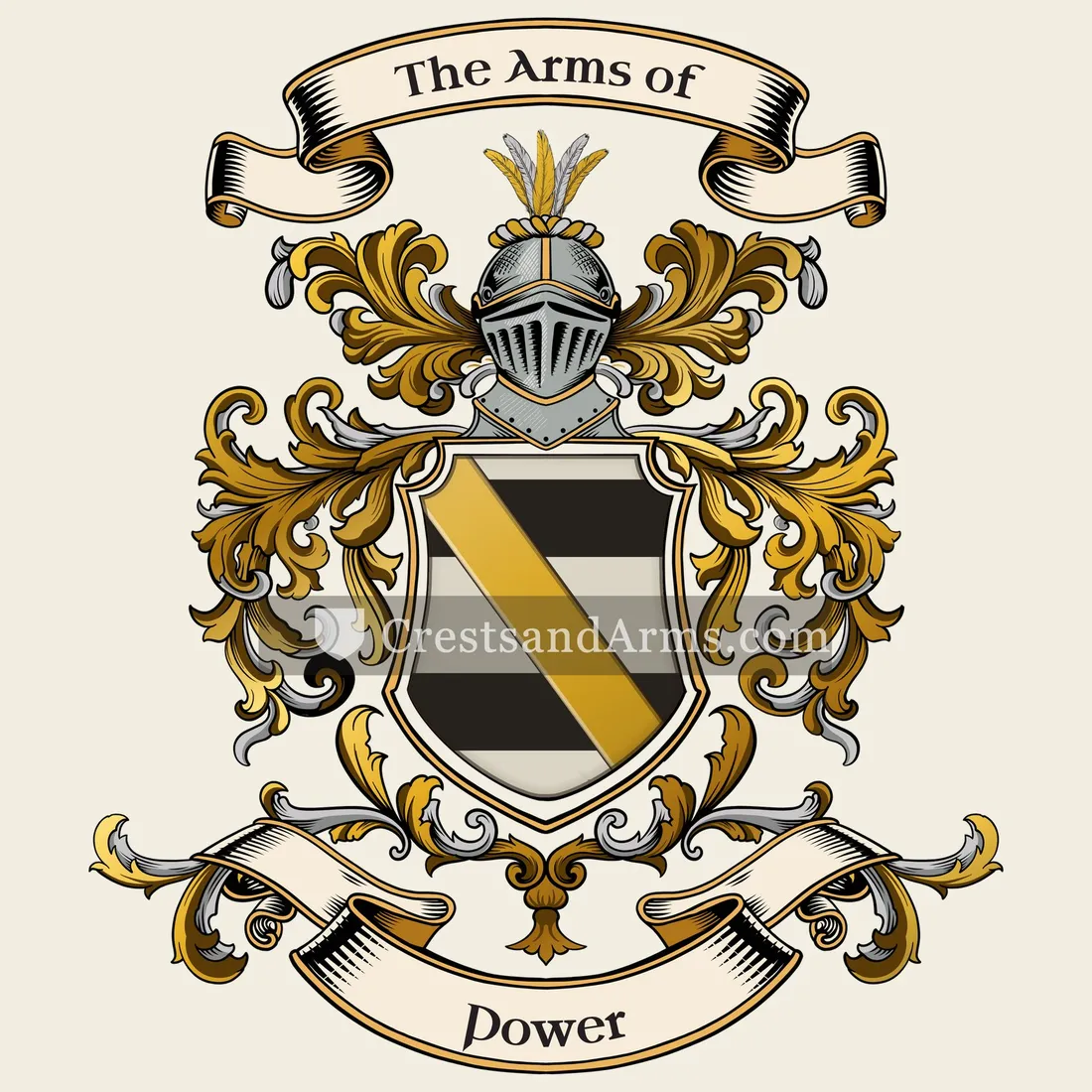
bendDefence, and the scarf of a commander
Colours
Silver (Argent)Means: Peace and sincerity
Black (Sable)Means: Constancy
Gold (Or)Means: Generosity
Historical info
Source
Sir Bernard Burke, The General Armory of England, Scotland, Ireland and Wales, London: Harrison & Sons, 1884
Blazon (the actual original written record)
“Ar. two bars nebulée sa. a bend or”
SurreyBletchington · Surrey, c. 1601
Digital archive packCoat of arms PNG, gold border print PDF, vector SVG and the certificate of authenticity. Sent to your email in minutes.
Map of England showing where the Power arms are recorded
The Power arms were recorded in Surrey, c. 1601.
Surrey sat just south of London and filled up with families who had made money in the City. Buying an estate there was the usual next step, and an estate was the usual reason to take arms.
This is where the arms were entered in the register. Families often moved to other parts of the country, so the same name can turn up in more than one region.
The body that granted and recorded arms in England in this period.
Elizabeth I of England
Sovereign of the period
Elizabeth I of England
1558–1603
Reigning in France when the Power arms are first recorded.
How Arms Worked in England
English heraldry allowed arms to be shared by all legitimate descendants of the original owner. These symbols were treated as personal property that moved through the generations to all children. While the eldest son kept the original design, other family members could use the same shield without needing to change it or register their own unique versions.
Granting authority
The College of Arms in London has regulated the use of coats of arms throughout England and Wales since 1484.
How they got arms
Families typically obtained their coats of arms through a formal grant from the Crown or by proving their ancient right to them.
Where arms were recorded
All official coats of arms are recorded in the registers kept at the College of Arms, which date back to the fifteenth century.
The family's standing
Recorded among the armigerous families of Surrey.
Origin & History of the Power Family in England
The surname Power has deep roots in England, where it emerged as a descriptive nickname long before it became a formal family name. The name is derived from the Old French word "pohier," which was used to describe someone who possessed a powerful or capable nature. By the time the name appeared in the records of Surrey in 1601, families bearing this title had already established themselves across various English counties for several centuries. These early individuals were often associated with land management and local administration, reflecting the strength and influence implied by their name. As the family settled into the Surrey region at the turn of the 17th century, they became part of a growing class of citizens who helped shape the local community through trade and agriculture. Their presence in these early parish records highlights how a simple nickname evolved into a lasting family identity that persisted through generations of English history.
Power Meaning & Related Branches
Root word
potere
Latin verb meaning to be able or to have power.
This name
PowerDerived from a nickname for a powerful person or one who held authority.
also spelled
Powere
Powers
Powerr
Poer
Poore
Related arms
Burtonsame arms
Negussame arms
Poervariant spelling
Poorevariant spelling
Documented Sources
J. B. Rietstap, Armorial Général, Gouda: G. B. van Goor Zonen, 1884–87
Archives départementales du Finistère, Série B (Cours et juridictions)
Archives départementales d'Ille-et-Vilaine, Série G (Clergé séculier)
Dauzat, Albert, Dictionnaire étymologique des noms et prénoms de France, 1951
Morvan, Françoise, Bretagne est une île, 2005
Digital archive packCoat of arms PNG, gold border print PDF, vector SVG and the certificate of authenticity. Sent to your email in minutes.


 chiefAuthority, wisdom and dominion
 mulletThe third son, and a divine quality from above
 chiefAuthority, wisdom and dominion
 mulletThe third son, and a divine quality from above


 lionCourage, strength and royalty


 bendDefence, and the scarf of a commander