Map of Germany showing where the Pratori arms are recorded
The Pratori arms were recorded in Germany, c. 1765.
Arms such as these were typically recorded in Bavaria.
Bavaria was a country of old landed families and walled market towns. Estates passed down the same line for centuries, and both the landowners and the leading townsmen kept arms, which is why so many Bavarian names sit in the registers.
This is where the arms were entered in the register. Families often moved to other parts of the country, so the same name can turn up in more than one region.
The body that granted and recorded arms in Germany in this period.
Francis I, Holy Roman Emperor
Sovereign of the period
Francis I, Holy Roman Emperor
1745–1765
Reigning in Germany when the Pratori arms are first recorded.
How Arms Worked in Germany
In the Holy Roman Empire, coats of arms were often granted to individuals by the Emperor or his representatives. These arms were then passed down through the generations to all legitimate descendants of the original holder. Younger branches of a family usually kept the same shield design without needing to change it, as the arms belonged to the entire lineage.
Granting authority
The Holy Roman Emperor held the sole power to grant new coats of arms throughout his vast imperial territories.
How they got arms
Families typically obtained their coats of arms through a formal imperial grant or by proving their noble status to the authorities.
Where arms were recorded
These grants were officially recorded in the Imperial Chancery registers, which began keeping formal records of such honors during the Middle Ages.
The family's standing
Recorded among the armigerous families of Germany.
Origin & History of the Pratori Family in Germany
The family name Pratori is deeply rooted in the historical landscape of southern Germany, with documented evidence placing members of the lineage in Bavaria by 1765. The name itself is a Latinized form of the word for a meadow or field, which suggests that the family’s earliest ancestors were likely landowners or farmers who held a strong connection to the rural landscape. During the eighteenth century, Bavaria was a region defined by its agricultural traditions and the influence of the Holy Roman Empire, providing a stable environment for families to establish roots in local villages. As the Pratori family settled into these Bavarian communities, they became part of the social fabric of the region, contributing to the local economy and the development of provincial life. This period marked a time of transition in Germany where families began to solidify their identities through consistent naming practices and local record-keeping, allowing the Pratori name to persist through generations as a testament to their long-standing presence in the heart of Europe.
Meaning of the Pratori family crest colors & symbols
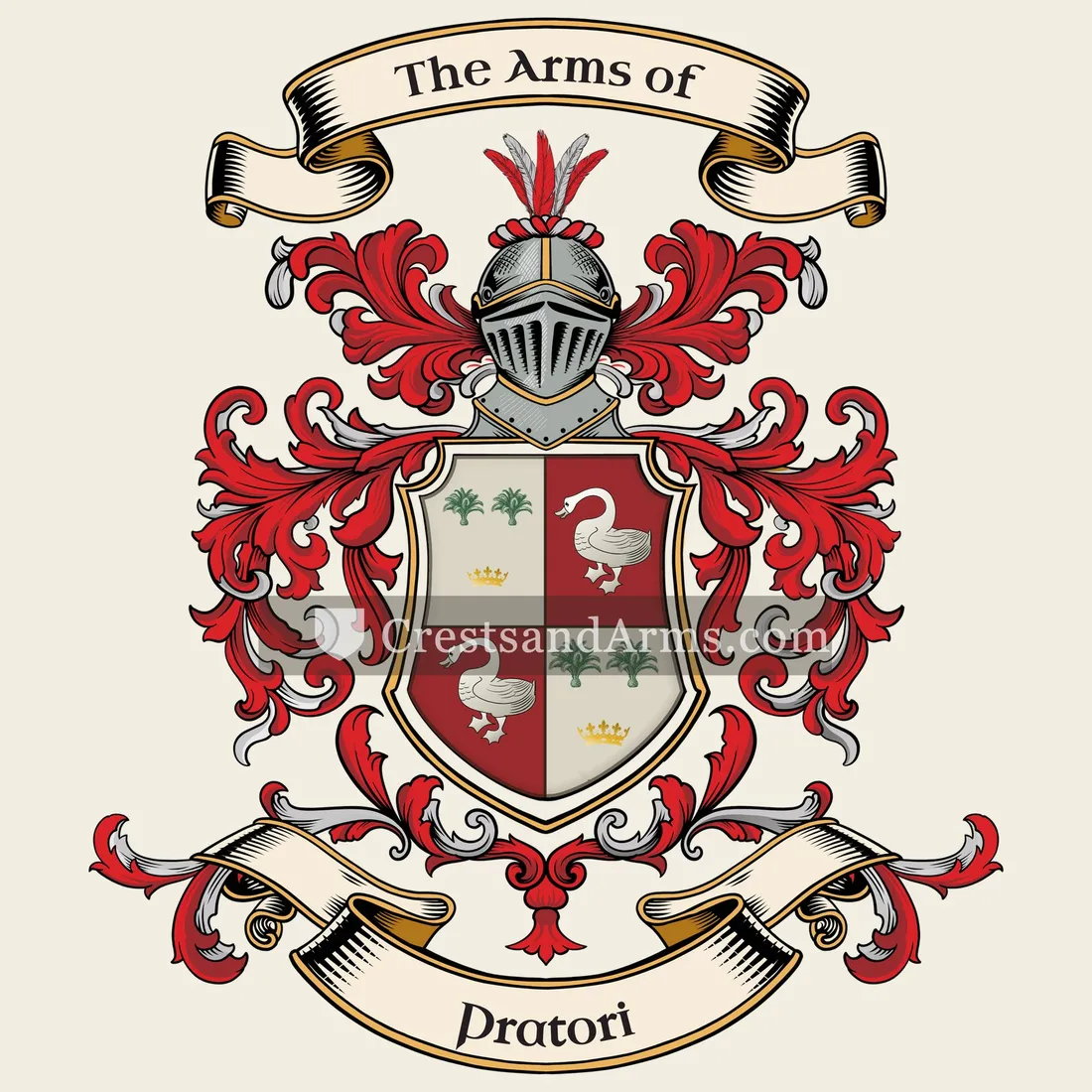
Symbols on this shield
palm treeVictory, and righteousness that flourishes
crownSovereignty, authority and just reward
swanGrace, light and the poet's art
Colours
Silver (Argent)Means: Peace and sincerity
Red (Gules)Means: Military strength
Green (Vert)Means: Hope
Gold (Or)Means: Generosity
Historical info
Source
J. B. Rietstap, Armorial Général, Gouda: G. B. van Goor Zonen, 1884–87
Blazon (the actual original written record)
“Ec.: aux 1 et 4 d'arg. à deux palmes de sin., passées en saut. dans une couronne d'or; aux 2 et 3 de gu. à un cygne d'arg., coll. d'une couronne d'or, le vol levé. Cq. cour. C.: deux têtes et cols de cygne adossées d'arg., bq. de gu., passées dans une couronne d'or et tenant chacune en son bec une couronne de feuillage de sin. - (Comtes, 11 oct. 1748.) Les armes précédentes, augmentées d'un surtout d'azur, ch. d'une épée en bande et d'un bâton de commandement en barre, passés en saut., le tout d'or. Trois cq. cour. C.: 1° et 3° un panache de trois pl. d'aut.: d'arg., d'azur et de gu.; 2° deux têtes et cols de cygne adossées au nat., tenant chacune en son bec une couronne de feuillage de sin.”
Denmarkc. 1722
Digital archive packCoat of arms PNG, gold border print PDF, vector SVG and the certificate of authenticity. Sent to your email in minutes.
Map of Denmark showing where the Pratori arms are recorded
The Pratori arms were recorded in Denmark, c. 1722.
Arms such as these were typically recorded in Sjaælland.
Zealand held the Danish court, the crown's offices and Copenhagen itself. Families who served the king kept estates within reach of it, and royal service was the ordinary route to a coat of arms.
This is where the arms were entered in the register. Families often moved to other parts of the country, so the same name can turn up in more than one region.
The body that granted and recorded arms in Denmark in this period.
Frederik IV of Denmark
Sovereign of the period
Frederik IV of Denmark
1699–1730
Reigning in Germany when the Pratori arms are first recorded.
How Arms Worked in Denmark
Danish heraldry during this period was closely tied to noble status and royal favor rather than being open to all citizens. Arms were typically granted by the monarch to individuals, and these symbols were then shared by all members of the noble house. If a family line died out, the right to use those specific arms ended with them.
Granting authority
The Danish royal chancery held the power to issue and regulate official coats of arms for the kingdom.
How they got arms
Families usually received their arms through a formal royal grant that confirmed their noble status and rights.
Where arms were recorded
These grants were officially recorded in the Danish Royal Chancery records starting in the sixteenth century.
The family's standing
Recorded among the armigerous families of Denmark.
Origin & History of the Pratori Family in Denmark
The Pratori family name first appears in the historical records of Sjælland in 1722, marking the beginning of their documented presence in Denmark. During this period, the name was often associated with individuals who served in administrative or professional roles within the local community. The structure of the name suggests a Latinized influence, which was a common trend among educated families and civil servants living in Northern Europe during the eighteenth century. As these early family members settled into the landscape of Sjælland, they became part of the growing network of families that helped manage the social and economic life of the region. By tracing their movements through parish registers and local census data, historians can see how the family established roots in the Danish countryside and integrated into the daily life of the island.
Pratori Meaning & Related Branches
Root word
pratum
Latin word meaning a meadow or field.
This name
PratoriAn occupational surname for someone who lived near or worked on a meadow.
also spelled
Pretorius
Documented Sources
J. B. Rietstap, Armorial Général, Gouda: G. B. van Goor Zonen, 1884–87


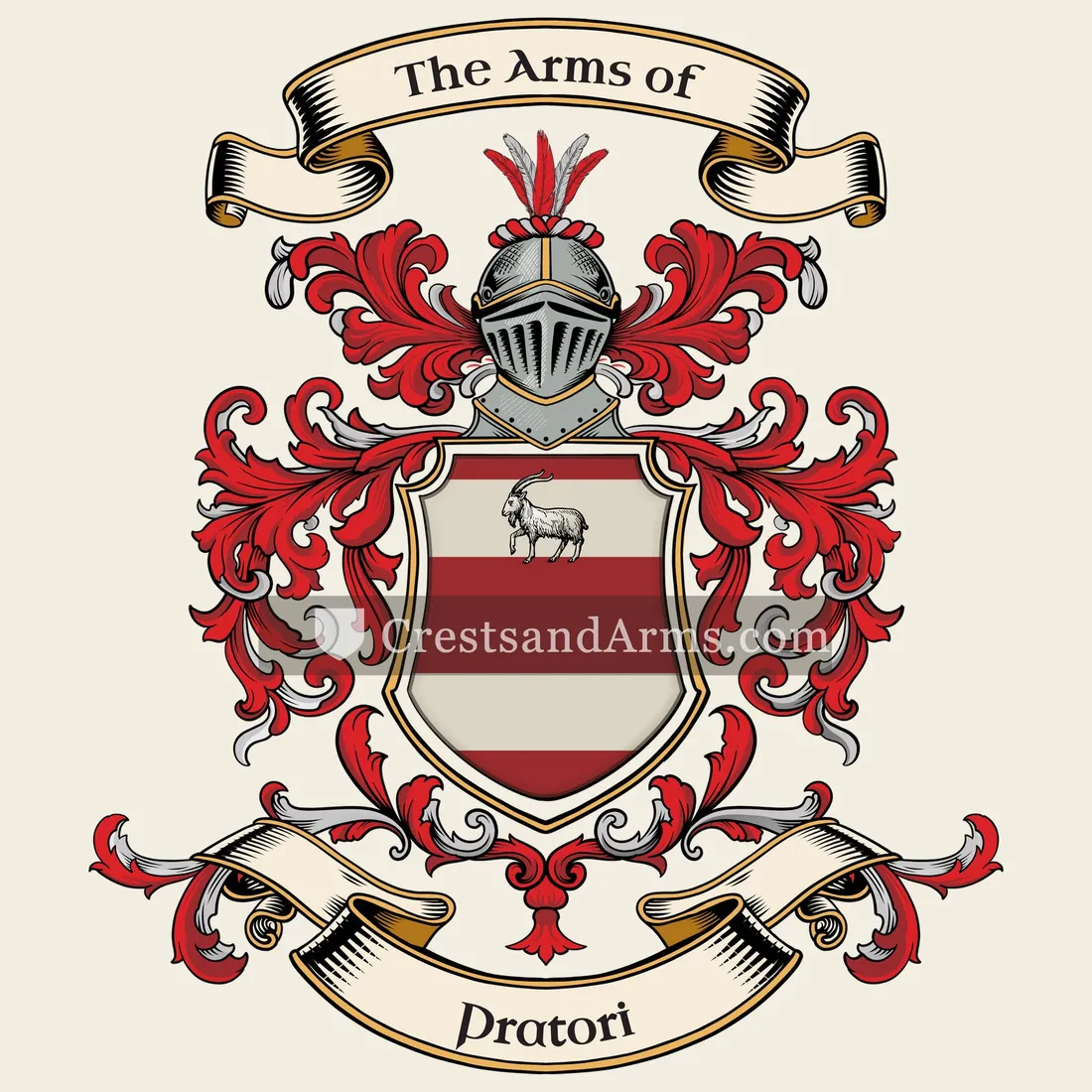
 goatOne who wins by diplomacy rather than force
 goatOne who wins by diplomacy rather than force


 palm treeVictory, and righteousness that flourishes
 crownSovereignty, authority and just reward
 swanGrace, light and the poet's art