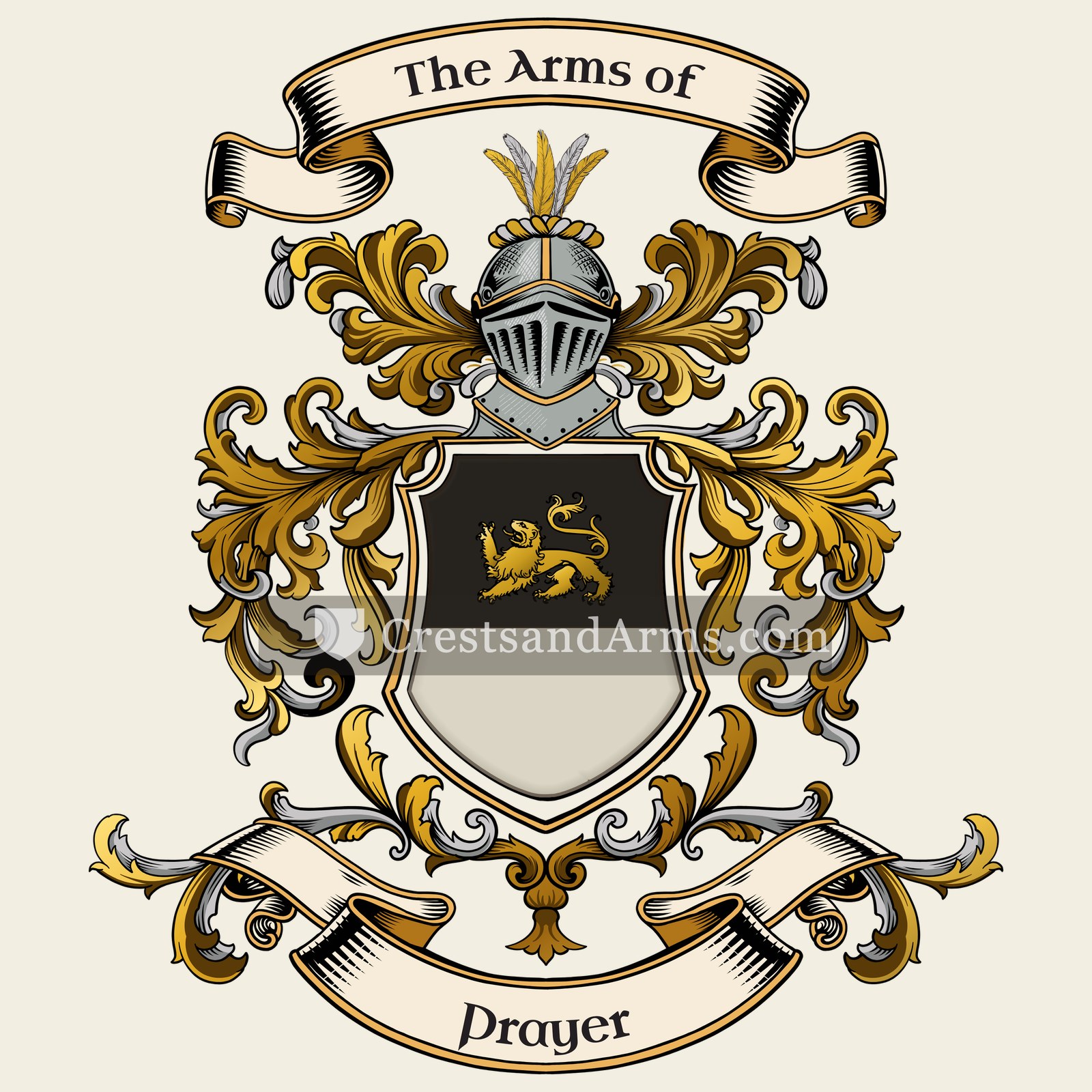
A record of documented arms, meaning and origin, researched for the Prayer family of Austria.
Reg. 1853 · Austrian, P–S
Coat of Arms & Family Crest Details
Symbols on this shield
lionCourage, strength and royalty
Colours
Black (Sable)Means: Constancy
Silver (Argent)Means: Peace and sincerity
Gold (Or)Means: Generosity
Historical info
Source
J. B. Rietstap, Armorial Général, Gouda: G. B. van Goor Zonen, 1884–87
Blazon (the actual original written record)
“Coupé: au 1 de sa. au lion d'or, tenant un maillet au manche allongé; au 2 d'arg. plein. C.: le lion, iss., entre deux prob. coupées, à dextre d'or sur sa., à sen. d'arg. sur gu. L.: conformes aux émaux des prob.”
AustriaVienne, c. 1772
Digital archive packCoat of arms PNG, gold border print PDF, vector SVG and the certificate of authenticity. Sent to your email in minutes.
Map of Austria showing where the Prayer arms are recorded
The Prayer arms were recorded in Vienne, c. 1772.
This is where the arms were entered in the register. Families often moved to other parts of the country, so the same name can turn up in more than one region.
Region
Vienne
Town
Vienne
First recorded
1772
Granting Authority for the Prayer Arms
Imperial and Royal chancery
Sodacan · CC BY-SA 3.0
The body that granted and recorded arms in Austria in this period.
Joseph II, Holy Roman Emperor
Sovereign of the period
Joseph II, Holy Roman Emperor
1765–1790
Reigning in Austria when the Prayer arms are first recorded.
How Arms Worked in Austria
Austrian coats of arms were often linked directly to noble titles granted by the Emperor. These symbols belonged to the entire family line rather than just one individual. When a family grew, new branches kept the original design without needing to change it. This system allowed all members of a noble house to share the same identity across many generations.
Granting authority
The Imperial and Royal chancery managed all heraldic matters and controlled the official granting of arms throughout the Austrian lands.
How they got arms
Families typically received their arms through a formal imperial decree that often accompanied the elevation of a person to noble status.
Where arms were recorded
Official records of these grants were kept in the Imperial Register of Nobility which began its formal documentation process in 1453.
The family's standing
Recorded among the armigerous families of Austria.
Origin & History of the Prayer Family in Austria
The family name Prayer has deep roots in the historical region of Vienne, France, where records confirm the presence of family members as early as 1772. During this period, the name was closely tied to the social and agricultural fabric of the Dauphiné province. Historians suggest that surnames like Prayer often originated from occupational or descriptive nicknames, potentially identifying individuals who were known for their piety or their roles within local religious institutions. As the family established itself in Vienne, they became part of a community defined by the transition from feudal traditions to the modern administrative structures that emerged in late eighteenth-century France. By settling in this region, the early members of the Prayer family contributed to the local demographic history, leaving behind a legacy that reflects the cultural shifts of the pre-revolutionary era.
Related Branches & Arms
Root word
Preier
A Middle High German term for a person who prays.
This name
PrayerAn occupational surname for a professional prayer or a pious individual.
also spelled
Preyar
Prayer
Documented Sources
J. B. Rietstap, Armorial Général, Gouda: G. B. van Goor Zonen, 1884–87
Archives départementales de l'Isère, Registres paroissiaux et d'état civil de la commune de Vienne
Baudet, Louis, Histoire de la ville de Vienne, 1935
Chevalier, Ulysse, Regeste dauphinois, ou Répertoire chronologique et analytique des documents imprimés et manuscrits relatifs à l'histoire du Dauphiné, 1913
Digital archive packCoat of arms PNG, gold border print PDF, vector SVG and the certificate of authenticity. Sent to your email in minutes.


 lionCourage, strength and royalty
 lionCourage, strength and royalty