Map of Belgium showing where the Prem arms are recorded
The Prem arms were recorded in Flandre, c. 1663.
Flandre grew rich on cloth, and its towns were among the busiest in Europe. Merchant families bought land with their profits and took arms to go with it, so trade put as many names in the registers here as land did.
This is where the arms were entered in the register. Families often moved to other parts of the country, so the same name can turn up in more than one region.
The body that granted and recorded arms in Belgium in this period.
Philip IV of Spain
Sovereign of the period
Philip IV of Spain
1621–1665
Reigning in Belgium when the Prem arms are first recorded.
How Arms Worked in Belgium
In Belgium, a coat of arms is considered personal property that is passed down through the male line to legitimate descendants. Families often use the same shield design across generations to show their shared heritage. If a branch of the family wants to change the design, they must apply for an official update to their specific version of the arms.
Granting authority
The Conseil héraldique is the official body that regulates and approves all coats of arms in Belgium.
How they got arms
Families obtain their coats of arms through formal royal grants or by confirming their historical right to use existing designs.
Where arms were recorded
All approved coats of arms are officially recorded in the public registers of the Conseil héraldique since 1844.
The family's standing
Recorded among the armigerous families of Flandre.
Origin & History of the Prem Family in Belgium
The family name Prem has roots in the Flanders region of Belgium that can be traced back to at least 1663. During the seventeenth century, this area was a center for trade and agriculture, which likely influenced the daily lives and social standing of the early Prem family members. Families in this region often lived in small, tight-knit communities where their surname was tied to their specific village or their occupation within the local economy. Because Flanders was a crossroads for many different cultures and languages at the time, the name may have evolved from local dialects or shorthand descriptions used to identify individuals in parish registers. By settling in this part of Belgium, the early Prem ancestors became part of a long tradition of regional history that saw the transition from feudal life to the early modern period. These early records suggest that the family was well-integrated into the local social fabric, living through a time of significant political and economic change in the Low Countries.
Meaning of the Prem family crest colors & symbols
Symbols on this shield
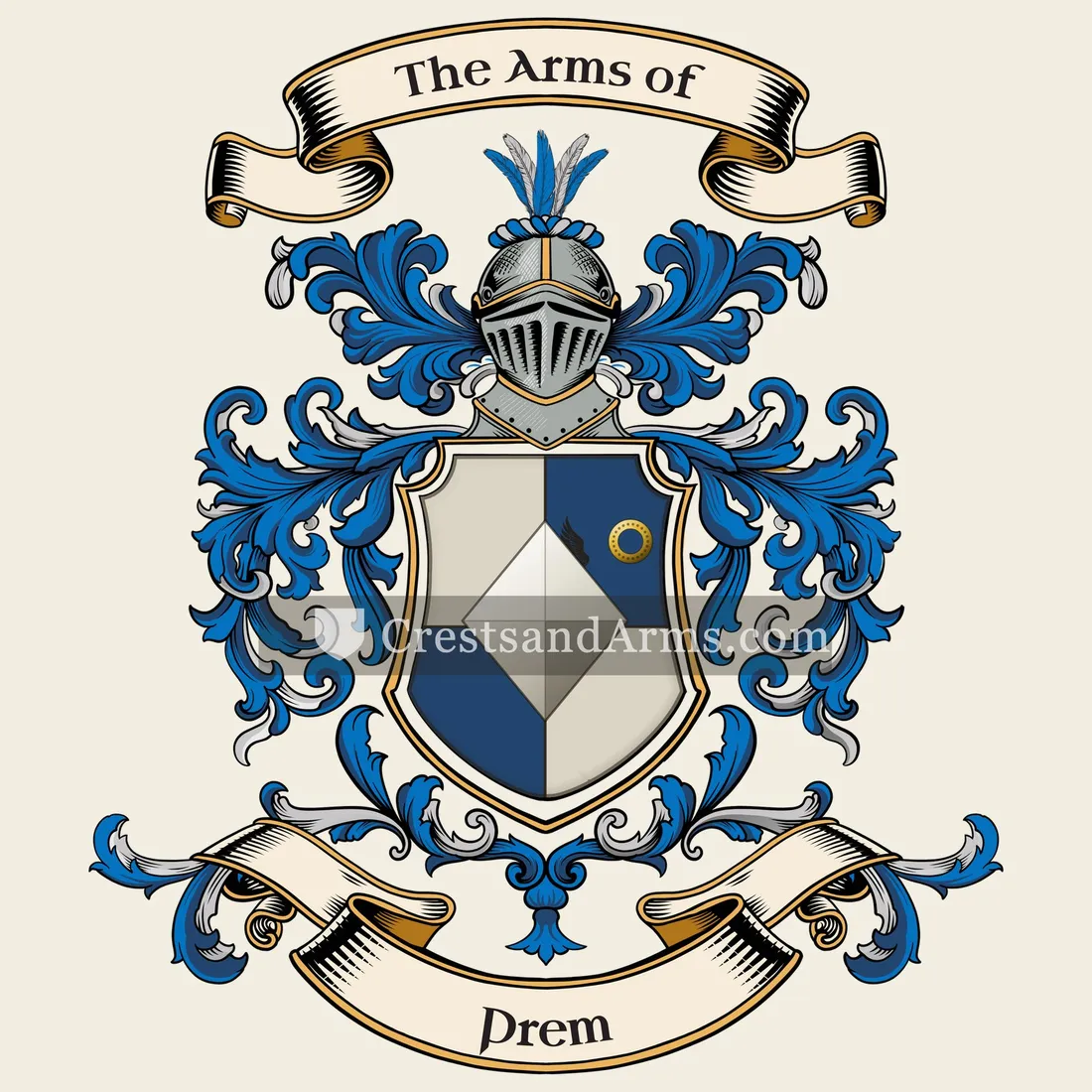
lozengeHonour and nobility, and the arms of a woman
wingSwiftness, and protection under a raised wing
ringFidelity, and a promise kept
Colours
Silver (Argent)Means: Peace and sincerity
Blue (Azure)Means: Loyalty and truth
Black (Sable)Means: Constancy
Gold (Or)Means: Generosity
Historical info
Source
J. B. Rietstap, Armorial Général, Gouda: G. B. van Goor Zonen, 1884–87
Blazon (the actual original written record)
“Ec. d'arg. et d'azur, à un fusil à aiguille au nat., posé en bande, br. sur le tout; le 2e quartier ch. d'un demi-vol de sa., surch. d'un demi-cercle treflé d'or, le 3e ch. de trois”
FranceBerlin, c. 1663
Digital archive packCoat of arms PNG, gold border print PDF, vector SVG and the certificate of authenticity. Sent to your email in minutes.
Map of France showing where the Prem arms are recorded
The Prem arms were recorded in Berlin, c. 1663.
Arms such as these were typically recorded in Bretagne.
More families held coats of arms in Bretagne than anywhere else in France. The land was divided into many small estates rather than a few large ones, so far more households counted as gentry, and each needed a shield of its own to be told apart.
This is where the arms were entered in the register. Families often moved to other parts of the country, so the same name can turn up in more than one region.
The body that granted and recorded arms in France in this period.
Louis XIV of France
Sovereign of the period
Louis XIV of France
1643–1715
Reigning in Belgium when the Prem arms are first recorded.
How Arms Worked in France
In France, a coat of arms was a mark of honor that passed down through the male line to all legitimate descendants. Families often used the same shield without changes to show their shared heritage. If a branch wanted to stand out, they could add a small mark to their shield to show their specific place in the family tree.
Granting authority
The Juge d'armes de France acted as the official authority that regulated and verified coats of arms across the country.
How they got arms
Families typically inherited their arms from ancestors, though they could also receive them through royal grants or by proving their noble status.
Where arms were recorded
Coats of arms were officially recorded in the Armorial Général de France, which began its main collection in the year 1696.
The family's standing
Recorded among the armigerous families of France.
Origin & History of the Prem Family in France
The history of the Prem family in France is deeply rooted in the rugged landscape of Bretagne, where records confirm their presence as early as 1663. During the seventeenth century, this region was a distinct province with its own strong cultural identity and maritime traditions. Families living in Bretagne at this time often relied on the land or the sea for their livelihoods, and the name likely emerged from the local linguistic patterns of the area. As the family established their roots in this coastal environment, they participated in the daily life of their parishes, which served as the primary centers for community records and social organization. By settling in Bretagne, the early members of the Prem family became part of a long tradition of regional resilience that defined the social fabric of northwestern France during the reign of King Louis XIV.
Meaning of the Prem family crest colors & symbols
Symbols on this shield
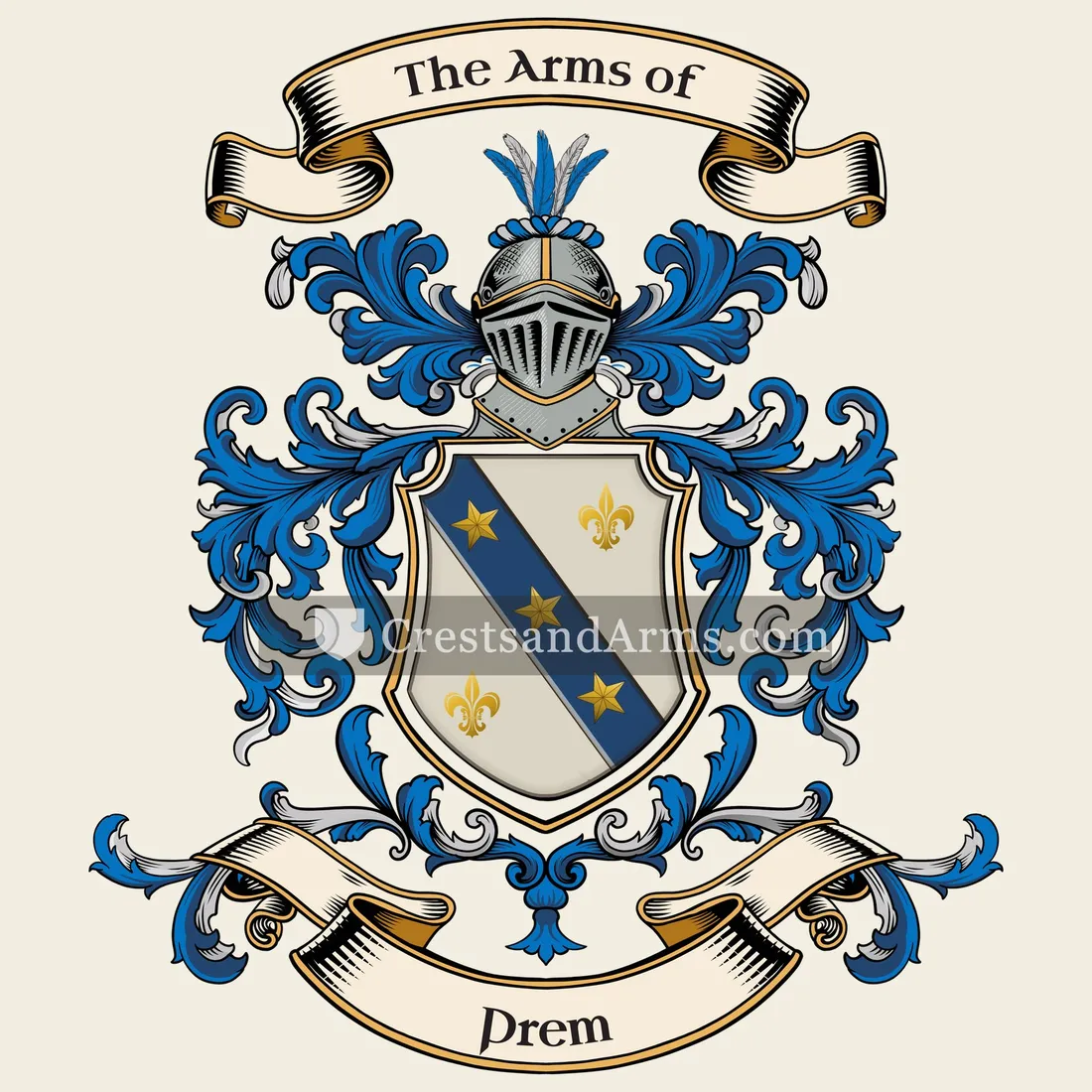
bendDefence, and the scarf of a commander
mulletThe third son, and a divine quality from above
fleur de lisPurity, light, and the sixth son
Colours
Silver (Argent)Means: Peace and sincerity
Blue (Azure)Means: Loyalty and truth
Gold (Or)Means: Generosity
Historical info
Source
J. B. Rietstap, Armorial Général, Gouda: G. B. van Goor Zonen, 1884–87
Blazon (the actual original written record)
“D'arg. à la bande d'azur, ch. de trois étoiles d'or et acc. de deux fleurs-de-lis du même. C.: une étoile d'or, entre un vol coupé alt. d'arg. et d'azur, chaque aile ch. d'une fleur-de-lis d'or, br. sur le coupé. L.: d'arg. et d'azur.”
GermanyRatisbonne, c. 1765
Digital archive packCoat of arms PNG, gold border print PDF, vector SVG and the certificate of authenticity. Sent to your email in minutes.
Map of Germany showing where the Prem arms are recorded
The Prem arms were recorded in Ratisbonne, c. 1765.
This is where the arms were entered in the register. Families often moved to other parts of the country, so the same name can turn up in more than one region.
The body that granted and recorded arms in Germany in this period.
Francis I, Holy Roman Emperor
Sovereign of the period
Francis I, Holy Roman Emperor
1745–1765
Reigning in Belgium when the Prem arms are first recorded.
How Arms Worked in Germany
In the Holy Roman Empire, coats of arms were often granted to individuals by the Emperor or his representatives. These arms were then passed down through the generations to all legitimate descendants of the original holder. Younger branches of a family usually kept the same shield design without needing to change it, as the arms belonged to the entire lineage.
Granting authority
The Holy Roman Emperor held the sole power to grant new coats of arms throughout his vast imperial territories.
How they got arms
Families typically obtained their coats of arms through a formal imperial grant or by proving their noble status to the authorities.
Where arms were recorded
These grants were officially recorded in the Imperial Chancery registers, which began keeping formal records of such honors during the Middle Ages.
The family's standing
Recorded among the armigerous families of Germany.
Origin & History of the Prem Family in Germany
The family name Prem finds its historical roots in the southern German regions, particularly within the historic city of Ratisbonne, known today as Regensburg. By the year 1765, records confirm that members of the Prem family were established residents of this influential center of trade and religion along the Danube River. The name itself is often linked to regional linguistic patterns in Bavaria and Austria, where it likely functioned as a topographic descriptor for people living near specific landmarks or within certain administrative districts. During the eighteenth century, families in Ratisbonne were often deeply integrated into the city’s guild systems and local governance, which allowed them to maintain a stable presence in the urban landscape. As the family moved through the late 1700s, they participated in the typical social structures of the Holy Roman Empire, contributing to the local economy and the cultural development of their home city.
Prem Meaning & Related Branches
Root word
Praemium
Latin term meaning reward, prize, or profit.
This name
PremA surname historically denoting a person who received a reward or a prize.
also spelled
Prym
Preem
Documented Sources
J. B. Rietstap, Armorial Général, Gouda: G. B. van Goor Zonen, 1884–87
State Archives in Belgium (Rijksarchief), Parochieregisters (Parish Registers)
State Archives in Belgium (Rijksarchief), Registers van de Burgerlijke Stand (Civil Registry Records)
De Smet, A., Geschiedenis van Vlaanderen, 1972
Pirenne, H., Histoire de Belgique, 1900
Digital archive packCoat of arms PNG, gold border print PDF, vector SVG and the certificate of authenticity. Sent to your email in minutes.


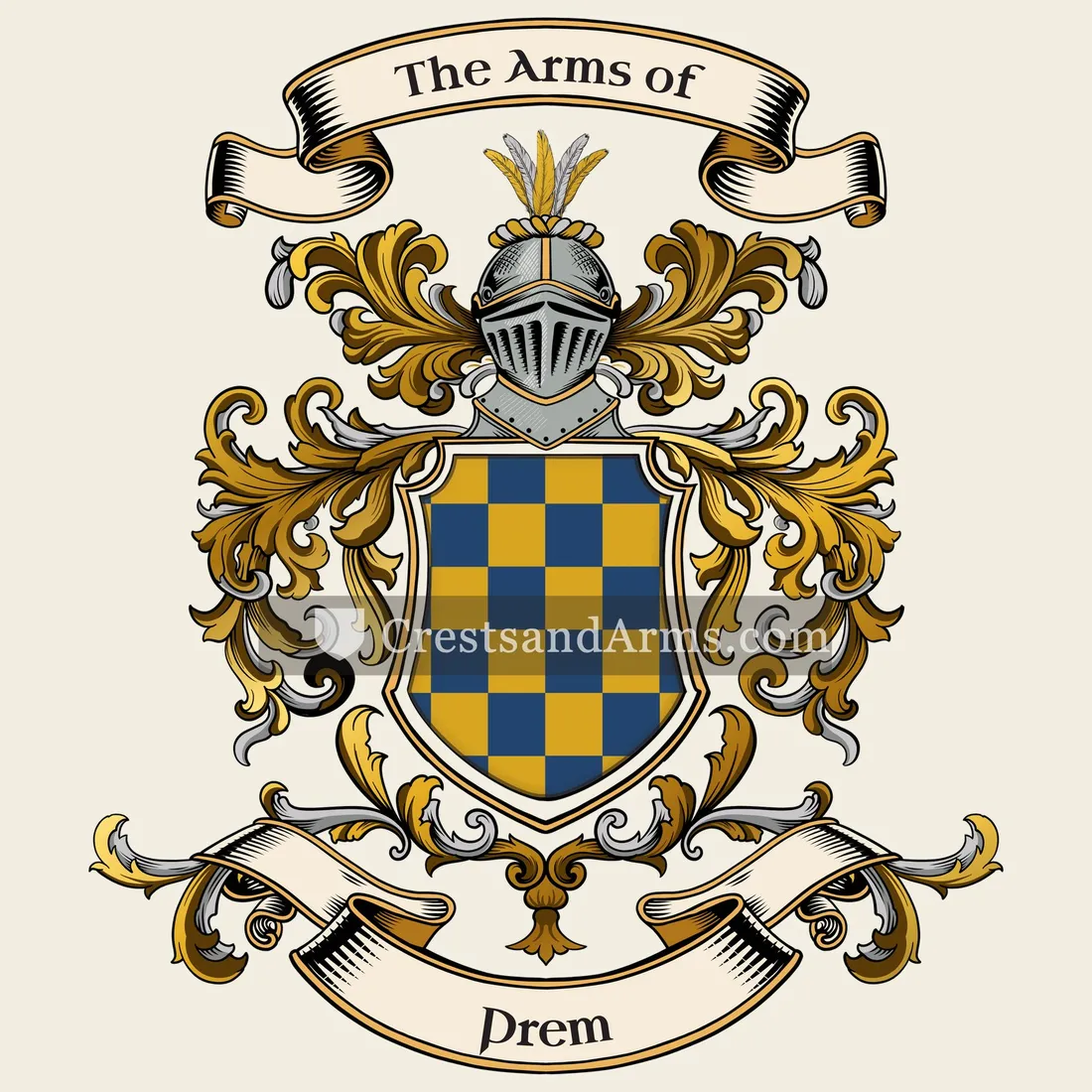
 chequyConstancy, and the counting-board
 chequyConstancy, and the counting-board


 lozengeHonour and nobility, and the arms of a woman
 wingSwiftness, and protection under a raised wing
 ringFidelity, and a promise kept


 bendDefence, and the scarf of a commander
 mulletThe third son, and a divine quality from above
 fleur de lisPurity, light, and the sixth son