Map of England showing where the Prichard arms are recorded
The Prichard arms were recorded in Lancaster, c. 1620.
Lancashire was divided among a great many small landed families, more than most northern counties. Estates were passed down whole rather than split up, so the same names hold the same ground for centuries in the records.
This is where the arms were entered in the register. Families often moved to other parts of the country, so the same name can turn up in more than one region.
The body that granted and recorded arms in England in this period.
James VI and I
Sovereign of the period
James VI and I
1603–1625
Reigning in England when the Prichard arms are first recorded.
How Arms Worked in England
English heraldry allowed arms to be shared by all legitimate descendants of the original owner. These symbols were treated as personal property that moved through the generations to all children. While the eldest son kept the original design, other family members could use the same shield without needing to change it or register their own unique versions.
Granting authority
The College of Arms in London has regulated the use of coats of arms throughout England and Wales since 1484.
How they got arms
Families typically obtained their coats of arms through a formal grant from the Crown or by proving their ancient right to them.
Where arms were recorded
All official coats of arms are recorded in the registers kept at the College of Arms, which date back to the fifteenth century.
The family's standing
Recorded among the armigerous families of Lancaster.
Origin & History of the Prichard Family in England
The surname Prichard is a patronymic name that originated in Wales, serving as a shortened form of the phrase "ap Richard," which translates to "son of Richard." As families moved across the border into England during the late sixteenth and early seventeenth centuries, the name gradually evolved from its Welsh roots into the spelling used today. By 1620, members of the Prichard family had established a notable presence in Lancaster, a town with a long history as a center for trade and regional administration. During this era, families often migrated to growing urban hubs like Lancaster to pursue new economic opportunities in commerce or local governance. The transition from the Welsh "ap Richard" to the Anglicized "Prichard" reflects the broader cultural integration that occurred as families moved from rural Welsh communities into the developing social and legal structures of Northern England.
Meaning of the Prichard family crest colors & symbols
Symbols on this shield
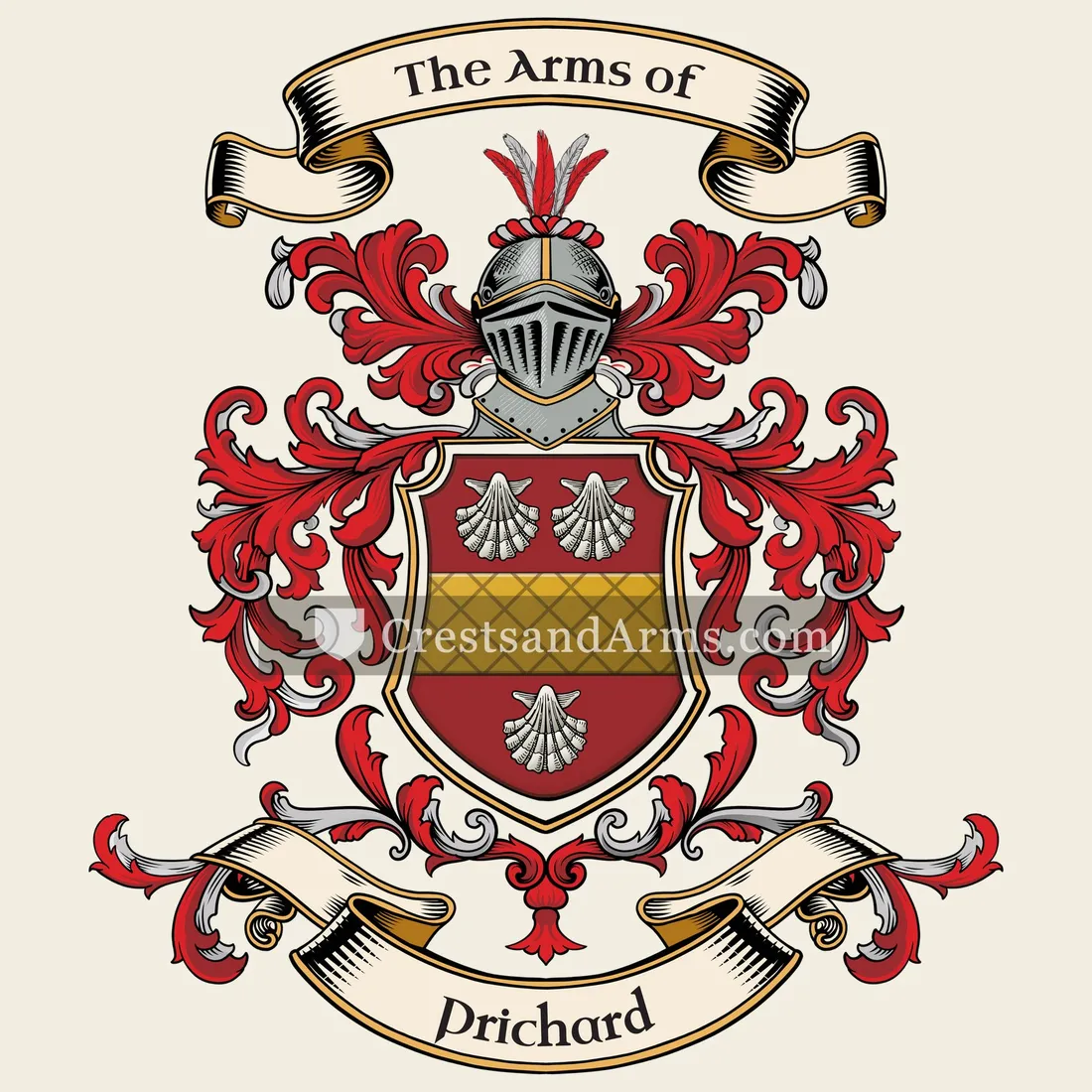
fessThe military belt, and readiness to serve
escallopThe pilgrim's shell, and a long journey made
Colours
Red (Gules)Means: Military strength
Gold (Or)Means: Generosity
Silver (Argent)Means: Peace and sincerity
Historical info
Source
Sir Bernard Burke, The General Armory of England, Scotland, Ireland and Wales, London: Harrison & Sons, 1884
Blazon (the actual original written record)
“Gu. a fess or, betw. three escallops ar”
Walesc. 1647
Digital archive packCoat of arms PNG, gold border print PDF, vector SVG and the certificate of authenticity. Sent to your email in minutes.
Map of Wales showing where the Prichard arms are recorded
The Prichard arms were recorded in Wales, c. 1647.
Arms such as these were typically recorded in Denbigh.
Denbighshire was north Welsh country of hills and small estates. Land was held by a great many families rather than a few, and each holding brought its own claim to a coat of arms.
This is where the arms were entered in the register. Families often moved to other parts of the country, so the same name can turn up in more than one region.
The body that granted and recorded arms in Wales in this period.
Charles I of England
Sovereign of the period
Charles I of England
1625–1649
Reigning in England when the Prichard arms are first recorded.
How Arms Worked in Wales
English heraldry allowed arms to be shared by all legitimate descendants of the original owner. These symbols were treated as personal property that moved through the generations to all children. While the eldest son kept the original design, other family members could use the same shield without needing to change it or register their own unique versions.
Granting authority
The College of Arms in London has regulated the use of coats of arms throughout England and Wales since 1484.
How they got arms
Families typically obtained their coats of arms through a formal grant from the Crown or by proving their ancient right to them.
Where arms were recorded
All official coats of arms are recorded in the registers kept at the College of Arms, which date back to the fifteenth century.
The family's standing
Recorded among the armigerous families of Wales.
Origin & History of the Prichard Family in Wales
The surname Prichard is a classic example of a Welsh patronymic name, which means it evolved from a father’s given name rather than a fixed family surname. It is derived from the Welsh phrase *ap Richard*, which translates to "son of Richard." Over many generations, the "ap" prefix gradually merged with the name Richard to form the single word Prichard. By the time members of the family were documented in Denbigh in 1647, the name had become a stable hereditary surname. This transition was part of a broader cultural shift in Wales during the sixteenth and seventeenth centuries, as families began adopting permanent surnames to align with English administrative practices. Living in a market town like Denbigh suggests that these early ancestors were likely part of the growing class of tradespeople or landowners who were increasingly integrated into the legal and social systems of the time.
Prichard Meaning & Related Branches
Root word
ap Richard
Welsh patronymic prefix meaning son of combined with the name Richard.
This name
PrichardDerived from the Germanic elements ric meaning power and hard meaning brave or hardy.
also spelled
Pritchard
Pricherd
Prichart
Related arms
Pritchardvariant spelling
Documented Sources
Sir Bernard Burke, The General Armory of England, Scotland, Ireland and Wales, London: Harrison & Sons, 1884
Bardsley, Charles Wareing, A Dictionary of English and Welsh Surnames, 1901
Guppy, Henry Brougham, Homes of Family Names in Great Britain, 1890
Lancashire Archives, Lancaster Parish Church Baptismal and Marriage Registers, 1600–1650
Digital archive packCoat of arms PNG, gold border print PDF, vector SVG and the certificate of authenticity. Sent to your email in minutes.


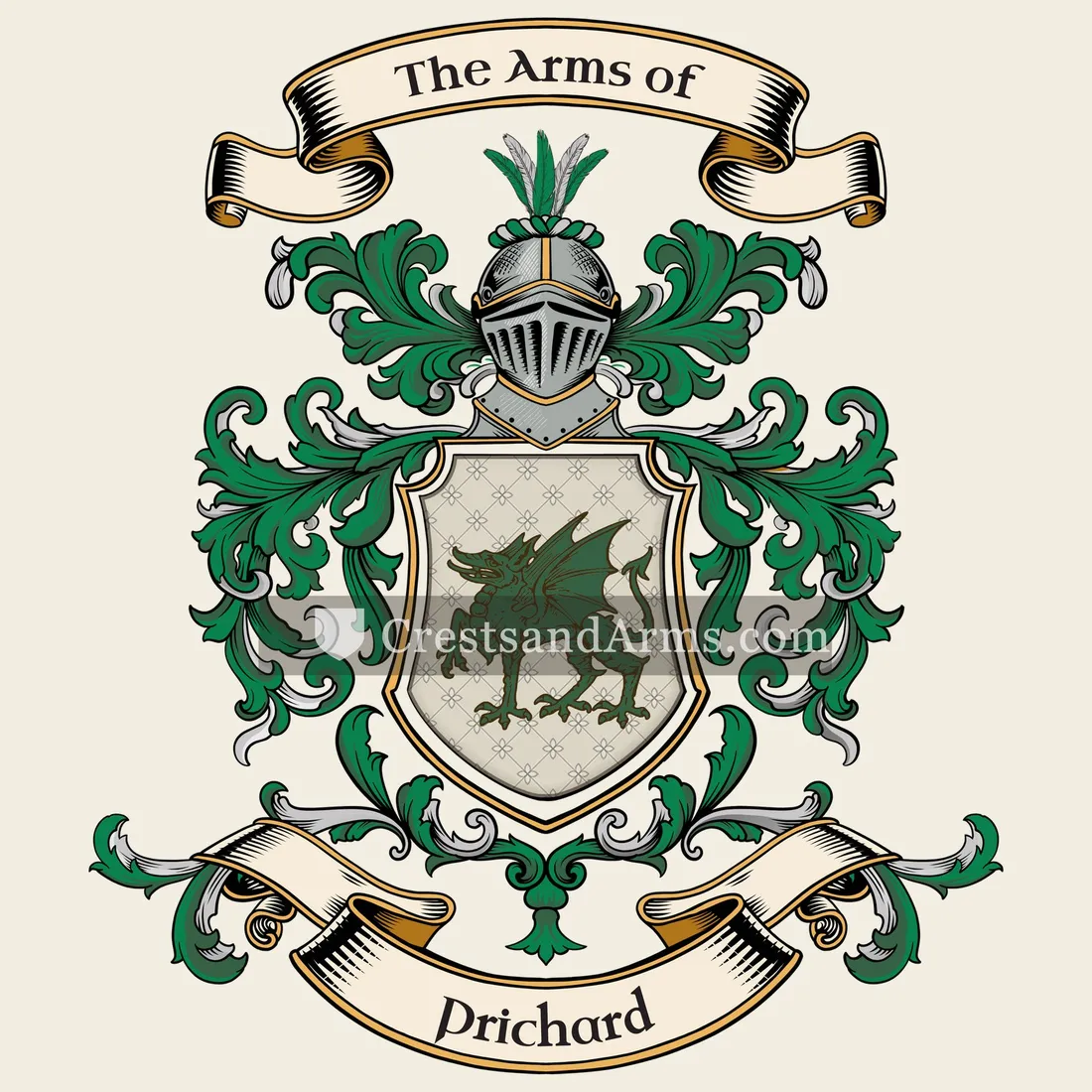
 dragonA most valiant defender of treasure
 dragonA most valiant defender of treasure


 fessThe military belt, and readiness to serve
 escallopThe pilgrim's shell, and a long journey made