Map of Wales showing where the Pritchard arms are recorded
The Pritchard arms were recorded in Monmouth, c. 1647.
Monmouthshire lay on the Welsh border, where land was held in return for military service. Families were expected to arm and to fight, and fighting households carried shields of their own.
This is where the arms were entered in the register. Families often moved to other parts of the country, so the same name can turn up in more than one region.
The body that granted and recorded arms in Wales in this period.
Charles I of England
Sovereign of the period
Charles I of England
1625–1649
Reigning in Wales when the Pritchard arms are first recorded.
How Arms Worked in Wales
English heraldry allowed arms to be shared by all legitimate descendants of the original owner. These symbols were treated as personal property that moved through the generations to all children. While the eldest son kept the original design, other family members could use the same shield without needing to change it or register their own unique versions.
Granting authority
The College of Arms in London has regulated the use of coats of arms throughout England and Wales since 1484.
How they got arms
Families typically obtained their coats of arms through a formal grant from the Crown or by proving their ancient right to them.
Where arms were recorded
All official coats of arms are recorded in the registers kept at the College of Arms, which date back to the fifteenth century.
The family's standing
Recorded among the armigerous families of Monmouth.
Origin & History of the Pritchard Family in Wales
The surname Pritchard is a classic example of a Welsh patronymic naming system that evolved into a permanent family name. It originated from the phrase ap Richard, which translates to son of Richard. In the Welsh language, the prefix ap indicates a direct line of descent from a father. Over many generations, the words ap and Richard gradually merged together to form the single name Pritchard. By the middle of the seventeenth century, this name was firmly established among families living in the border regions of Wales. Records confirm that members of the Pritchard family were settled in Monmouth by 1647, a time when the town was a significant center for local trade and political activity. As the family grew, they became part of the social fabric of the Welsh Marches, helping to preserve the unique cultural identity of the region through their presence in local government and community life.
Coat of Arms & Family Crest Details
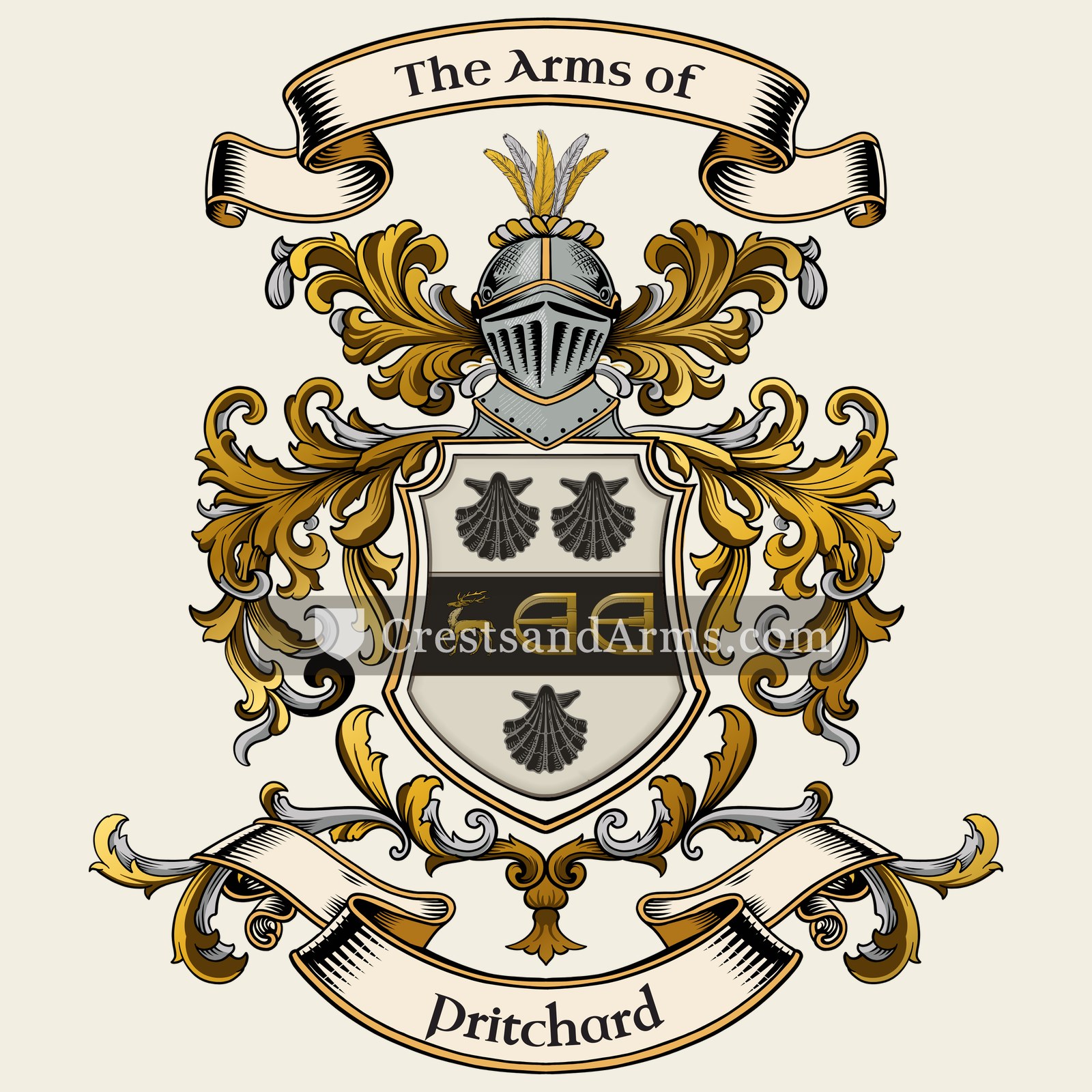
Symbols on this shield
fessThe military belt, and readiness to serve
escallopThe pilgrim's shell, and a long journey made
stagPeace and harmony, and one who will not fight unprovoked
buckleFidelity, and a bond firmly held
Colours
Silver (Argent)Means: Peace and sincerity
Black (Sable)Means: Constancy
Gold (Or)Means: Generosity
Historical info
Source
Sir Bernard Burke, The General Armory of England, Scotland, Ireland and Wales, London: Harrison & Sons, 1884
Blazon (the actual original written record)
“Ar. on a fess betw. three escallops sa. a buck's head cabossed betw. two buckles or”
SalopBroseley · Salop, c. 1620
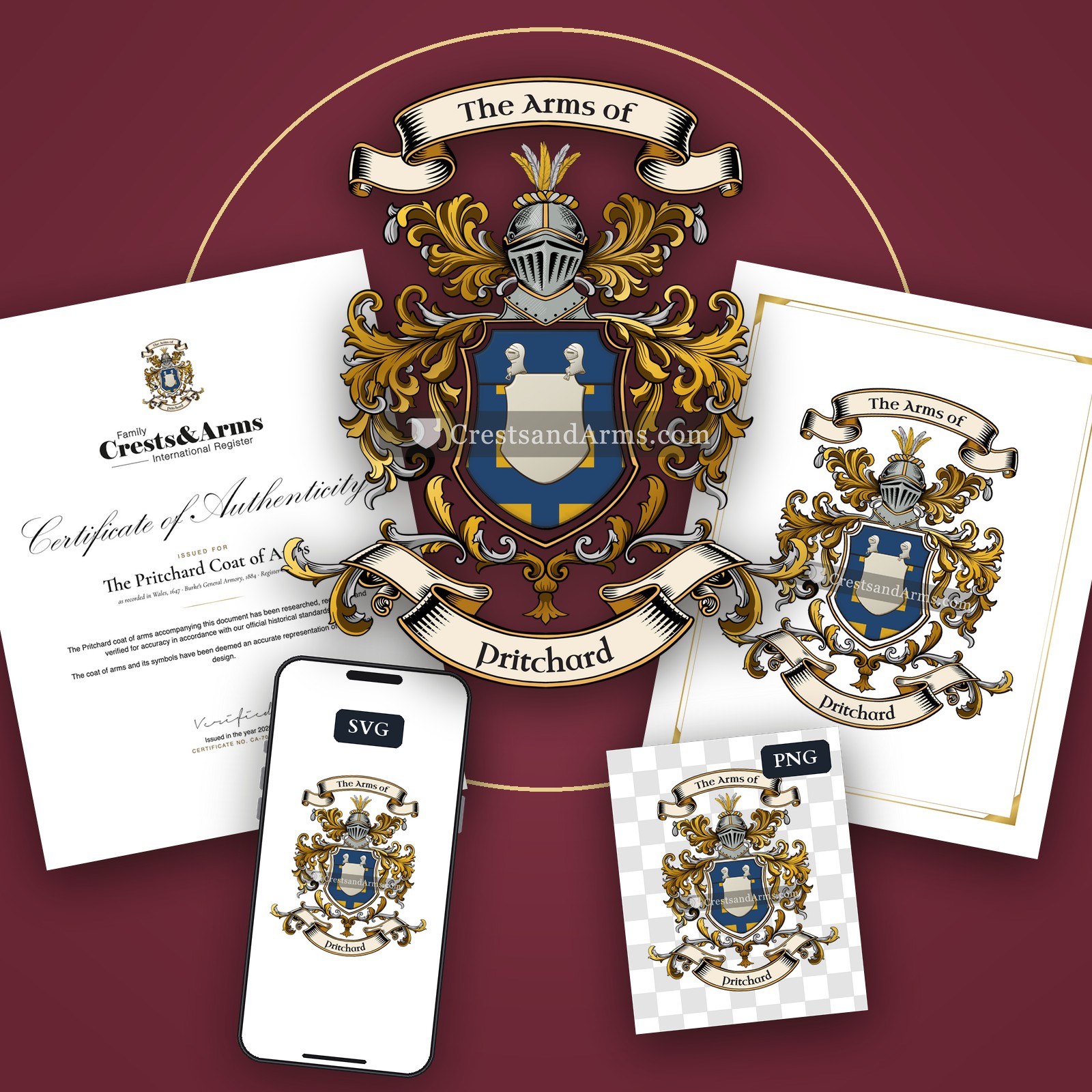
Digital archive packCoat of arms PNG, gold border print PDF, vector SVG and the certificate of authenticity. Sent to your email in minutes.
Map of England showing where the Pritchard arms are recorded
The Pritchard arms were recorded in Salop, c. 1620.
Shropshire lay on the Welsh border, and border country needed men who could fight. Families held their land in return for service, and service in arms is what a coat of arms was originally for.
This is where the arms were entered in the register. Families often moved to other parts of the country, so the same name can turn up in more than one region.
The body that granted and recorded arms in England in this period.
James VI and I
Sovereign of the period
James VI and I
1603–1625
Reigning in Wales when the Pritchard arms are first recorded.
How Arms Worked in England
English heraldry allowed arms to be shared by all legitimate descendants of the original owner. These symbols were treated as personal property that moved through the generations to all children. While the eldest son kept the original design, other family members could use the same shield without needing to change it or register their own unique versions.
Granting authority
The College of Arms in London has regulated the use of coats of arms throughout England and Wales since 1484.
How they got arms
Families typically obtained their coats of arms through a formal grant from the Crown or by proving their ancient right to them.
Where arms were recorded
All official coats of arms are recorded in the registers kept at the College of Arms, which date back to the fifteenth century.
The family's standing
Recorded among the armigerous families of Salop.
Origin & History of the Pritchard Family in England
The surname Pritchard is a patronymic name, which means it originated as a way to identify a person by their father’s name. It is a classic example of a Welsh name that migrated across the border into England. The name is derived from the Welsh phrase "ap Richard," which translates to "son of Richard." Over time, the "ap" prefix merged with the name Richard to create the single word Pritchard. By the early 17th century, families carrying this name were well-established in the county of Salop, also known as Shropshire. This region served as a cultural crossroads where Welsh naming traditions blended with English administrative practices. As these families settled in the English countryside, they became part of the local social fabric, often appearing in parish registers and tax records that documented the growth of rural communities during the Stuart period.
Pritchard Meaning & Related Branches
Root word
ap Richard
Patronymic prefix meaning son of combined with the Germanic name Richard.
This name
PritchardDerived from the Welsh patronymic system meaning son of the brave or strong ruler.
also spelled
Prichard
Pritcherd
Pritchart
Related arms
Prichardvariant spelling
Matthewsrecorded with Pritchard, same area
Documented Sources
Sir Bernard Burke, The General Armory of England, Scotland, Ireland and Wales, London: Harrison & Sons, 1884
Morgan, T. J. and Morgan, Prys. Welsh Surnames. 1985
Gwent Archives. Monmouth Borough Records. 1647
Rowlands, John and Rowlands, Sheila. The Surnames of Wales. 1996
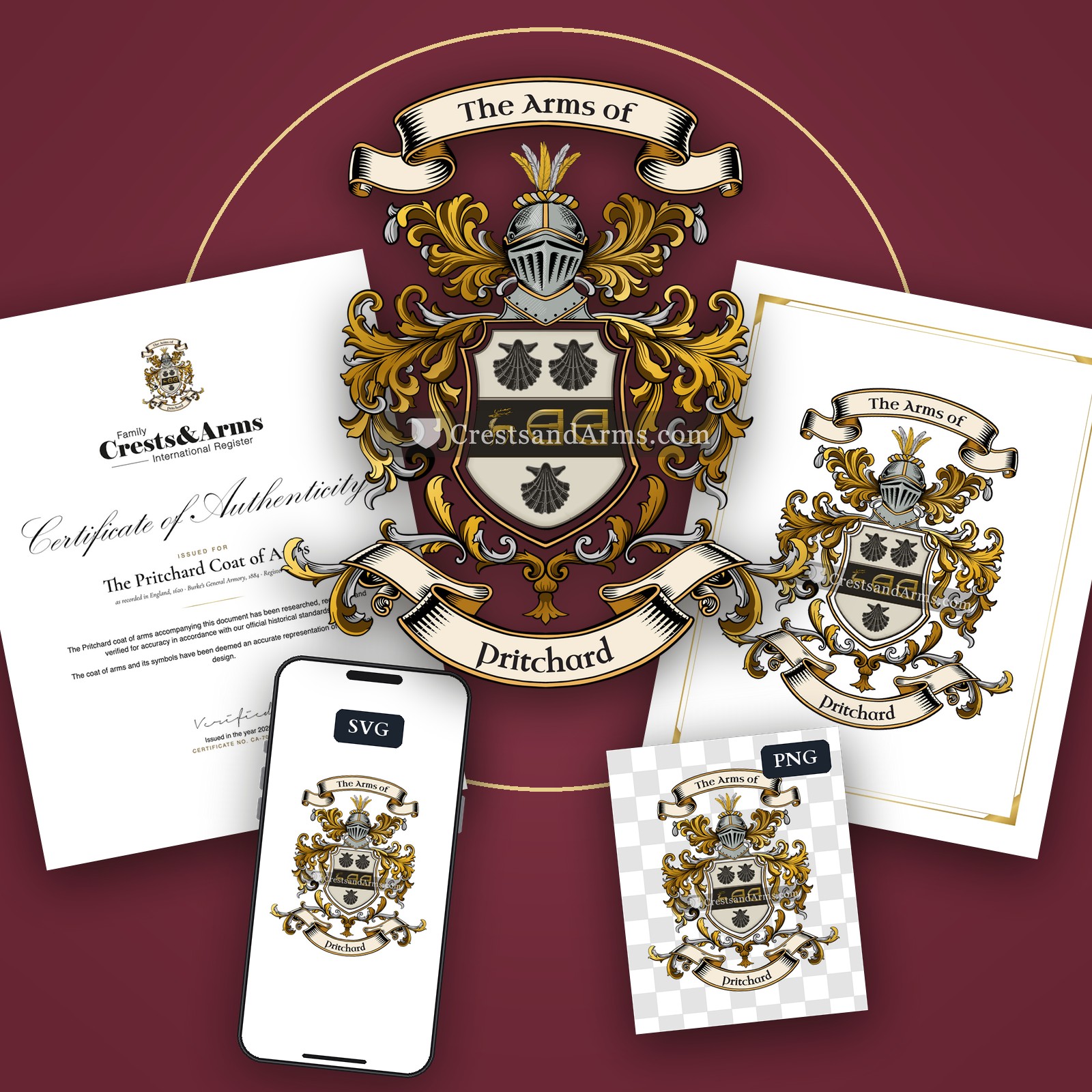
Digital archive packCoat of arms PNG, gold border print PDF, vector SVG and the certificate of authenticity. Sent to your email in minutes.


 chiefAuthority, wisdom and dominion
 paleMilitary strength, and a fortified defence
 helmetWisdom and security in defence
 chiefAuthority, wisdom and dominion
 paleMilitary strength, and a fortified defence
 helmetWisdom and security in defence
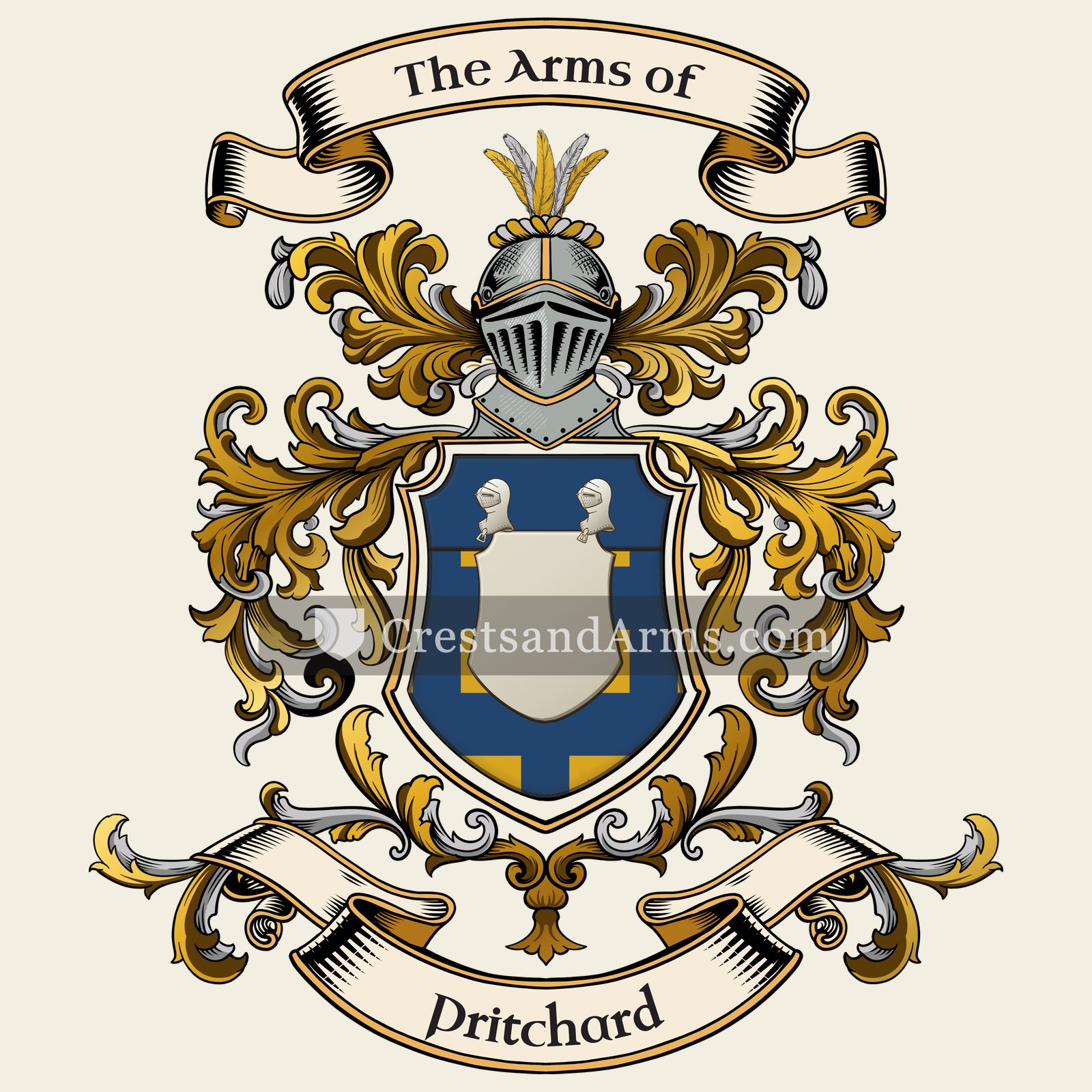


 fessThe military belt, and readiness to serve
 escallopThe pilgrim's shell, and a long journey made
 stagPeace and harmony, and one who will not fight unprovoked
 buckleFidelity, and a bond firmly held