Map of Netherlands showing where the Puleo arms are recorded
The Puleo arms were recorded in Netherlands, c. 1815.
Arms such as these were typically recorded in Friesland.
Friesland was low, wet country on the northern coast of the Netherlands, farmed by families who had held the same land for centuries. Free landholders were unusually common there, and a free landholder could carry arms.
This is where the arms were entered in the register. Families often moved to other parts of the country, so the same name can turn up in more than one region.
Region
Friesland
First recorded
1815
Granting Authority for the Puleo Arms
Hoge Raad van Adel
Photograph made by me · CC BY-SA 3.0
The body that granted and recorded arms in Netherlands in this period.
William I of the Netherlands
Sovereign of the period
William I of the Netherlands
1815–1840
Reigning in Netherlands when the Puleo arms are first recorded.
How Arms Worked in Netherlands
In the Netherlands, coats of arms were often used by noble families and those who held specific public offices. These arms were passed down through the generations to legitimate descendants. Younger branches of a family usually kept the original design without needing to add special marks. This system ensured that the family identity remained clear and consistent over many years.
Granting authority
The Hoge Raad van Adel is the official body that regulates and manages noble titles and coats of arms in the Netherlands.
How they got arms
Families typically obtained their coats of arms through official royal grants or by proving their long-standing historical use of the symbols.
Where arms were recorded
Coats of arms are officially recorded in the registers held by the Hoge Raad van Adel, which began its work in 1814.
The family's standing
Recorded among the armigerous families of Netherlands.
Origin & History of the Puleo Family in Netherlands
The history of the Puleo family in the Netherlands is deeply connected to the northern province of Friesland, where records confirm their presence by 1815. During this period, the Netherlands was undergoing significant administrative changes following the end of the Napoleonic era, which required citizens to formalize their surnames in official civil registries. While the name Puleo is often associated with Mediterranean origins, its appearance in Friesland suggests a unique migration story or a specific historical adaptation within the Dutch population. Families in this region were often involved in local agriculture or maritime trade, and the Puleo name likely became integrated into the local community through these social and economic networks. By settling in Friesland, the family became part of a distinct cultural landscape known for its strong regional identity and historical independence. Their presence in the 1815 records marks a clear starting point for tracing how the family established roots and contributed to the diverse social fabric of the Dutch northern provinces.
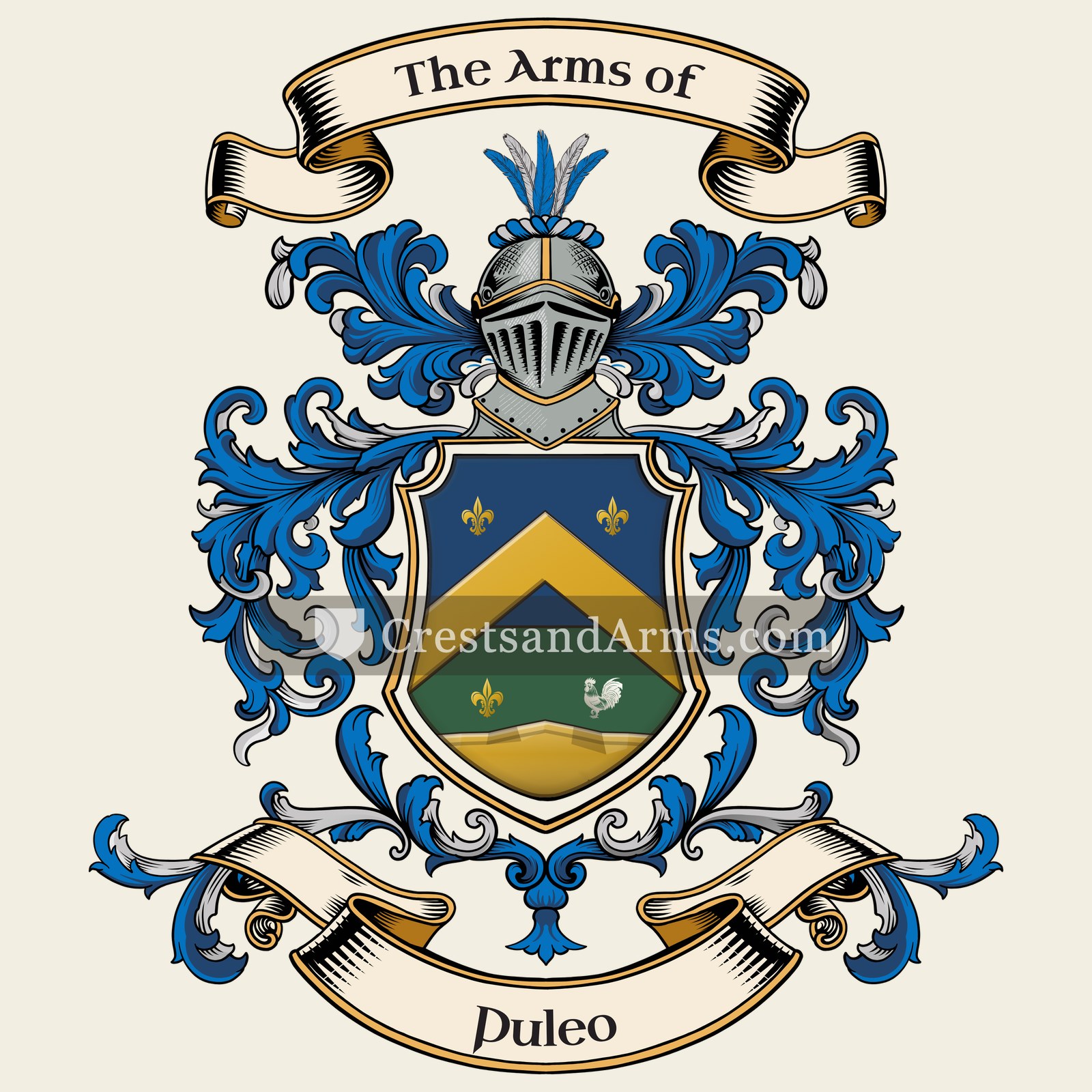
Coat of Arms & Family Crest Details
Symbols on this shield
mountThe ground held, and steadfastness upon it
chevronProtection, and faithful service completed
fleur de lisPurity, light, and the sixth son
cockCourage, vigilance and readiness for battle
Colours
Blue (Azure)Means: Loyalty and truth
Green (Vert)Means: Hope
Gold (Or)Means: Generosity
Silver (Argent)Means: Peace and sincerity
Historical info
Source
J. B. Rietstap, Armorial Général, Gouda: G. B. van Goor Zonen, 1884–87
Blazon (the actual original written record)
“d'azur à trois fleurs-de-lis mal-ordonnées d'or, sur sin. à une poule d'arg., posée sur un tertre d'or; au chev. d'or, br. sur la division. D.: POL EN VAILLANCE EST LION.”
ItalyVérone, c. 1775
Digital archive packCoat of arms PNG, gold border print PDF, vector SVG and the certificate of authenticity. Sent to your email in minutes.
Map of Italy showing where the Puleo arms are recorded
The Puleo arms were recorded in Vérone, c. 1775.
This is where the arms were entered in the register. Families often moved to other parts of the country, so the same name can turn up in more than one region.
The body that granted and recorded arms in Italy in this period.
Alvise Giovanni Mocenigo
Sovereign of the period
Alvise Giovanni Mocenigo
1763–1778
Reigning in Netherlands when the Puleo arms are first recorded.
How Arms Worked in Italy
In the Italian states, coats of arms were often used by noble families to show their status and history. These symbols were passed down through the generations to all legitimate male descendants. Younger branches of a family usually kept the original design but sometimes added small changes to distinguish their specific line from the main branch.
Granting authority
Various local rulers and city governments controlled the use of coats of arms across the different Italian states.
How they got arms
Families often assumed their own arms or received them as official grants from local lords, popes, or city councils.
Where arms were recorded
Arms were recorded in local city archives or private family books rather than in one single national register.
The family's standing
Recorded among the armigerous families of Italy.
Origin & History of the Puleo Family in Italy
The Puleo family name has deep roots in the Italian peninsula, with historical records placing members of the family in the city of Verona by the year 1775. The name itself is believed to be derived from the Italian word "puleo," which historically referred to a young horse or a colt. In the context of early Italian society, such names were often descriptive nicknames that eventually became permanent family identifiers as populations grew and record-keeping became more formal. By the late 18th century, families like the Puleos were integrated into the urban life of northern Italian cities, likely participating in the local trades, agriculture, or civic administration that defined the region. While the family had a notable presence in Verona during this period, the name also appears in various southern Italian administrative documents, suggesting that the lineage may have moved across the country over several generations to seek new opportunities in different provinces.
Related Branches & Arms
Root word
Puleium
Latin term for the pennyroyal plant or a type of herb.
This name
PuleoDerived from a topographic or occupational name related to the cultivation of herbs.
also spelled
Pull
Pulleh
Pullee
Pool
Documented Sources
J. B. Rietstap, Armorial Général, Gouda: G. B. van Goor Zonen, 1884–87
Tresoar (Fries Historisch en Letterkundig Centrum), Burgerlijke Stand van de provincie Friesland
Netherlands National Archives (Nationaal Archief), Registers van de Burgerlijke Stand
Digital archive packCoat of arms PNG, gold border print PDF, vector SVG and the certificate of authenticity. Sent to your email in minutes.


 mulletThe third son, and a divine quality from above
 lozengeHonour and nobility, and the arms of a woman
 mulletThe third son, and a divine quality from above
 lozengeHonour and nobility, and the arms of a woman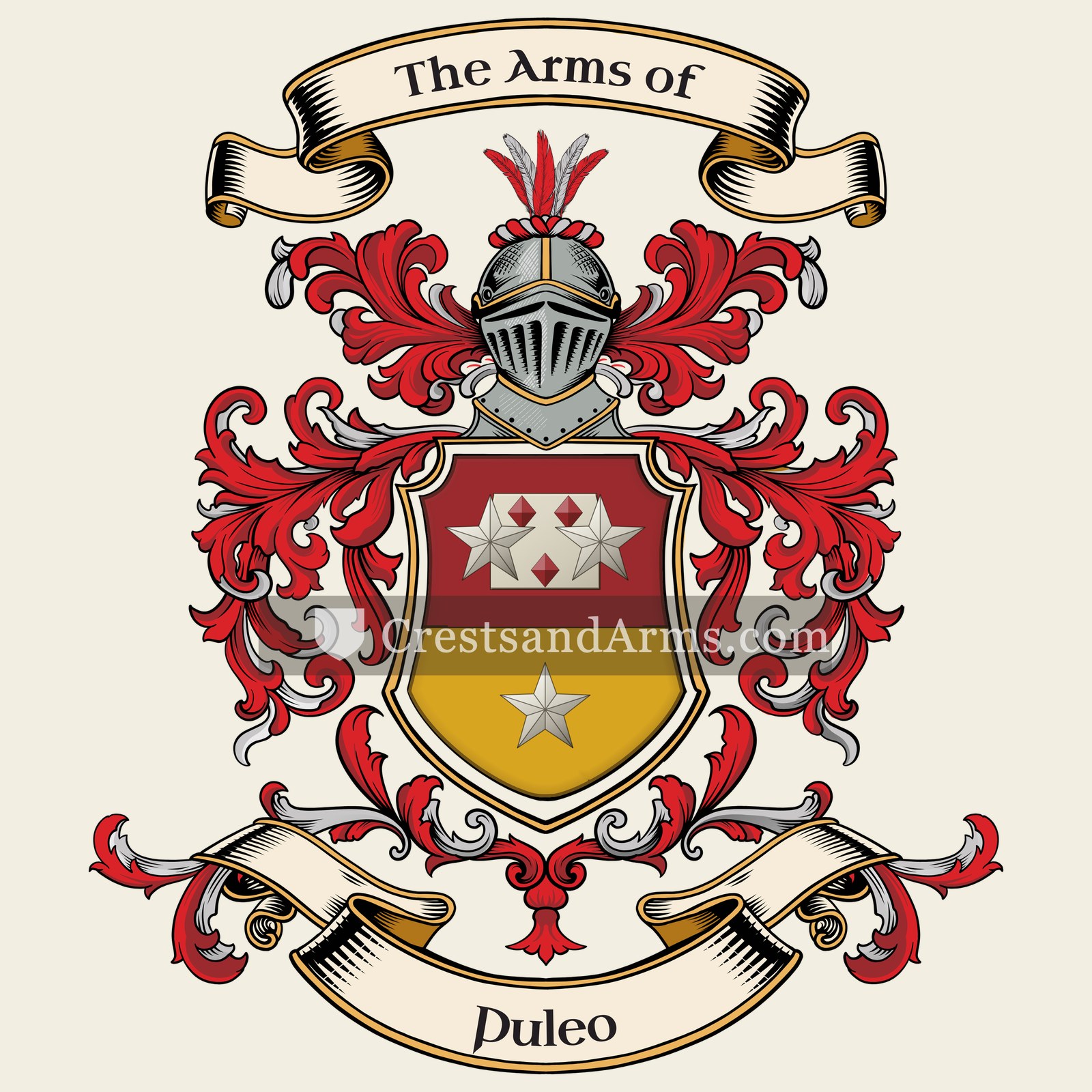


 mountThe ground held, and steadfastness upon it
 chevronProtection, and faithful service completed
 fleur de lisPurity, light, and the sixth son
 cockCourage, vigilance and readiness for battle