Map of Netherlands showing where the Pull arms are recorded
The Pull arms were recorded in Netherlands, c. 1815.
Arms such as these were typically recorded in Friesland.
Friesland was low, wet country on the northern coast of the Netherlands, farmed by families who had held the same land for centuries. Free landholders were unusually common there, and a free landholder could carry arms.
This is where the arms were entered in the register. Families often moved to other parts of the country, so the same name can turn up in more than one region.
Region
Friesland
First recorded
1815
Granting Authority for the Pull Arms
Hoge Raad van Adel
Photograph made by me · CC BY-SA 3.0
The body that granted and recorded arms in Netherlands in this period.
William I of the Netherlands
Sovereign of the period
William I of the Netherlands
1815–1840
Reigning in Netherlands when the Pull arms are first recorded.
How Arms Worked in Netherlands
In the Netherlands, coats of arms were often used by noble families and those who held specific public offices. These arms were passed down through the generations to legitimate descendants. Younger branches of a family usually kept the original design without needing to add special marks. This system ensured that the family identity remained clear and consistent over many years.
Granting authority
The Hoge Raad van Adel is the official body that regulates and manages noble titles and coats of arms in the Netherlands.
How they got arms
Families typically obtained their coats of arms through official royal grants or by proving their long-standing historical use of the symbols.
Where arms were recorded
Coats of arms are officially recorded in the registers held by the Hoge Raad van Adel, which began its work in 1814.
The family's standing
Recorded among the armigerous families of Netherlands.
Origin & History of the Pull Family in Netherlands
The family name Pull has deep roots in the northern region of the Netherlands known as Friesland. By the early 19th century, records confirm that members of the family were well-established in this area. The name itself likely originated as a topographical surname, which means it was often used to describe the specific landscape where a person lived. In the Frisian language and local dialects, such names were frequently tied to the unique geography of the marshy, low-lying coastal plains. Families in this region often identified themselves by their proximity to specific water features or small plots of land that defined their daily work. As the family grew, they became part of the local social fabric, participating in the agricultural and maritime traditions that shaped Frisian life during the Napoleonic era and beyond. This connection to the land and the local community helped the name persist through generations as the family moved across the Dutch provinces.
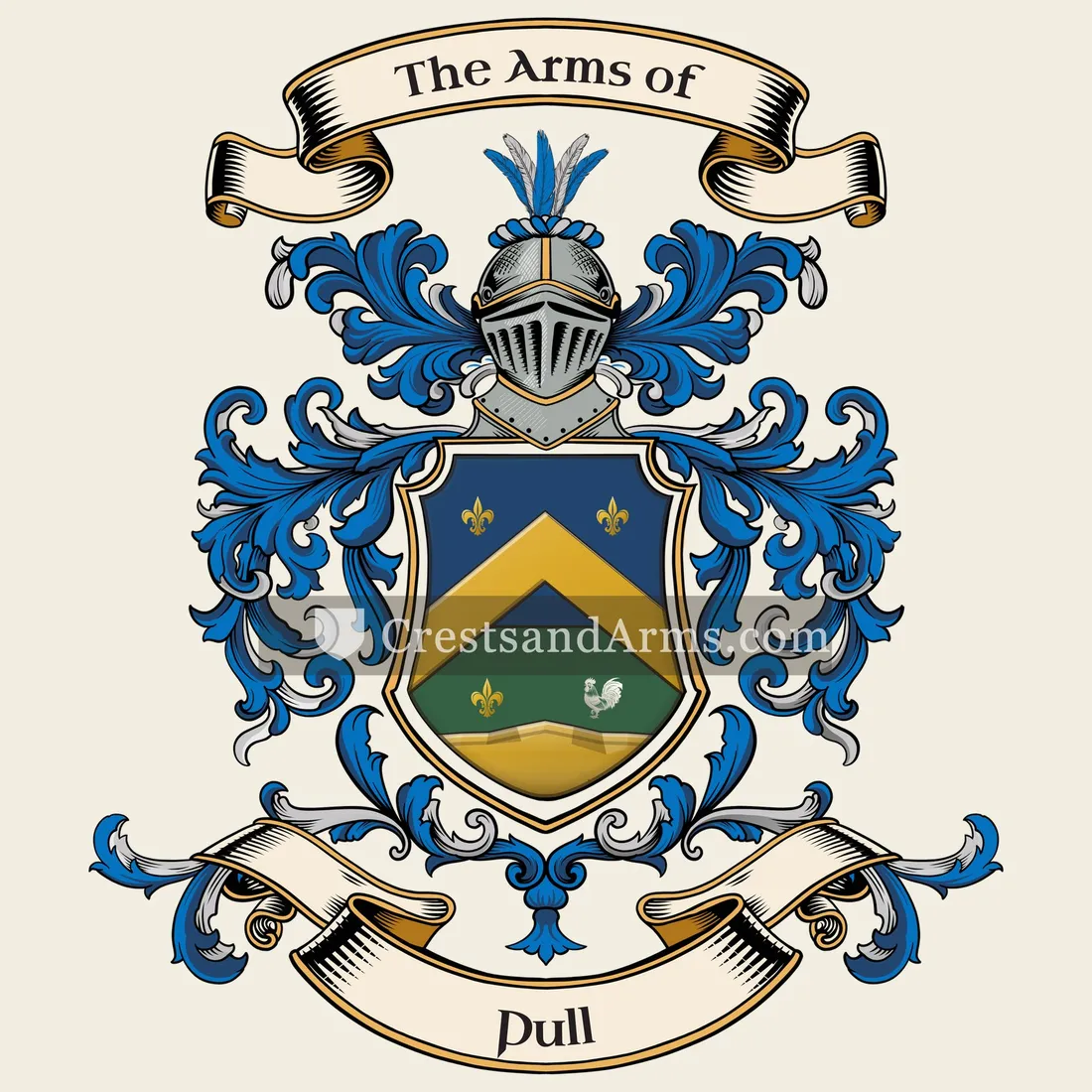
Meaning of the Pull family crest colors & symbols
Symbols on this shield
mountThe ground held, and steadfastness upon it
chevronProtection, and faithful service completed
fleur de lisPurity, light, and the sixth son
cockCourage, vigilance and readiness for battle
Colours
Blue (Azure)Means: Loyalty and truth
Green (Vert)Means: Hope
Gold (Or)Means: Generosity
Silver (Argent)Means: Peace and sincerity
Historical info
Source
J. B. Rietstap, Armorial Général, Gouda: G. B. van Goor Zonen, 1884–87
Blazon (the actual original written record)
“d'azur à trois fleurs-de-lis mal-ordonnées d'or, sur sin. à une poule d'arg., posée sur un tertre d'or; au chev. d'or, br. sur la division. D.: POL EN VAILLANCE EST LION.”
ItalyVérone, c. 1775
Digital archive packCoat of arms PNG, gold border print PDF, vector SVG and the certificate of authenticity. Sent to your email in minutes.
Map of Italy showing where the Pull arms are recorded
The Pull arms were recorded in Vérone, c. 1775.
This is where the arms were entered in the register. Families often moved to other parts of the country, so the same name can turn up in more than one region.
The body that granted and recorded arms in Italy in this period.
Alvise Giovanni Mocenigo
Sovereign of the period
Alvise Giovanni Mocenigo
1763–1778
Reigning in Netherlands when the Pull arms are first recorded.
How Arms Worked in Italy
In the Italian states, coats of arms were often used by noble families to show their status and history. These symbols were passed down through the generations to all legitimate male descendants. Younger branches of a family usually kept the original design but sometimes added small changes to distinguish their specific line from the main branch.
Granting authority
Various local rulers and city governments controlled the use of coats of arms across the different Italian states.
How they got arms
Families often assumed their own arms or received them as official grants from local lords, popes, or city councils.
Where arms were recorded
Arms were recorded in local city archives or private family books rather than in one single national register.
The family's standing
Recorded among the armigerous families of Italy.
Origin & History of the Pull Family in Italy
The history of the Pull family in Italy is deeply rooted in the cultural landscape of the Veneto region, with documented evidence placing members of the family in the city of Verona by 1775. During the late eighteenth century, Verona served as a vital crossroads for trade and intellectual exchange under the influence of the Republic of Venice. Families like the Pulls often occupied roles within the local urban structure, contributing to the administrative and social life of the city as it transitioned through a period of significant political change. By settling in such a prominent center of art and commerce, the family became part of the long-standing tradition of Veronese civic life. Their presence in the city records during this era highlights their integration into a society that valued both regional stability and the steady growth of professional middle-class families.
Pull Meaning & Related Branches
Root word
Pulle
A pool or small body of standing water.
This name
PullA topographic name for someone who lived near a pool or a small pond.
also spelled
Pull
Pulleh
Pullee
Pool
Documented Sources
J. B. Rietstap, Armorial Général, Gouda: G. B. van Goor Zonen, 1884–87
Tresoar, Bevolkingsregister van Friesland (1811-1850)
Nederlandse Familienamenbank, Nederlandse Familienamenbank (Centraal Bureau voor Genealogie)
Meertens Instituut, Nederlandse Voornamenbank en Familienamen
Digital archive packCoat of arms PNG, gold border print PDF, vector SVG and the certificate of authenticity. Sent to your email in minutes.


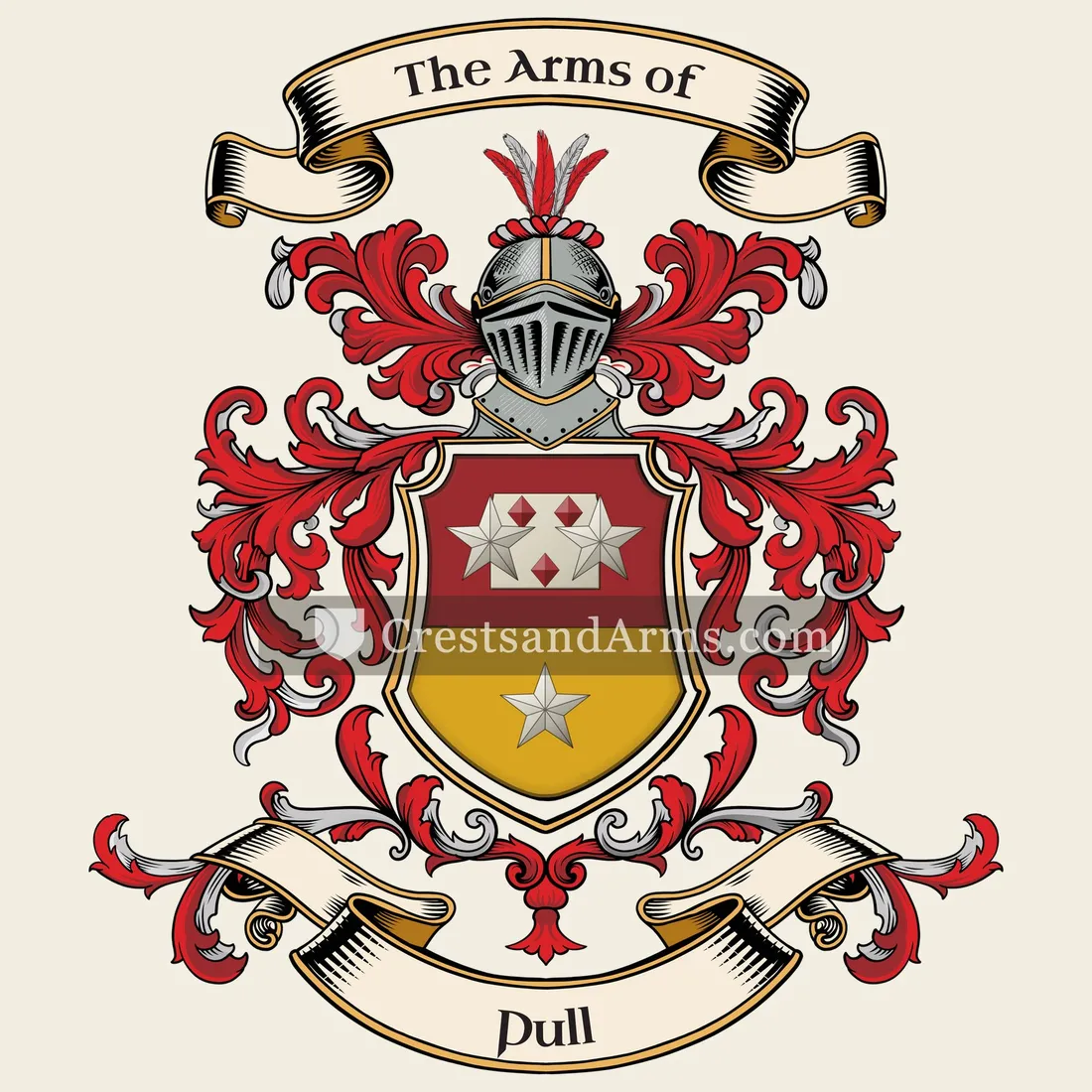
 mulletThe third son, and a divine quality from above
 lozengeHonour and nobility, and the arms of a woman
 mulletThe third son, and a divine quality from above
 lozengeHonour and nobility, and the arms of a woman


 mountThe ground held, and steadfastness upon it
 chevronProtection, and faithful service completed
 fleur de lisPurity, light, and the sixth son
 cockCourage, vigilance and readiness for battle