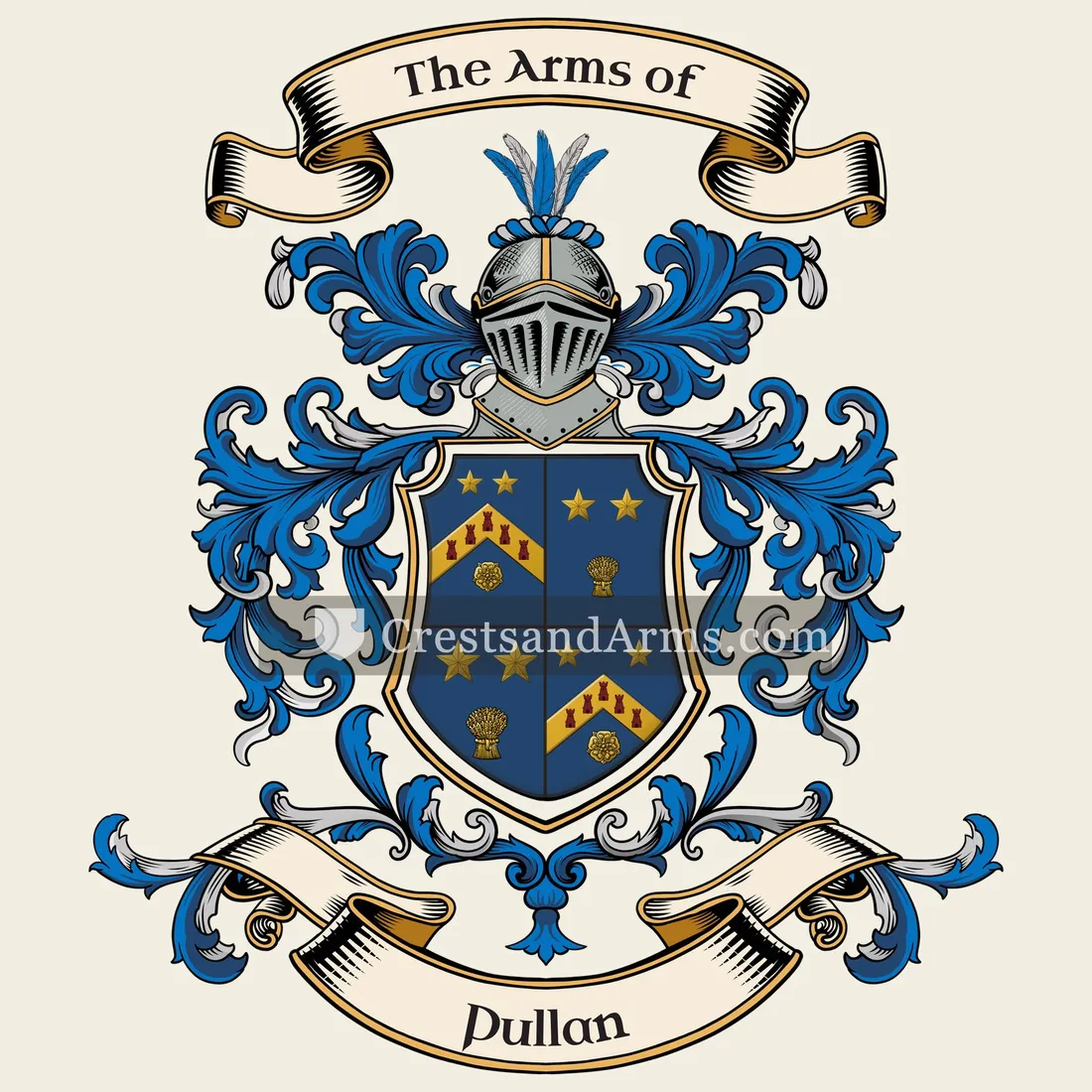
A record of documented arms, meaning and origin, researched for the Pullan family of France.
Reg. 1965 · French, P–S
Meaning of the Pullan family crest colors & symbols
Symbols on this shield
chevronProtection, and faithful service completed
towerGrandeur and solidity, and a stronghold defended
mulletThe third son, and a divine quality from above
roseThe seventh son, and beauty with grace
wheatsheafPlenty, and the harvest of one's own labour
Colours
Blue (Azure)Means: Loyalty and truth
Gold (Or)Means: Generosity
Red (Gules)Means: Military strength
Historical info
Source
J. B. Rietstap, Armorial Général, Gouda: G. B. van Goor Zonen, 1884–87
Blazon (the actual original written record)
“Ec.: aux 1 et 4 d'azur au chev. d'or, ch. de cinq tours de gu. et acc. en chef de deux molettes d'or et en p. d'un souci du même; aux 2 et 3 d'azur au chev., acc. en chef de deux étoiles et en p. d'une gerbe, le tout d'or.”
FranceParis, c. 1663
Digital archive packCoat of arms PNG, gold border print PDF, vector SVG and the certificate of authenticity. Sent to your email in minutes.
Map of France showing where the Pullan arms are recorded
The Pullan arms were recorded in Paris, c. 1663.
This is where the arms were entered in the register. Families often moved to other parts of the country, so the same name can turn up in more than one region.
The body that granted and recorded arms in France in this period.
Louis XIV of France
Sovereign of the period
Louis XIV of France
1643–1715
Reigning in France when the Pullan arms are first recorded.
How Arms Worked in France
In France, a coat of arms was a mark of honor that passed down through the male line to all legitimate descendants. Families often used the same shield without changes to show their shared heritage. If a branch wanted to stand out, they could add a small mark to their shield to show their specific place in the family tree.
Granting authority
The Juge d'armes de France acted as the official authority that regulated and verified coats of arms across the country.
How they got arms
Families typically inherited their arms from ancestors, though they could also receive them through royal grants or by proving their noble status.
Where arms were recorded
Coats of arms were officially recorded in the Armorial Général de France, which began its main collection in the year 1696.
The family's standing
Recorded among the armigerous families of France.
Origin & History of the Pullan Family in France
The history of the Pullan name is deeply rooted in the linguistic traditions of Northern France, where the surname first emerged as a descriptive identifier. By the mid-17th century, records confirm that members of the family were well-established in Paris, specifically appearing in civil and parish registers by 1663. The name likely evolved from Old French terms related to local occupations or physical characteristics, eventually solidifying into a hereditary surname as families became more settled in urban centers. As these individuals moved through the social structures of 17th-century France, they participated in the typical life of the era, including trade, craftsmanship, and the administrative duties required by the growing city. This early presence in Paris suggests that the family was integrated into the professional and social fabric of the capital during a time of significant cultural and political development.
Pullan Meaning & Related Branches
Root word
pullus
Latin term meaning a young animal or chicken.
This name
PullanA topographic or occupational name for someone who raised or dealt in poultry.
also spelled
Poulain
Poulaind
Poolan
Documented Sources
J. B. Rietstap, Armorial Général, Gouda: G. B. van Goor Zonen, 1884–87
Archives Nationales, Minutier central des notaires de Paris, Series Et/XXIX
Boutier, Jean, Les noms de famille en France: Histoire et société, 2005
Dauzat, Albert, Dictionnaire étymologique des noms de famille et prénoms de France, 1951
Digital archive packCoat of arms PNG, gold border print PDF, vector SVG and the certificate of authenticity. Sent to your email in minutes.


 chevronProtection, and faithful service completed
 towerGrandeur and solidity, and a stronghold defended
 mulletThe third son, and a divine quality from above
 roseThe seventh son, and beauty with grace
 wheatsheafPlenty, and the harvest of one's own labour
 chevronProtection, and faithful service completed
 towerGrandeur and solidity, and a stronghold defended
 mulletThe third son, and a divine quality from above
 roseThe seventh son, and beauty with grace
 wheatsheafPlenty, and the harvest of one's own labour