Map of Netherlands showing where the Pympe arms are recorded
The Pympe arms were recorded in Gorinchem, c. 1815.
This is where the arms were entered in the register. Families often moved to other parts of the country, so the same name can turn up in more than one region.
Region
Gorinchem
Town
Gorinchem
First recorded
1815
Granting Authority for the Pympe Arms
Hoge Raad van Adel
Photograph made by me · CC BY-SA 3.0
The body that granted and recorded arms in Netherlands in this period.
William I of the Netherlands
Sovereign of the period
William I of the Netherlands
1815–1840
Reigning in Netherlands when the Pympe arms are first recorded.
How Arms Worked in Netherlands
In the Netherlands, coats of arms were often used by noble families and those who held specific public offices. These arms were passed down through the generations to legitimate descendants. Younger branches of a family usually kept the original design without needing to add special marks. This system ensured that the family identity remained clear and consistent over many years.
Granting authority
The Hoge Raad van Adel is the official body that regulates and manages noble titles and coats of arms in the Netherlands.
How they got arms
Families typically obtained their coats of arms through official royal grants or by proving their long-standing historical use of the symbols.
Where arms were recorded
Coats of arms are officially recorded in the registers held by the Hoge Raad van Adel, which began its work in 1814.
The family's standing
Recorded among the armigerous families of Netherlands.
Origin & History of the Pympe Family in Netherlands
The family name Pympe traces its roots to the historic town of Gorinchem in the Netherlands. By the year 1815, records confirm that members of the family were firmly established within this community. Gorinchem was a significant fortified city during this era, serving as a vital hub for trade and river transport along the Waal and Linge rivers. Families living in the region at this time often relied on the local shipping industry or agricultural work to sustain their households. The name likely evolved as a way to identify specific branches of local families living near the city walls or the bustling harbor districts. As the nineteenth century progressed, the Pympe family became part of the social fabric of the region, contributing to the daily life and steady growth of the town during a period of major political change in Europe.
Pympe Meaning & Related Branches
Root word
Pimp
A Middle Dutch term referring to a person of low social standing.
This name
PympeA topographic or occupational surname likely denoting a person of humble origins or status.
also spelled
Pompee
Pompp
Pompeh
Pompa
Documented Sources
J. B. Rietstap, Armorial Général, Gouda: G. B. van Goor Zonen, 1884–87


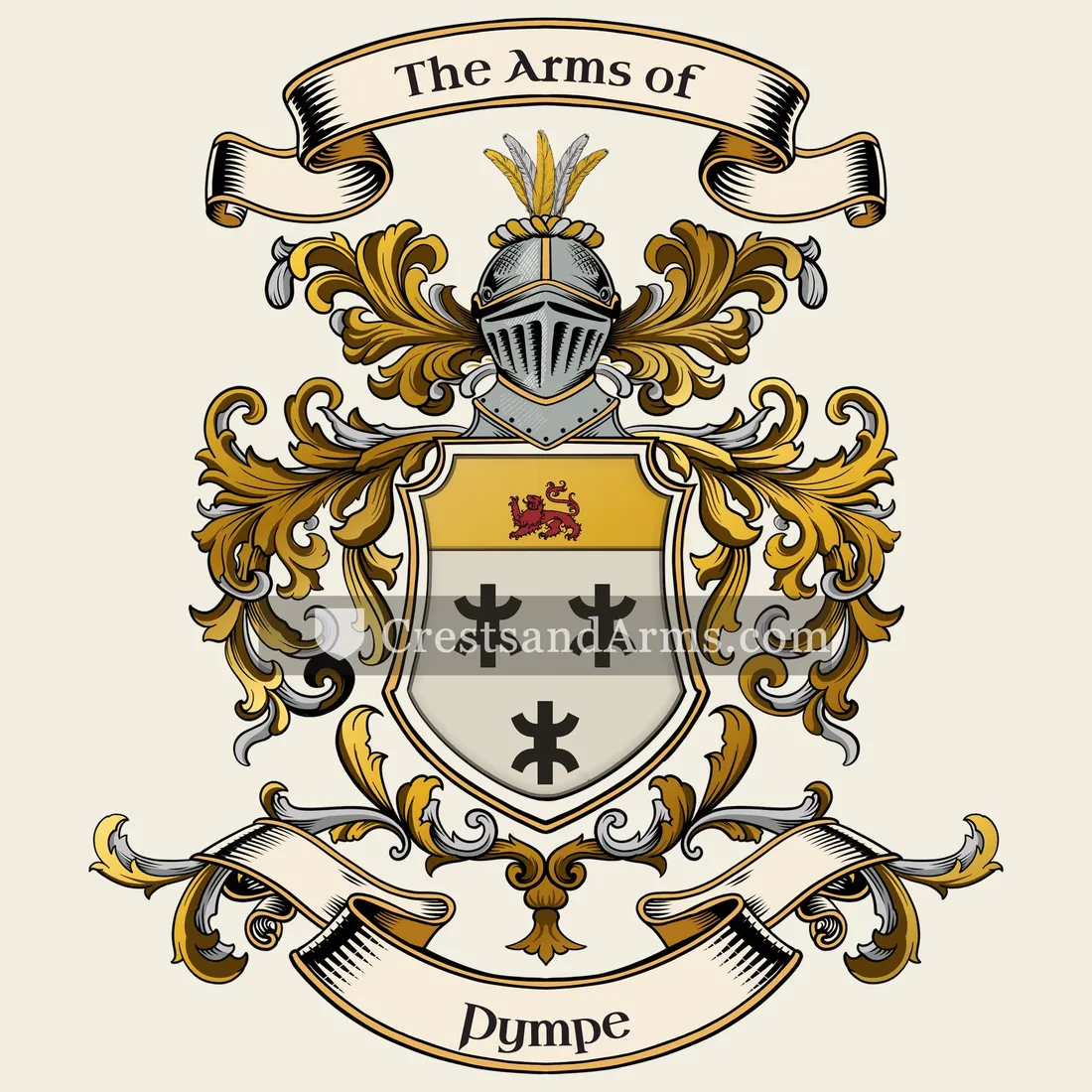
 chiefAuthority, wisdom and dominion
 millrind / fer de molineThe mill's iron, and the grinding of grain
 lionCourage, strength and royalty
 chiefAuthority, wisdom and dominion
 millrind / fer de molineThe mill's iron, and the grinding of grain
 lionCourage, strength and royalty