A record of documented arms, meaning and origin, researched for the Raabe family lines. Documented in 3 countries.
Reg. 4361 · Swedish, P–S
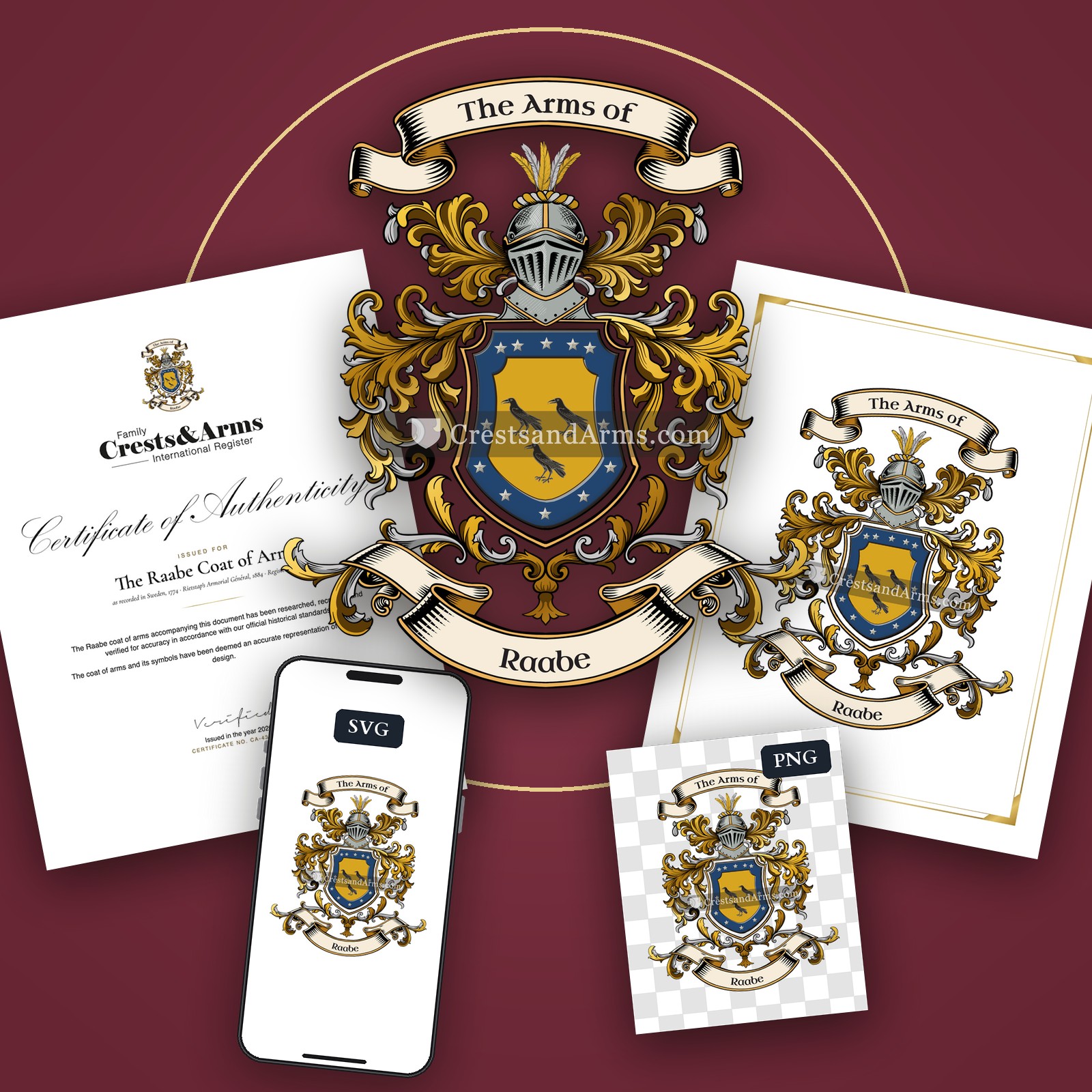
Coat of Arms & Family Crest Details
Symbols on this shield
ravenConstancy and divine providence
mulletThe third son, and a divine quality from above
Colours
Gold (Or)Means: Generosity
Blue (Azure)Means: Loyalty and truth
Black (Sable)Means: Constancy
Silver (Argent)Means: Peace and sincerity
Historical info
Source
J. B. Rietstap, Armorial Général, Gouda: G. B. van Goor Zonen, 1884–87
Blazon (the actual original written record)
“D'or à trois corbeaux de sa.; à la bord. d'azur, ch. de douze étoiles (5) d'arg. Deux cq. cour. C.: 1° un faisceau des licteurs d'azur, en pal, entre deux pl. d'aut. d'arg.; et une clé d'or en bande et une ancre d'arg. en barre, passées en saut. et br. sur le faisceau et les plumes; 2° un bras, paré d'azur, la main de carn. tenant un sabre d'arg., garni d'or; entre deux banderoles coupées d'or sur azur, enroulées autour de leurs hampes. S.: à dextre un lion reg. de gu., à sen. un griffon reg. d'azur.”
Swedenc. 1774
Digital archive packCoat of arms PNG, gold border print PDF, vector SVG and the certificate of authenticity. Sent to your email in minutes.
Map of Sweden showing where the Raabe arms are recorded
The Raabe arms were recorded in Sweden, c. 1774.
Arms such as these were typically recorded in Stockholm.
Stockholm held the Swedish court and the House of Nobility, where every noble family's arms were entered and kept. Families ennobled for service registered there, which is why so many are recorded around the city.
This is where the arms were entered in the register. Families often moved to other parts of the country, so the same name can turn up in more than one region.
The body that granted and recorded arms in Sweden in this period.
Gustav III of Sweden
Sovereign of the period
Gustav III of Sweden
1771–1792
Reigning in Sweden when the Raabe arms are first recorded.
How Arms Worked in Sweden
In Sweden, a coat of arms belonged to a noble family as a whole rather than just one individual. These arms were passed down through the generations to all legitimate descendants. Younger branches of the family used the same shield without needing to change it. This system ensured that the entire lineage shared the same identity and status under the law.
Granting authority
The Riddarhuset, or House of Nobility, regulated all noble coats of arms in Sweden under royal authority.
How they got arms
Families received their coats of arms through royal grants of nobility which were then officially registered with the House.
Where arms were recorded
Coats of arms were officially recorded in the Swedish House of Nobility register starting in the year 1626.
The family's standing
Recorded among the armigerous families of Sweden.
Origin & History of the Raabe Family in Sweden
The family name Raabe has deep roots in Northern Europe, and its presence in Sweden became well-established by the late eighteenth century. Records confirm that members of the family were living in Stockholm by 1774, a time when the city was a growing hub for trade and administration. The name itself is derived from the Middle High German word for raven, a bird often associated with wisdom and foresight in folklore. As the family settled into Swedish society, they integrated into the urban life of the capital, likely participating in the professional and merchant classes that defined Stockholm during the Gustavian era. Over time, the family name became a permanent fixture in the region, reflecting the broader movement of families across the Baltic Sea who sought new opportunities in the expanding Swedish kingdom.
Coat of Arms & Family Crest Details
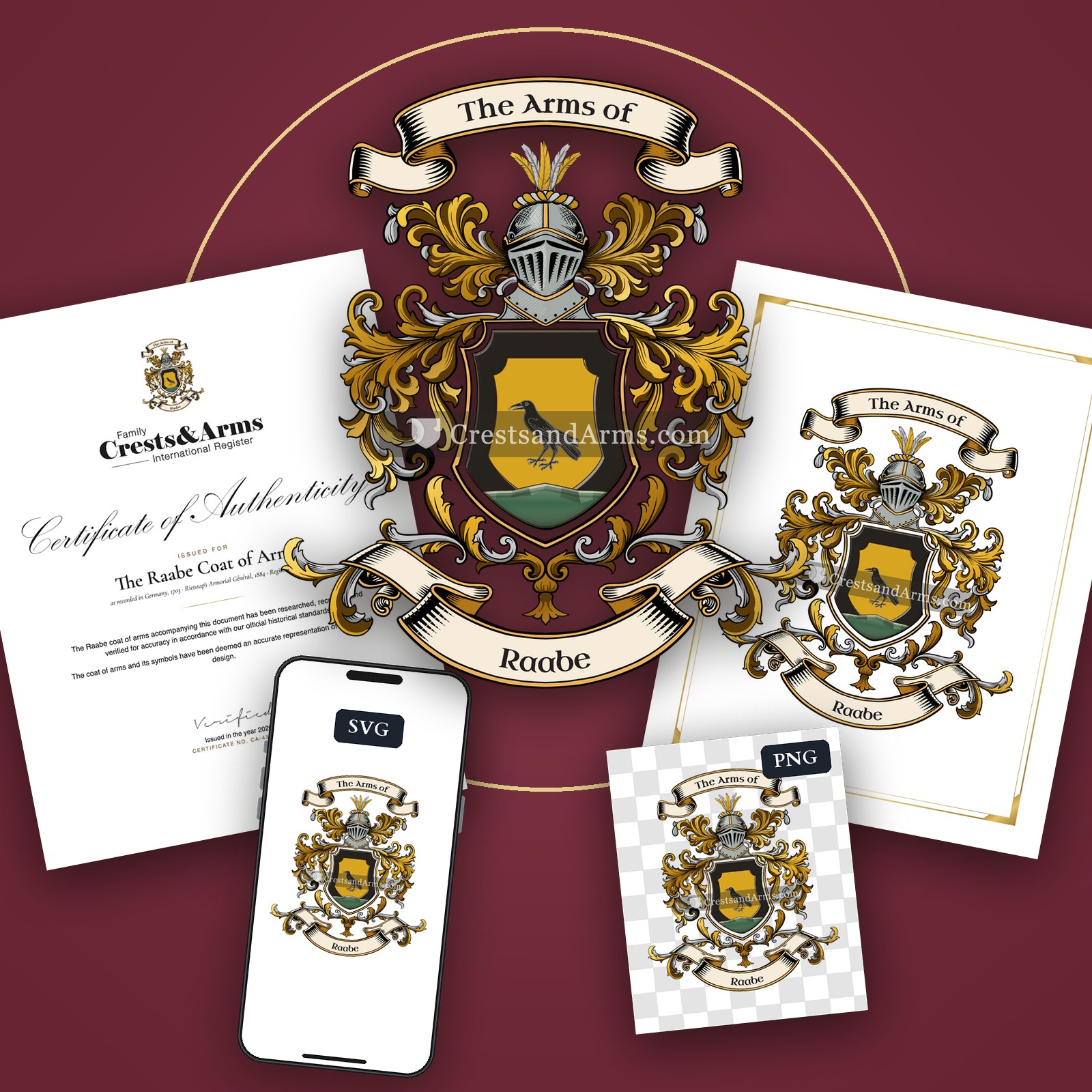
Symbols on this shield
mountThe ground held, and steadfastness upon it
ravenConstancy and divine providence
Colours
Gold (Or)Means: Generosity
Black (Sable)Means: Constancy
Green (Vert)Means: Hope
Historical info
Source
J. B. Rietstap, Armorial Général, Gouda: G. B. van Goor Zonen, 1884–87
Blazon (the actual original written record)
“D'or à un corbeau cont. de sa., cour. d'or, posé sur un tertre de sin.; l'écu bordé d'or. C.: le corbeau. L. d'arg. et de sa.”
Germanyc. 1703
Digital archive packCoat of arms PNG, gold border print PDF, vector SVG and the certificate of authenticity. Sent to your email in minutes.
Map of Germany showing where the Raabe arms are recorded
The Raabe arms were recorded in Germany, c. 1703.
Arms such as these were typically recorded in Bavaria.
Bavaria was a country of old landed families and walled market towns. Estates passed down the same line for centuries, and both the landowners and the leading townsmen kept arms, which is why so many Bavarian names sit in the registers.
This is where the arms were entered in the register. Families often moved to other parts of the country, so the same name can turn up in more than one region.
The body that granted and recorded arms in Germany in this period.
Leopold I, Holy Roman Emperor
Sovereign of the period
Leopold I, Holy Roman Emperor
1658–1705
Reigning in Sweden when the Raabe arms are first recorded.
How Arms Worked in Germany
In the Holy Roman Empire, coats of arms were often granted to individuals by the Emperor or his representatives. These arms were then passed down through the generations to all legitimate descendants of the original holder. Younger branches of a family usually kept the same shield design without needing to change it, as the arms belonged to the entire lineage.
Granting authority
The Holy Roman Emperor held the sole power to grant new coats of arms throughout his vast imperial territories.
How they got arms
Families typically obtained their coats of arms through a formal imperial grant or by proving their noble status to the authorities.
Where arms were recorded
These grants were officially recorded in the Imperial Chancery registers, which began keeping formal records of such honors during the Middle Ages.
The family's standing
Recorded among the armigerous families of Germany.
Origin & History of the Raabe Family in Germany
The surname Raabe is a classic example of a German occupational or descriptive name that originated during the Middle Ages. In the German language, the word "Raabe" translates to "raven," a bird that held significant symbolic meaning in Germanic folklore and daily life. Families often acquired this name as a nickname, perhaps to describe someone with dark hair or a sharp, observant personality. By the time historical records confirm the presence of the Raabe family in Bavaria in 1703, the name had already been established across various German-speaking regions for centuries. During this era, families were often tied to the land and local trade, and the name likely spread as individuals moved between villages to find work or settle on new farms. Because the name was rooted in common language, it was used by people from many different social backgrounds, reflecting the diverse history of the German people before the country was fully unified.
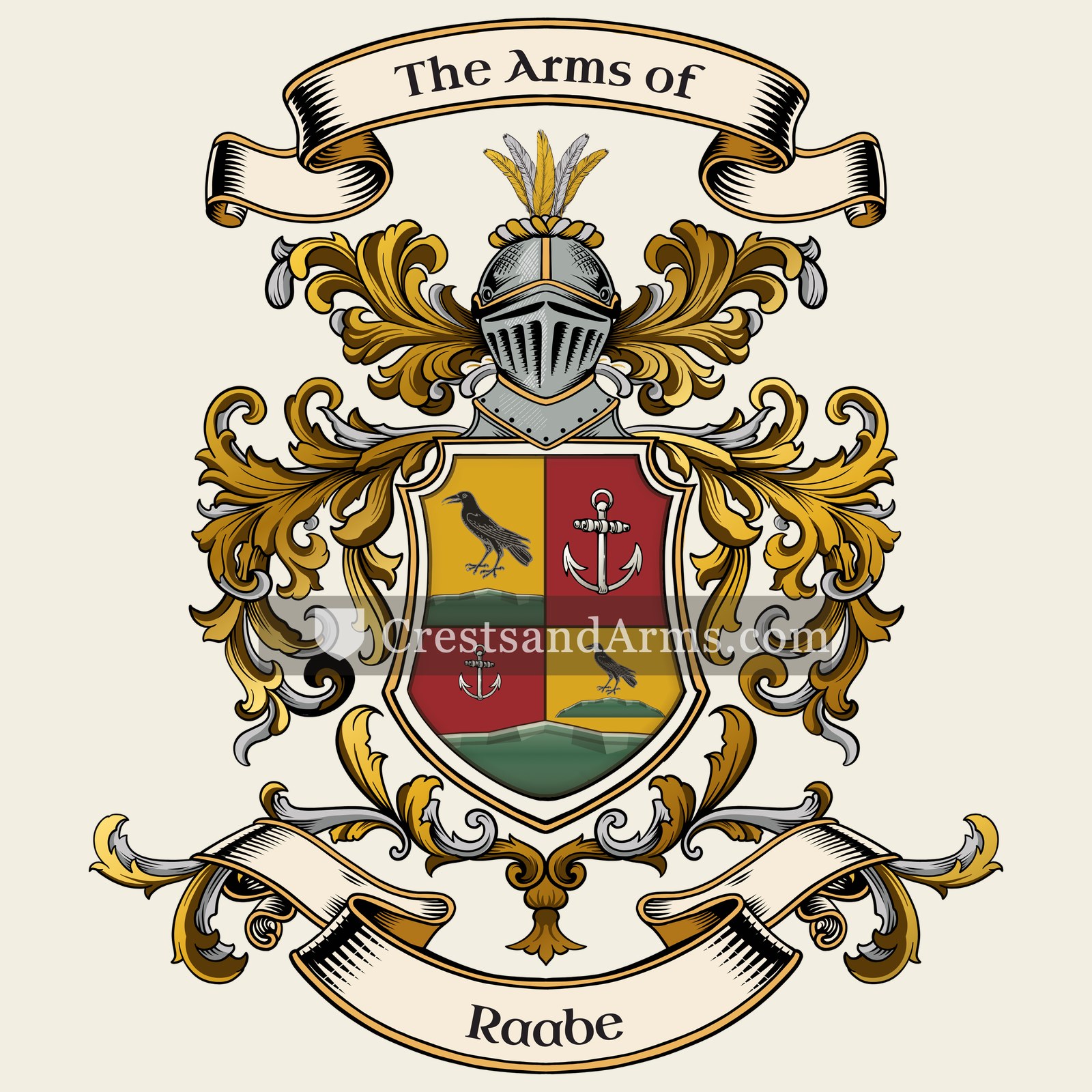
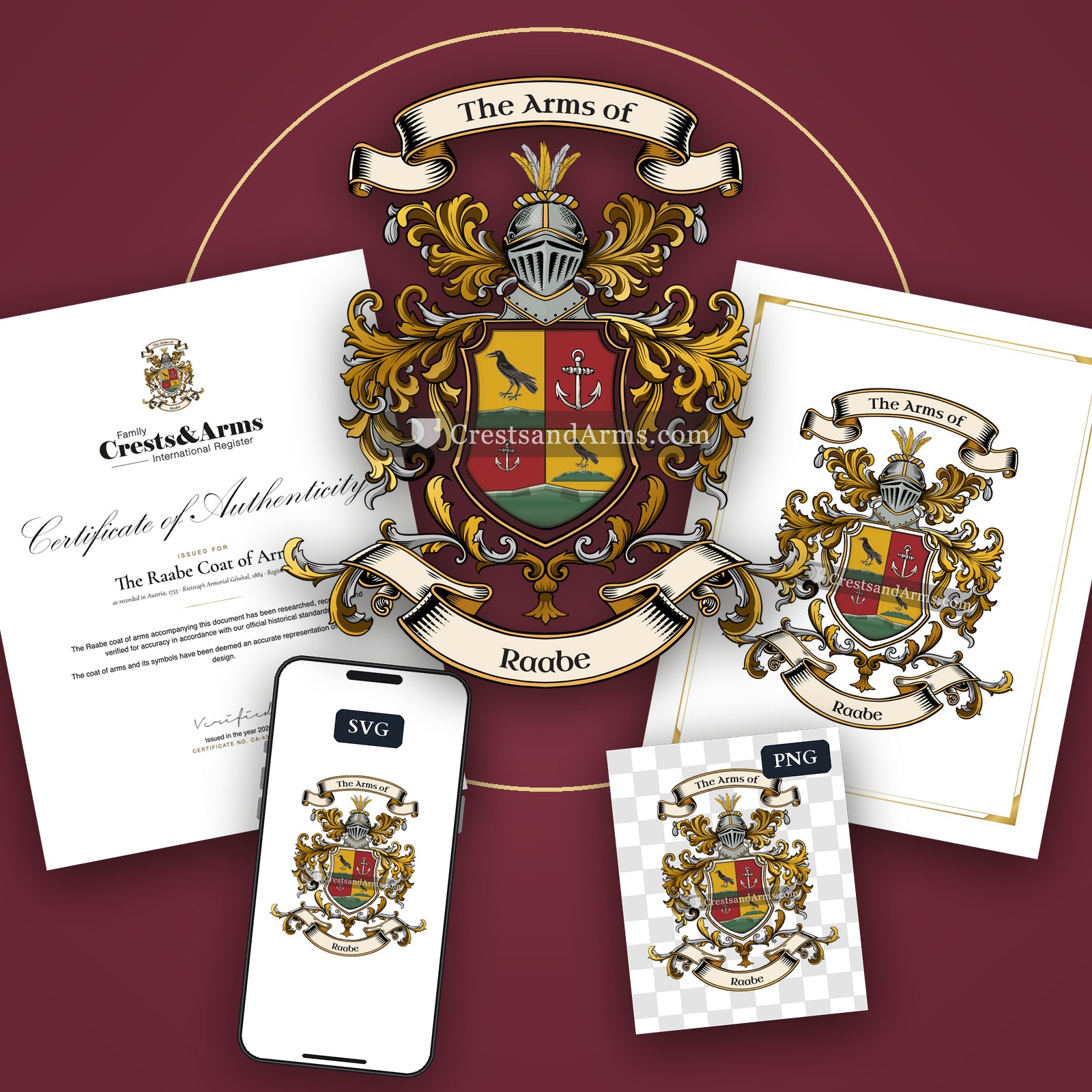
Coat of Arms & Family Crest Details
Symbols on this shield
mountThe ground held, and steadfastness upon it
ravenConstancy and divine providence
anchorHope, and steadfastness in trouble
Colours
Gold (Or)Means: Generosity
Red (Gules)Means: Military strength
Green (Vert)Means: Hope
Black (Sable)Means: Constancy
Silver (Argent)Means: Peace and sincerity
Historical info
Source
J. B. Rietstap, Armorial Général, Gouda: G. B. van Goor Zonen, 1884–87
Blazon (the actual original written record)
“Ec.: aux 1 et 4 d'or à un corbeau de sa., posé sur un tertre de sin.; aux 2 et 3 de gu. à une ancre renv. d'arg. Deux cq. cour. C.: 1° l'ancre renv.; entre un vol, de gu. et de sa.; l. d'or et de sa.; 2° un griffon iss. d'or; l. d'et de gu.”
CarinthiaCarinthia, c. 1755
Digital archive packCoat of arms PNG, gold border print PDF, vector SVG and the certificate of authenticity. Sent to your email in minutes.
Map of Austria showing where the Raabe arms are recorded
The Raabe arms were recorded in Carinthia, c. 1755.
Carinthia was Alpine country in southern Austria with iron and lead in its mountains. Mining and landholding both made money, and families who held either kind of property took arms.
This is where the arms were entered in the register. Families often moved to other parts of the country, so the same name can turn up in more than one region.
Region
Carinthia
First recorded
1755
Granting Authority for the Raabe Arms
Imperial and Royal chancery
Sodacan · CC BY-SA 3.0
The body that granted and recorded arms in Austria in this period.
Francis I, Holy Roman Emperor
Sovereign of the period
Francis I, Holy Roman Emperor
1745–1765
Reigning in Sweden when the Raabe arms are first recorded.
How Arms Worked in Austria
Austrian coats of arms were often linked directly to noble titles granted by the Emperor. These symbols belonged to the entire family line rather than just one individual. When a family grew, new branches kept the original design without needing to change it. This system allowed all members of a noble house to share the same identity across many generations.
Granting authority
The Imperial and Royal chancery managed all heraldic matters and controlled the official granting of arms throughout the Austrian lands.
How they got arms
Families typically received their arms through a formal imperial decree that often accompanied the elevation of a person to noble status.
Where arms were recorded
Official records of these grants were kept in the Imperial Register of Nobility which began its formal documentation process in 1453.
The family's standing
Recorded among the armigerous families of Carinthia.
Origin & History of the Raabe Family in Austria
The surname Raabe is a German name that translates literally to raven, and it likely began as a descriptive nickname for a person with dark hair or a sharp, observant personality. By the mid-eighteenth century, the family had established a clear presence in the mountainous region of Carinthia, Austria. During this period, the lives of families in Carinthia were deeply tied to the local agricultural economy and the strict social structures of the Habsburg Empire. Records from 1755 indicate that members of the Raabe family were integrated into these rural communities, where they likely worked as farmers, craftsmen, or tradespeople. As the family navigated the challenges of life in the Eastern Alps, they contributed to the cultural and economic fabric of the region. Their history reflects the broader movement of German-speaking populations across Central Europe during the eighteenth century as they sought stability and community in the Austrian provinces.
Raabe Meaning & Related Branches
Root word
Rabe
A Middle Low German term for the bird known as a raven.
This name
RaabeAn occupational or descriptive surname referring to a person resembling a raven.
also spelled
Rabb
Raabe
Rabe
Rab
Documented Sources
J. B. Rietstap, Armorial Général, Gouda: G. B. van Goor Zonen, 1884–87
Stockholm City Archives (Stockholms stadsarkiv), Mantalslängder för Stockholms stad
National Archives of Sweden (Riksarkivet), Inrikespass och personregister
Elgenstierna, Gustaf, Den introducerade svenska adelns ättartavlor, 1925–1936
Sveriges Släktforskarförbund, Svenska släktkalendern, 1912–present
Digital archive packCoat of arms PNG, gold border print PDF, vector SVG and the certificate of authenticity. Sent to your email in minutes.


 ravenConstancy and divine providence
 mulletThe third son, and a divine quality from above
 ravenConstancy and divine providence
 mulletThe third son, and a divine quality from above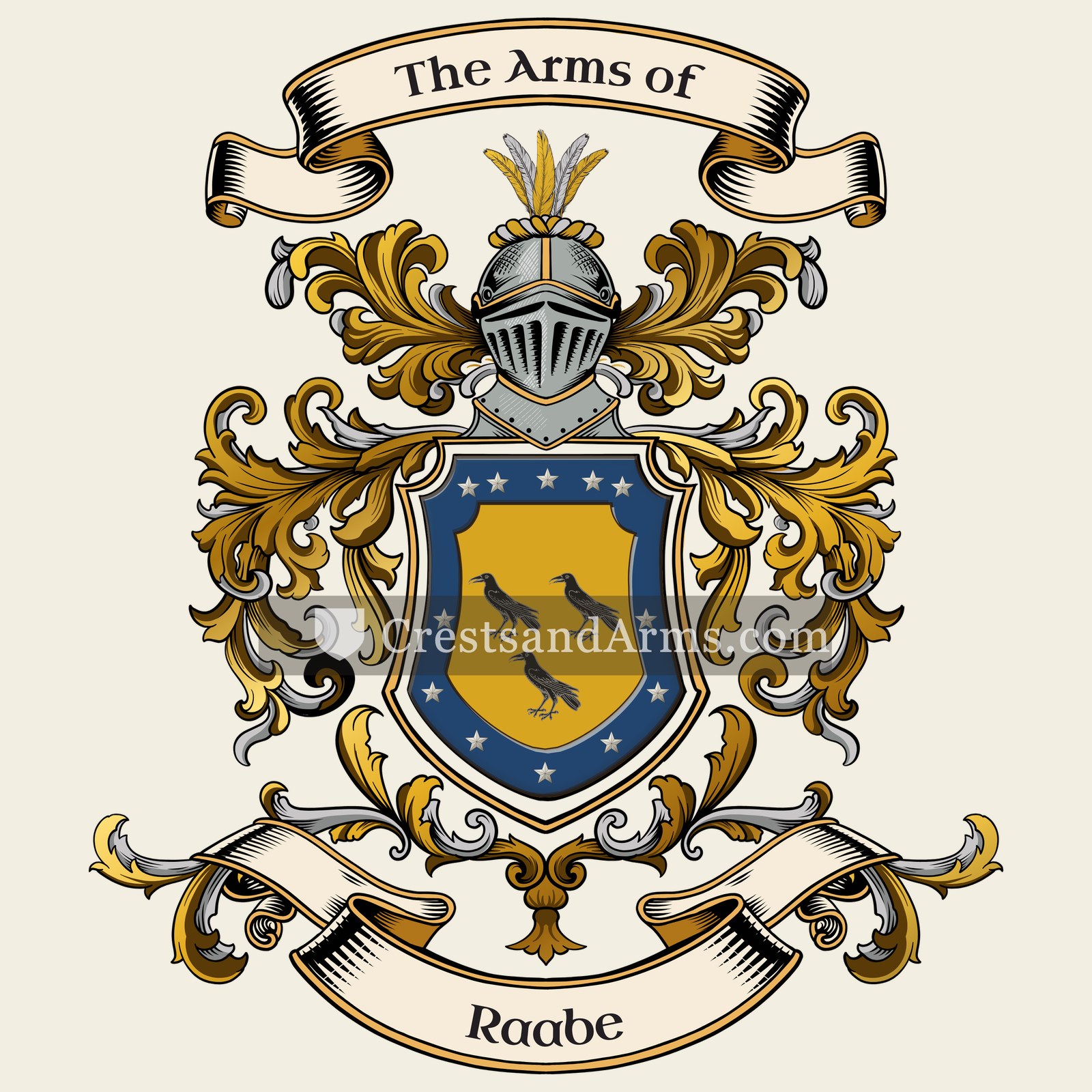


 mountThe ground held, and steadfastness upon it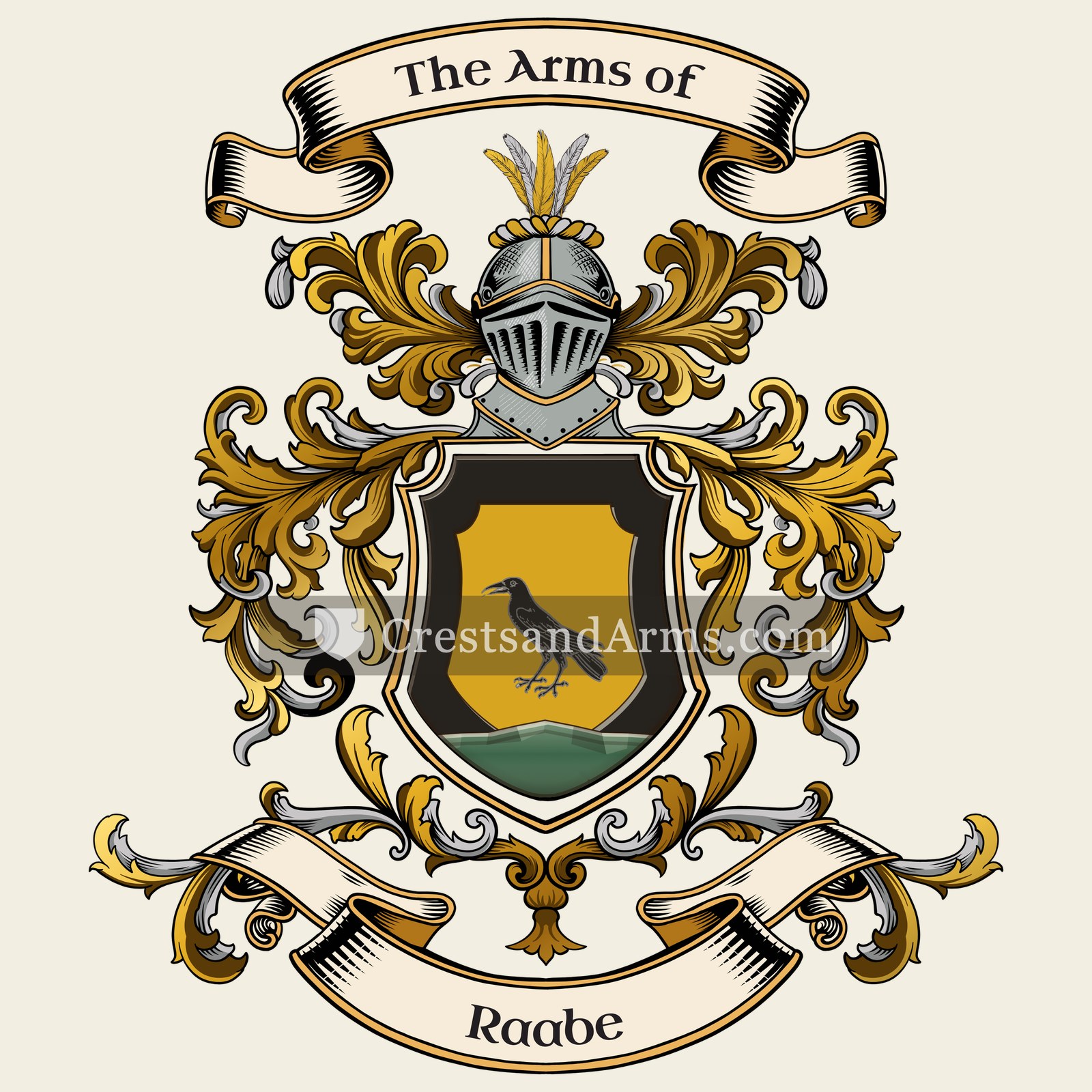


 anchorHope, and steadfastness in trouble