A record of documented arms, meaning and origin, researched for the Rabb family lines. Documented in 3 countries.
Reg. 3885 · Swedish, P–S
Meaning of the Rabb family crest colors & symbols
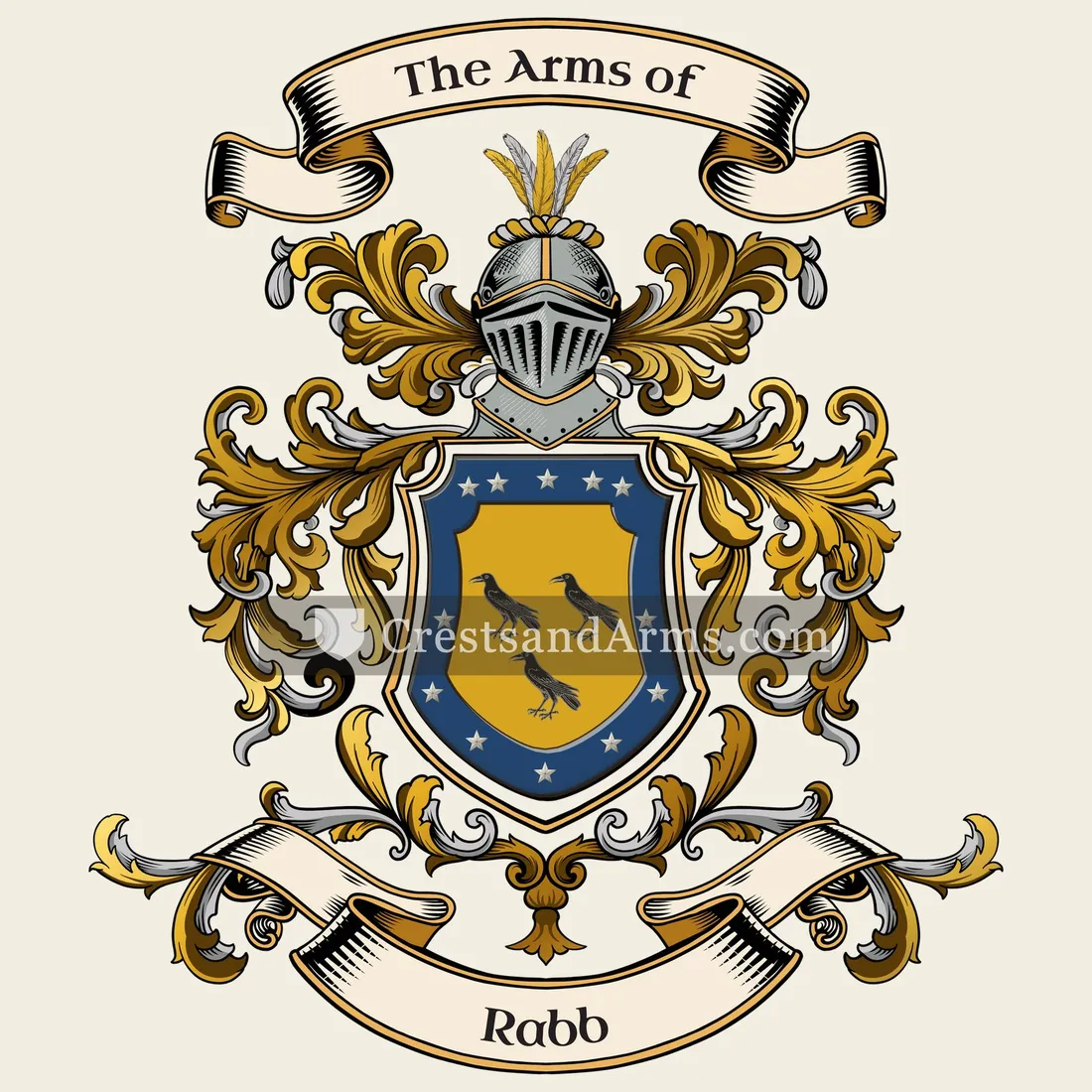
Symbols on this shield
ravenConstancy and divine providence
mulletThe third son, and a divine quality from above
Colours
Gold (Or)Means: Generosity
Blue (Azure)Means: Loyalty and truth
Black (Sable)Means: Constancy
Silver (Argent)Means: Peace and sincerity
Historical info
Source
J. B. Rietstap, Armorial Général, Gouda: G. B. van Goor Zonen, 1884–87
Blazon (the actual original written record)
“D'or à trois corbeaux de sa.; à la bord. d'azur, ch. de douze étoiles (5) d'arg. Deux cq. cour. C.: 1° un faisceau des licteurs d'azur, en pal, entre deux pl. d'aut. d'arg.; et une clé d'or en bande et une ancre d'arg. en barre, passées en saut. et br. sur le faisceau et les plumes; 2° un bras, paré d'azur, la main de carn. tenant un sabre d'arg., garni d'or; entre deux banderoles coupées d'or sur azur, enroulées autour de leurs hampes. S.: à dextre un lion reg. de gu., à sen. un griffon reg. d'azur.”
Swedenc. 1774
Digital archive packCoat of arms PNG, gold border print PDF, vector SVG and the certificate of authenticity. Sent to your email in minutes.
Map of Sweden showing where the Rabb arms are recorded
The Rabb arms were recorded in Sweden, c. 1774.
Arms such as these were typically recorded in Stockholm.
Stockholm held the Swedish court and the House of Nobility, where every noble family's arms were entered and kept. Families ennobled for service registered there, which is why so many are recorded around the city.
This is where the arms were entered in the register. Families often moved to other parts of the country, so the same name can turn up in more than one region.
The body that granted and recorded arms in Sweden in this period.
Gustav III of Sweden
Sovereign of the period
Gustav III of Sweden
1771–1792
Reigning in Sweden when the Rabb arms are first recorded.
How Arms Worked in Sweden
In Sweden, a coat of arms belonged to a noble family as a whole rather than just one individual. These arms were passed down through the generations to all legitimate descendants. Younger branches of the family used the same shield without needing to change it. This system ensured that the entire lineage shared the same identity and status under the law.
Granting authority
The Riddarhuset, or House of Nobility, regulated all noble coats of arms in Sweden under royal authority.
How they got arms
Families received their coats of arms through royal grants of nobility which were then officially registered with the House.
Where arms were recorded
Coats of arms were officially recorded in the Swedish House of Nobility register starting in the year 1626.
The family's standing
Recorded among the armigerous families of Sweden.
Origin & History of the Rabb Family in Sweden
The surname Rabb has a distinct presence in Swedish history, particularly within the urban landscape of Stockholm during the late eighteenth century. By 1774, records confirm that members of the family were already established in the capital, a time when Stockholm was a bustling center of trade and craftsmanship. In the Swedish naming tradition of that era, surnames were often adopted by individuals to distinguish themselves within the growing city population or to reflect their specific professional roles. The name itself carries a sharp, concise quality that was common among families seeking to establish a clear identity in official registers. As these early ancestors navigated the social and economic shifts of the Swedish Enlightenment, they became part of the fabric of city life, leaving behind traces in tax rolls and parish records that document their residency and daily contributions to the community.
Meaning of the Rabb family crest colors & symbols
Symbols on this shield
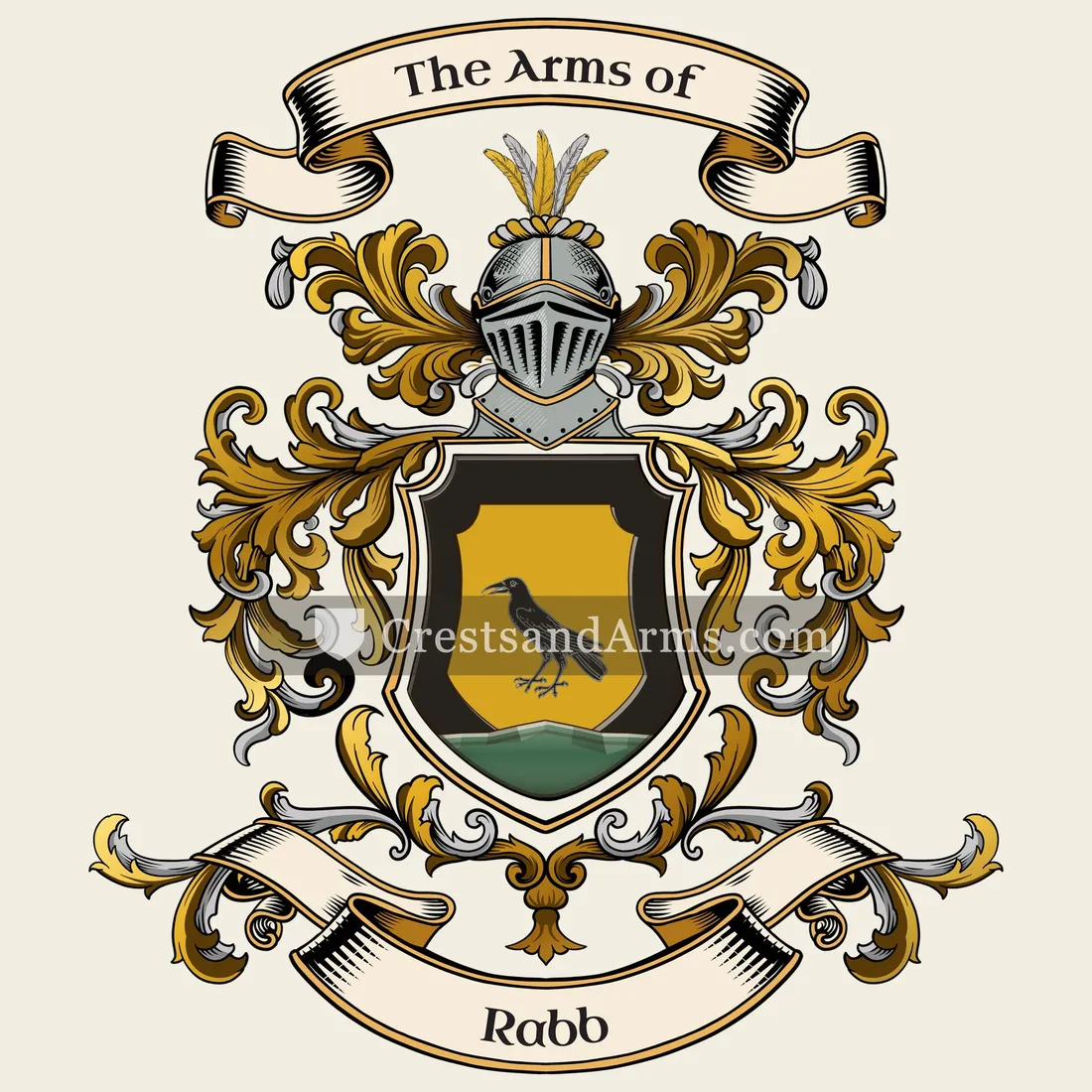
mountThe ground held, and steadfastness upon it
ravenConstancy and divine providence
Colours
Gold (Or)Means: Generosity
Black (Sable)Means: Constancy
Green (Vert)Means: Hope
Historical info
Source
J. B. Rietstap, Armorial Général, Gouda: G. B. van Goor Zonen, 1884–87
Blazon (the actual original written record)
“D'or à un corbeau cont. de sa., cour. d'or, posé sur un tertre de sin.; l'écu bordé d'or. C.: le corbeau. L. d'arg. et de sa.”
Germanyc. 1703
Digital archive packCoat of arms PNG, gold border print PDF, vector SVG and the certificate of authenticity. Sent to your email in minutes.
Map of Germany showing where the Rabb arms are recorded
The Rabb arms were recorded in Germany, c. 1703.
Arms such as these were typically recorded in Bavaria.
Bavaria was a country of old landed families and walled market towns. Estates passed down the same line for centuries, and both the landowners and the leading townsmen kept arms, which is why so many Bavarian names sit in the registers.
This is where the arms were entered in the register. Families often moved to other parts of the country, so the same name can turn up in more than one region.
The body that granted and recorded arms in Germany in this period.
Leopold I, Holy Roman Emperor
Sovereign of the period
Leopold I, Holy Roman Emperor
1658–1705
Reigning in Sweden when the Rabb arms are first recorded.
How Arms Worked in Germany
In the Holy Roman Empire, coats of arms were often granted to individuals by the Emperor or his representatives. These arms were then passed down through the generations to all legitimate descendants of the original holder. Younger branches of a family usually kept the same shield design without needing to change it, as the arms belonged to the entire lineage.
Granting authority
The Holy Roman Emperor held the sole power to grant new coats of arms throughout his vast imperial territories.
How they got arms
Families typically obtained their coats of arms through a formal imperial grant or by proving their noble status to the authorities.
Where arms were recorded
These grants were officially recorded in the Imperial Chancery registers, which began keeping formal records of such honors during the Middle Ages.
The family's standing
Recorded among the armigerous families of Germany.
Origin & History of the Rabb Family in Germany
The surname Rabb is deeply rooted in the historical landscape of southern Germany, particularly within the region of Bavaria. By the early 18th century, the name was already well-established in local communities, as evidenced by records confirming family members were living in the area by 1703. The name itself is likely derived from the Middle High German word for a rabbit, which was often used as a descriptive nickname for a person who was known for being quick or agile. During this period, families in Bavaria were closely tied to the land and the local parish system, which tracked births, marriages, and deaths in church registers. As the family grew, they became part of the social fabric of rural German life, contributing to the agricultural and trade-based economy that defined the region before the industrial era. This connection to the Bavarian landscape suggests that the early ancestors of the Rabb family were likely farmers or craftsmen who lived in small villages where their name became a permanent part of the local identity.
Meaning of the Rabb family crest colors & symbols
Symbols on this shield
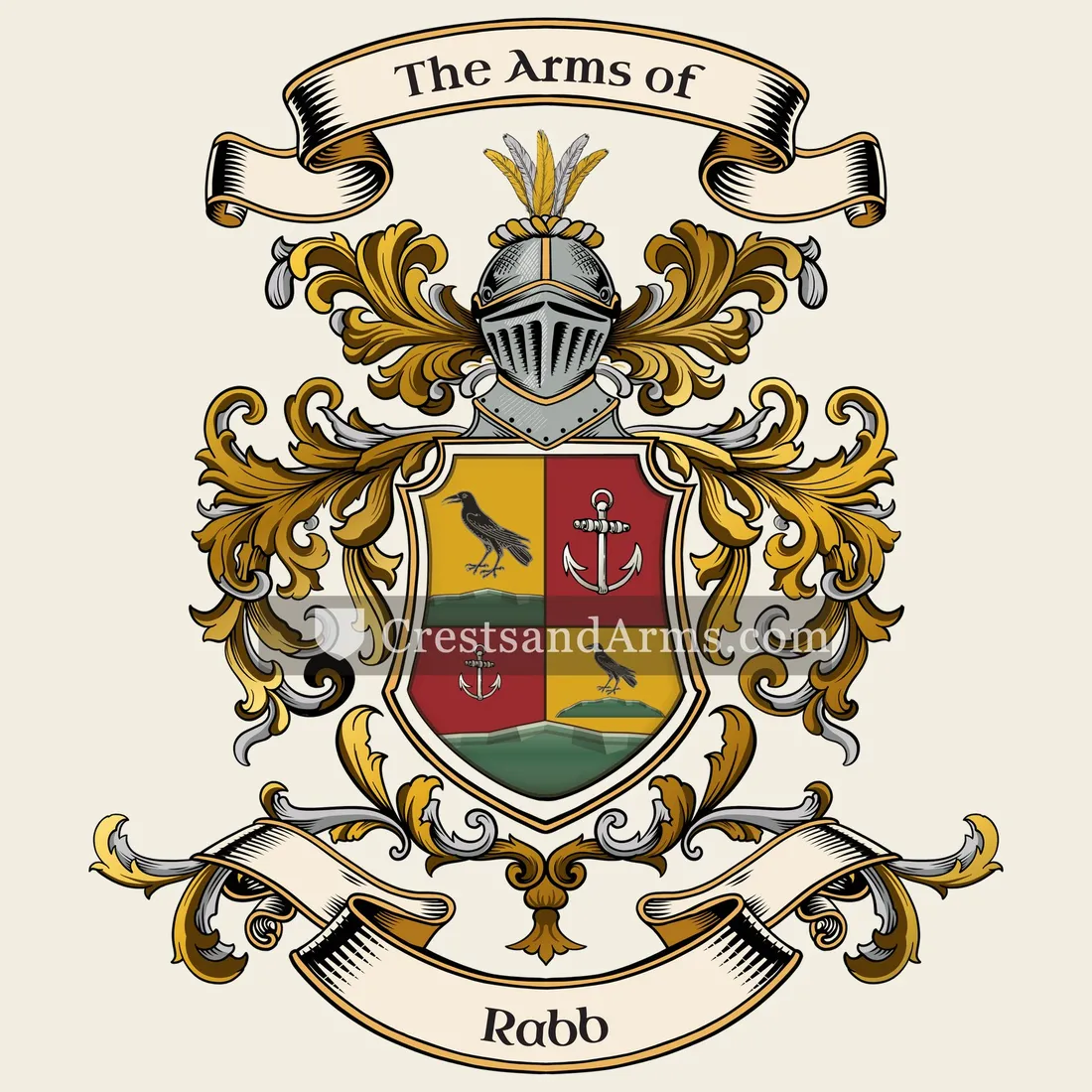
mountThe ground held, and steadfastness upon it
ravenConstancy and divine providence
anchorHope, and steadfastness in trouble
Colours
Gold (Or)Means: Generosity
Red (Gules)Means: Military strength
Green (Vert)Means: Hope
Black (Sable)Means: Constancy
Silver (Argent)Means: Peace and sincerity
Historical info
Source
J. B. Rietstap, Armorial Général, Gouda: G. B. van Goor Zonen, 1884–87
Blazon (the actual original written record)
“Ec.: aux 1 et 4 d'or à un corbeau de sa., posé sur un tertre de sin.; aux 2 et 3 de gu. à une ancre renv. d'arg. Deux cq. cour. C.: 1° l'ancre renv.; entre un vol, de gu. et de sa.; l. d'or et de sa.; 2° un griffon iss. d'or; l. d'et de gu.”
CarinthiaCarinthia, c. 1755
Digital archive packCoat of arms PNG, gold border print PDF, vector SVG and the certificate of authenticity. Sent to your email in minutes.
Map of Austria showing where the Rabb arms are recorded
The Rabb arms were recorded in Carinthia, c. 1755.
Carinthia was Alpine country in southern Austria with iron and lead in its mountains. Mining and landholding both made money, and families who held either kind of property took arms.
This is where the arms were entered in the register. Families often moved to other parts of the country, so the same name can turn up in more than one region.
Region
Carinthia
First recorded
1755
Granting Authority for the Rabb Arms
Imperial and Royal chancery
Sodacan · CC BY-SA 3.0
The body that granted and recorded arms in Austria in this period.
Francis I, Holy Roman Emperor
Sovereign of the period
Francis I, Holy Roman Emperor
1745–1765
Reigning in Sweden when the Rabb arms are first recorded.
How Arms Worked in Austria
Austrian coats of arms were often linked directly to noble titles granted by the Emperor. These symbols belonged to the entire family line rather than just one individual. When a family grew, new branches kept the original design without needing to change it. This system allowed all members of a noble house to share the same identity across many generations.
Granting authority
The Imperial and Royal chancery managed all heraldic matters and controlled the official granting of arms throughout the Austrian lands.
How they got arms
Families typically received their arms through a formal imperial decree that often accompanied the elevation of a person to noble status.
Where arms were recorded
Official records of these grants were kept in the Imperial Register of Nobility which began its formal documentation process in 1453.
The family's standing
Recorded among the armigerous families of Carinthia.
Origin & History of the Rabb Family in Austria
The family name Rabb has deep roots in the mountainous landscape of Carinthia, where records confirm the family was established by at least 1755. During this period, the region was part of the Habsburg Monarchy, and families often lived in small, tight-knit rural communities centered around agriculture and local trade. The name itself is likely derived from the Middle High German word for a rabbit, which was often used as a descriptive nickname for a person who was quick, agile, or perhaps lived near a place where these animals were common. In the mid-eighteenth century, life for the Rabb family in Carinthia would have been defined by the rhythms of the seasons and the strict social structures of the Austrian Empire. As the family grew, they became part of the local fabric of the province, contributing to the development of the region through their labor and community involvement. While they were not part of the nobility, their presence in the official parish and tax records of the time shows they were stable, recognized members of their village society.
Rabb Meaning & Related Branches
Root word
Rabb
Derived from the Middle Low German word for a turnip.
This name
RabbAn occupational surname originally used to describe a grower or seller of turnips.
also spelled
Rabb
Raabe
Rabe
Rab
Documented Sources
J. B. Rietstap, Armorial Général, Gouda: G. B. van Goor Zonen, 1884–87
Stockholms stadsarkiv, Överståthållarämbetet för uppbördsärenden, Mantalslängder 1774
Riksarkivet, Kyrkoarkiv, Födelse- och dopböcker för Stockholms församlingar
Digital archive packCoat of arms PNG, gold border print PDF, vector SVG and the certificate of authenticity. Sent to your email in minutes.


 ravenConstancy and divine providence
 mulletThe third son, and a divine quality from above
 ravenConstancy and divine providence
 mulletThe third son, and a divine quality from above


 mountThe ground held, and steadfastness upon it


 anchorHope, and steadfastness in trouble