A record of documented arms, meaning and origin, researched for the Racca family lines. Documented in 3 countries.
Reg. 6545 · French, P–S
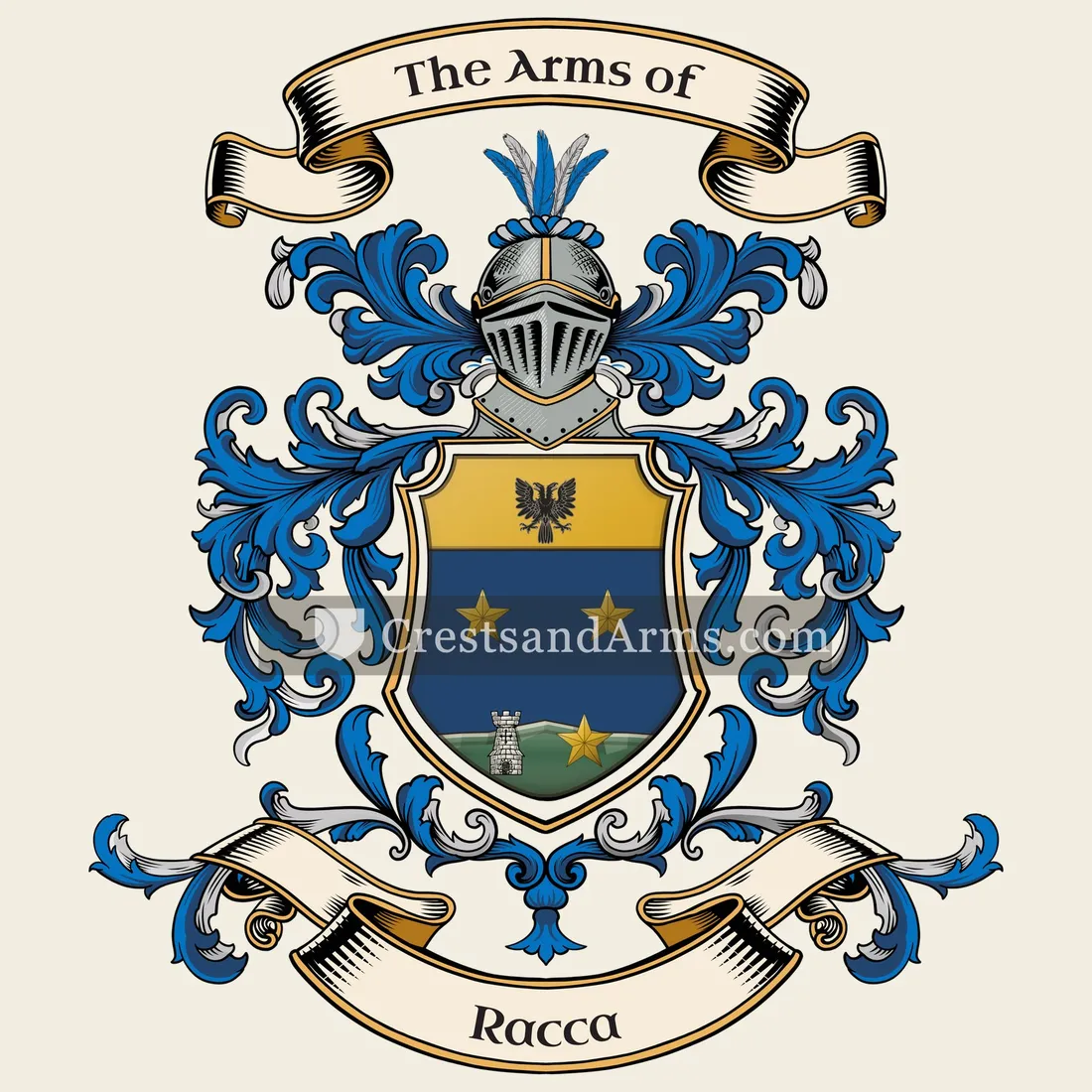
Meaning of the Racca family crest colors & symbols
Symbols on this shield
mountThe ground held, and steadfastness upon it
chiefAuthority, wisdom and dominion
towerGrandeur and solidity, and a stronghold defended
mulletThe third son, and a divine quality from above
eagleNobility, strength and a keen mind
Colours
Blue (Azure)Means: Loyalty and truth
Gold (Or)Means: Generosity
Green (Vert)Means: Hope
Silver (Argent)Means: Peace and sincerity
Black (Sable)Means: Constancy
Historical info
Source
J. B. Rietstap, Armorial Général, Gouda: G. B. van Goor Zonen, 1884–87
Blazon (the actual original written record)
“D'azur à une tour d'arg., aj. de sa., soutenue d'une terrasse de sin., et acc. de trois étoiles d'or, 1 en chef et 2 en flancs; au chef d'or, ch. d'une aigle de sa., cour. d'or.”
BourgogneBourgogne, c. 1663
Digital archive packCoat of arms PNG, gold border print PDF, vector SVG and the certificate of authenticity. Sent to your email in minutes.
Map of France showing where the Racca arms are recorded
The Racca arms were recorded in Bourgogne, c. 1663.
Bourgogne was one of the richest parts of France, built on wine, wool and the roads that carried both. Wealth of that kind bought land, and land brought arms, so the region filled with armed families earlier than most of the country.
This is where the arms were entered in the register. Families often moved to other parts of the country, so the same name can turn up in more than one region.
The body that granted and recorded arms in France in this period.
Louis XIV of France
Sovereign of the period
Louis XIV of France
1643–1715
Reigning in France when the Racca arms are first recorded.
How Arms Worked in France
In France, a coat of arms was a mark of honor that passed down through the male line to all legitimate descendants. Families often used the same shield without changes to show their shared heritage. If a branch wanted to stand out, they could add a small mark to their shield to show their specific place in the family tree.
Granting authority
The Juge d'armes de France acted as the official authority that regulated and verified coats of arms across the country.
How they got arms
Families typically inherited their arms from ancestors, though they could also receive them through royal grants or by proving their noble status.
Where arms were recorded
Coats of arms were officially recorded in the Armorial Général de France, which began its main collection in the year 1696.
The family's standing
Recorded among the armigerous families of Bourgogne.
Origin & History of the Racca Family in France
The family name Racca has deep roots in the historical region of Bourgogne, where records confirm members of the family were established by 1663. During this period, the social structure of France was heavily influenced by the agricultural and viticultural traditions of the Burgundy area. Families like the Raccas were often tied to the land, serving as local landowners or skilled tradespeople who helped sustain the regional economy. As the name appears in parish registers and local administrative documents from the seventeenth century, it suggests that the family was well-integrated into the village life of the time. These early ancestors likely navigated the complex shifts of the French monarchy and the evolving local laws that governed rural life. By maintaining a consistent presence in the region, the family became a part of the long-standing cultural fabric that defines the history of eastern France.
Meaning of the Racca family crest colors & symbols
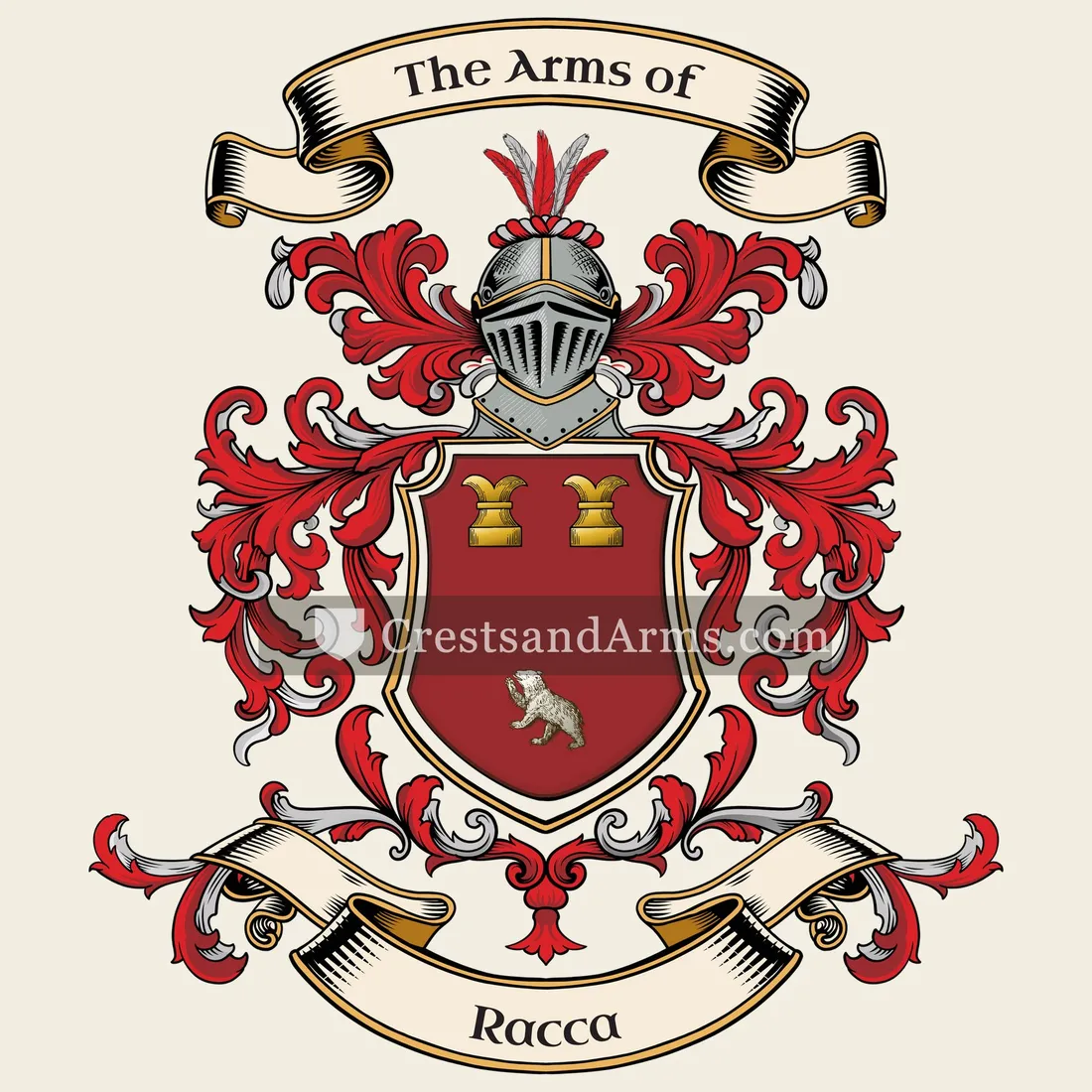
Symbols on this shield
chess rookStrategy, and the defence of a position
bearStrength, cunning and protection of kin
Colours
Red (Gules)Means: Military strength
Gold (Or)Means: Generosity
Silver (Argent)Means: Peace and sincerity
Historical info
Source
J. B. Rietstap, Armorial Général, Gouda: G. B. van Goor Zonen, 1884–87
Blazon (the actual original written record)
“De gu. à deux rocs d'échiquier d'or en chef et une tête d'ours d'arg., emmuselée de sa., en p.”
PiedmontPiedmont, c. 1775
Digital archive packCoat of arms PNG, gold border print PDF, vector SVG and the certificate of authenticity. Sent to your email in minutes.
Map of Italy showing where the Racca arms are recorded
The Racca arms were recorded in Piedmont, c. 1775.
Piedmont was Alpine and river country in north-western Italy, ruled from Turin. Its noble houses were listed formally by the state, and a name on that list carried arms as a matter of record.
This is where the arms were entered in the register. Families often moved to other parts of the country, so the same name can turn up in more than one region.
The body that granted and recorded arms in Italy in this period.
Alvise Giovanni Mocenigo
Sovereign of the period
Alvise Giovanni Mocenigo
1763–1778
Reigning in France when the Racca arms are first recorded.
How Arms Worked in Italy
In the Italian states, coats of arms were often used by noble families to show their status and history. These symbols were passed down through the generations to all legitimate male descendants. Younger branches of a family usually kept the original design but sometimes added small changes to distinguish their specific line from the main branch.
Granting authority
Various local rulers and city governments controlled the use of coats of arms across the different Italian states.
How they got arms
Families often assumed their own arms or received them as official grants from local lords, popes, or city councils.
Where arms were recorded
Arms were recorded in local city archives or private family books rather than in one single national register.
The family's standing
Recorded among the armigerous families of Piedmont.
Origin & History of the Racca Family in Italy
The family name Racca has deep roots in the Piedmont region of northern Italy, where it has been documented since at least the late 18th century. The name likely originated as a descriptive term or a local nickname used to identify families living in the rural areas near the foothills of the Alps. During the 1700s, the people of Piedmont were heavily involved in agriculture and the growing silk trade, which shaped the daily lives of families like the Raccas. As the region transitioned through various political changes and shifts in land ownership, the family remained firmly established within their local communities. By 1775, records confirm that the name was already well-integrated into the social fabric of the area, reflecting a long history of stability and local connection to the land. This period marked a time when families were increasingly recorded in parish registers and civil documents, allowing us to trace the presence of the Racca name back through generations of Piedmontese history.
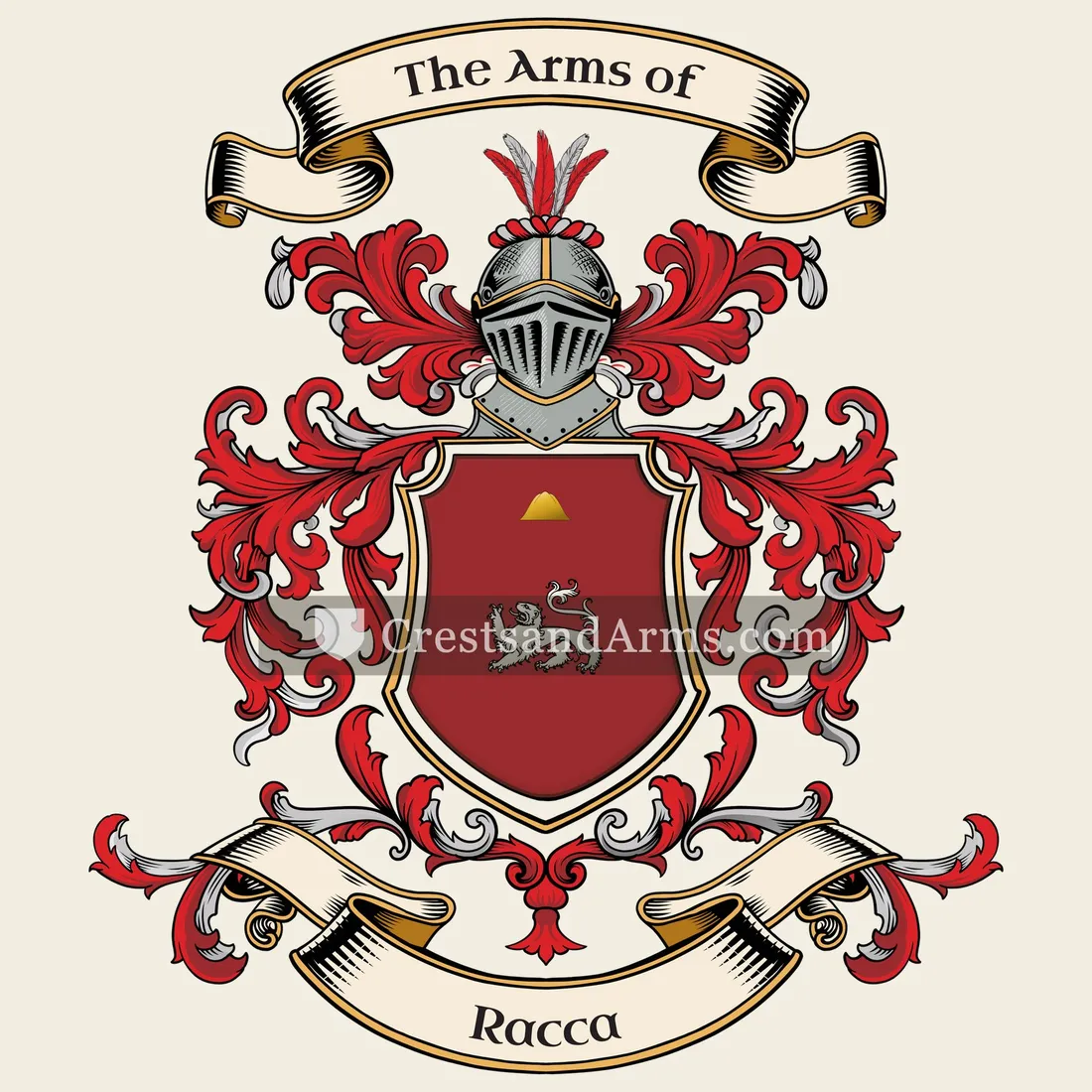
Meaning of the Racca family crest colors & symbols
Symbols on this shield
mountThe ground held, and steadfastness upon it
lionCourage, strength and royalty
Colours
Red (Gules)Means: Military strength
Silver (Argent)Means: Peace and sincerity
Gold (Or)Means: Generosity
Historical info
Source
J. B. Rietstap, Armorial Général, Gouda: G. B. van Goor Zonen, 1884–87
Blazon (the actual original written record)
“De gu. au lion d'arg., ramp. contre un rocher d'or, mouv. du flanc dextre.”
SwitzerlandGenève, c. 1745
Digital archive packCoat of arms PNG, gold border print PDF, vector SVG and the certificate of authenticity. Sent to your email in minutes.
Map of Switzerland showing where the Racca arms are recorded
The Racca arms were recorded in Genève, c. 1745.
This is where the arms were entered in the register. Families often moved to other parts of the country, so the same name can turn up in more than one region.
The body that granted and recorded arms in Switzerland in this period.
How Arms Worked in Switzerland
In Switzerland, coats of arms were not restricted to the nobility and were often adopted by common citizens and families. These symbols were passed down through generations to show family identity. When branches of a family grew, they often changed small details of the design to distinguish their own line from the original group.
Granting authority
Cantonal and civic authorities managed the use of coats of arms within their specific regions and local jurisdictions.
How they got arms
Families typically assumed their own coats of arms based on local custom rather than receiving them from a central monarch.
Where arms were recorded
Arms were recorded in various cantonal and civic registers starting from the fourteenth century throughout the Swiss region.
The family's standing
Recorded among the armigerous families of Switzerland.
Origin & History of the Racca Family in Switzerland
The history of the Racca family in Switzerland is deeply rooted in the cultural and social landscape of Geneva during the eighteenth century. By 1745, records confirm that members of the family were already established residents within the city, a time when Geneva was a thriving center for trade, watchmaking, and intellectual exchange. The name itself likely originated from regional dialects in the borderlands between Switzerland, France, and Italy, reflecting the fluid movement of people across the Alps. Families like the Raccas often integrated into the local bourgeoisie, participating in the civic life of the Republic of Geneva while maintaining connections to the broader European merchant networks. Their presence in the city during this era suggests they were part of the steady migration of skilled individuals who sought stability and opportunity in the Swiss cantons. Over time, the family became a quiet but persistent thread in the urban tapestry of Geneva, contributing to the development of the city as it transitioned into the modern age.
Racca Meaning & Related Branches
Root word
Rach
A Germanic root meaning counsel or advice.
This name
RaccaDerived from a nickname for a person who is considered wise or advisory.
also spelled
Roca
Roka
Rock
Documented Sources
J. B. Rietstap, Armorial Général, Gouda: G. B. van Goor Zonen, 1884–87
Archives départementales de la Côte-d'Or, Registres paroissiaux et d'état civil, Series E
Bouchard, Gérard, Quelques aspects de la démographie historique en Bourgogne, 1974
Richard, Jean, Histoire de la Bourgogne, 1988
Digital archive packCoat of arms PNG, gold border print PDF, vector SVG and the certificate of authenticity. Sent to your email in minutes.


 mountThe ground held, and steadfastness upon it
 chiefAuthority, wisdom and dominion
 towerGrandeur and solidity, and a stronghold defended
 mulletThe third son, and a divine quality from above
 eagleNobility, strength and a keen mind
 mountThe ground held, and steadfastness upon it
 chiefAuthority, wisdom and dominion
 towerGrandeur and solidity, and a stronghold defended
 mulletThe third son, and a divine quality from above
 eagleNobility, strength and a keen mind


 chess rookStrategy, and the defence of a position
 bearStrength, cunning and protection of kin


 lionCourage, strength and royalty