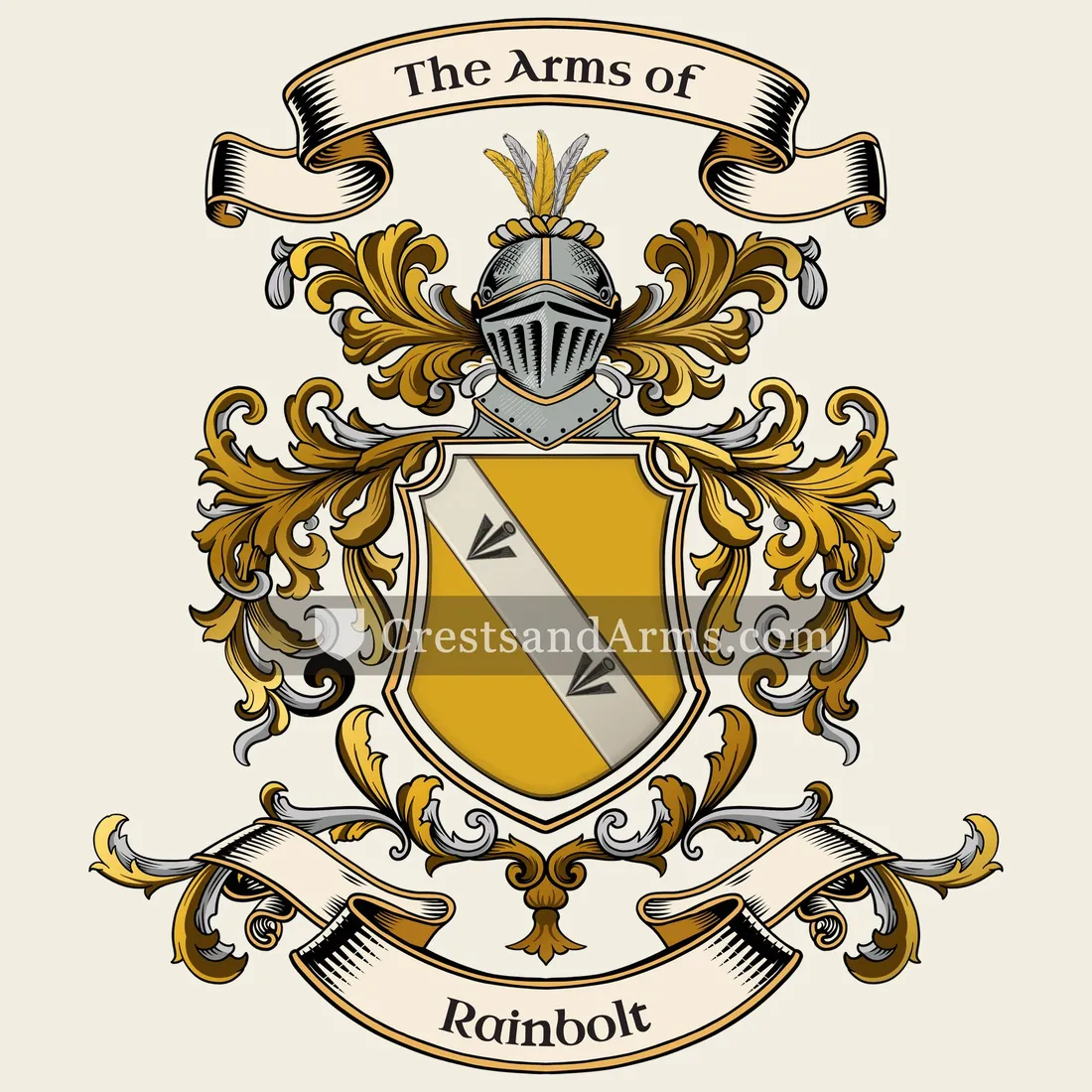
A record of documented arms, meaning and origin, researched for the Rainbolt family of Germany.
Reg. 5979 · German, P–S
Meaning of the Rainbolt family crest colors & symbols
Symbols on this shield
bendDefence, and the scarf of a commander
arrowReadiness for battle, and affliction endured
Colours
Gold (Or)Means: Generosity
Silver (Argent)Means: Peace and sincerity
Black (Sable)Means: Constancy
Historical info
Source
J. B. Rietstap, Armorial Général, Gouda: G. B. van Goor Zonen, 1884–87
Blazon (the actual original written record)
“D'or à une bande d'arg. bordée-ondée d'azur, ch. de deux flèches de sa., empennées de gu., passées en saut. C.: un faisceau de trois flèches de sa., empennées de gu., liées d'un ruban d'azur. L.: à dextre d'or et d'azur, à sen. d'arg. et de sa.”
GermanyHan, c. 1793
Digital archive packCoat of arms PNG, gold border print PDF, vector SVG and the certificate of authenticity. Sent to your email in minutes.
Map of Germany showing where the Rainbolt arms are recorded
The Rainbolt arms were recorded in Han, c. 1793.
This is where the arms were entered in the register. Families often moved to other parts of the country, so the same name can turn up in more than one region.
The body that granted and recorded arms in Germany in this period.
Francis II, Holy Roman Emperor
Sovereign of the period
Francis II, Holy Roman Emperor
1792–1806
Reigning in Germany when the Rainbolt arms are first recorded.
How Arms Worked in Germany
In the Holy Roman Empire, coats of arms were often granted to individuals by the Emperor or his representatives. These arms were then passed down through the generations to all legitimate descendants of the original holder. Younger branches of a family usually kept the same shield design without needing to change it, as the arms belonged to the entire lineage.
Granting authority
The Holy Roman Emperor held the sole power to grant new coats of arms throughout his vast imperial territories.
How they got arms
Families typically obtained their coats of arms through a formal imperial grant or by proving their noble status to the authorities.
Where arms were recorded
These grants were officially recorded in the Imperial Chancery registers, which began keeping formal records of such honors during the Middle Ages.
The family's standing
Recorded among the armigerous families of Germany.
Origin & History of the Rainbolt Family in Germany
The Rainbolt family name is believed to have Germanic roots, likely evolving from the name Reinbold, which combines elements meaning "counsel" and "bold." By the late 18th century, the family had established a presence in the region of Han, Germany, as evidenced by records dating back to 1793. During this period, families in the Han area were often deeply connected to the local agricultural economy and the social structures of the Holy Roman Empire. As the 19th century approached, many individuals with this surname began to migrate, seeking new opportunities in different parts of Europe and eventually across the Atlantic. This movement was often driven by the desire for land ownership and the pursuit of greater economic stability during a time of significant political change in the German states. The transition from the name Reinbold to the anglicized Rainbolt reflects the common linguistic shifts that occurred as family members integrated into new communities and cultures.
Rainbolt Meaning & Related Branches
Root word
Raginbald
Derived from Germanic elements meaning counsel and bold or brave.
This name
RainboltA surname denoting a person who is bold in counsel or wise and courageous.
also spelled
Reynbold
Reinbolt
Rinbold
Documented Sources
J. B. Rietstap, Armorial Général, Gouda: G. B. van Goor Zonen, 1884–87
Hessisches Staatsarchiv Marburg, Kirchenbuch der evangelischen Kirchengemeinde Han, 1793
Bahlow, Hans, Deutsches Namenlexikon: Familien- und Vornamen nach Ursprung und Sinn erklärt, 1967
Digital archive packCoat of arms PNG, gold border print PDF, vector SVG and the certificate of authenticity. Sent to your email in minutes.


 bendDefence, and the scarf of a commander
 arrowReadiness for battle, and affliction endured
 bendDefence, and the scarf of a commander
 arrowReadiness for battle, and affliction endured