A record of documented arms, meaning and origin, researched for the Raith family lines. Documented in 2 countries.
Reg. 6736 · German, P–S
Meaning of the Raith family crest colors & symbols
Symbols on this shield
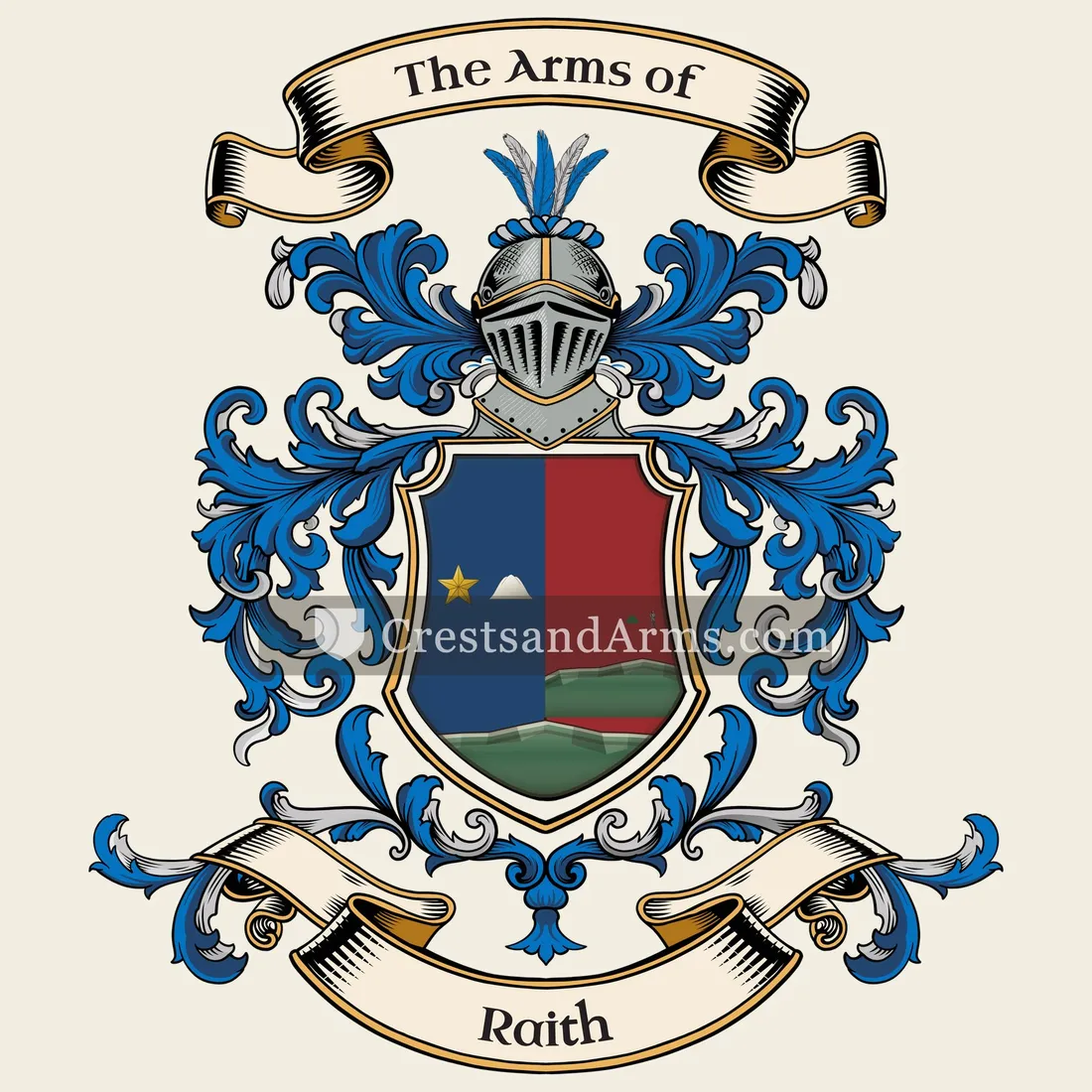
mountThe ground held, and steadfastness upon it
mulletThe third son, and a divine quality from above
knightChivalry and service in arms
Colours
Blue (Azure)Means: Loyalty and truth
Red (Gules)Means: Military strength
Green (Vert)Means: Hope
Gold (Or)Means: Generosity
Historical info
Source
J. B. Rietstap, Armorial Général, Gouda: G. B. van Goor Zonen, 1884–87
Blazon (the actual original written record)
“Parti: au 1 d'azur semé d'étoiles d'or; à un rocher escarpé au nat., mouv. du bas et sommé d'une colombe cont. d'arg., tenant en son bec une étoile du sec.; au 2 de gu. à un homme cuirassé, posé de trois quarts, sur une terrasse de sin., la tête coiffée d'une toque panachée; tenant de sa main dextre levée un stylus d'or et de sa sen. une tablette du même, appuyée contre sa poitrine. C.: l'homme du 2, iss., entre un vol coupé, à dextre d'arg. sur gu., à sen. d'azur sur or. L.: à dextre d'arg. et de gu., à sen. d'or et d'azur.”
GermanyAibling Bav, c. 1727
Digital archive packCoat of arms PNG, gold border print PDF, vector SVG and the certificate of authenticity. Sent to your email in minutes.
Map of Germany showing where the Raith arms are recorded
The Raith arms were recorded in Aibling Bav, c. 1727.
This is where the arms were entered in the register. Families often moved to other parts of the country, so the same name can turn up in more than one region.
The body that granted and recorded arms in Germany in this period.
Charles VI, Holy Roman Emperor
Sovereign of the period
Charles VI, Holy Roman Emperor
1711–1740
Reigning in Germany when the Raith arms are first recorded.
How Arms Worked in Germany
In the Holy Roman Empire, coats of arms were often granted to individuals by the Emperor or his representatives. These arms were then passed down through the generations to all legitimate descendants of the original holder. Younger branches of a family usually kept the same shield design without needing to change it, as the arms belonged to the entire lineage.
Granting authority
The Holy Roman Emperor held the sole power to grant new coats of arms throughout his vast imperial territories.
How they got arms
Families typically obtained their coats of arms through a formal imperial grant or by proving their noble status to the authorities.
Where arms were recorded
These grants were officially recorded in the Imperial Chancery registers, which began keeping formal records of such honors during the Middle Ages.
The family's standing
Recorded among the armigerous families of Germany.
Origin & History of the Raith Family in Germany
The family name Raith is deeply rooted in the historical landscape of Bavaria, where it emerged as a localized surname during the late Middle Ages. In the German language, the name is often associated with the Middle High German term "reit," which refers to a clearing in a forest or a piece of land prepared for cultivation. This suggests that the earliest ancestors of the Raith family were likely farmers or settlers who cleared wooded areas to establish homesteads. By the early 18th century, the family had established a documented presence in the town of Aibling, which is located in the Upper Bavarian region. Records from 1727 confirm that members of the family were active members of this community, living within a society defined by agrarian traditions and the influence of the local parish. As residents of Aibling, the Raith family participated in the daily life of a region that served as a vital crossroads for trade and agriculture between Munich and the Austrian border.
Meaning of the Raith family crest colors & symbols
Symbols on this shield
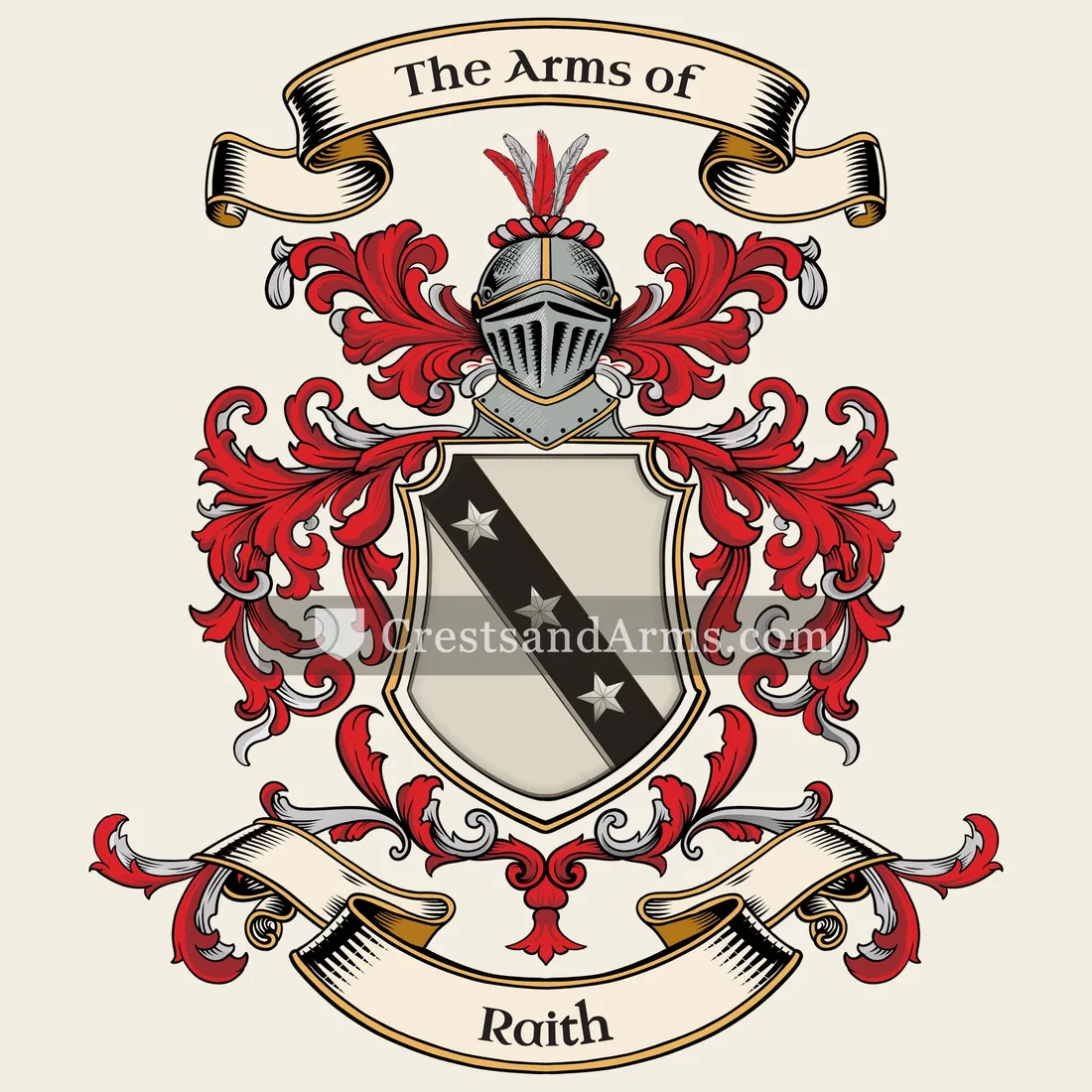
bendDefence, and the scarf of a commander
mulletThe third son, and a divine quality from above
Colours
Silver (Argent)Means: Peace and sincerity
Black (Sable)Means: Constancy
Historical info
Source
Sir Bernard Burke, The General Armory of England, Scotland, Ireland and Wales, London: Harrison & Sons, 1884
Blazon (the actual original written record)
“Ar. on a bend with a bendlet enhanced sa. three mullets of the field”
Irelandc. 1645
Digital archive packCoat of arms PNG, gold border print PDF, vector SVG and the certificate of authenticity. Sent to your email in minutes.
Map of Ireland showing where the Raith arms are recorded
The Raith arms were recorded in Ireland, c. 1645.
Arms such as these were typically recorded in Dublin.
Dublin was the seat of government in Ireland and the place where grants were sought and recorded. Families with business at the castle or the courts settled nearby, and settling there put their arms on record.
This is where the arms were entered in the register. Families often moved to other parts of the country, so the same name can turn up in more than one region.
The body that granted and recorded arms in Ireland in this period.
Charles I of England
Sovereign of the period
Charles I of England
1625–1649
Reigning in Germany when the Raith arms are first recorded.
How Arms Worked in Ireland
The Ulster King of Arms granted coats of arms to individuals who proved their social standing and good character. These symbols were typically inherited by all legitimate descendants of the original holder. If a family branch wanted a unique look, they could apply for a specific change to their design through the office to ensure their identity remained distinct.
Granting authority
The Ulster King of Arms acted as the official body that regulated and issued all coats of arms throughout Ireland.
How they got arms
Families obtained their arms through formal grants issued by the office after proving their eligibility and paying the required fees.
Where arms were recorded
All official grants were recorded in the registers held by the Ulster King of Arms starting from the year 1552.
The family's standing
Recorded among the armigerous families of Ireland.
Origin & History of the Raith Family in Ireland
The history of the Raith name in Ireland is deeply connected to the turbulent political landscape of the seventeenth century. By 1645, records confirm that members of the family were established in Dublin, a city that served as the primary center for trade and administration during a period of intense conflict. During this era, Dublin was a melting pot of displaced populations and shifting loyalties, and families like the Raiths often navigated the complex social changes brought on by the Cromwellian conquest. While the name likely arrived in Ireland through migration from Britain, those living in the capital during the mid-1600s were positioned at the heart of the country's economic life. These early settlers helped shape the urban character of Dublin, living through the transition from the late Renaissance into the early modern era of Irish history. Their presence in the city archives during this specific decade suggests they were part of the growing merchant or professional class that helped stabilize the city after years of regional unrest.
Raith Meaning & Related Branches
Root word
Rat
Old High German word for counsel, advice, or deliberation.
This name
RaithA topographic name for someone living near a clearing or a counselor.
also spelled
Rayth
Rait
Raethe
Related arms
Duschlrecorded with Raith, same area
Feichtingenrecorded with Raith, same area
Nindlrecorded with Raith, same area
Documented Sources
J. B. Rietstap, Armorial Général, Gouda: G. B. van Goor Zonen, 1884–87


 mountThe ground held, and steadfastness upon it
 mulletThe third son, and a divine quality from above
 knightChivalry and service in arms
 mountThe ground held, and steadfastness upon it
 mulletThe third son, and a divine quality from above
 knightChivalry and service in arms


 bendDefence, and the scarf of a commander