Map of England showing where the Rakes arms are recorded
The Rakes arms were recorded in York, c. 1620.
Yorkshire is the largest of the English counties, and it held more gentry families than any other. Land there was split among a great many households rather than a few, so a great many of them carried arms.
This is where the arms were entered in the register. Families often moved to other parts of the country, so the same name can turn up in more than one region.
The body that granted and recorded arms in England in this period.
James VI and I
Sovereign of the period
James VI and I
1603–1625
Reigning in England when the Rakes arms are first recorded.
How Arms Worked in England
English heraldry allowed arms to be shared by all legitimate descendants of the original owner. These symbols were treated as personal property that moved through the generations to all children. While the eldest son kept the original design, other family members could use the same shield without needing to change it or register their own unique versions.
Granting authority
The College of Arms in London has regulated the use of coats of arms throughout England and Wales since 1484.
How they got arms
Families typically obtained their coats of arms through a formal grant from the Crown or by proving their ancient right to them.
Where arms were recorded
All official coats of arms are recorded in the registers kept at the College of Arms, which date back to the fifteenth century.
The family's standing
Recorded among the armigerous families of York.
Origin & History of the Rakes Family in England
The surname Rakes has roots that trace back to the northern regions of England, with documented evidence placing members of the family in the historic city of York by the year 1620. The name is generally considered a topographic or occupational descriptor, likely originating from the Old English word "racu," which referred to a narrow path, a mountain pass, or a steep rake-like slope in the landscape. Families bearing this name were often associated with the rugged terrain of the Pennines or the Yorkshire Dales, where such geographical features were common. During the early seventeenth century, York served as a major administrative and social hub, and the presence of the Rakes family there suggests they were part of the growing urban middle class or skilled trade community. As the family moved through the generations, they adapted to the changing economic landscape of Northern England, transitioning from rural settings to the bustling markets of historic cathedral cities.
Coat of Arms & Family Crest Details
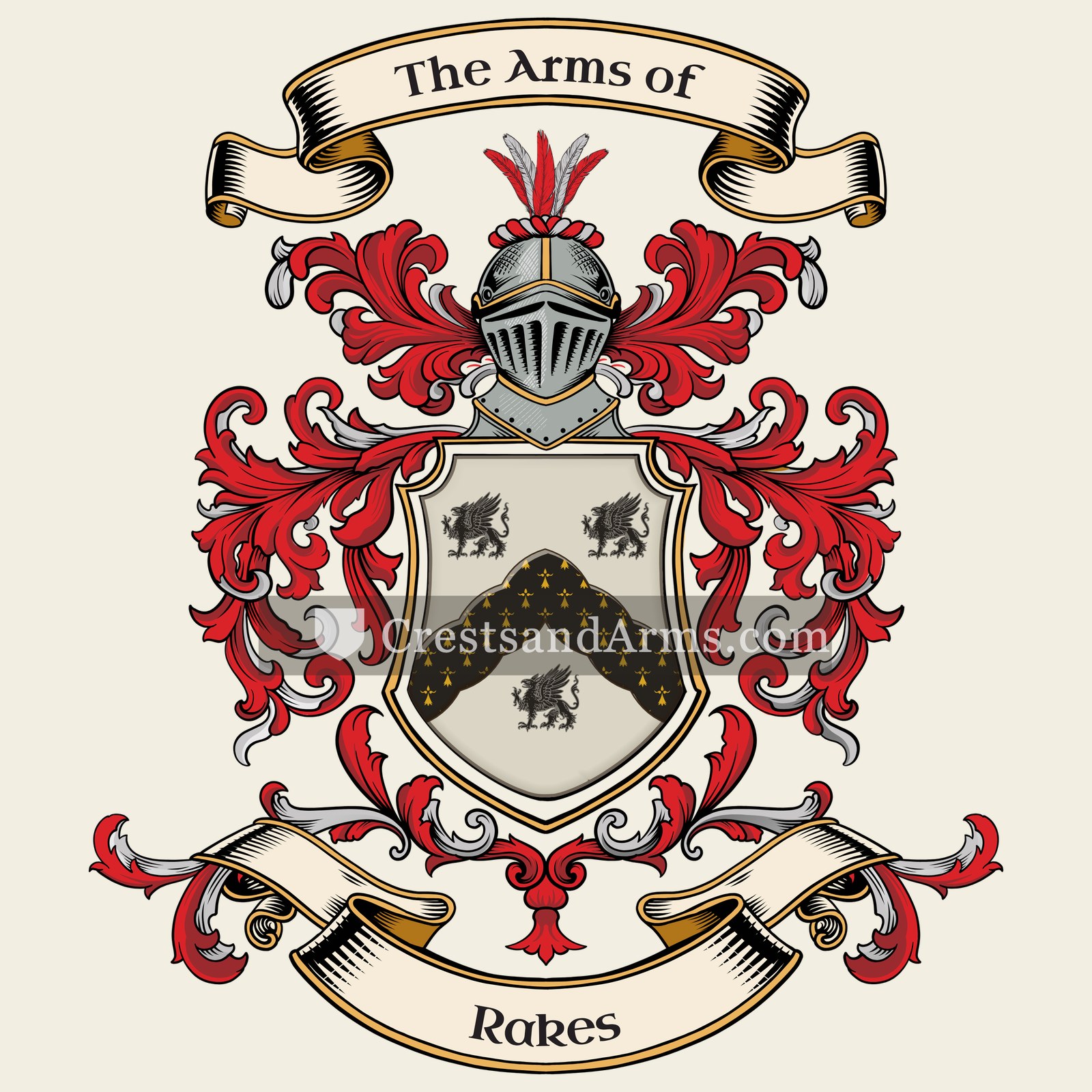
Symbols on this shield
chevronProtection, and faithful service completed
ermineDignity and rank
griffinValour and vigilance, guarding great treasure
Colours
Silver (Argent)Means: Peace and sincerity
Black (Sable)Means: Constancy
Historical info
Source
Sir Bernard Burke, The General Armory of England, Scotland, Ireland and Wales, London: Harrison & Sons, 1884
Blazon (the actual original written record)
“Ar. a chev. engr. pean betw. three griffins' heads erased sa. beaked ppr. the neck of each charged with an erm. spot ar”
BreconTreberfydd · Brecon, c. 1647
Digital archive packCoat of arms PNG, gold border print PDF, vector SVG and the certificate of authenticity. Sent to your email in minutes.
Map of Wales showing where the Rakes arms are recorded
The Rakes arms were recorded in Brecon, c. 1647.
Brecon was mid-Welsh hill country, held in small estates by families who stayed for generations. Land was worth less than in the lowlands, but holding it still brought arms.
This is where the arms were entered in the register. Families often moved to other parts of the country, so the same name can turn up in more than one region.
The body that granted and recorded arms in Wales in this period.
Charles I of England
Sovereign of the period
Charles I of England
1625–1649
Reigning in England when the Rakes arms are first recorded.
How Arms Worked in Wales
English heraldry allowed arms to be shared by all legitimate descendants of the original owner. These symbols were treated as personal property that moved through the generations to all children. While the eldest son kept the original design, other family members could use the same shield without needing to change it or register their own unique versions.
Granting authority
The College of Arms in London has regulated the use of coats of arms throughout England and Wales since 1484.
How they got arms
Families typically obtained their coats of arms through a formal grant from the Crown or by proving their ancient right to them.
Where arms were recorded
All official coats of arms are recorded in the registers kept at the College of Arms, which date back to the fifteenth century.
The family's standing
Recorded among the armigerous families of Brecon.
Origin & History of the Rakes Family in Wales
The history of the Rakes family in Wales is deeply connected to the rugged landscape of Brecon, where records confirm their presence by the year 1647. During this period, the region was undergoing significant social and economic shifts following the turbulence of the English Civil War. Families like the Rakes were often tied to the local agricultural economy, living in the shadow of the Brecon Beacons where they likely worked as tenant farmers or tradespeople. The name itself is thought to be topographical or occupational in origin, perhaps referring to those who lived near a steep incline or those who worked with specific agricultural tools. As members of the local community, they would have been subject to the parish record-keeping systems established under the Church of England, which helped solidify their identity within the Welsh borderlands. Over the following generations, the family became a quiet but persistent part of the social fabric of the county, navigating the transition from a traditional rural lifestyle to the changing demands of Welsh society.
Related Branches & Arms
Root word
Rake
A narrow path or steep mountain pass.
This name
RakesA topographical name for someone who lived near a steep slope or narrow mountain pass.
also spelled
Raickes
Raykes
Documented Sources
Sir Bernard Burke, The General Armory of England, Scotland, Ireland and Wales, London: Harrison & Sons, 1884
Bardsley, Charles Wareing, A Dictionary of English and Welsh Surnames, 1901
Reaney, P.H. and Wilson, R.M., A Dictionary of English Surnames, 1991
The National Archives, Yorkshire Parish Registers, 1620
Digital archive packCoat of arms PNG, gold border print PDF, vector SVG and the certificate of authenticity. Sent to your email in minutes.


 chevronProtection, and faithful service completed
 griffinValour and vigilance, guarding great treasure
 chevronProtection, and faithful service completed
 griffinValour and vigilance, guarding great treasure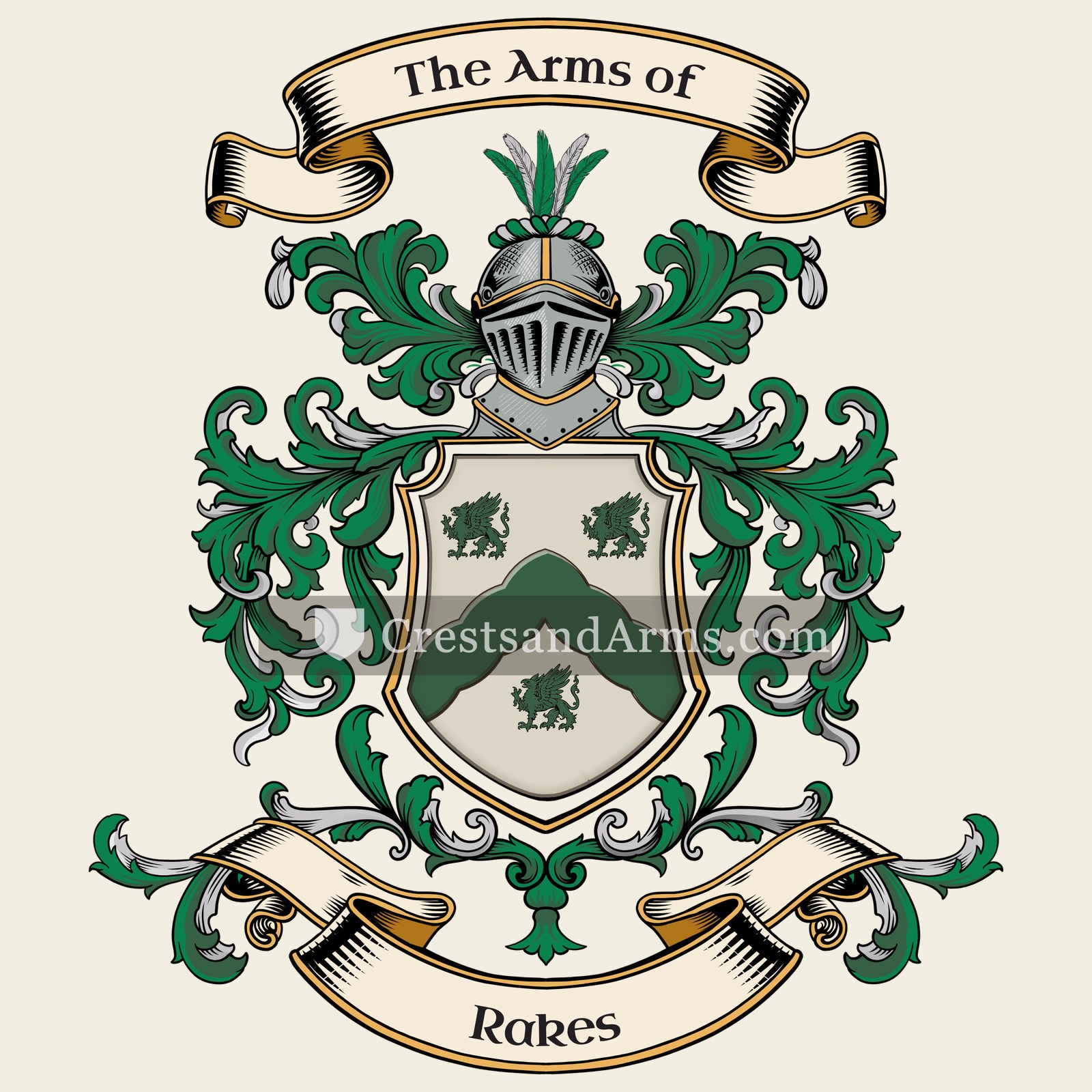


 ermineDignity and rank