A record of documented arms, meaning and origin, researched for the Ramella family lines. Documented in 3 countries.
Reg. 8871 · German, P–S
Meaning of the Ramella family crest colors & symbols
Symbols on this shield
chequyConstancy, and the counting-board
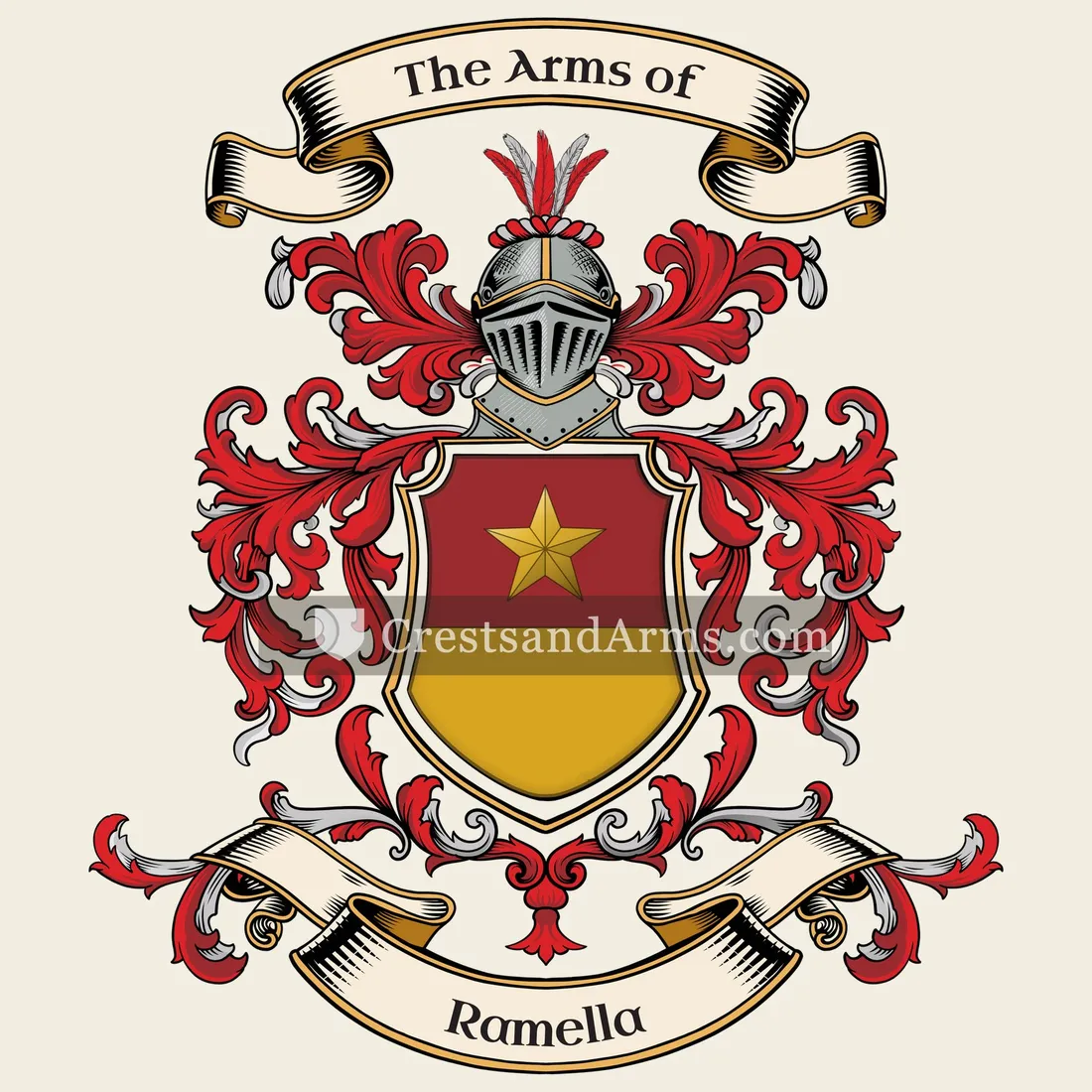
mulletThe third son, and a divine quality from above
Colours
Red (Gules)Means: Military strength
Gold (Or)Means: Generosity
Black (Sable)Means: Constancy
Historical info
Source
J. B. Rietstap, Armorial Général, Gouda: G. B. van Goor Zonen, 1884–87
Blazon (the actual original written record)
“Coupé: au 1 de gu. à une étoile d'or; au 2 échiq. d'or et de sa. de quatre tires. Cq. cour. C.: trois frondes en pals, composées chacune de trois cordes entortillées d'or, de gu. et de sa. L.: à dextre d'or et de sa., à sen. d'or et de gu.”
PomeraniaPomerania, c. 1765
Digital archive packCoat of arms PNG, gold border print PDF, vector SVG and the certificate of authenticity. Sent to your email in minutes.
Map of Germany showing where the Ramella arms are recorded
The Ramella arms were recorded in Pomerania, c. 1765.
Pomerania was flat farming country on the Baltic coast, held in large estates by a small number of families. They kept their land for generations, and generations of landholding is what fills the registers.
This is where the arms were entered in the register. Families often moved to other parts of the country, so the same name can turn up in more than one region.
The body that granted and recorded arms in Germany in this period.
Francis I, Holy Roman Emperor
Sovereign of the period
Francis I, Holy Roman Emperor
1745–1765
Reigning in Germany when the Ramella arms are first recorded.
How Arms Worked in Germany
In the Holy Roman Empire, coats of arms were often granted to individuals by the Emperor or his representatives. These arms were then passed down through the generations to all legitimate descendants of the original holder. Younger branches of a family usually kept the same shield design without needing to change it, as the arms belonged to the entire lineage.
Granting authority
The Holy Roman Emperor held the sole power to grant new coats of arms throughout his vast imperial territories.
How they got arms
Families typically obtained their coats of arms through a formal imperial grant or by proving their noble status to the authorities.
Where arms were recorded
These grants were officially recorded in the Imperial Chancery registers, which began keeping formal records of such honors during the Middle Ages.
The family's standing
Recorded among the armigerous families of Pomerania.
Origin & History of the Ramella Family in Germany
The history of the Ramella family in Germany is deeply rooted in the northern region of Pomerania. By the year 1765, records confirm that members of the family were living and working within this area, which was then part of the Kingdom of Prussia. During this period, Pomerania was a landscape defined by agricultural estates and growing rural communities. Families like the Ramellas often moved across these territories to find stable work as farmers or skilled laborers. Because the name has distinct linguistic roots that suggest a connection to southern European origins, its presence in the Baltic region points to a long history of migration and integration. These early ancestors likely adapted to the local German customs and language while maintaining their unique family identity. Their presence in 18th-century Pomerania serves as a vital link to understanding how families moved and settled in the changing political landscape of early modern Germany.
Meaning of the Ramella family crest colors & symbols
Symbols on this shield
chequyConstancy, and the counting-board
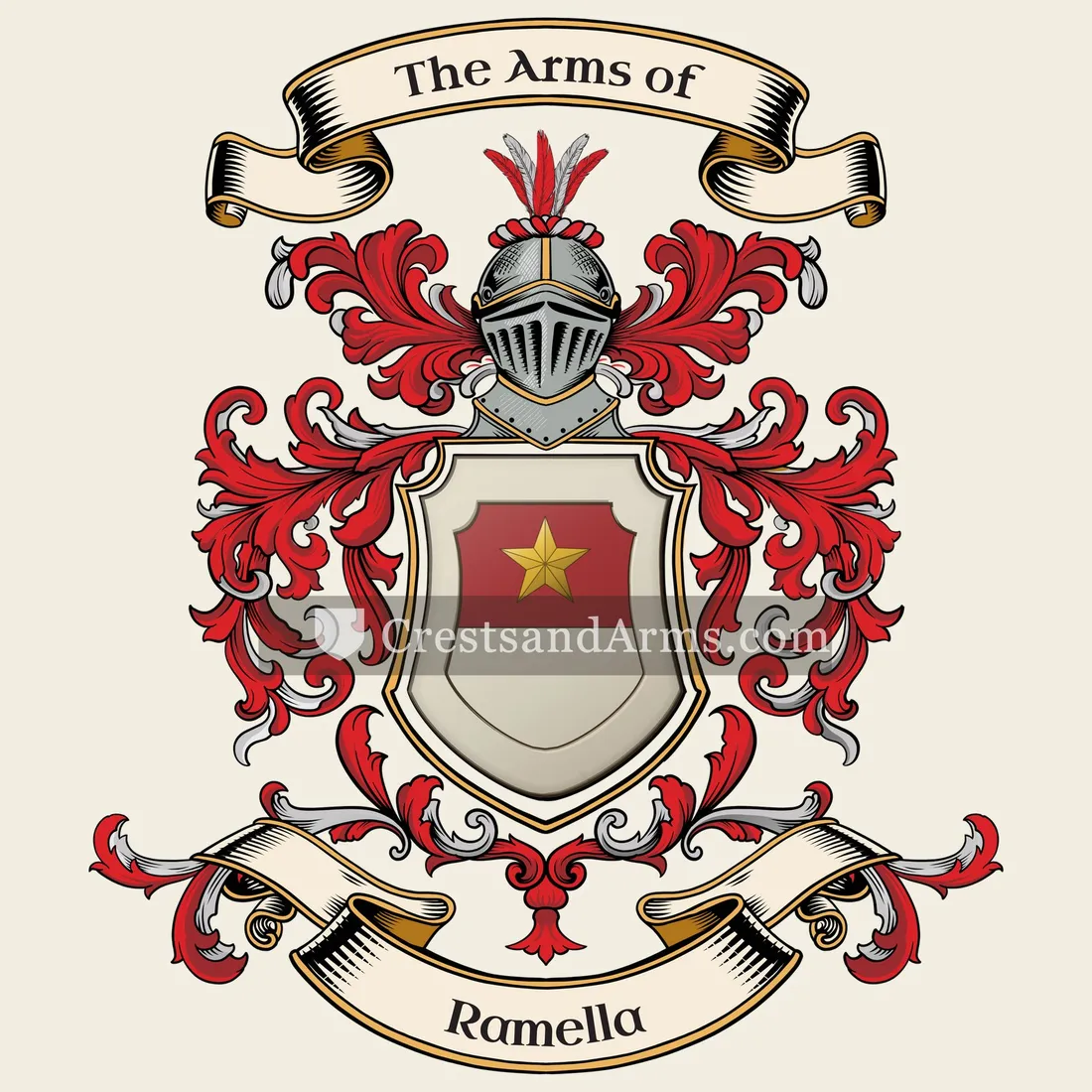
mulletThe third son, and a divine quality from above
Colours
Red (Gules)Means: Military strength
Silver (Argent)Means: Peace and sincerity
Gold (Or)Means: Generosity
Blue (Azure)Means: Loyalty and truth
Historical info
Source
J. B. Rietstap, Armorial Général, Gouda: G. B. van Goor Zonen, 1884–87
Blazon (the actual original written record)
“Coupé: au 1 de gu. à une étoile (5) d'or; au 2 échiq. d'arg. et d'azur de quatre tires. L'écu bordé d'arg. Deux cq. cour. C.: 1° trois frondes en pals, composées chacune de trois cordes entortillées d'or, de gu. et d'azur; 2° un lion iss., coupé de gu. sur azur, tenant de ses pattes une couleuvre d'azur, ondoyante en pal. Entre les cq. cinq épis d'or, feuillés du même. T.: deux sauvages de carn., ceints et cour. de lierre, arm. chacun d'une massue.”
Swedenc. 1771
Digital archive packCoat of arms PNG, gold border print PDF, vector SVG and the certificate of authenticity. Sent to your email in minutes.
Map of Sweden showing where the Ramella arms are recorded
The Ramella arms were recorded in Sweden, c. 1771.
Arms such as these were typically recorded in Stockholm.
Stockholm held the Swedish court and the House of Nobility, where every noble family's arms were entered and kept. Families ennobled for service registered there, which is why so many are recorded around the city.
This is where the arms were entered in the register. Families often moved to other parts of the country, so the same name can turn up in more than one region.
The body that granted and recorded arms in Sweden in this period.
Adolf Fredrik of Sweden
Sovereign of the period
Adolf Fredrik of Sweden
1751–1771
Reigning in Germany when the Ramella arms are first recorded.
How Arms Worked in Sweden
In Sweden, a coat of arms belonged to a noble family as a whole rather than just one individual. These arms were passed down through the generations to all legitimate descendants. Younger branches of the family used the same shield without needing to change it. This system ensured that the entire lineage shared the same identity and status under the law.
Granting authority
The Riddarhuset, or House of Nobility, regulated all noble coats of arms in Sweden under royal authority.
How they got arms
Families received their coats of arms through royal grants of nobility which were then officially registered with the House.
Where arms were recorded
Coats of arms were officially recorded in the Swedish House of Nobility register starting in the year 1626.
The family's standing
Recorded among the armigerous families of Sweden.
Origin & History of the Ramella Family in Sweden
The history of the Ramella family in Sweden begins in the bustling urban environment of Stockholm during the late eighteenth century. By 1771, members of the family were already established residents within the capital city. During this period, Stockholm was a major hub for international trade and craftsmanship, attracting skilled migrants from across Europe who sought new opportunities in the Swedish market. The name Ramella suggests an origin linked to the Piedmont region of Italy, indicating that the family likely arrived as part of a wave of continental artisans or merchants who traveled north to serve the growing needs of the Swedish royal court and the expanding middle class. These early settlers integrated into the local community by adopting Swedish naming customs while maintaining their distinct family identity. Their presence in the city records from 1771 highlights a period of significant social mobility, as the family navigated the complex guild systems and administrative requirements of the Swedish state to build their lives in a new country.
Meaning of the Ramella family crest colors & symbols
Symbols on this shield
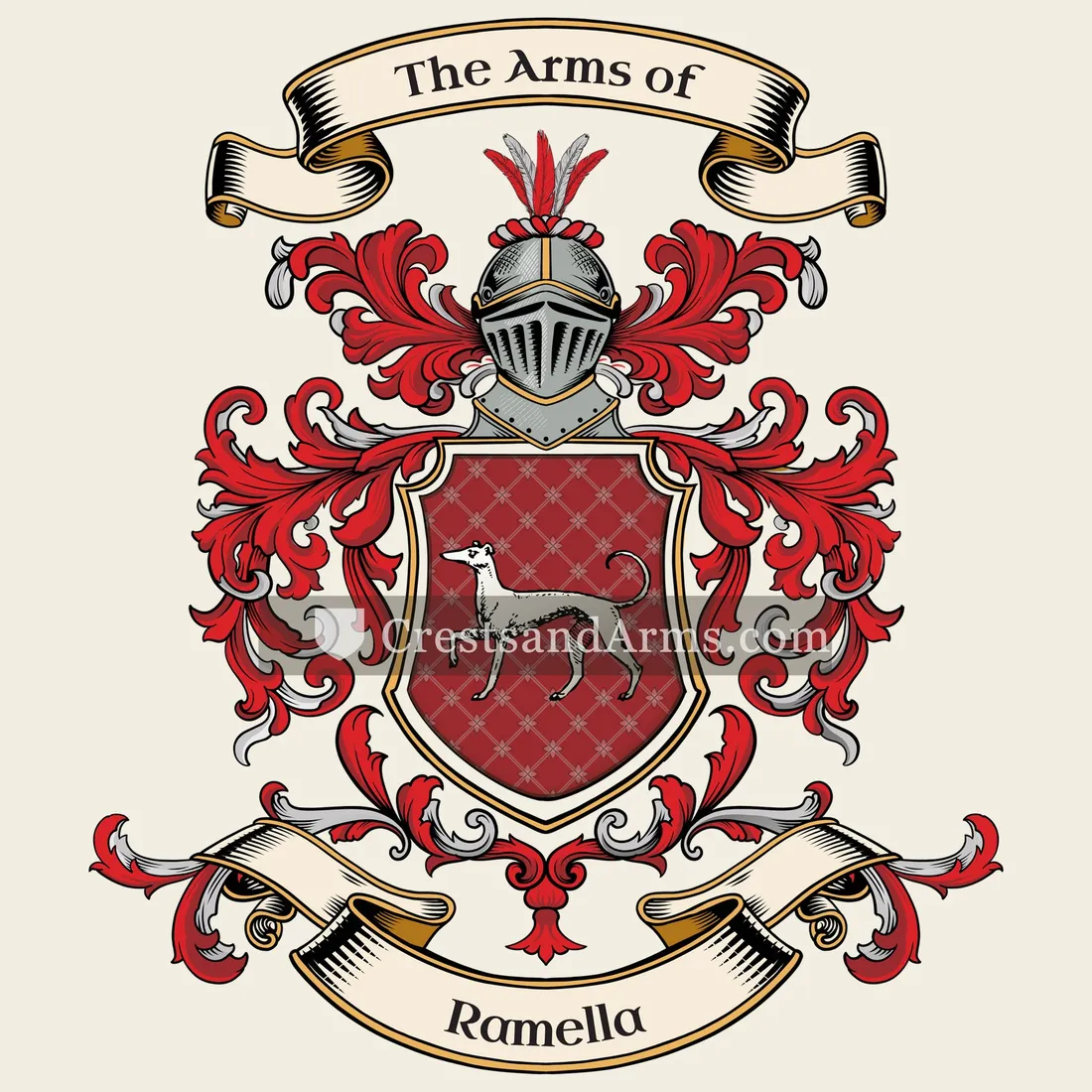
greyhoundCourage, vigilance and loyalty
Colours
Red (Gules)Means: Military strength
Silver (Argent)Means: Peace and sincerity
Historical info
Source
J. B. Rietstap, Armorial Général, Gouda: G. B. van Goor Zonen, 1884–87
Blazon (the actual original written record)
“De gu. à un lévrier ramp. d'arg. coll. de gu. et bouclé d'or. C.: le lévrier.”
FranceBesançon, c. 1661
Digital archive packCoat of arms PNG, gold border print PDF, vector SVG and the certificate of authenticity. Sent to your email in minutes.
Map of France showing where the Ramella arms are recorded
The Ramella arms were recorded in Besançon, c. 1661.
This is where the arms were entered in the register. Families often moved to other parts of the country, so the same name can turn up in more than one region.
The body that granted and recorded arms in France in this period.
Louis XIV of France
Sovereign of the period
Louis XIV of France
1643–1715
Reigning in Germany when the Ramella arms are first recorded.
How Arms Worked in France
In France, a coat of arms was a mark of honor that passed down through the male line to all legitimate descendants. Families often used the same shield without changes to show their shared heritage. If a branch wanted to stand out, they could add a small mark to their shield to show their specific place in the family tree.
Granting authority
The Juge d'armes de France acted as the official authority that regulated and verified coats of arms across the country.
How they got arms
Families typically inherited their arms from ancestors, though they could also receive them through royal grants or by proving their noble status.
Where arms were recorded
Coats of arms were officially recorded in the Armorial Général de France, which began its main collection in the year 1696.
The family's standing
Recorded among the armigerous families of France.
Origin & History of the Ramella Family in France
The surname Ramella carries a rich history rooted in the Franche-Comté region of eastern France. By the mid-seventeenth century, the family was well-established in the city of Besançon, a location that served as a vital crossroads between French and Burgundian influences. During this period, Besançon was a place of significant transition, and families like the Ramellas often integrated into the local urban fabric through trade, craftsmanship, or service to the regional administration. The name itself reflects the linguistic patterns of the borderlands, where names often evolved through local dialects and proximity to neighboring Alpine regions. As residents of a city known for its ancient fortifications and strategic importance, the early members of the Ramella family likely navigated the complex social and economic shifts that defined life in the seventeenth-century French provinces. Their presence in the 1661 records suggests they were part of a stable community that helped shape the local culture of the city during a time of great political change.
Ramella Meaning & Related Branches
Root word
Ramo
A branch or bough of a tree.
This name
RamellaDerived from a topographic descriptor for someone living near a prominent branch or wooded area.
Documented Sources
J. B. Rietstap, Armorial Général, Gouda: G. B. van Goor Zonen, 1884–87
Landesarchiv Greifswald, Kirchenbücher der Provinz Pommern (Church records of the Province of Pomerania)
Geheimes Staatsarchiv Preußischer Kulturbesitz, General-Direktorium, Kurmark und Pommern (General Directory, Kurmark and Pomerania)
Heitz, Gerhard, Die ländliche Gesellschaft in Pommern (The rural society in Pomerania), 1968
Brüggemann, Ludwig Wilhelm, Ausführliche Beschreibung des gegenwärtigen Zustandes des Königl. Preußischen Herzogthums Vor- und Hinter-Pommern (Detailed description of the current state of the Royal Prussian Duchy of Hither and Farther Pomerania), 1779
Digital archive packCoat of arms PNG, gold border print PDF, vector SVG and the certificate of authenticity. Sent to your email in minutes.


 chequyConstancy, and the counting-board
 mulletThe third son, and a divine quality from above
 chequyConstancy, and the counting-board
 mulletThe third son, and a divine quality from above




 greyhoundCourage, vigilance and loyalty