A record of documented arms, meaning and origin, researched for the Ramus family lines. Documented in 2 countries.
Reg. 5518 · Swiss, P–S
Coat of Arms & Family Crest Details
Symbols on this shield
mountThe ground held, and steadfastness upon it
ladderAmbition, and a fearless assault
dovePeace, love and the Holy Spirit
Colours
Gold (Or)Means: Generosity
Green (Vert)Means: Hope
Red (Gules)Means: Military strength
Blue (Azure)Means: Loyalty and truth
Historical info
Source
J. B. Rietstap, Armorial Général, Gouda: G. B. van Goor Zonen, 1884–87
Blazon (the actual original written record)
“D'or à une échelle de quatre échelons de gu., posée en pal, sommée d'une croissette du même, soutenue d'un tertre de trois coupeaux de sin. et surm. d'un St.-Esprit d'azur.”
SwitzerlandNeufchâtel, c. 1745
Digital archive packCoat of arms PNG, gold border print PDF, vector SVG and the certificate of authenticity. Sent to your email in minutes.
Map of Switzerland showing where the Ramus arms are recorded
The Ramus arms were recorded in Neufchâtel, c. 1745.
This is where the arms were entered in the register. Families often moved to other parts of the country, so the same name can turn up in more than one region.
The body that granted and recorded arms in Switzerland in this period.
How Arms Worked in Switzerland
In Switzerland, coats of arms were not restricted to the nobility and were often adopted by common citizens and families. These symbols were passed down through generations to show family identity. When branches of a family grew, they often changed small details of the design to distinguish their own line from the original group.
Granting authority
Cantonal and civic authorities managed the use of coats of arms within their specific regions and local jurisdictions.
How they got arms
Families typically assumed their own coats of arms based on local custom rather than receiving them from a central monarch.
Where arms were recorded
Arms were recorded in various cantonal and civic registers starting from the fourteenth century throughout the Swiss region.
The family's standing
Recorded among the armigerous families of Switzerland.
Origin & History of the Ramus Family in Switzerland
The family name Ramus has deep roots in the Swiss region of Neuchâtel, where records confirm their presence as early as 1745. During this period, the area was a principality with a complex political status, often balancing its local traditions with influences from both Switzerland and Prussia. Families like the Ramus were typically integrated into the local social fabric through agricultural work, trade, or craft guilds that defined the economy of the Jura Mountains. As the name spread through the region, it became associated with the distinct cultural identity of the Neuchâtelois people, who were known for their resilience in a rugged landscape. By settling in this area, the early members of the Ramus family contributed to the growth of local communities that relied on close-knit family ties and shared civic responsibilities. Over the following decades, the family name became a permanent part of the historical record in the region, reflecting the steady migration and development patterns common to Swiss families of the eighteenth century.
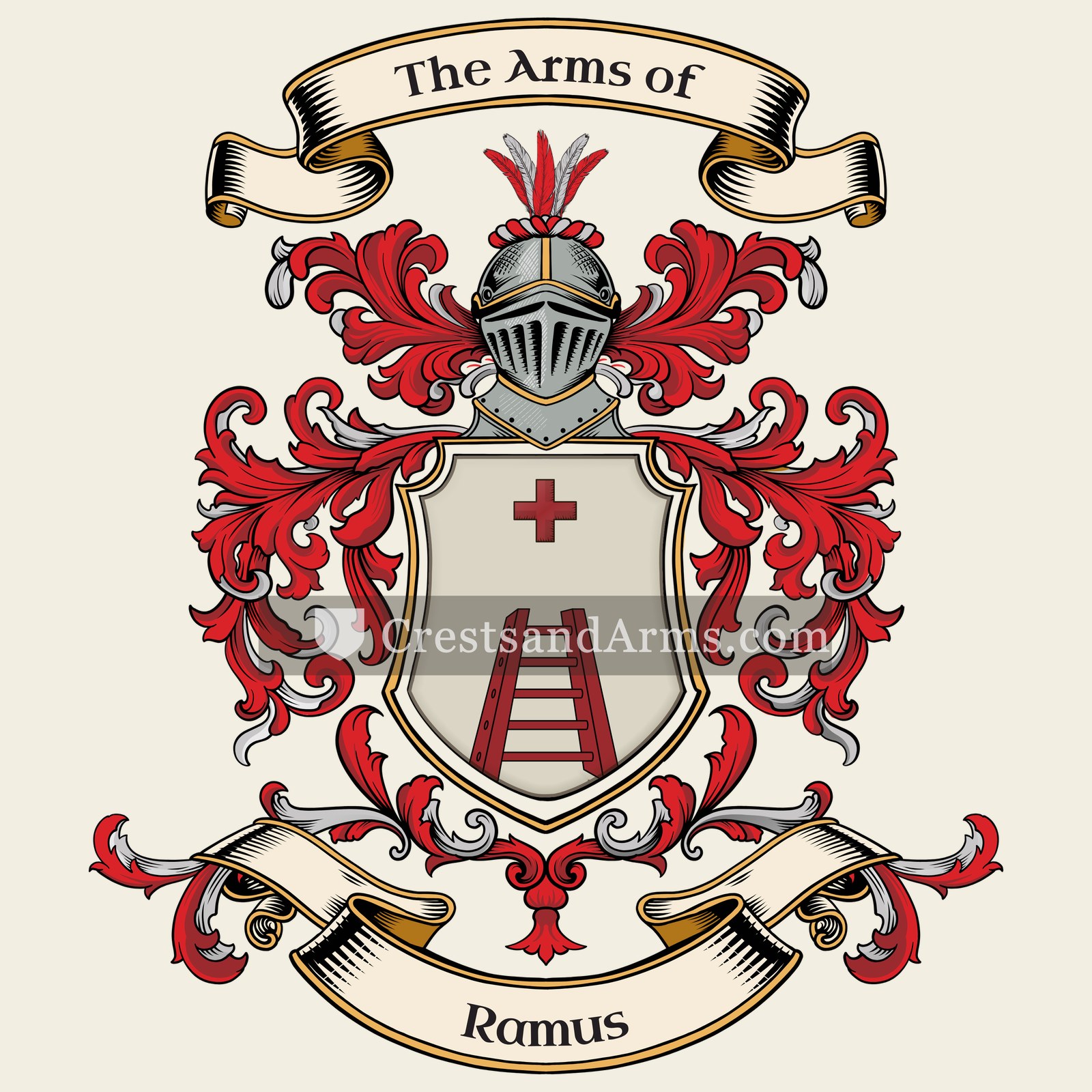
Coat of Arms & Family Crest Details
Symbols on this shield
cross symbolChristian faith and service
ladderAmbition, and a fearless assault
Colours
Silver (Argent)Means: Peace and sincerity
Red (Gules)Means: Military strength
Historical info
Source
Sir Bernard Burke, The General Armory of England, Scotland, Ireland and Wales, London: Harrison & Sons, 1884
Blazon (the actual original written record)
“Ar. a scaling ladder in pale gu. in chief a cross crosslet fitchée of the last”
EnglandWestminster, c. 1772
Digital archive packCoat of arms PNG, gold border print PDF, vector SVG and the certificate of authenticity. Sent to your email in minutes.
Map of England showing where the Ramus arms are recorded
The Ramus arms were recorded in Westminster, c. 1772.
This is where the arms were entered in the register. Families often moved to other parts of the country, so the same name can turn up in more than one region.
The body that granted and recorded arms in England in this period.
George III of Great Britain
Sovereign of the period
George III of Great Britain
1760–1801
Reigning in Switzerland when the Ramus arms are first recorded.
How Arms Worked in England
English heraldry allowed arms to be shared by all legitimate descendants of the original owner. These symbols were treated as personal property that moved through the generations to all children. While the eldest son kept the original design, other family members could use the same shield without needing to change it or register their own unique versions.
Granting authority
The College of Arms in London has regulated the use of coats of arms throughout England and Wales since 1484.
How they got arms
Families typically obtained their coats of arms through a formal grant from the Crown or by proving their ancient right to them.
Where arms were recorded
All official coats of arms are recorded in the registers kept at the College of Arms, which date back to the fifteenth century.
The family's standing
Recorded among the armigerous families of England.
Origin & History of the Ramus Family in England
The family name Ramus carries a distinct history that becomes clearly visible in the records of 18th-century England. While the name likely has roots tracing back to continental Europe, the family established a notable presence in Westminster by 1772. During this period, members of the family were closely connected to the British royal household, serving in positions of trust within the court of King George III. These early figures were often involved in the personal service of the monarch, which allowed them to integrate into the social and political life of London. Their presence in the capital during the late 1700s suggests a family that had successfully transitioned into English society, moving from their ancestral origins to become established residents of the Westminster district.
Related Branches & Arms
Root word
Ramus
Latin for a branch or bough of a tree.
This name
RamusA topographic surname for someone who lived near a prominent branch or wooded area.
also spelled
Ramuz
Ramuss
Rammes
Ramis
Documented Sources
J. B. Rietstap, Armorial Général, Gouda: G. B. van Goor Zonen, 1884–87
Archives de l’État de Neuchâtel, État civil ancien, Registres paroissiaux de Neuchâtel, 1745
Balsiger, David, Histoire du canton de Neuchâtel, 1989
Jeanrenaud, Albert, Les familles neuchâteloises et leur histoire, 1995
Digital archive packCoat of arms PNG, gold border print PDF, vector SVG and the certificate of authenticity. Sent to your email in minutes.


 mountThe ground held, and steadfastness upon it
 ladderAmbition, and a fearless assault
 dovePeace, love and the Holy Spirit
 mountThe ground held, and steadfastness upon it
 ladderAmbition, and a fearless assault
 dovePeace, love and the Holy Spirit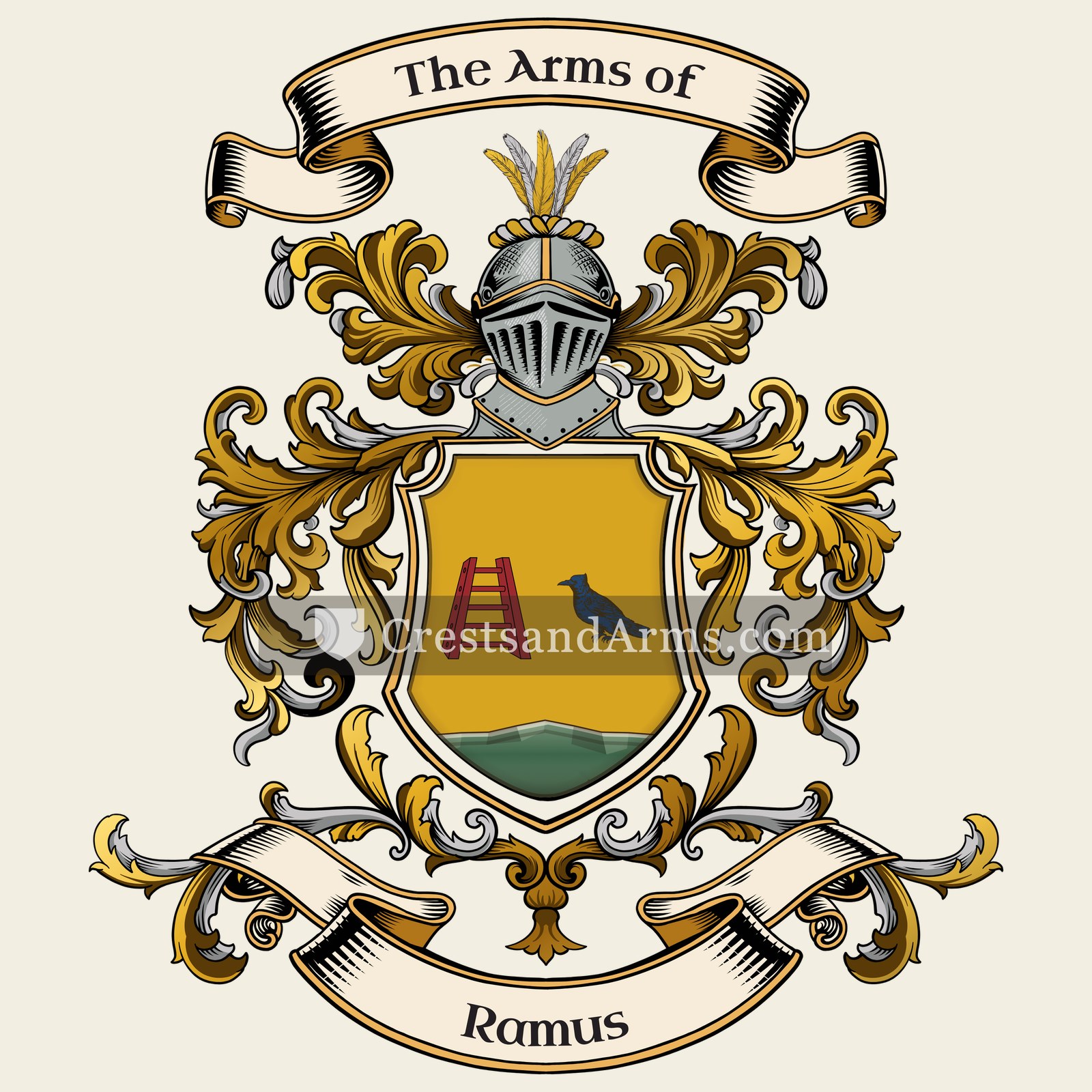

 cross symbolChristian faith and service