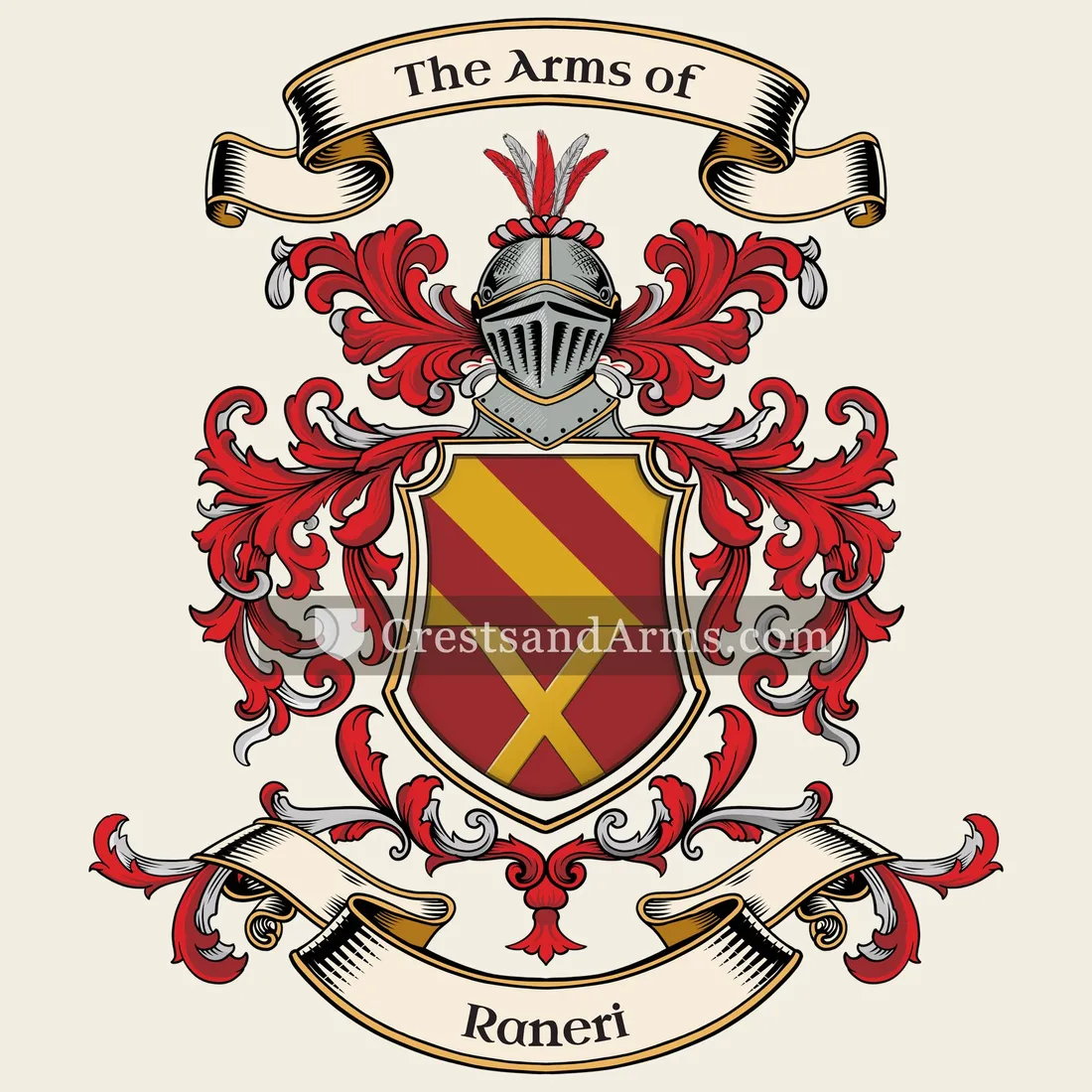
A record of documented arms, meaning and origin, researched for the Raneri family lines. Documented in 2 countries.
Reg. 0519 · Austrian, P–S
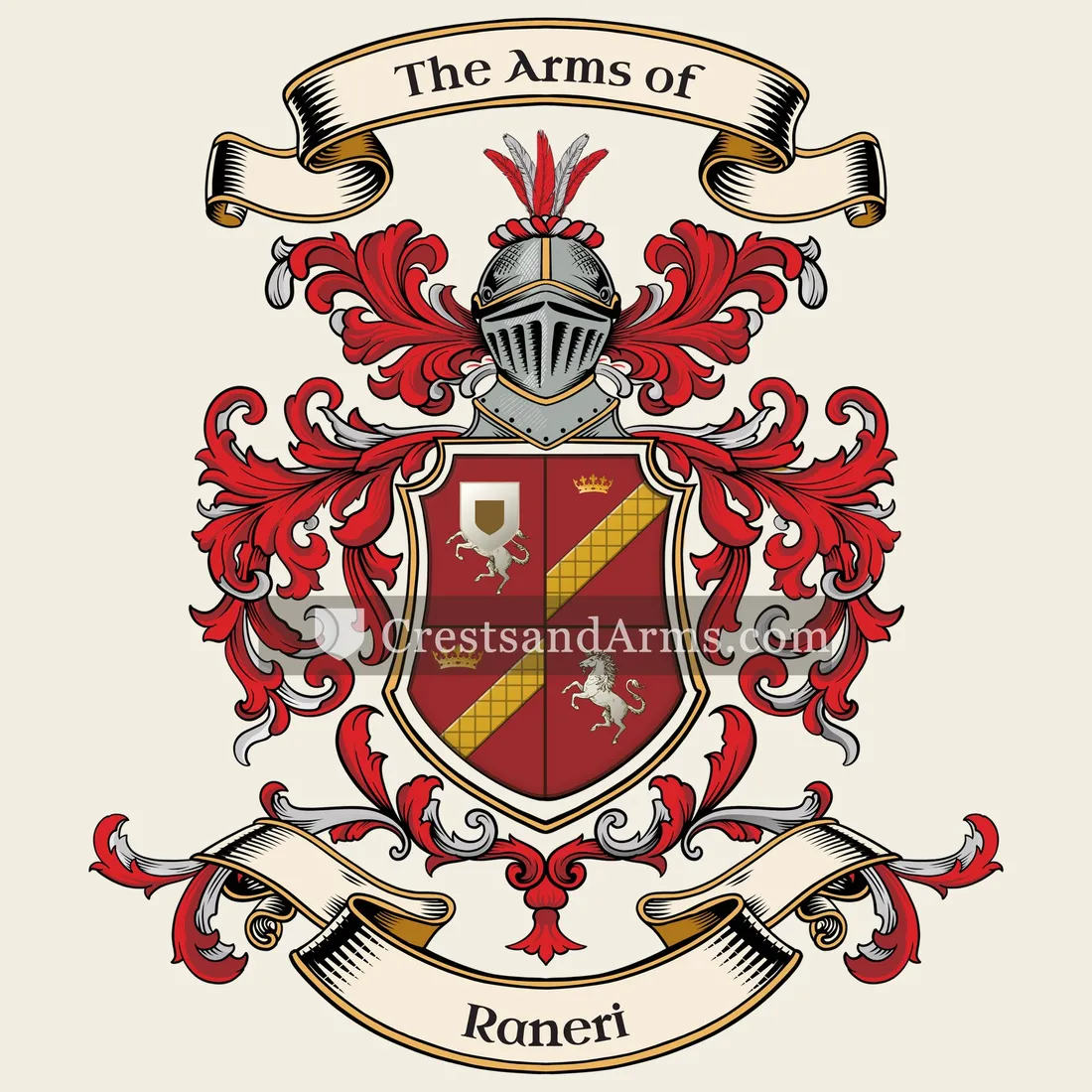
Meaning of the Raneri family crest colors & symbols
Symbols on this shield
bendDefence, and the scarf of a commander
escutcheonA shield within a shield, and a claim inherited
unicornPurity, and extreme courage in defence of honour
crownSovereignty, authority and just reward
Colours
Red (Gules)Means: Military strength
Gold (Or)Means: Generosity
Silver (Argent)Means: Peace and sincerity
Historical info
Source
J. B. Rietstap, Armorial Général, Gouda: G. B. van Goor Zonen, 1884–87
Blazon (the actual original written record)
“Ec.: aux 1 et 4 tranché: a. de gu. à une licorne saillante d'arg.; b. bandé d'arg. et de gu., de quatre pièces; aux 2 et 3 de gu. à la barre d'arg. Sur le tout éc.: a. et d. palé d'arg. et d'azur, de quatre pièces; b. et c. d'azur à une couronne d'or. Cq. cour.”
StyriaStyria, c. 1772
Digital archive packCoat of arms PNG, gold border print PDF, vector SVG and the certificate of authenticity. Sent to your email in minutes.
Map of Austria showing where the Raneri arms are recorded
The Raneri arms were recorded in Styria, c. 1772.
Styria was mountain and forest country in southern Austria, with iron in its hills. Mining and landholding both made money, and families who held either kind of property took arms to seal their papers with.
This is where the arms were entered in the register. Families often moved to other parts of the country, so the same name can turn up in more than one region.
Region
Styria
First recorded
1772
Granting Authority for the Raneri Arms
Imperial and Royal chancery
Sodacan · CC BY-SA 3.0
The body that granted and recorded arms in Austria in this period.
Joseph II, Holy Roman Emperor
Sovereign of the period
Joseph II, Holy Roman Emperor
1765–1790
Reigning in Austria when the Raneri arms are first recorded.
How Arms Worked in Austria
Austrian coats of arms were often linked directly to noble titles granted by the Emperor. These symbols belonged to the entire family line rather than just one individual. When a family grew, new branches kept the original design without needing to change it. This system allowed all members of a noble house to share the same identity across many generations.
Granting authority
The Imperial and Royal chancery managed all heraldic matters and controlled the official granting of arms throughout the Austrian lands.
How they got arms
Families typically received their arms through a formal imperial decree that often accompanied the elevation of a person to noble status.
Where arms were recorded
Official records of these grants were kept in the Imperial Register of Nobility which began its formal documentation process in 1453.
The family's standing
Recorded among the armigerous families of Styria.
Origin & History of the Raneri Family in Austria
The history of the Raneri family in Austria is deeply rooted in the mountainous landscape of Styria. By 1772, records confirm that members of the family were already established residents within this region. During the late eighteenth century, Styria was a vital part of the Habsburg Monarchy, and families like the Raneris often played essential roles in the local agricultural or trade-based economy. Because the name appears in regional census and tax records from this period, it suggests that the family was well-integrated into the social fabric of the Austrian countryside. Life in Styria at that time was defined by strict administrative oversight, meaning that the presence of the Raneri name in official documents indicates a settled and recognized status within their local community. Over time, the family likely adapted to the shifting political boundaries of the region while maintaining their connection to the Styrian lands where their ancestors first appeared in the historical record.
Meaning of the Raneri family crest colors & symbols
Symbols on this shield
bendDefence, and the scarf of a commander
saltireResolution, and St Andrew's cross
Colours
Red (Gules)Means: Military strength
Gold (Or)Means: Generosity
Historical info
Source
J. B. Rietstap, Armorial Général, Gouda: G. B. van Goor Zonen, 1884–87
Blazon (the actual original written record)
“Coupé: au 1 bandé de gu. et d'or; au 2 de gu. au saut. diminué alésé d'or.”
Switzerlandc. 1745
Digital archive packCoat of arms PNG, gold border print PDF, vector SVG and the certificate of authenticity. Sent to your email in minutes.
Map of Switzerland showing where the Raneri arms are recorded
The Raneri arms were recorded in Switzerland, c. 1745.
Arms such as these were typically recorded in Bern.
Bern was the largest of the Swiss cantons and ran itself, with its own council and its own courts. Its governing families held office for generations, and office of that kind carried a shield with it.
This is where the arms were entered in the register. Families often moved to other parts of the country, so the same name can turn up in more than one region.
The body that granted and recorded arms in Switzerland in this period.
How Arms Worked in Switzerland
In Switzerland, coats of arms were not restricted to the nobility and were often adopted by common citizens and families. These symbols were passed down through generations to show family identity. When branches of a family grew, they often changed small details of the design to distinguish their own line from the original group.
Granting authority
Cantonal and civic authorities managed the use of coats of arms within their specific regions and local jurisdictions.
How they got arms
Families typically assumed their own coats of arms based on local custom rather than receiving them from a central monarch.
Where arms were recorded
Arms were recorded in various cantonal and civic registers starting from the fourteenth century throughout the Swiss region.
The family's standing
Recorded among the armigerous families of Switzerland.
Origin & History of the Raneri Family in Switzerland
The family name Raneri has deep roots that connect to the historical landscape of Switzerland, specifically within the city of Bern during the mid-eighteenth century. By 1745, records indicate that members of the Raneri family were established residents of this region, which was a time of significant political and social organization in the Swiss Confederacy. During this era, families often settled in urban centers like Bern to participate in the growing trade and administrative networks that defined the city. The presence of the Raneri name in these official documents suggests that the family was integrated into the local community, likely contributing to the civic life of the canton. Because Bern served as a central hub for commerce and governance, the family would have been part of a society that valued record-keeping and structured social standing. This early history reflects the broader movement of families across European borders who sought stability and opportunity within the Swiss territories.
Raneri Meaning & Related Branches
Root word
Rainer
Derived from the Germanic elements ragin meaning counsel and hari meaning army.
This name
RaneriAn Italianized form of the Germanic name Rainer, signifying a wise warrior or army counselor.
also spelled
Ranner
Documented Sources
J. B. Rietstap, Armorial Général, Gouda: G. B. van Goor Zonen, 1884–87


 bendDefence, and the scarf of a commander
 escutcheonA shield within a shield, and a claim inherited
 unicornPurity, and extreme courage in defence of honour
 crownSovereignty, authority and just reward
 bendDefence, and the scarf of a commander
 escutcheonA shield within a shield, and a claim inherited
 unicornPurity, and extreme courage in defence of honour
 crownSovereignty, authority and just reward


 saltireResolution, and St Andrew's cross