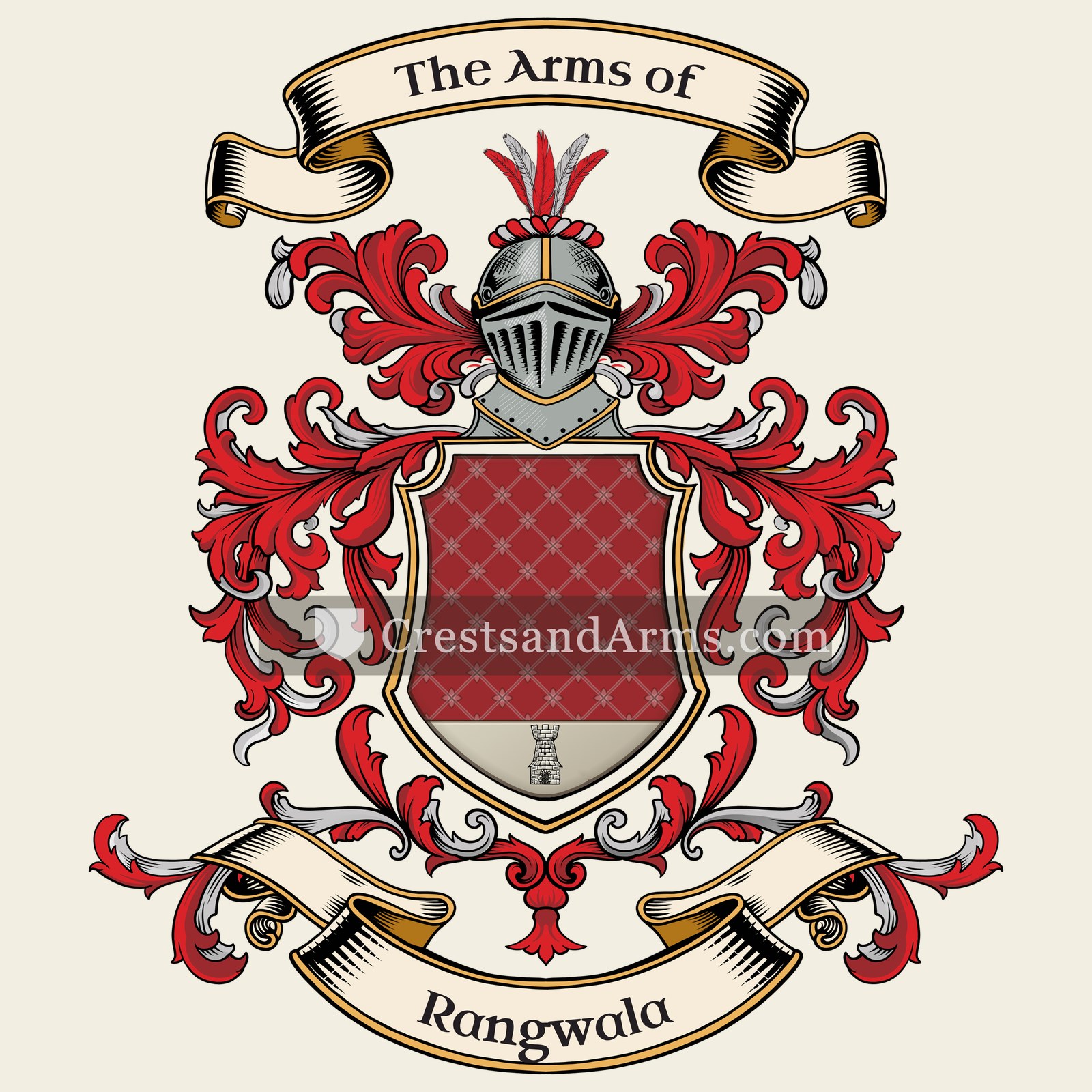
A record of documented arms, meaning and origin, researched for the Rangwala family of Switzerland.
Reg. 5273 · Swiss, P–S
Coat of Arms & Family Crest Details
Symbols on this shield
towerGrandeur and solidity, and a stronghold defended
Colours
Red (Gules)Means: Military strength
Silver (Argent)Means: Peace and sincerity
Historical info
Source
J. B. Rietstap, Armorial Général, Gouda: G. B. van Goor Zonen, 1884–87
Blazon (the actual original written record)
“De gu. à un mur crén. d'arg., maconné de sa., occupant la moitié inférieure de l'écu, sommé de trois arbres de sin. Cq. timbré d'une couronne murale d'arg. C.: un arbre de sin. L. d'arg. et de gu.”
SwitzerlandBâle, c. 1745
Digital archive packCoat of arms PNG, gold border print PDF, vector SVG and the certificate of authenticity. Sent to your email in minutes.
Map of Switzerland showing where the Rangwala arms are recorded
The Rangwala arms were recorded in Bâle, c. 1745.
This is where the arms were entered in the register. Families often moved to other parts of the country, so the same name can turn up in more than one region.
The body that granted and recorded arms in Switzerland in this period.
How Arms Worked in Switzerland
In Switzerland, coats of arms were not restricted to the nobility and were often adopted by common citizens and families. These symbols were passed down through generations to show family identity. When branches of a family grew, they often changed small details of the design to distinguish their own line from the original group.
Granting authority
Cantonal and civic authorities managed the use of coats of arms within their specific regions and local jurisdictions.
How they got arms
Families typically assumed their own coats of arms based on local custom rather than receiving them from a central monarch.
Where arms were recorded
Arms were recorded in various cantonal and civic registers starting from the fourteenth century throughout the Swiss region.
The family's standing
Recorded among the armigerous families of Switzerland.
Origin & History of the Rangwala Family in Switzerland
The family name Rangwala carries a history that bridges distinct cultural landscapes, with roots that trace back to the mercantile traditions of South Asia and an intriguing presence in Europe by the mid-eighteenth century. While the name itself is derived from the Gujarati words "rang," meaning color, and "wala," denoting a person who works with or sells a specific item, it traditionally identified those involved in the trade of dyes, textiles, or colorful pigments. By 1745, records confirm that members of the family were established in the city of Bâle, a major center for commerce and the textile industry in Switzerland. This suggests that early ancestors were likely part of the sophisticated trade networks that connected the Indian subcontinent to European markets. Their presence in Bâle during this period highlights the family’s long-standing role as global intermediaries who moved goods and expertise across vast distances during the height of the early modern trading era.
Related Branches & Arms
Root word
Rang
Derived from the Persian word for color or dye.
This name
RangwalaRefers to a person who worked as a dyer of textiles or fabrics.
also spelled
Ringwalt
Documented Sources
J. B. Rietstap, Armorial Général, Gouda: G. B. van Goor Zonen, 1884–87
Staatsarchiv Basel-Stadt, Bürgerverzeichnisse und Einwohnerregister 1700–1800
Burckhardt, A., Die Basler Handelsgesellschaften im 18. Jahrhundert, 1928
Shah, P. G., The Vania Community of Gujarat, 1955
Digital archive packCoat of arms PNG, gold border print PDF, vector SVG and the certificate of authenticity. Sent to your email in minutes.


 towerGrandeur and solidity, and a stronghold defended
 towerGrandeur and solidity, and a stronghold defended