A record of documented arms, meaning and origin, researched for the Rappa family lines. Documented in 3 countries.
Reg. 6920 · German, P–S
Meaning of the Rappa family crest colors & symbols
Symbols on this shield
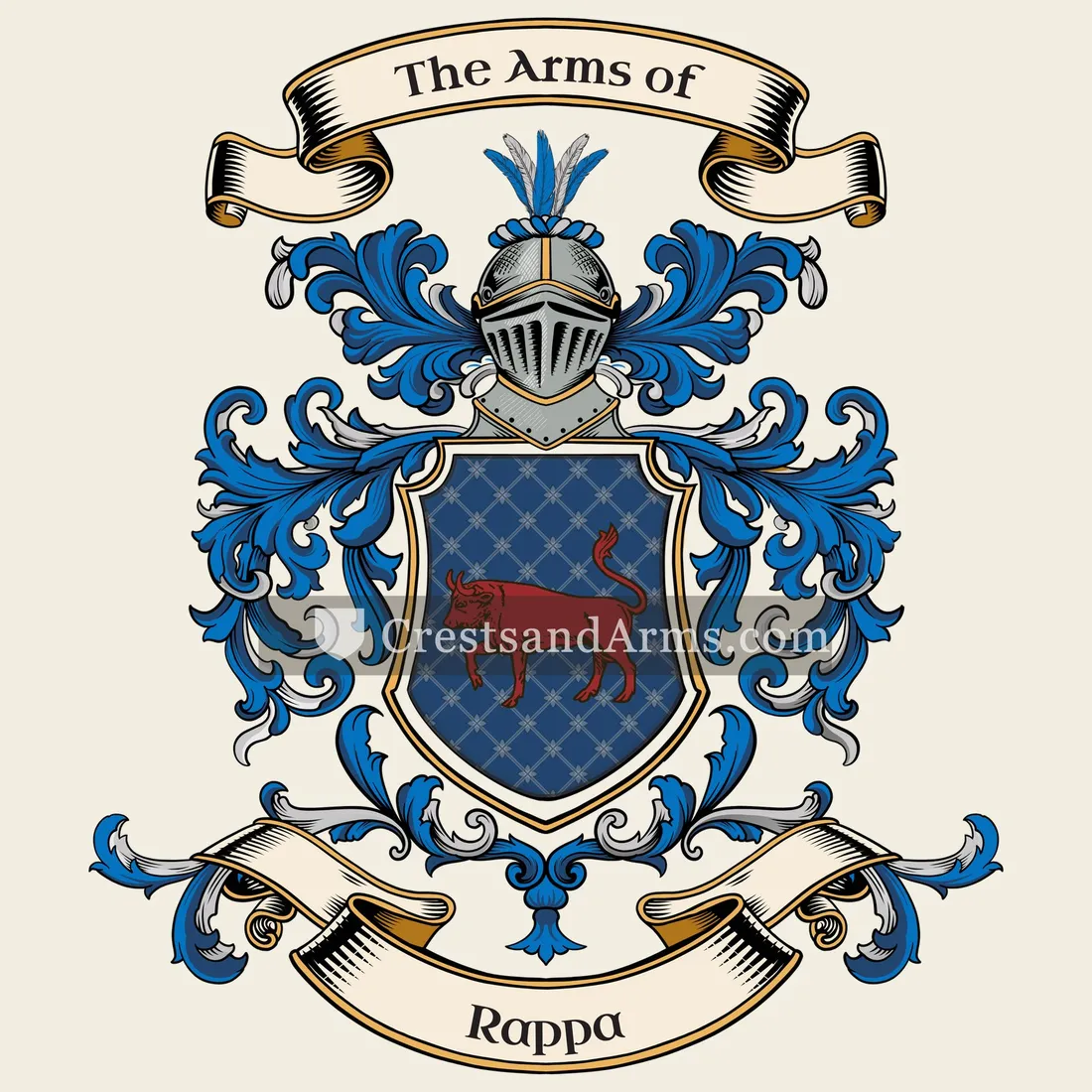
bullValour and generosity
Colours
Blue (Azure)Means: Loyalty and truth
Red (Gules)Means: Military strength
Historical info
Source
J. B. Rietstap, Armorial Général, Gouda: G. B. van Goor Zonen, 1884–87
Blazon (the actual original written record)
“D'azur à un rencontre de boeuf parti de gu. et d'arg. C.: un bonnet de gu., retr. d'herm., sommé de trois fleurs-de-lis héraldiques, de gu., d'arg. et d'azur, tigées de sin. L. d'arg. et de gu.”
GermanyThuringe, c. 1765
Digital archive packCoat of arms PNG, gold border print PDF, vector SVG and the certificate of authenticity. Sent to your email in minutes.
Map of Germany showing where the Rappa arms are recorded
The Rappa arms were recorded in Thuringe, c. 1765.
This is where the arms were entered in the register. Families often moved to other parts of the country, so the same name can turn up in more than one region.
The body that granted and recorded arms in Germany in this period.
Francis I, Holy Roman Emperor
Sovereign of the period
Francis I, Holy Roman Emperor
1745–1765
Reigning in Germany when the Rappa arms are first recorded.
How Arms Worked in Germany
In the Holy Roman Empire, coats of arms were often granted to individuals by the Emperor or his representatives. These arms were then passed down through the generations to all legitimate descendants of the original holder. Younger branches of a family usually kept the same shield design without needing to change it, as the arms belonged to the entire lineage.
Granting authority
The Holy Roman Emperor held the sole power to grant new coats of arms throughout his vast imperial territories.
How they got arms
Families typically obtained their coats of arms through a formal imperial grant or by proving their noble status to the authorities.
Where arms were recorded
These grants were officially recorded in the Imperial Chancery registers, which began keeping formal records of such honors during the Middle Ages.
The family's standing
Recorded among the armigerous families of Germany.
Origin & History of the Rappa Family in Germany
The family name Rappa has deep roots in the central German region of Thuringia, where records confirm members of the family were established by 1765. During this period, Thuringia was a collection of small states characterized by a mix of agricultural traditions and growing trade networks. Families with this name likely lived in small rural villages or towns where they worked as skilled laborers or farmers. The name itself is thought to be linked to local dialects, potentially describing a person’s physical traits or their specific role within the community. As the family grew, they became part of the steady social fabric of the region, navigating the changes brought on by the local nobility and the shifting borders of the German states. By the mid-18th century, the Rappa family was already well-integrated into the local parish systems, which served as the primary way for families to document births, marriages, and deaths in their home towns.
Meaning of the Rappa family crest colors & symbols
Symbols on this shield
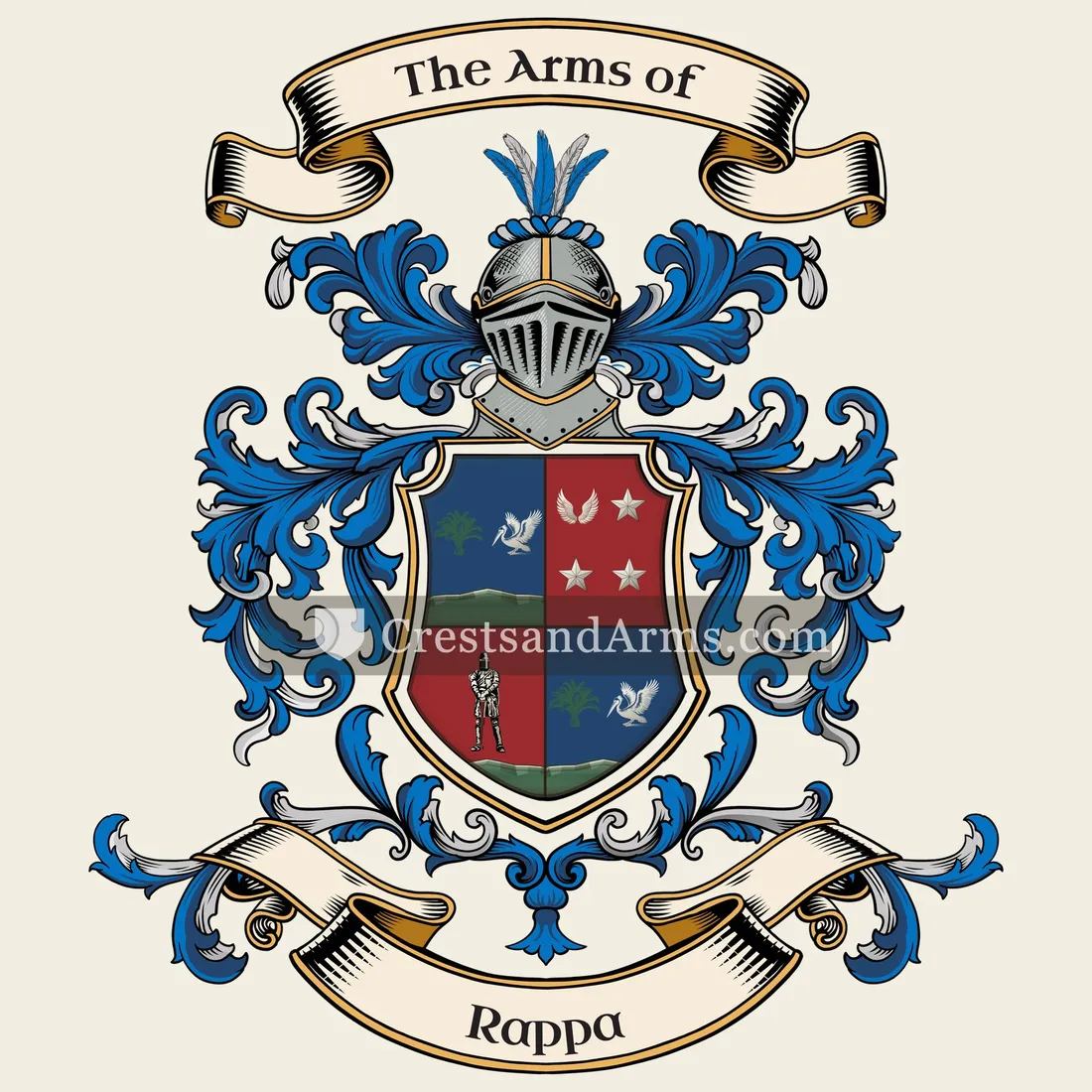
mountThe ground held, and steadfastness upon it
palm treeVictory, and righteousness that flourishes
pelicanSelf-sacrifice and devotion to one's children
vol / wingsSwiftness and protection
mulletThe third son, and a divine quality from above
knightChivalry and service in arms
Colours
Blue (Azure)Means: Loyalty and truth
Red (Gules)Means: Military strength
Green (Vert)Means: Hope
Silver (Argent)Means: Peace and sincerity
Historical info
Source
J. B. Rietstap, Armorial Général, Gouda: G. B. van Goor Zonen, 1884–87
Blazon (the actual original written record)
“Ec.: aux 1 et 4 d'azur à un palmier terrassé de sin., et un crocodile d'arg., pass. au pied de l'arbre; à sen. un pélican d'arg., tenant en son bec un serpent du même; au 2 de gu. à un vol d'arg., surm. de trois étoiles du même; au 3 de gu. à un chevalier, arm. de toutes pièces d'arg., tenant une épée et un bouclier du même, galopant sur une terrasse de sin.”
AlsaceAlsace, c. 1809
Digital archive packCoat of arms PNG, gold border print PDF, vector SVG and the certificate of authenticity. Sent to your email in minutes.
Map of France showing where the Rappa arms are recorded
The Rappa arms were recorded in Alsace, c. 1809.
Alsace lay between France and the German lands and belonged to both at different times. Its families held small estates and served whichever side ruled, and men who served in arms carried arms of their own.
This is where the arms were entered in the register. Families often moved to other parts of the country, so the same name can turn up in more than one region.
The body that granted and recorded arms in France in this period.
Napoleon
Sovereign of the period
Napoleon
1804–1814
Reigning in Germany when the Rappa arms are first recorded.
How Arms Worked in France
In France, a coat of arms was a mark of honor that passed down through the male line to all legitimate descendants. Families often used the same shield without changes to show their shared heritage. If a branch wanted to stand out, they could add a small mark to their shield to show their specific place in the family tree.
Granting authority
The Juge d'armes de France acted as the official authority that regulated and verified coats of arms across the country.
How they got arms
Families typically inherited their arms from ancestors, though they could also receive them through royal grants or by proving their noble status.
Where arms were recorded
Coats of arms were officially recorded in the Armorial Général de France, which began its main collection in the year 1696.
The family's standing
Recorded among the armigerous families of Alsace.
Origin & History of the Rappa Family in France
The history of the Rappa family in France is deeply tied to the unique cultural landscape of the Alsace region. By 1809, members of the family were firmly established in this area, which served as a historic crossroads between French and German influences. The name likely evolved from local linguistic roots, potentially reflecting the regional dialects spoken in the Rhine valley during the transition into the nineteenth century. Families living in Alsace at this time often navigated complex social changes brought on by the Napoleonic era, which included new systems for civil registration and record-keeping. Because Alsace was a hub for trade and agriculture, the Rappa family likely participated in the vibrant local economy that defined this borderland. Their presence in official records from the early 1800s suggests they were part of a stable community that helped shape the identity of the region during a period of significant political transformation.
Meaning of the Rappa family crest colors & symbols
Symbols on this shield
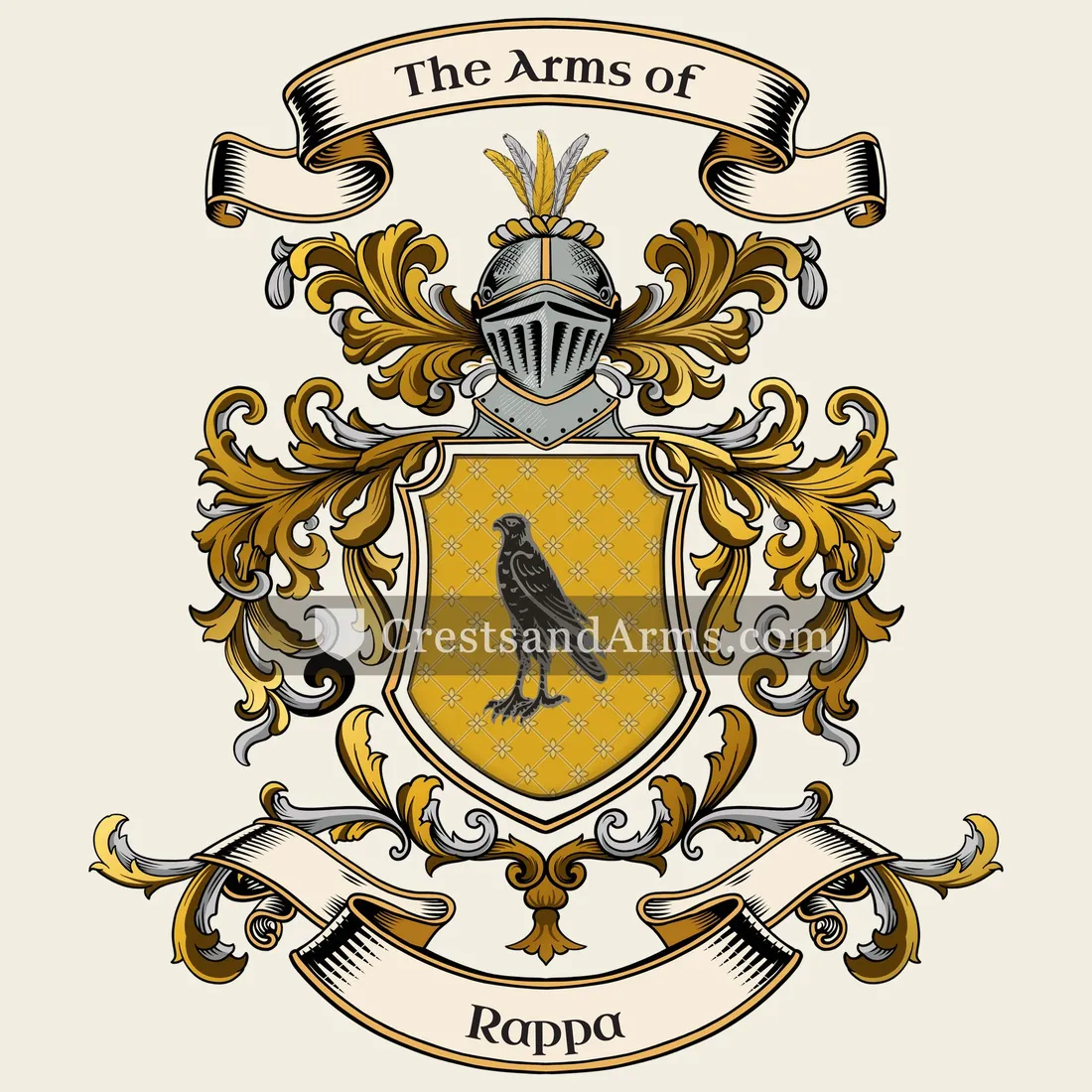
falconOne eager and quick in pursuit
Colours
Gold (Or)Means: Generosity
Black (Sable)Means: Constancy
Historical info
Source
J. B. Rietstap, Armorial Général, Gouda: G. B. van Goor Zonen, 1884–87
Blazon (the actual original written record)
“D'or à un vautour de sa., le vol levé. C.: le vautour, entre deux prob. coupées de sa. sur or.”
SwitzerlandBâle, c. 1745
Digital archive packCoat of arms PNG, gold border print PDF, vector SVG and the certificate of authenticity. Sent to your email in minutes.
Map of Switzerland showing where the Rappa arms are recorded
The Rappa arms were recorded in Bâle, c. 1745.
This is where the arms were entered in the register. Families often moved to other parts of the country, so the same name can turn up in more than one region.
The body that granted and recorded arms in Switzerland in this period.
How Arms Worked in Switzerland
In Switzerland, coats of arms were not restricted to the nobility and were often adopted by common citizens and families. These symbols were passed down through generations to show family identity. When branches of a family grew, they often changed small details of the design to distinguish their own line from the original group.
Granting authority
Cantonal and civic authorities managed the use of coats of arms within their specific regions and local jurisdictions.
How they got arms
Families typically assumed their own coats of arms based on local custom rather than receiving them from a central monarch.
Where arms were recorded
Arms were recorded in various cantonal and civic registers starting from the fourteenth century throughout the Swiss region.
The family's standing
Recorded among the armigerous families of Switzerland.
Origin & History of the Rappa Family in Switzerland
The Rappa family name has roots in Switzerland that trace back to the mid-eighteenth century, with documented evidence placing members of the family in the city of Bâle by 1745. During this period, Bâle served as a major center for trade and craftsmanship, and families like the Rappas often integrated into the local guild systems that defined the city’s social and economic life. The name itself is thought to be linked to regional dialects, potentially describing a person who worked with specific tools or lived near a particular type of terrain. As residents of a city known for its strict record-keeping and civic organization, the early Rappa family members were likely part of the growing urban middle class that helped shape the administrative and commercial landscape of the region. Their presence in Bâle during the 1740s suggests they were established citizens who participated in the daily functions of a bustling Swiss trade hub.
Rappa Meaning & Related Branches
Root word
Rappe
Middle High German term for a black horse.
This name
RappaAn occupational surname for a horse breeder or a nickname for someone with dark features.
also spelled
Rap
Documented Sources
J. B. Rietstap, Armorial Général, Gouda: G. B. van Goor Zonen, 1884–87
Thüringisches Staatsarchiv Rudolstadt, Kirchenbücher der Gemeinde (Parish records of the community), 1765
Meyers, A., Die Thüringischen Familiennamen und ihre Herkunft (The Thuringian family names and their origin), 1912
Historische Kommission für Thüringen, Thüringische Vierteljahresschrift für Geschichte und Kunst (Thuringian Quarterly Journal for History and Art), 1905
Digital archive packCoat of arms PNG, gold border print PDF, vector SVG and the certificate of authenticity. Sent to your email in minutes.


 bullValour and generosity
 bullValour and generosity


 mountThe ground held, and steadfastness upon it
 palm treeVictory, and righteousness that flourishes
 pelicanSelf-sacrifice and devotion to one's children
 vol / wingsSwiftness and protection
 mulletThe third son, and a divine quality from above
 knightChivalry and service in arms


 falconOne eager and quick in pursuit