Map of France showing where the Rasta arms are recorded
The Rasta arms were recorded in Lyonnais, c. 1663.
Lyonnais centred on Lyon, one of the great banking and silk towns of France. Money made in the city bought estates in the countryside around it, and those estates brought arms with them.
This is where the arms were entered in the register. Families often moved to other parts of the country, so the same name can turn up in more than one region.
The body that granted and recorded arms in France in this period.
Louis XIV of France
Sovereign of the period
Louis XIV of France
1643–1715
Reigning in France when the Rasta arms are first recorded.
How Arms Worked in France
In France, a coat of arms was a mark of honor that passed down through the male line to all legitimate descendants. Families often used the same shield without changes to show their shared heritage. If a branch wanted to stand out, they could add a small mark to their shield to show their specific place in the family tree.
Granting authority
The Juge d'armes de France acted as the official authority that regulated and verified coats of arms across the country.
How they got arms
Families typically inherited their arms from ancestors, though they could also receive them through royal grants or by proving their noble status.
Where arms were recorded
Coats of arms were officially recorded in the Armorial Général de France, which began its main collection in the year 1696.
The family's standing
Recorded among the armigerous families of Lyonnais.
Origin & History of the Rasta Family in France
The history of the Rasta family in France is rooted in the fertile landscape of the Lyonnais region, where records confirm their presence as early as 1663. During the seventeenth century, this area served as a vital crossroads for trade and agriculture, placing the family at the heart of a society defined by local craftsmanship and rural development. As inhabitants of the Lyonnais, the early members of the Rasta family likely participated in the traditional economic life of the province, which was heavily influenced by the proximity to the city of Lyon and its growing influence in silk production and regional commerce. While the name itself remains distinct, its survival through the centuries reflects the stability of families who remained tied to the land and local parishes. By maintaining their presence in this specific part of France, the Rasta family became part of the social fabric that defined the Lyonnais during the reign of King Louis XIV.
Meaning of the Rasta family crest colors & symbols
Symbols on this shield
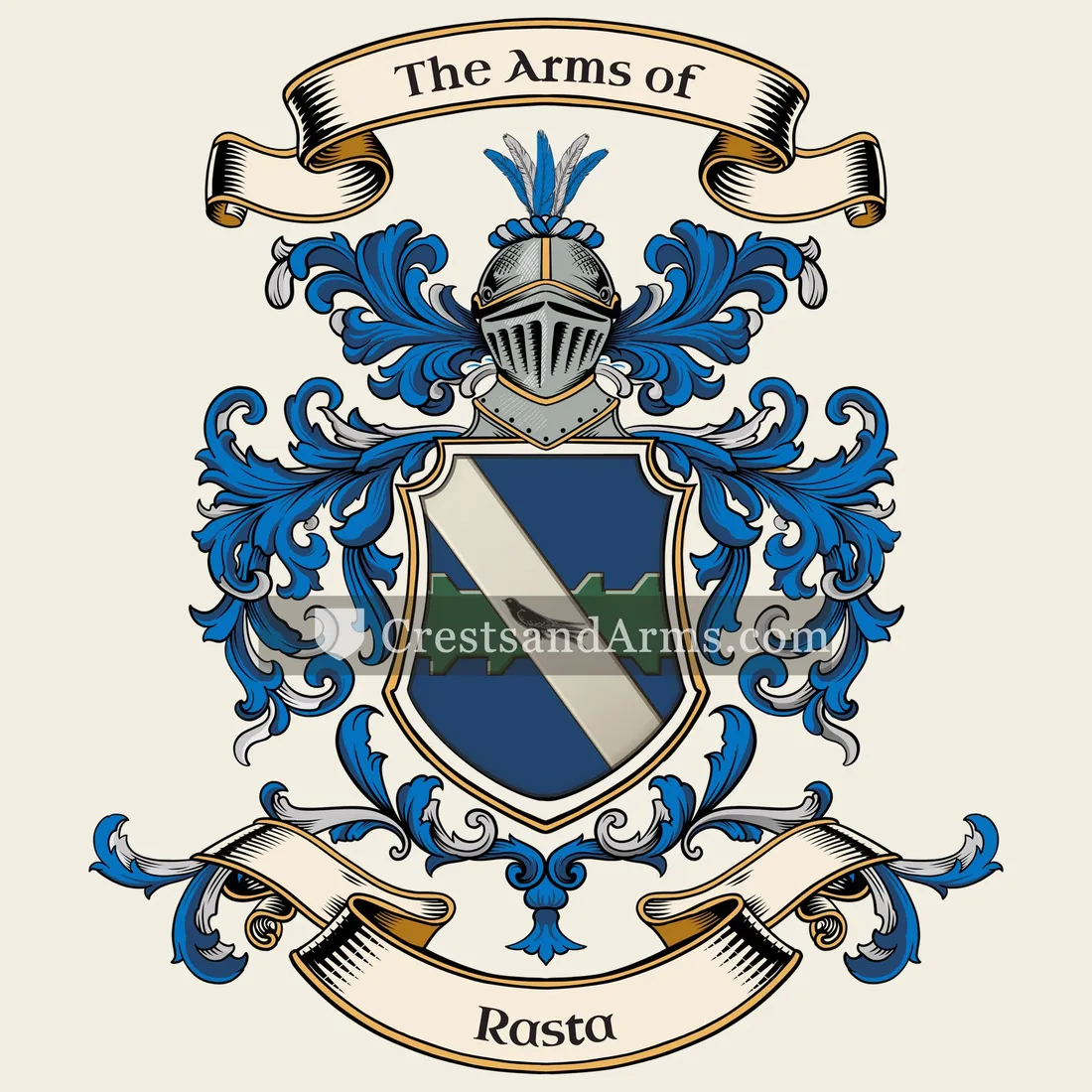
fessThe military belt, and readiness to serve
bendDefence, and the scarf of a commander
martletA younger son, who must win his own land
Colours
Blue (Azure)Means: Loyalty and truth
Green (Vert)Means: Hope
Silver (Argent)Means: Peace and sincerity
Black (Sable)Means: Constancy
Historical info
Source
J. B. Rietstap, Armorial Général, Gouda: G. B. van Goor Zonen, 1884–87
Blazon (the actual original written record)
“D'azur à la fasce crén. de sin., penchée de dextre à sen., supp. un oiseau de sa. et acc. en p. de deux bandes d'arg. Cq. cour. C.: un oiseau de sa. L. d'arg. et d'azur.”
Germanyc. 1765
Digital archive packCoat of arms PNG, gold border print PDF, vector SVG and the certificate of authenticity. Sent to your email in minutes.
Map of Germany showing where the Rasta arms are recorded
The Rasta arms were recorded in Germany, c. 1765.
Arms such as these were typically recorded in Bavaria.
Bavaria was a country of old landed families and walled market towns. Estates passed down the same line for centuries, and both the landowners and the leading townsmen kept arms, which is why so many Bavarian names sit in the registers.
This is where the arms were entered in the register. Families often moved to other parts of the country, so the same name can turn up in more than one region.
The body that granted and recorded arms in Germany in this period.
Francis I, Holy Roman Emperor
Sovereign of the period
Francis I, Holy Roman Emperor
1745–1765
Reigning in France when the Rasta arms are first recorded.
How Arms Worked in Germany
In the Holy Roman Empire, coats of arms were often granted to individuals by the Emperor or his representatives. These arms were then passed down through the generations to all legitimate descendants of the original holder. Younger branches of a family usually kept the same shield design without needing to change it, as the arms belonged to the entire lineage.
Granting authority
The Holy Roman Emperor held the sole power to grant new coats of arms throughout his vast imperial territories.
How they got arms
Families typically obtained their coats of arms through a formal imperial grant or by proving their noble status to the authorities.
Where arms were recorded
These grants were officially recorded in the Imperial Chancery registers, which began keeping formal records of such honors during the Middle Ages.
The family's standing
Recorded among the armigerous families of Germany.
Origin & History of the Rasta Family in Germany
The history of the Rasta family name in Germany is deeply rooted in the rural traditions of the Bavarian region during the eighteenth century. Official records confirm that members of the family were established in this area by 1765, living as part of the agrarian society that defined the landscape of southern Germany at the time. During this period, surnames often evolved from specific geographic markers or local nicknames, suggesting that the name Rasta may have been linked to a particular plot of land or a unique trade practiced by the family ancestors. Life for the family in 1765 Bavaria would have been centered around the seasonal rhythms of farming and the tight-knit social structures of small village communities. As the family grew and moved through the German states, they carried this regional identity with them, preserving their connection to the Bavarian highlands even as they integrated into the broader cultural fabric of the nation.
Meaning of the Rasta family crest colors & symbols
Symbols on this shield
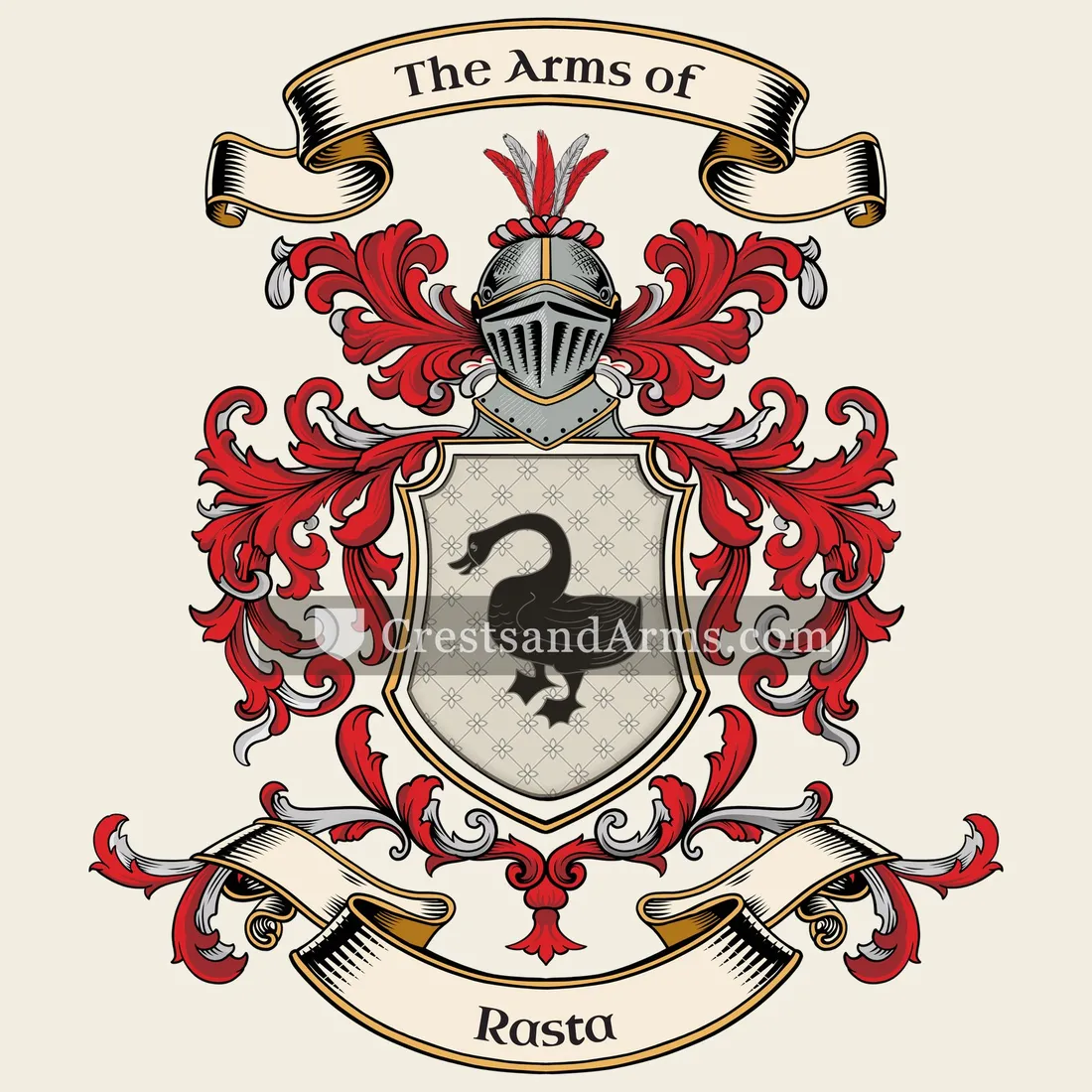
swanGrace, light and the poet's art
Colours
Silver (Argent)Means: Peace and sincerity
Black (Sable)Means: Constancy
Historical info
Source
J. B. Rietstap, Armorial Général, Gouda: G. B. van Goor Zonen, 1884–87
Blazon (the actual original written record)
“D'arg. à un cygne de sa., bq. et m. de gu. C.: deux têtes et cols de cygne affr. de sa., bq. de gu., ornés le long du col à l'ext. de plumes d'arg.”
Switzerlandc. 1745
Digital archive packCoat of arms PNG, gold border print PDF, vector SVG and the certificate of authenticity. Sent to your email in minutes.
Map of Switzerland showing where the Rasta arms are recorded
The Rasta arms were recorded in Switzerland, c. 1745.
Arms such as these were typically recorded in Bern.
Bern was the largest of the Swiss cantons and ran itself, with its own council and its own courts. Its governing families held office for generations, and office of that kind carried a shield with it.
This is where the arms were entered in the register. Families often moved to other parts of the country, so the same name can turn up in more than one region.
The body that granted and recorded arms in Switzerland in this period.
How Arms Worked in Switzerland
In Switzerland, coats of arms were not restricted to the nobility and were often adopted by common citizens and families. These symbols were passed down through generations to show family identity. When branches of a family grew, they often changed small details of the design to distinguish their own line from the original group.
Granting authority
Cantonal and civic authorities managed the use of coats of arms within their specific regions and local jurisdictions.
How they got arms
Families typically assumed their own coats of arms based on local custom rather than receiving them from a central monarch.
Where arms were recorded
Arms were recorded in various cantonal and civic registers starting from the fourteenth century throughout the Swiss region.
The family's standing
Recorded among the armigerous families of Switzerland.
Origin & History of the Rasta Family in Switzerland
The history of the Rasta family in Switzerland begins in the mid-eighteenth century, specifically within the city of Bern. Records confirm that members of the family were established residents there by 1745, living during a time when the city was a powerful center of trade and politics. The name itself is thought to be a regional variation of older Germanic or Alemannic surnames, likely evolving from local dialects spoken in the Swiss plateau. During this era, families like the Rastas were often part of the growing urban middle class, participating in the guilds and local civic life that defined Bernese society. Their presence in the city archives suggests they were integrated into the community for generations, contributing to the local economy and the steady development of the region. By settling in Bern, the early Rasta family became part of the long-standing tradition of Swiss citizenship that has shaped the country for centuries.
Rasta Meaning & Related Branches
Root word
Rastel
Derived from the Old French word for a rake or comb.
This name
RastaA topographic or occupational name for someone who lived near a rake-shaped feature or worked as a comb maker.
also spelled
Raste
Rastt
Documented Sources
J. B. Rietstap, Armorial Général, Gouda: G. B. van Goor Zonen, 1884–87
Archives départementales du Rhône, Registres paroissiaux de la province du Lyonnais, 1663
Béghain, Patrice, Dictionnaire historique de Lyon, 2009
Garrisson, Janine, L'Édit de Nantes et sa révocation: Histoire d'une intolérance, 1985
Digital archive packCoat of arms PNG, gold border print PDF, vector SVG and the certificate of authenticity. Sent to your email in minutes.


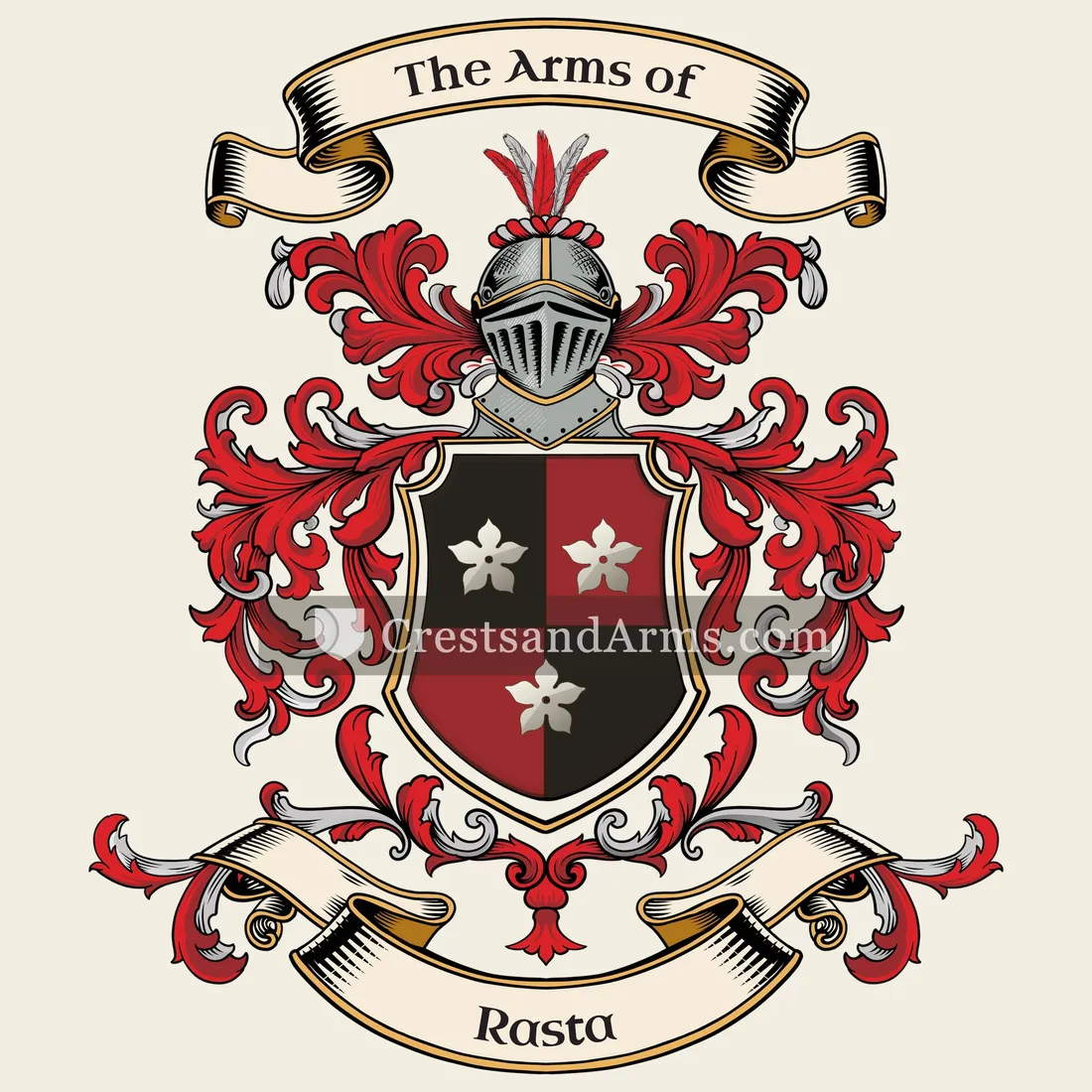
 cinquefoilHope and joy
 cinquefoilHope and joy


 fessThe military belt, and readiness to serve
 bendDefence, and the scarf of a commander
 martletA younger son, who must win his own land


 swanGrace, light and the poet's art