Map of France showing where the Ravo arms are recorded
The Ravo arms were recorded in Bourgogne, c. 1663.
Bourgogne was one of the richest parts of France, built on wine, wool and the roads that carried both. Wealth of that kind bought land, and land brought arms, so the region filled with armed families earlier than most of the country.
This is where the arms were entered in the register. Families often moved to other parts of the country, so the same name can turn up in more than one region.
The body that granted and recorded arms in France in this period.
Louis XIV of France
Sovereign of the period
Louis XIV of France
1643–1715
Reigning in France when the Ravo arms are first recorded.
How Arms Worked in France
In France, a coat of arms was a mark of honor that passed down through the male line to all legitimate descendants. Families often used the same shield without changes to show their shared heritage. If a branch wanted to stand out, they could add a small mark to their shield to show their specific place in the family tree.
Granting authority
The Juge d'armes de France acted as the official authority that regulated and verified coats of arms across the country.
How they got arms
Families typically inherited their arms from ancestors, though they could also receive them through royal grants or by proving their noble status.
Where arms were recorded
Coats of arms were officially recorded in the Armorial Général de France, which began its main collection in the year 1696.
The family's standing
Recorded among the armigerous families of Bourgogne.
Origin & History of the Ravo Family in France
The family name Ravo has deep roots in the Bourgogne region of France, where records confirm members of the family were living as early as 1663. During the seventeenth century, Bourgogne was a prominent area known for its rich agricultural traditions and its role in the wine trade. Families in this region often lived in small rural communities where they were closely tied to the land and local parish life. The name Ravo likely evolved from regional dialects or nicknames used to identify specific households within these tight-knit villages. As the family grew, they became part of the social fabric of eastern France, contributing to the local economy and the development of their community over several generations.
Ravo Meaning & Related Branches
Root word
Rave
Old French term referring to a turnip or a root vegetable.
This name
RavoA topographic surname for someone who lived near a turnip field or a cultivator of turnips.
also spelled
Ravaul
Ravo
Documented Sources
J. B. Rietstap, Armorial Général, Gouda: G. B. van Goor Zonen, 1884–87
Archives départementales de la Côte-d'Or, Registres paroissiaux et d'état civil, 1663
Bouchard, Gérard, Quelques aspects de la démographie historique en Bourgogne, 1978
Richard, Jean, Histoire de la Bourgogne, 1988
Digital archive packCoat of arms PNG, gold border print PDF, vector SVG and the certificate of authenticity. Sent to your email in minutes.


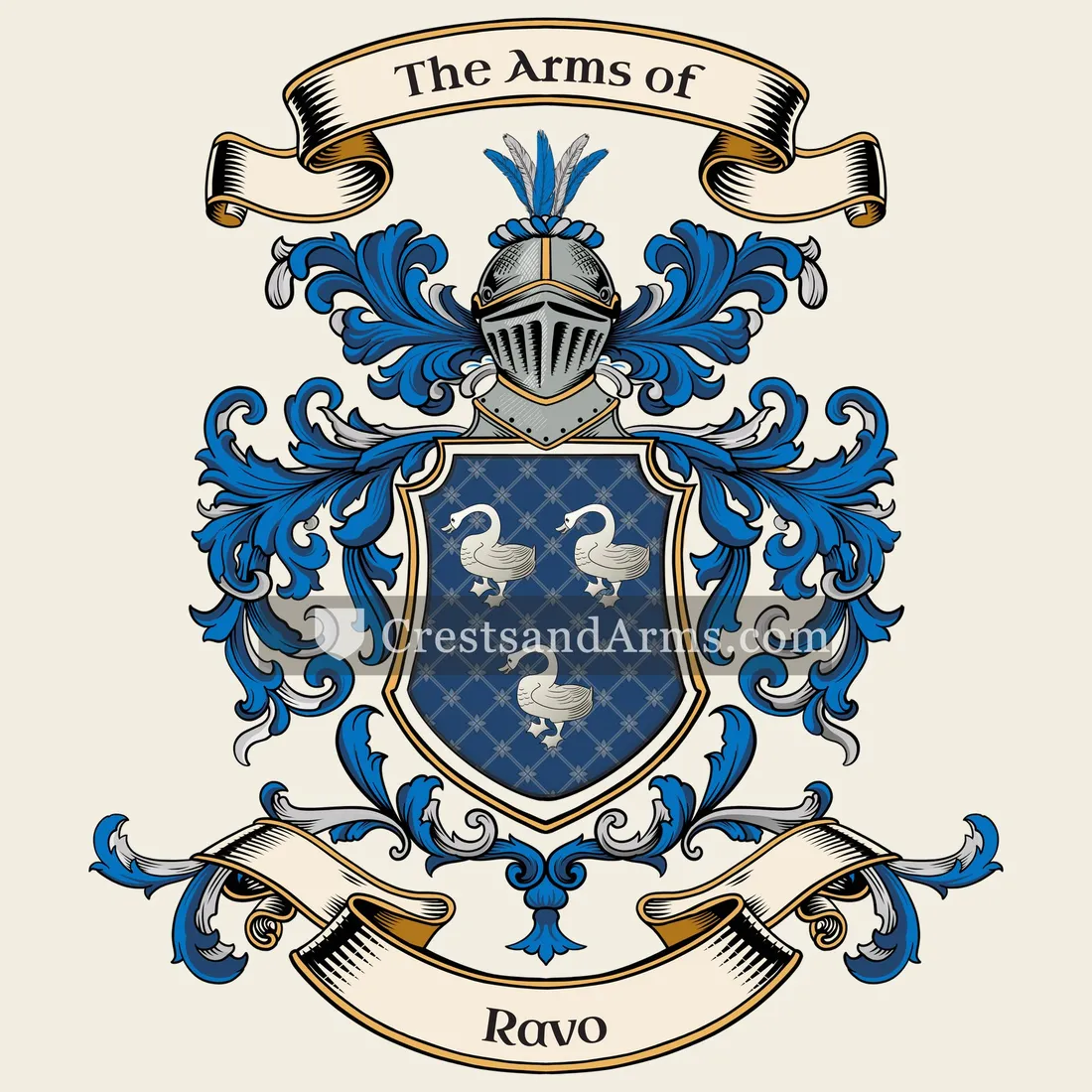
 swanGrace, light and the poet's art
 swanGrace, light and the poet's art