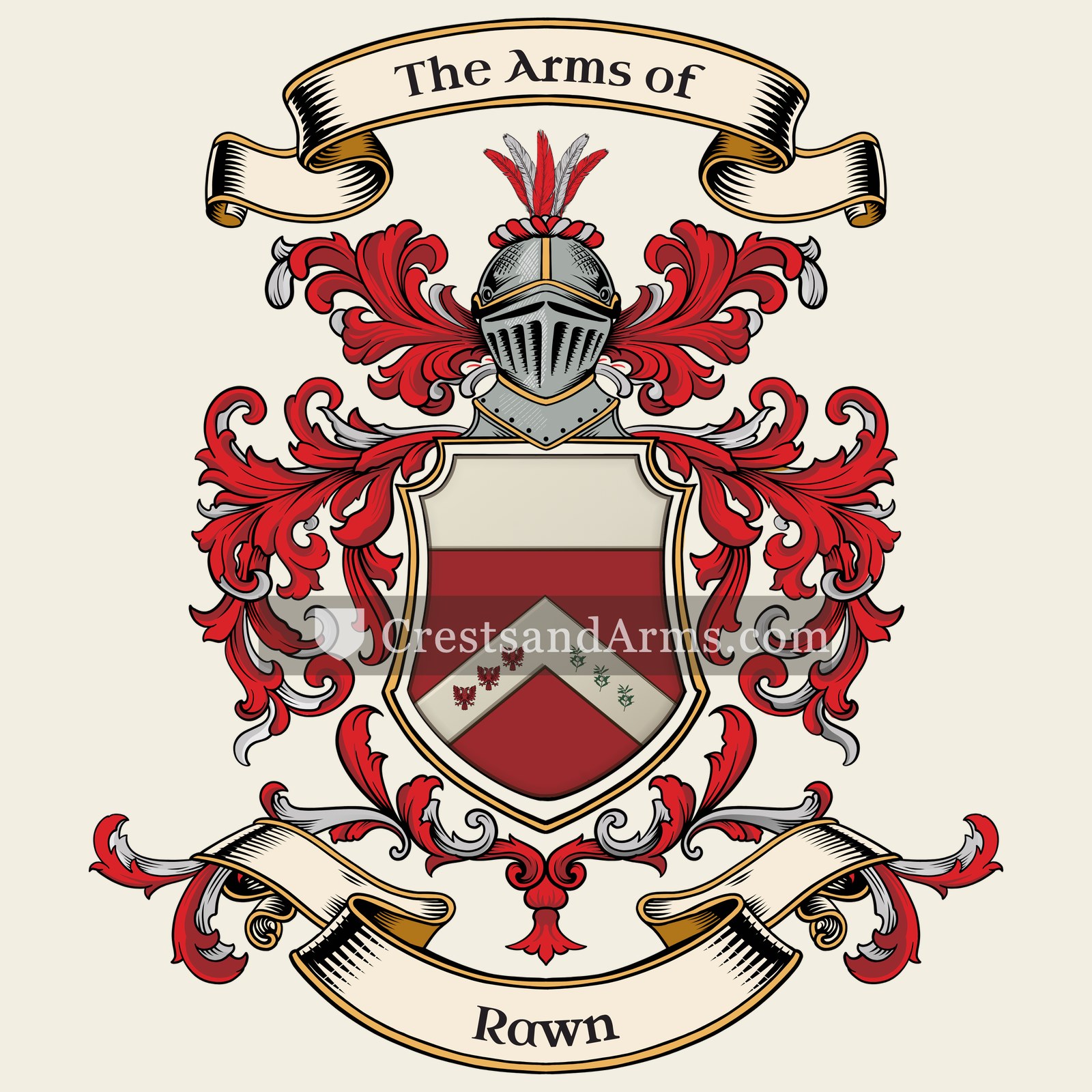
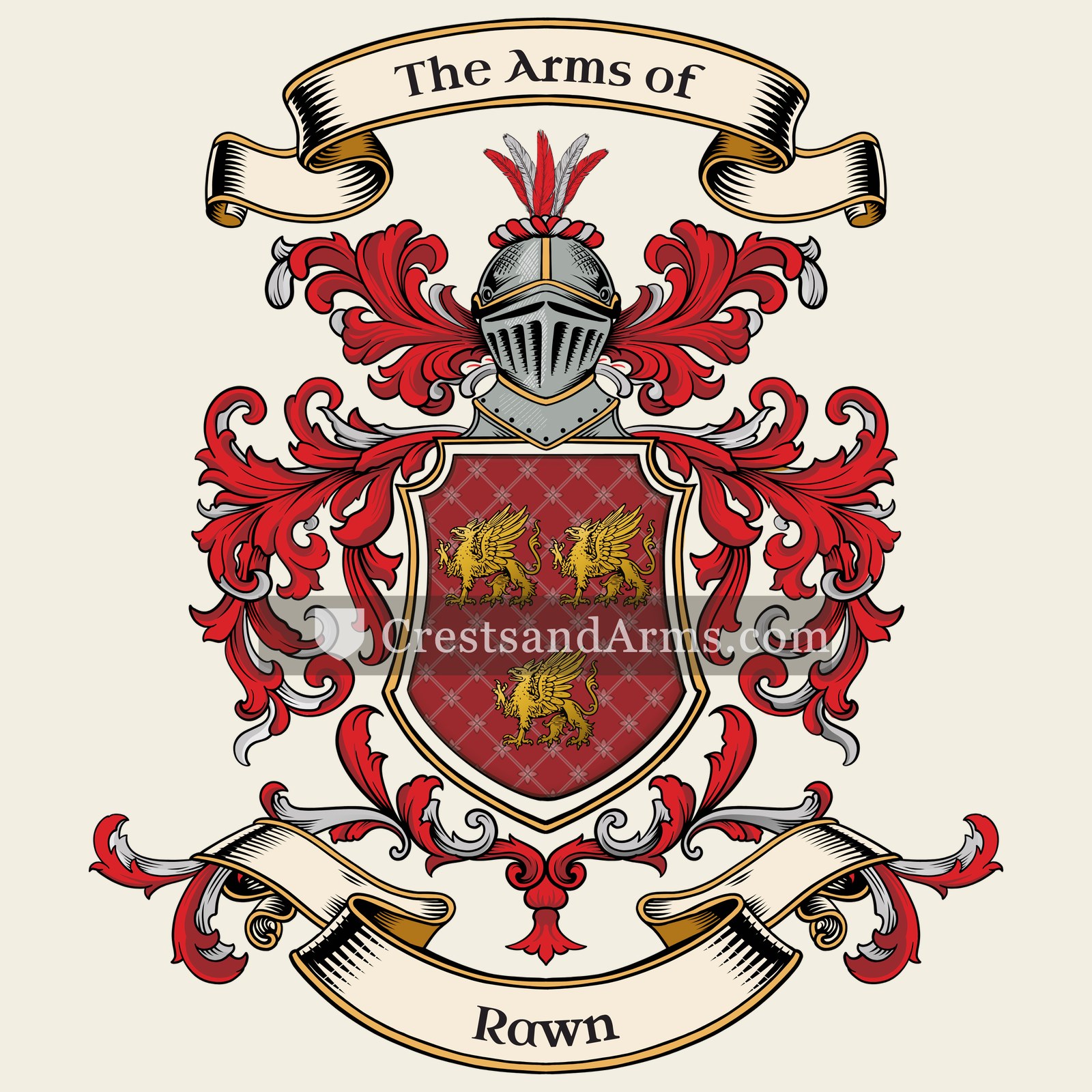
A record of documented arms, meaning and origin, researched for the Rawn family lines. Documented in 2 countries.
Reg. 5845 · French, P–S
Coat of Arms & Family Crest Details
Symbols on this shield
chevronProtection, and faithful service completed
headHonour, and a mind held high
eagleNobility, strength and a keen mind
chiefAuthority, wisdom and dominion
branchPeace, and new growth
hollyTruth, and protection through winter
leafHappiness and abundance
griffinValour and vigilance, guarding great treasure
armA person of action, industrious and laborious
swordJustice, and military honour
pawStrength held ready, the beast's power in a single limb
Colours
Red (Gules)Means: Military strength
Silver (Argent)Means: Peace and sincerity
Green (Vert)Means: Hope
Black (Sable)Means: Constancy
Historical info
Source
J. B. Rietstap, Armorial Général, Gouda: G. B. van Goor Zonen, 1884–87
Blazon (the actual original written record)
“De gu. au chev. d'arg., ch. de trois têtes d'aigle du champ; au chef du sec., ch. de trois branches de houx, feuillées chacune de cinq pièces de sin. Cq. cour. C.: un griffon de gu., arm. d'une épée d'arg., empoignant de sa patte dextre la lame et de sa sen. la garde de l'épée. L. d'arg. et de gu. D.: MALO MORI QUAM FOEDARI.”
Francec. 1725
Digital archive packCoat of arms PNG, gold border print PDF, vector SVG and the certificate of authenticity. Sent to your email in minutes.
Map of France showing where the Rawn arms are recorded
The Rawn arms were recorded in France, c. 1725.
Arms such as these were typically recorded in Bretagne.
More families held coats of arms in Bretagne than anywhere else in France. The land was divided into many small estates rather than a few large ones, so far more households counted as gentry, and each needed a shield of its own to be told apart.
This is where the arms were entered in the register. Families often moved to other parts of the country, so the same name can turn up in more than one region.
The body that granted and recorded arms in France in this period.
Louis XV of France
Sovereign of the period
Louis XV of France
1715–1774
Reigning in France when the Rawn arms are first recorded.
How Arms Worked in France
In France, a coat of arms was a mark of honor that passed down through the male line to all legitimate descendants. Families often used the same shield without changes to show their shared heritage. If a branch wanted to stand out, they could add a small mark to their shield to show their specific place in the family tree.
Granting authority
The Juge d'armes de France acted as the official authority that regulated and verified coats of arms across the country.
How they got arms
Families typically inherited their arms from ancestors, though they could also receive them through royal grants or by proving their noble status.
Where arms were recorded
Coats of arms were officially recorded in the Armorial Général de France, which began its main collection in the year 1696.
The family's standing
Recorded among the armigerous families of France.
Origin & History of the Rawn Family in France
The family name Rawn finds its early roots in the rugged landscape of Bretagne, France, where records confirm the presence of family members by the year 1725. During this era, the region of Bretagne functioned with a distinct cultural identity that was often separate from the rest of the French kingdom. Families living in this coastal area were frequently involved in maritime trades, agriculture, or the production of linen, which was a major economic driver for the province at the time. Life in eighteenth-century Bretagne was shaped by strong local traditions and the influence of the Catholic Church, which meticulously recorded births, marriages, and deaths in parish registers. As members of this family navigated the social structures of the time, they were part of a resilient population that maintained deep ties to their ancestral lands before many families began to migrate outward toward new opportunities in the Atlantic world.
Coat of Arms & Family Crest Details
Symbols on this shield
griffinValour and vigilance, guarding great treasure
Colours
Red (Gules)Means: Military strength
Gold (Or)Means: Generosity
Historical info
Source
Sir Bernard Burke, The General Armory of England, Scotland, Ireland and Wales, London: Harrison & Sons, 1884
Blazon (the actual original written record)
“Gu. three griffins' heads erased or”
TipperaryInch House · Tipperary, c. 1645
Digital archive packCoat of arms PNG, gold border print PDF, vector SVG and the certificate of authenticity. Sent to your email in minutes.
Map of Ireland showing where the Rawn arms are recorded
The Rawn arms were recorded in Tipperary, c. 1645.
Tipperary was the best grazing land in Ireland, held by a small number of powerful families. Land of that value stayed in the same hands, and unbroken holding is what puts a name in the records.
This is where the arms were entered in the register. Families often moved to other parts of the country, so the same name can turn up in more than one region.
The body that granted and recorded arms in Ireland in this period.
Charles I of England
Sovereign of the period
Charles I of England
1625–1649
Reigning in France when the Rawn arms are first recorded.
How Arms Worked in Ireland
The Ulster King of Arms granted coats of arms to individuals who proved their social standing and good character. These symbols were typically inherited by all legitimate descendants of the original holder. If a family branch wanted a unique look, they could apply for a specific change to their design through the office to ensure their identity remained distinct.
Granting authority
The Ulster King of Arms acted as the official body that regulated and issued all coats of arms throughout Ireland.
How they got arms
Families obtained their arms through formal grants issued by the office after proving their eligibility and paying the required fees.
Where arms were recorded
All official grants were recorded in the registers held by the Ulster King of Arms starting from the year 1552.
The family's standing
Recorded among the armigerous families of Tipperary.
Origin & History of the Rawn Family in Ireland
The Rawn family name has deep roots in the landscape of County Tipperary, where records confirm their presence as early as 1645. During this period, Ireland was undergoing significant political and social upheaval, which often forced families to establish themselves firmly within their local communities to survive. The name likely evolved from older Gaelic or Anglo-Norman naming traditions, reflecting the complex mix of cultures present in the region during the seventeenth century. As residents of Tipperary, the early members of the Rawn family were likely involved in the agricultural life that defined the area, navigating the challenges of land ownership and shifting regional power structures. By maintaining a steady presence in this specific part of Ireland, the family became part of the long-standing history of the province of Munster, contributing to the local identity that persisted through centuries of change.
Related Branches & Arms
Root word
Raoul
Derived from the Germanic name Radulf meaning wolf counsel.
This name
RawnA variant of the French name Raoul, signifying a wise counselor or wolf advisor.
also spelled
Rian
Ryann
Ryen
Documented Sources
J. B. Rietstap, Armorial Général, Gouda: G. B. van Goor Zonen, 1884–87
Archives départementales d'Ille-et-Vilaine, Série B (Fonds de la juridiction de Bretagne)
Archives départementales du Finistère, Série E (État civil et registres paroissiaux)
Croix, Alain, La Bretagne aux 16e et 17e siècles: la vie, la mort, la foi, 1981
Le Goff, Jacques, La Bretagne, 1989
Digital archive packCoat of arms PNG, gold border print PDF, vector SVG and the certificate of authenticity. Sent to your email in minutes.


 chevronProtection, and faithful service completed
 headHonour, and a mind held high
 eagleNobility, strength and a keen mind
 chiefAuthority, wisdom and dominion
 branchPeace, and new growth
 hollyTruth, and protection through winter
 leafHappiness and abundance
 griffinValour and vigilance, guarding great treasure
 armA person of action, industrious and laborious
 swordJustice, and military honour
 pawStrength held ready, the beast's power in a single limb
 chevronProtection, and faithful service completed
 headHonour, and a mind held high
 eagleNobility, strength and a keen mind
 chiefAuthority, wisdom and dominion
 branchPeace, and new growth
 hollyTruth, and protection through winter
 leafHappiness and abundance
 griffinValour and vigilance, guarding great treasure
 armA person of action, industrious and laborious
 swordJustice, and military honour
 pawStrength held ready, the beast's power in a single limb