Map of France showing where the Ray arms are recorded
The Ray arms were recorded in Franche-Comte, c. 1623.
Franche-Comte sat between France and the Empire and changed hands more than once. Border families held their land under arms and expected to defend it, so a shield was a practical thing rather than an ornament.
This is where the arms were entered in the register. Families often moved to other parts of the country, so the same name can turn up in more than one region.
The body that granted and recorded arms in France in this period.
Louis XIII of France
Sovereign of the period
Louis XIII of France
1617–1643
Reigning in France when the Ray arms are first recorded.
How Arms Worked in France
In France, a coat of arms was a mark of honor that passed down through the male line to all legitimate descendants. Families often used the same shield without changes to show their shared heritage. If a branch wanted to stand out, they could add a small mark to their shield to show their specific place in the family tree.
Granting authority
The Juge d'armes de France acted as the official authority that regulated and verified coats of arms across the country.
How they got arms
Families typically inherited their arms from ancestors, though they could also receive them through royal grants or by proving their noble status.
Where arms were recorded
Coats of arms were officially recorded in the Armorial Général de France, which began its main collection in the year 1696.
The family's standing
Recorded among the armigerous families of Franche-Comte.
Origin & History of the Ray Family in France
The family name Ray traces its roots to the historic region of Franche-Comté in eastern France. By the year 1623, records confirm that members of the family were already established in this area, which was then a territory known for its unique blend of French and Burgundian cultural influences. The name likely originated as a descriptive term, potentially derived from the Old French word "rai," which referred to a beam of light or a specific geographic feature like a small stream. Families in this mountainous region often took names based on the natural landscape or the specific village where they resided. During the early 17th century, the people of Franche-Comté lived through a period of significant political transition as the region moved toward integration with the French crown. The Ray family would have been part of this local society, likely working in agriculture or trade within the small communities nestled in the Jura Mountains. Their presence in the historical record during this time highlights a long-standing connection to the land and the complex social history of eastern France.
Coat of Arms & Family Crest Details
Symbols on this shield
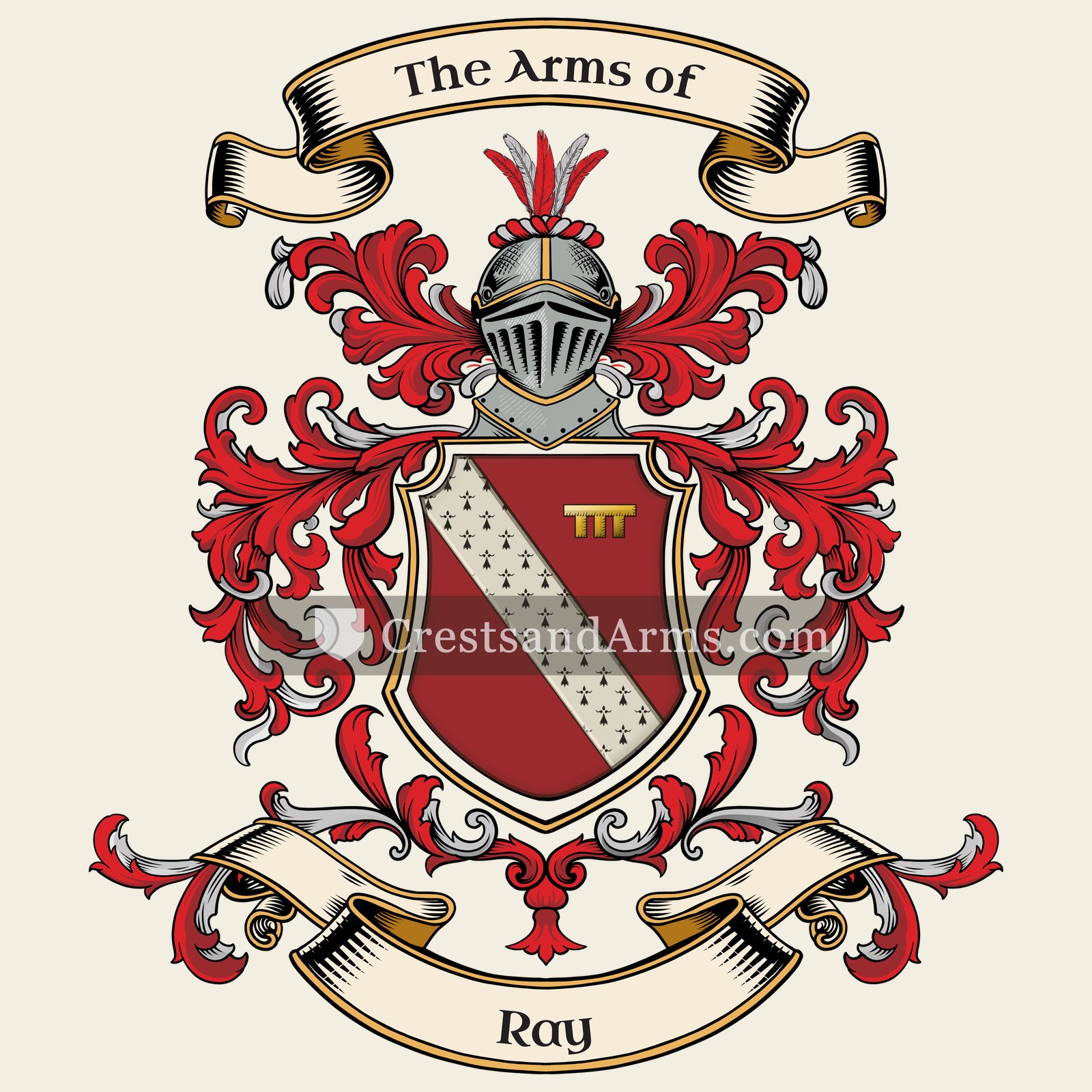
bendDefence, and the scarf of a commander
labelThe eldest son, during his father's life
Colours
Red (Gules)Means: Military strength
ErmineMeans: Dignity
Gold (Or)Means: Generosity
Historical info
Source
Sir Bernard Burke, The General Armory of England, Scotland, Ireland and Wales, London: Harrison & Sons, 1884
Blazon (the actual original written record)
“Gu. a bend erm. a label or”
BerwickPursuivant Extraordinary · Berwick, c. 1565
Digital archive packCoat of arms PNG, gold border print PDF, vector SVG and the certificate of authenticity. Sent to your email in minutes.
Map of Scotland showing where the Ray arms are recorded
The Ray arms were recorded in Berwick, c. 1565.
Berwickshire was Scottish border country, raided and fought over for three centuries. Families held their land in return for defending it, and a defending household carried a shield.
This is where the arms were entered in the register. Families often moved to other parts of the country, so the same name can turn up in more than one region.
The body that granted and recorded arms in Scotland in this period.
Mary, Queen of Scots
Sovereign of the period
Mary, Queen of Scots
1542–1567
Reigning in France when the Ray arms are first recorded.
How Arms Worked in Scotland
Scottish heraldry is unique because it treats a coat of arms as a piece of personal property protected by law. Only one person can own a specific design at any given time. When a family grows, the head keeps the original shield while other relatives must apply for their own distinct version with slight changes to prove their specific identity.
Granting authority
The Court of the Lord Lyon acts as the official body that regulates and controls all heraldic matters throughout Scotland.
How they got arms
Individuals obtain a legal right to their arms through a formal petition process that confirms their identity and family connection.
Where arms were recorded
All valid coats of arms are officially entered into the Public Register of All Arms and Bearings starting from 1672.
The family's standing
Recorded among the armigerous families of Berwick.
Origin & History of the Ray Family in Scotland
The family name Ray has deep roots in the Scottish Borders, a region defined by its rugged landscape and long history of shifting political boundaries. By 1565, records confirm that members of the Ray family were established in the coastal town of Berwick. During this era, Berwick was a focal point of intense activity due to its strategic position between the kingdoms of Scotland and England. Families living in this area often navigated a complex social environment shaped by trade, border disputes, and the influence of local landowners. The name itself likely evolved from older descriptive terms used to identify people based on their physical traits or their connection to the local environment. As the family grew, they became part of the resilient population that helped define the cultural identity of the Scottish borderlands during the sixteenth century.
Coat of Arms & Family Crest Details
Symbols on this shield
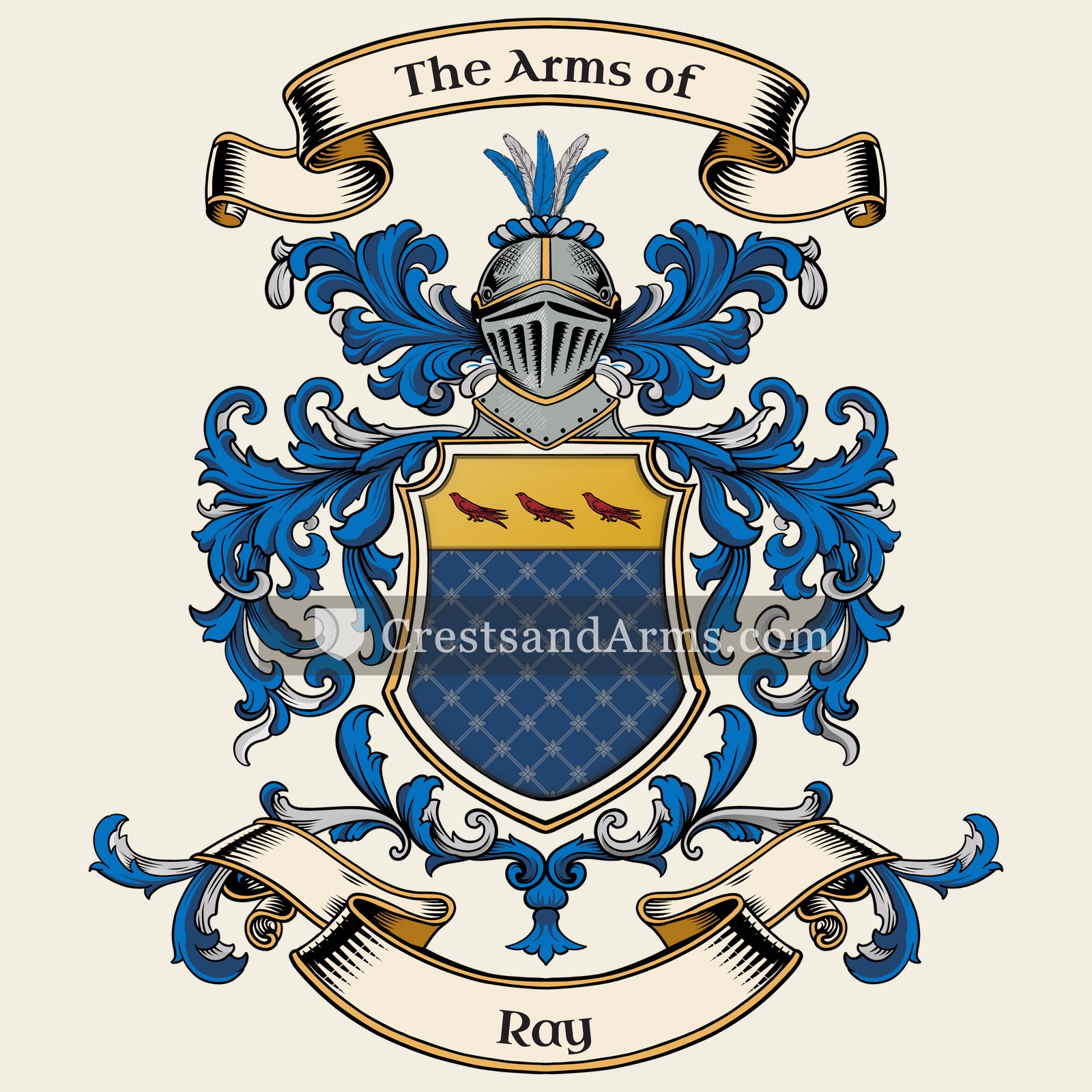
chiefAuthority, wisdom and dominion
martletA younger son, who must win his own land
Colours
Blue (Azure)Means: Loyalty and truth
Gold (Or)Means: Generosity
Red (Gules)Means: Military strength
Historical info
Source
Sir Bernard Burke, The General Armory of England, Scotland, Ireland and Wales, London: Harrison & Sons, 1884
Blazon (the actual original written record)
“Az. on a chief or, three martlets gu”
LincolnLincoln, c. 1620
Digital archive packCoat of arms PNG, gold border print PDF, vector SVG and the certificate of authenticity. Sent to your email in minutes.
Map of England showing where the Ray arms are recorded
The Ray arms were recorded in Lincoln, c. 1620.
Lincolnshire was rich farming country, and its wealth was spread across many middling families. Households of that size bought land and took arms, and the county holds a large share of English names.
This is where the arms were entered in the register. Families often moved to other parts of the country, so the same name can turn up in more than one region.
The body that granted and recorded arms in England in this period.
James VI and I
Sovereign of the period
James VI and I
1603–1625
Reigning in France when the Ray arms are first recorded.
How Arms Worked in England
English heraldry allowed arms to be shared by all legitimate descendants of the original owner. These symbols were treated as personal property that moved through the generations to all children. While the eldest son kept the original design, other family members could use the same shield without needing to change it or register their own unique versions.
Granting authority
The College of Arms in London has regulated the use of coats of arms throughout England and Wales since 1484.
How they got arms
Families typically obtained their coats of arms through a formal grant from the Crown or by proving their ancient right to them.
Where arms were recorded
All official coats of arms are recorded in the registers kept at the College of Arms, which date back to the fifteenth century.
The family's standing
Recorded among the armigerous families of Lincoln.
Origin & History of the Ray Family in England
The surname Ray has deep roots in the English landscape, emerging as a descriptive name long before it became a formal family identifier. In its earliest form, the name likely functioned as a nickname derived from the Old French word "rei," meaning king, or from the Middle English word "ray," which referred to a streak of light or a specific type of striped cloth. By the time members of the family were documented in Lincoln in 1620, the name was already well-established across various English counties. Families bearing this name often lived in rural communities where they worked as farmers or tradespeople. Because surnames were still evolving during this period, the spelling was highly flexible and often changed based on how a local clerk heard the name pronounced. The presence of the Ray family in Lincoln during the early 17th century suggests they were part of the growing middle class that helped shape the social and economic life of the region during a time of significant transition in England.
Ray Meaning & Related Branches
Root word
Radius
Latin term meaning a ray of light or a spoke of wheel.
This name
RayA topographic name for someone who lived near a boundary or a stream.
also spelled
Rai
Rae
Rea
Reay
Related arms
Raesimilar arms
Rea, or Reevariant spelling
Reayvariant spelling
Reyvariant spelling
Documented Sources
J. B. Rietstap, Armorial Général, Gouda: G. B. van Goor Zonen, 1884–87
Bavoux, François, Histoire de la Franche-Comté, 1950
Gauthier, Jules, Inventaire sommaire des archives départementales antérieures à 1790: Jura, 1887
Archives départementales du Jura, Série B: Cours et juridictions
Digital archive packCoat of arms PNG, gold border print PDF, vector SVG and the certificate of authenticity. Sent to your email in minutes.




 bendDefence, and the scarf of a commander
 labelThe eldest son, during his father's life


 chiefAuthority, wisdom and dominion
 martletA younger son, who must win his own land