A record of documented arms, meaning and origin, researched for the Reade family lines. Documented in 3 countries.
Reg. 5062 · Britain, P–S
Meaning of the Reade family crest colors & symbols
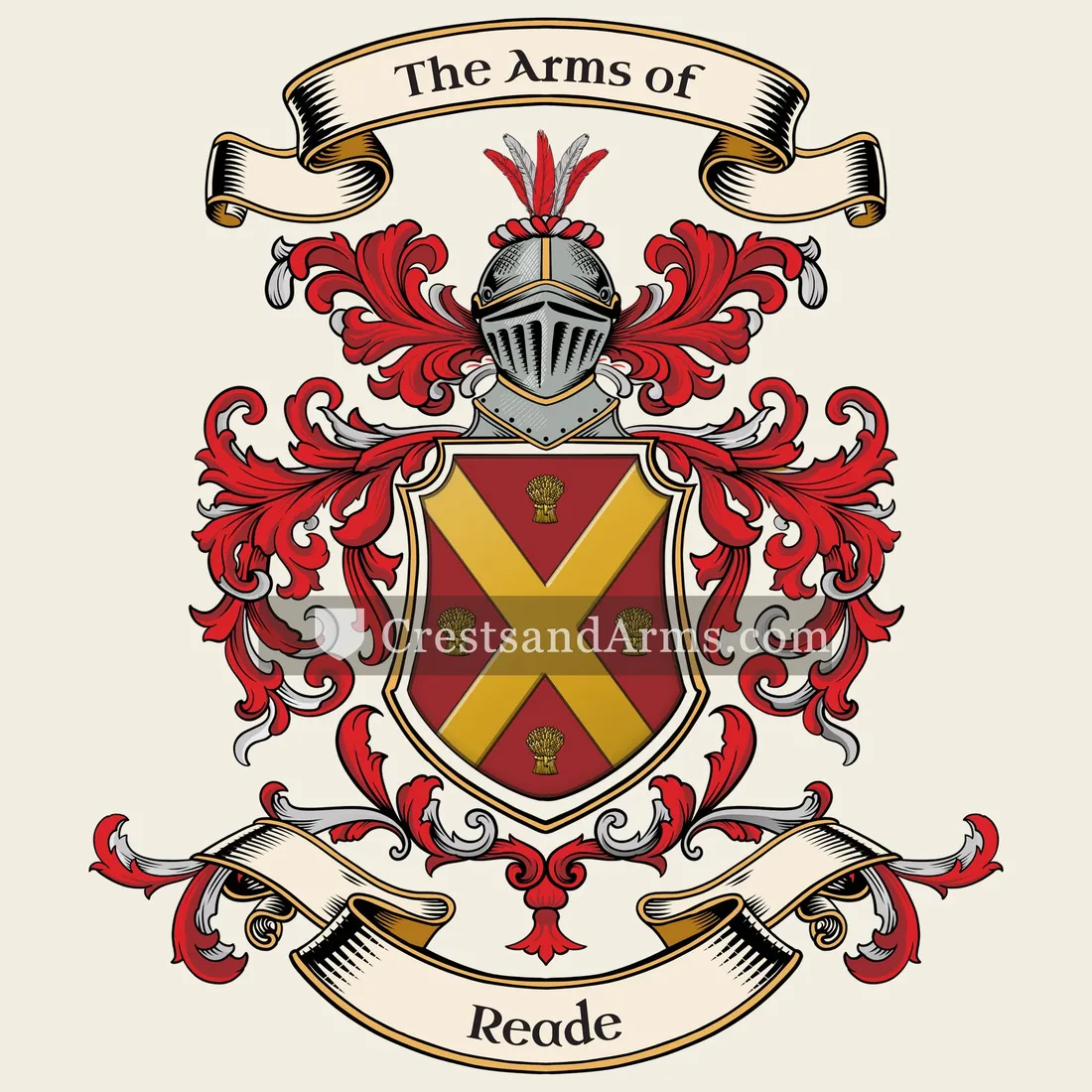
Symbols on this shield
saltireResolution, and St Andrew's cross
wheatsheafPlenty, and the harvest of one's own labour
Colours
Red (Gules)Means: Military strength
Gold (Or)Means: Generosity
Historical info
Source
J. B. Rietstap, Armorial Général, Gouda: G. B. van Goor Zonen, 1884–87
Blazon (the actual original written record)
“De gu. au saut. d'or, cant. de quatre gerbes du même. C.: un faucon ess. au nat., longé et grilleté d'or, soutenu d'un tronc d'arbre au nat. D.: CEDANT ARMA TOGÆ.”
OxfordshireOxfordshire, c. 1660
Digital archive packCoat of arms PNG, gold border print PDF, vector SVG and the certificate of authenticity. Sent to your email in minutes.
Map of Britain showing where the Reade arms are recorded
The Reade arms were recorded in Oxfordshire, c. 1660.
This is where the arms were entered in the register. Families often moved to other parts of the country, so the same name can turn up in more than one region.
The body that granted and recorded arms in Britain in this period.
Charles II of England
Sovereign of the period
Charles II of England
1660–1685
Reigning in Britain when the Reade arms are first recorded.
How Arms Worked in Britain
English heraldry allowed arms to be shared by all legitimate descendants of the original owner. These symbols were treated as personal property that moved through the generations to all children. While the eldest son kept the original design, other family members could use the same shield without needing to change it or register their own unique versions.
Granting authority
The College of Arms in London has regulated the use of coats of arms throughout England and Wales since 1484.
How they got arms
Families typically obtained their coats of arms through a formal grant from the Crown or by proving their ancient right to them.
Where arms were recorded
All official coats of arms are recorded in the registers kept at the College of Arms, which date back to the fifteenth century.
The family's standing
Recorded among the armigerous families of Oxfordshire.
Origin & History of the Reade Family in Britain
The surname Reade is rooted in the Old English word "read," which translates to the color red. In medieval Britain, this name often served as a descriptive nickname for someone with a ruddy complexion or bright red hair. While the name appeared in various regions across England, the family established a significant presence in Oxfordshire by the mid-seventeenth century. By 1660, members of the Reade family were well-integrated into the local social and economic life of the county. During this period, the name was frequently recorded in parish registers and legal documents as the family navigated the shifting political landscape of the English Restoration. These early records illustrate how a simple descriptive nickname evolved into a stable hereditary surname that anchored the family within their local community for generations.
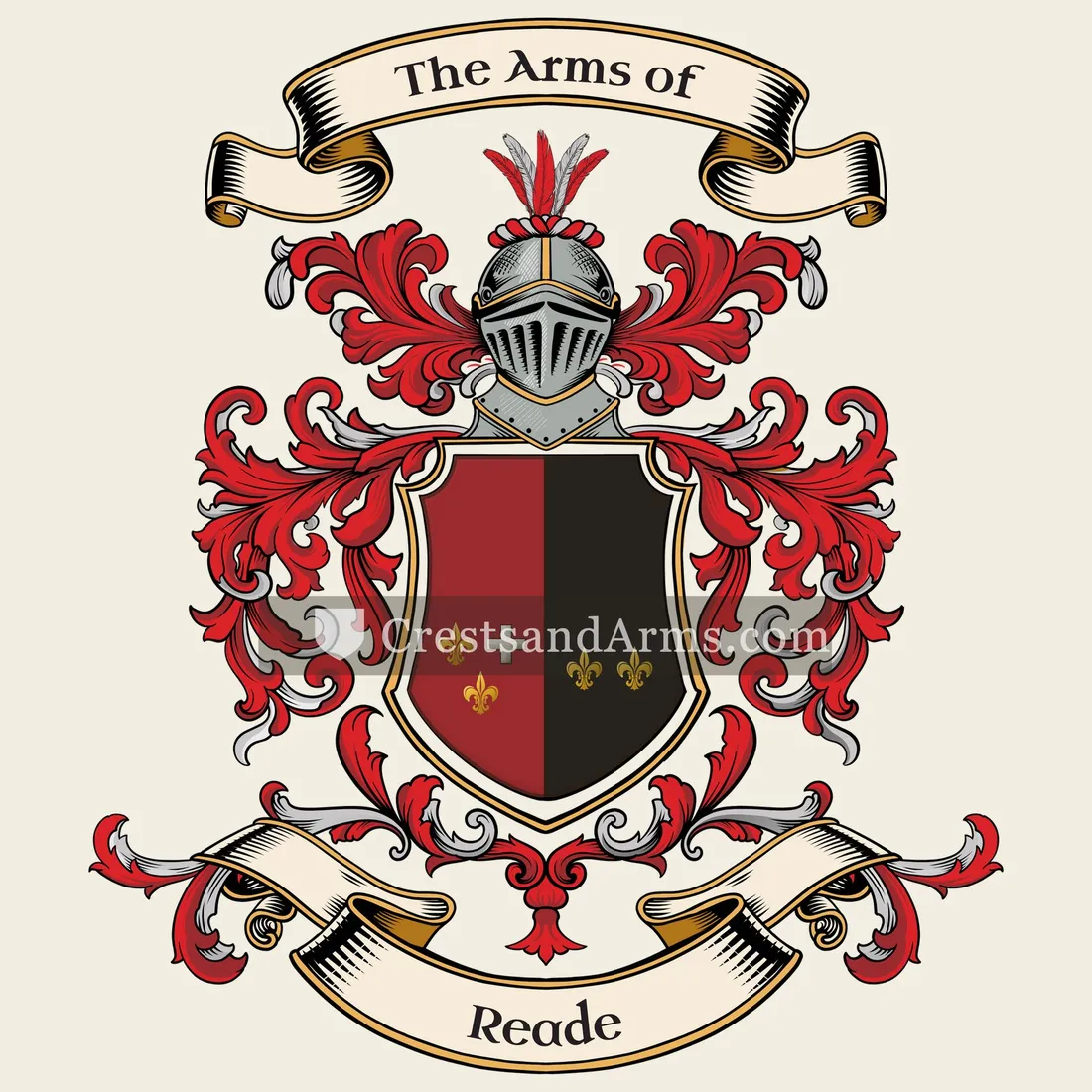
Meaning of the Reade family crest colors & symbols
Symbols on this shield
cross symbolChristian faith and service
fleur de lisPurity, light, and the sixth son
Colours
Red (Gules)Means: Military strength
Black (Sable)Means: Constancy
Silver (Argent)Means: Peace and sincerity
Gold (Or)Means: Generosity
Historical info
Source
Sir Bernard Burke, The General Armory of England, Scotland, Ireland and Wales, London: Harrison & Sons, 1884
Blazon (the actual original written record)
“Per pale gu. and sa. a cross botonnée fitchée ar. betw. four fleurs-de-lis or”
EnglandLondon, c. 1502
Digital archive packCoat of arms PNG, gold border print PDF, vector SVG and the certificate of authenticity. Sent to your email in minutes.
Map of England showing where the Reade arms are recorded
The Reade arms were recorded in London, c. 1502.
This is where the arms were entered in the register. Families often moved to other parts of the country, so the same name can turn up in more than one region.
The body that granted and recorded arms in England in this period.
Henry VII of England
Sovereign of the period
Henry VII of England
1485–1509
Reigning in Britain when the Reade arms are first recorded.
How Arms Worked in England
English heraldry allowed arms to be shared by all legitimate descendants of the original owner. These symbols were treated as personal property that moved through the generations to all children. While the eldest son kept the original design, other family members could use the same shield without needing to change it or register their own unique versions.
Granting authority
The College of Arms in London has regulated the use of coats of arms throughout England and Wales since 1484.
How they got arms
Families typically obtained their coats of arms through a formal grant from the Crown or by proving their ancient right to them.
Where arms were recorded
All official coats of arms are recorded in the registers kept at the College of Arms, which date back to the fifteenth century.
The family's standing
Recorded among the armigerous families of England.
Origin & History of the Reade Family in England
The family name Reade is an ancient English surname that originated as a descriptive nickname for people with red hair or a ruddy complexion. During the Middle Ages, surnames were often adopted to help distinguish individuals in growing communities, and the name evolved from the Old English word "read." By the time the family was documented in London in 1502, the name had already become well-established across various regions of England. Families bearing this name were often involved in trade, local government, and the legal profession as the nation transitioned into the early modern period. Because the name was tied to a physical trait rather than a specific location, it emerged independently in several different parts of the country. This led to a diverse history where different branches of the family contributed to the economic and social life of English cities and rural parishes alike.
Meaning of the Reade family crest colors & symbols
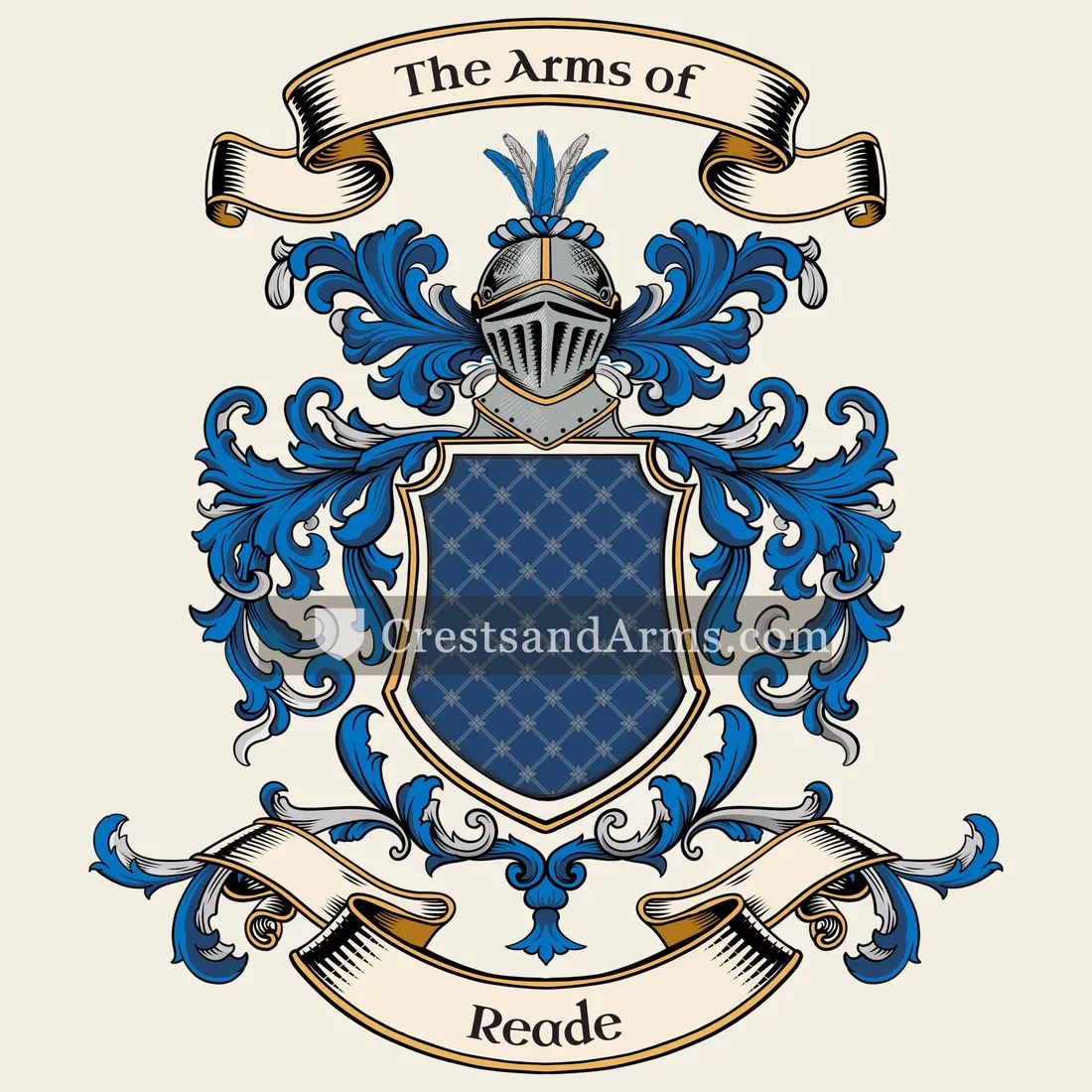
Colours
Blue (Azure)Means: Loyalty and truth
Historical info
Source
Sir Bernard Burke, The General Armory of England, Scotland, Ireland and Wales, London: Harrison & Sons, 1884
Blazon (the actual original written record)
“Az. three butter churns or”
Walesc. 1647
Digital archive packCoat of arms PNG, gold border print PDF, vector SVG and the certificate of authenticity. Sent to your email in minutes.
Map of Wales showing where the Reade arms are recorded
The Reade arms were recorded in Wales, c. 1647.
Arms such as these were typically recorded in Denbigh.
Denbighshire was north Welsh country of hills and small estates. Land was held by a great many families rather than a few, and each holding brought its own claim to a coat of arms.
This is where the arms were entered in the register. Families often moved to other parts of the country, so the same name can turn up in more than one region.
The body that granted and recorded arms in Wales in this period.
Charles I of England
Sovereign of the period
Charles I of England
1625–1649
Reigning in Britain when the Reade arms are first recorded.
How Arms Worked in Wales
English heraldry allowed arms to be shared by all legitimate descendants of the original owner. These symbols were treated as personal property that moved through the generations to all children. While the eldest son kept the original design, other family members could use the same shield without needing to change it or register their own unique versions.
Granting authority
The College of Arms in London has regulated the use of coats of arms throughout England and Wales since 1484.
How they got arms
Families typically obtained their coats of arms through a formal grant from the Crown or by proving their ancient right to them.
Where arms were recorded
All official coats of arms are recorded in the registers kept at the College of Arms, which date back to the fifteenth century.
The family's standing
Recorded among the armigerous families of Wales.
Origin & History of the Reade Family in Wales
The surname Reade is rooted in the Old English word for red, which likely served as a descriptive nickname for an ancestor with a ruddy complexion or red hair. While the name is common across England, its presence in Wales is tied to the movement of families across the border during the seventeenth century. By 1647, records confirm that members of the Reade family were established in the town of Denbigh. This period was a time of significant social and political upheaval in Wales due to the English Civil War. Families living in Denbigh during this era often navigated a unique cultural landscape where they balanced their English-derived surnames with the local traditions and linguistic patterns of North Wales. The family’s presence in this region suggests they were part of a growing class of landowners or tradespeople who settled in the historic market towns that served as centers for commerce and administration in the Welsh countryside.
Reade Meaning & Related Branches
Root word
read
Old English word meaning red in color.
This name
ReadeA descriptive nickname for a person with red hair or a ruddy complexion.
also spelled
Read
Reades
Reed
Rede
Related arms
Redesame arms
Reedvariant spelling
Mordauntrecorded with Reade, same area
Williamsrecorded with Reade, same area
Documented Sources
J. B. Rietstap, Armorial Général, Gouda: G. B. van Goor Zonen, 1884–87
Bardsley, Charles Wareing, A Dictionary of English and Welsh Surnames, 1901
Reaney, P.H., A Dictionary of British Surnames, 1958
Oxfordshire History Centre, Parish Register Transcripts for Oxfordshire, 1660
Digital archive packCoat of arms PNG, gold border print PDF, vector SVG and the certificate of authenticity. Sent to your email in minutes.


 saltireResolution, and St Andrew's cross
 wheatsheafPlenty, and the harvest of one's own labour
 saltireResolution, and St Andrew's cross
 wheatsheafPlenty, and the harvest of one's own labour


 cross symbolChristian faith and service
 fleur de lisPurity, light, and the sixth son