Map of Netherlands showing where the Rees arms are recorded
The Rees arms were recorded in Dordrecht, c. 1815.
This is where the arms were entered in the register. Families often moved to other parts of the country, so the same name can turn up in more than one region.
Region
Dordrecht
Town
Dordrecht
First recorded
1815
Granting Authority for the Rees Arms
Hoge Raad van Adel
Photograph made by me · CC BY-SA 3.0
The body that granted and recorded arms in Netherlands in this period.
William I of the Netherlands
Sovereign of the period
William I of the Netherlands
1815–1840
Reigning in Netherlands when the Rees arms are first recorded.
How Arms Worked in Netherlands
In the Netherlands, coats of arms were often used by noble families and those who held specific public offices. These arms were passed down through the generations to legitimate descendants. Younger branches of a family usually kept the original design without needing to add special marks. This system ensured that the family identity remained clear and consistent over many years.
Granting authority
The Hoge Raad van Adel is the official body that regulates and manages noble titles and coats of arms in the Netherlands.
How they got arms
Families typically obtained their coats of arms through official royal grants or by proving their long-standing historical use of the symbols.
Where arms were recorded
Coats of arms are officially recorded in the registers held by the Hoge Raad van Adel, which began its work in 1814.
The family's standing
Recorded among the armigerous families of Netherlands.
Origin & History of the Rees Family in Netherlands
The family name Rees has deep roots in the Netherlands, where it evolved as a topographic surname. In the Dutch language, the word "rees" or "res" often referred to a clearing in a forest or a specific type of marshy land, suggesting that the earliest ancestors likely lived near such a landscape. By the early nineteenth century, the family established a notable presence in the historic city of Dordrecht. Records from 1815 confirm that members of the family were active in this bustling river port, which served as a major center for trade and shipping. As the family integrated into the social fabric of Dordrecht, they became part of the city's long tradition of commerce and civic life. This transition from a name describing a person's home environment to a recognized family line reflects the broader history of how Dutch surnames became permanent during the Napoleonic era.
Coat of Arms & Family Crest Details
Symbols on this shield
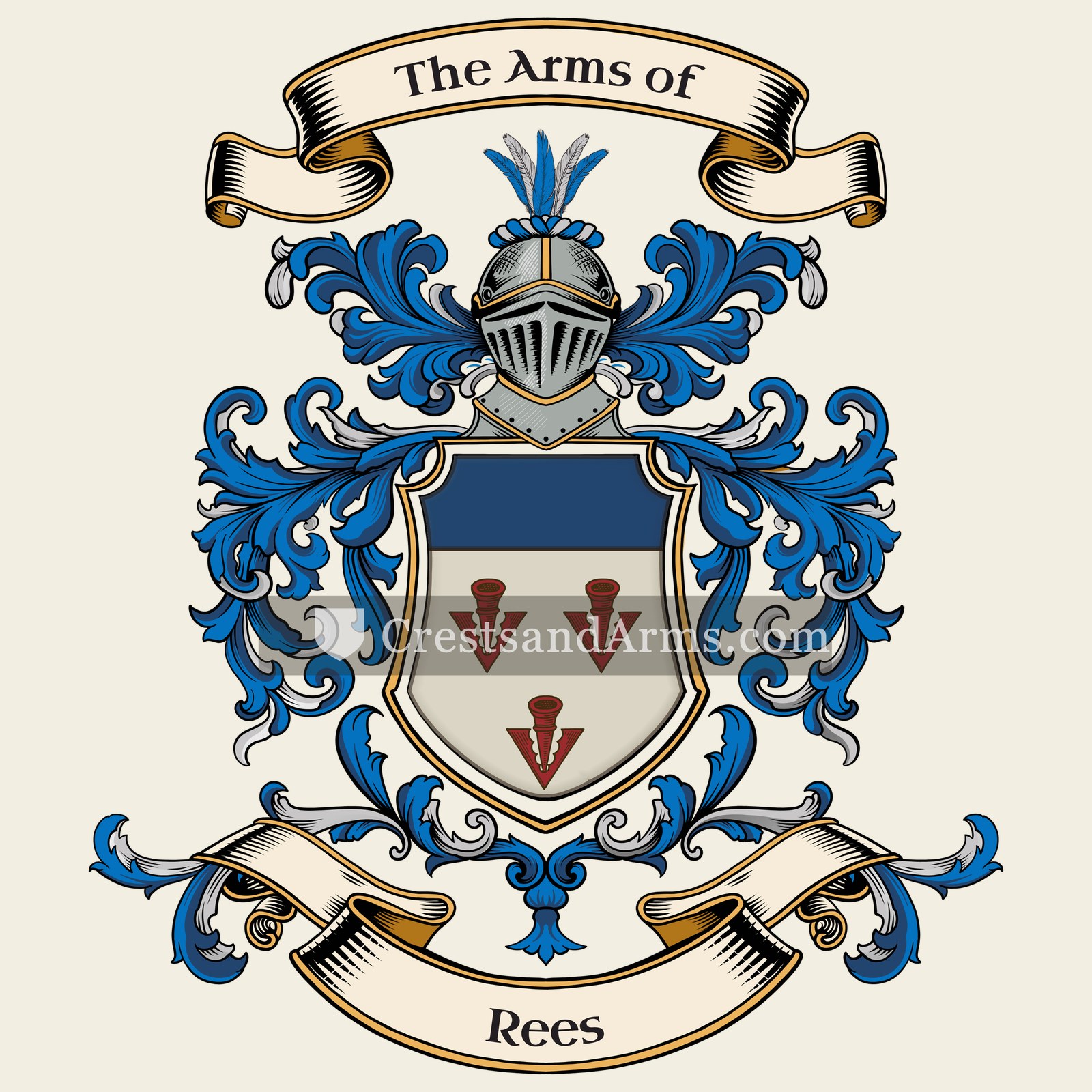
chiefAuthority, wisdom and dominion
arms pheon arrowheadReadiness for battle, and the broad arrow of the sovereign
Colours
Silver (Argent)Means: Peace and sincerity
Blue (Azure)Means: Loyalty and truth
Red (Gules)Means: Military strength
Historical info
Source
Sir Bernard Burke, The General Armory of England, Scotland, Ireland and Wales, London: Harrison & Sons, 1884
Blazon (the actual original written record)
“Ar. three pheons gu. a chief az”
NorfolkNorfolk, c. 1397
Digital archive packCoat of arms PNG, gold border print PDF, vector SVG and the certificate of authenticity. Sent to your email in minutes.
Map of England showing where the Rees arms are recorded
The Rees arms were recorded in Norfolk, c. 1397.
Norfolk grew rich on wool and grain, and its wealth was spread among many middling families rather than a few great ones. Households of that kind bought land and took arms, and the county holds a large share of English names.
This is where the arms were entered in the register. Families often moved to other parts of the country, so the same name can turn up in more than one region.
The body that granted and recorded arms in England in this period.
Richard II of England
Sovereign of the period
Richard II of England
1377–1399
Reigning in Netherlands when the Rees arms are first recorded.
How Arms Worked in England
English heraldry allowed arms to be shared by all legitimate descendants of the original owner. These symbols were treated as personal property that moved through the generations to all children. While the eldest son kept the original design, other family members could use the same shield without needing to change it or register their own unique versions.
Granting authority
The College of Arms in London has regulated the use of coats of arms throughout England and Wales since 1484.
How they got arms
Families typically obtained their coats of arms through a formal grant from the Crown or by proving their ancient right to them.
Where arms were recorded
All official coats of arms are recorded in the registers kept at the College of Arms, which date back to the fifteenth century.
The family's standing
Recorded among the armigerous families of Norfolk.
Origin & History of the Rees Family in England
The family name Rees has deep roots that stretch back to the medieval period, serving as a patronymic name derived from the Welsh personal name Rhys, which translates to enthusiasm or ardor. While the name is famously associated with Wales, historical records confirm that members of the family had established a presence in Norfolk, England, as early as 1397. During this era, surnames were becoming increasingly common as a way for government officials to track taxpayers and landowners. Families often migrated from the Welsh borders into the English countryside for trade or agricultural opportunities. By settling in areas like Norfolk, these early individuals helped integrate the name into the broader English social fabric. Over the following centuries, the spelling of the name often shifted based on local dialects and the way clerks recorded it in official documents, yet it remained a consistent marker of the family’s long history within the region.
Coat of Arms & Family Crest Details
Symbols on this shield
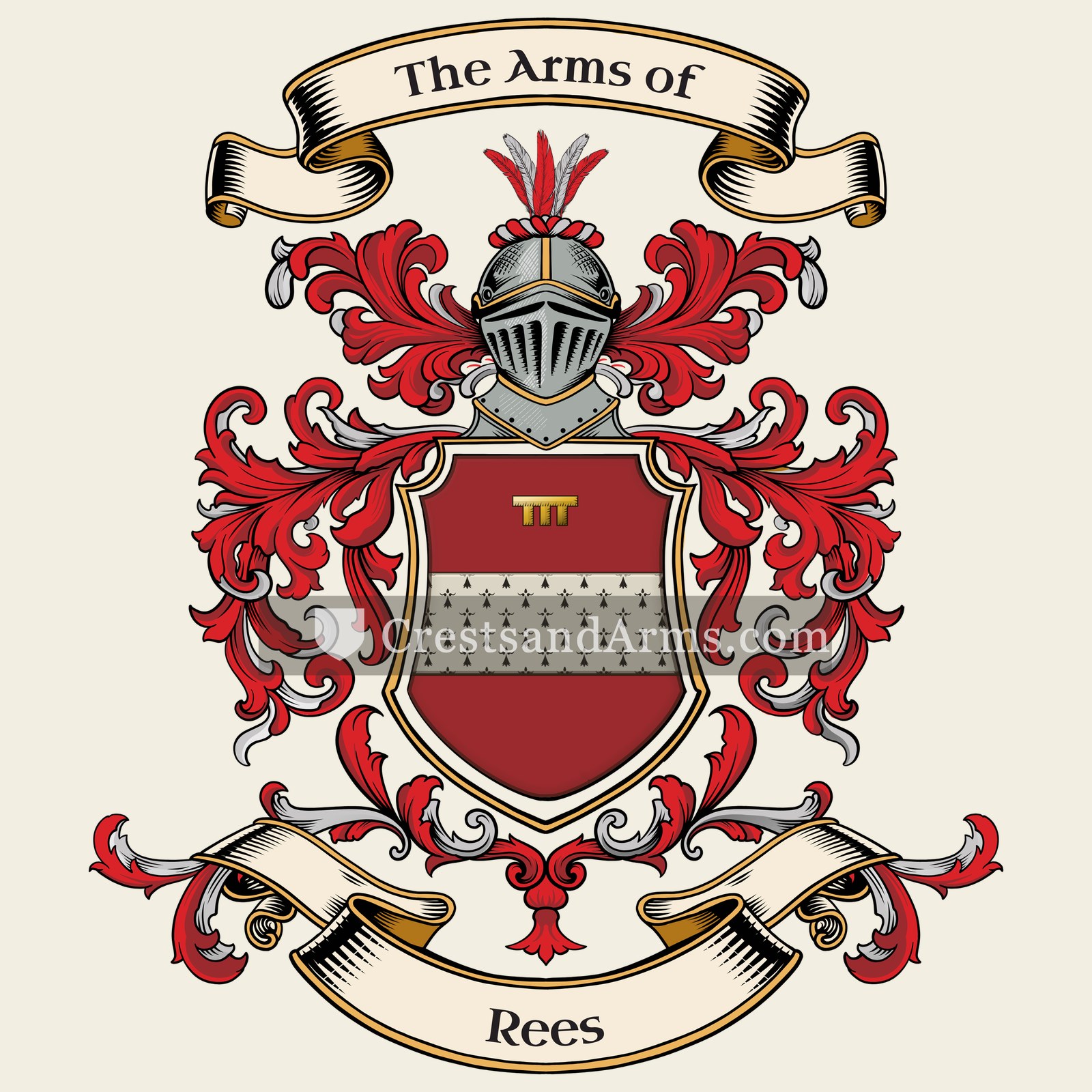
fessThe military belt, and readiness to serve
labelThe eldest son, during his father's life
Colours
Red (Gules)Means: Military strength
ErmineMeans: Dignity
Gold (Or)Means: Generosity
Historical info
Source
Sir Bernard Burke, The General Armory of England, Scotland, Ireland and Wales, London: Harrison & Sons, 1884
Blazon (the actual original written record)
“Gu. a fesse erm. in chief a label or”
Walesc. 1647
Digital archive packCoat of arms PNG, gold border print PDF, vector SVG and the certificate of authenticity. Sent to your email in minutes.
Map of Wales showing where the Rees arms are recorded
The Rees arms were recorded in Wales, c. 1647.
Arms such as these were typically recorded in Denbigh.
Denbighshire was north Welsh country of hills and small estates. Land was held by a great many families rather than a few, and each holding brought its own claim to a coat of arms.
This is where the arms were entered in the register. Families often moved to other parts of the country, so the same name can turn up in more than one region.
The body that granted and recorded arms in Wales in this period.
Charles I of England
Sovereign of the period
Charles I of England
1625–1649
Reigning in Netherlands when the Rees arms are first recorded.
How Arms Worked in Wales
English heraldry allowed arms to be shared by all legitimate descendants of the original owner. These symbols were treated as personal property that moved through the generations to all children. While the eldest son kept the original design, other family members could use the same shield without needing to change it or register their own unique versions.
Granting authority
The College of Arms in London has regulated the use of coats of arms throughout England and Wales since 1484.
How they got arms
Families typically obtained their coats of arms through a formal grant from the Crown or by proving their ancient right to them.
Where arms were recorded
All official coats of arms are recorded in the registers kept at the College of Arms, which date back to the fifteenth century.
The family's standing
Recorded among the armigerous families of Wales.
Origin & History of the Rees Family in Wales
The name Rees is a patronymic surname, which means it originated from the given name Rhys, a popular name in medieval Wales that translates to enthusiasm or passion. For centuries, Welsh families did not use fixed surnames but instead identified themselves by their father’s name using the prefix "ap," meaning "son of." As English administrative practices became more common in Wales, many families transitioned to fixed surnames by dropping the "ap" and adopting the father’s name as their own. By the time records confirm the presence of the family in Denbigh in 1647, the name had stabilized into its current spelling. During this period, the Denbigh area was a significant center for trade and local governance, placing the family within a region that was actively navigating the cultural shift between traditional Welsh customs and the influence of the English legal system.
Rees Meaning & Related Branches
Root word
Rhys
Welsh word meaning enthusiasm or ardor.
This name
ReesA patronymic surname derived from the given name meaning passionate or enthusiastic.
also spelled
Res
Reese
Reece
Related arms
Deréevariant spelling
Resvariant spelling
Reecevariant spelling
Rhysvariant spelling
Documented Sources
J. B. Rietstap, Armorial Général, Gouda: G. B. van Goor Zonen, 1884–87
Meertens, P.J., De betekenis van de Nederlandse familienamen, 1950
Dordrecht Regional Archives, Bevolkingsregister van Dordrecht 1815
Van der Schaar, J., Woordenboek van voornamen, 1964
Digital archive packCoat of arms PNG, gold border print PDF, vector SVG and the certificate of authenticity. Sent to your email in minutes.


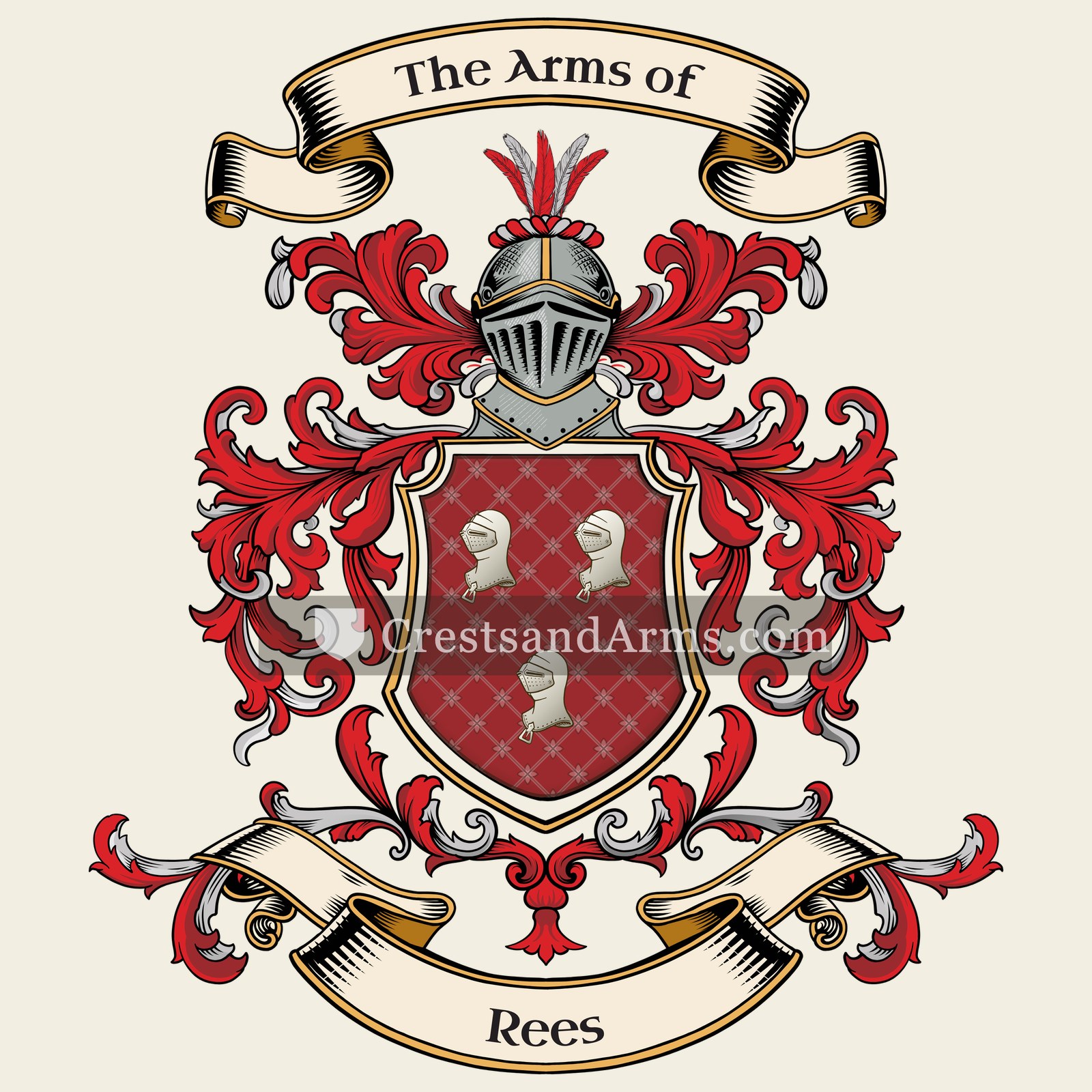
 helmetWisdom and security in defence
 helmetWisdom and security in defence


 chiefAuthority, wisdom and dominion
 arms pheon arrowheadReadiness for battle, and the broad arrow of the sovereign


 fessThe military belt, and readiness to serve
 labelThe eldest son, during his father's life