Map of Belgium showing where the Regnier arms are recorded
The Regnier arms were recorded in Hainaut, c. 1737.
Hainaut sat on the border between France and the Low Countries and was fought over for centuries. Families there held their land under arms and expected to defend it, so a shield was a working thing.
This is where the arms were entered in the register. Families often moved to other parts of the country, so the same name can turn up in more than one region.
The body that granted and recorded arms in Belgium in this period.
Charles VI, Holy Roman Emperor
Sovereign of the period
Charles VI, Holy Roman Emperor
1711–1740
Reigning in Belgium when the Regnier arms are first recorded.
How Arms Worked in Belgium
In Belgium, a coat of arms is considered personal property that is passed down through the male line to legitimate descendants. Families often use the same shield design across generations to show their shared heritage. If a branch of the family wants to change the design, they must apply for an official update to their specific version of the arms.
Granting authority
The Conseil héraldique is the official body that regulates and approves all coats of arms in Belgium.
How they got arms
Families obtain their coats of arms through formal royal grants or by confirming their historical right to use existing designs.
Where arms were recorded
All approved coats of arms are officially recorded in the public registers of the Conseil héraldique since 1844.
The family's standing
Recorded among the armigerous families of Hainaut.
Origin & History of the Regnier Family in Belgium
The family name Regnier finds its roots in the Germanic tradition, originating from the ancient name Raginheri, which combines words meaning counsel and army. By the eighteenth century, the family established a notable presence in the Hainaut region of present-day Belgium. During this period, the area was a center for agriculture and coal mining, which shaped the daily lives of families living in the province. Records from 1737 confirm that the Regnier name was already embedded in the local social fabric of Hainaut, likely among families who worked the land or participated in the growing trade networks of the Southern Netherlands. As the family grew, they became part of the long history of the region, contributing to the local culture and economy that defined this part of Belgium for generations.
Coat of Arms & Family Crest Details
Symbols on this shield
roundelA coin, and one who has been to the crusades
Colours
Silver (Argent)Means: Peace and sincerity
Blue (Azure)Means: Loyalty and truth
Historical info
Source
J. B. Rietstap, Armorial Général, Gouda: G. B. van Goor Zonen, 1884–87
Blazon (the actual original written record)
“D'arg. à trois tourt. d'azur.”
ArtoisArtois, c. 1663
Digital archive packCoat of arms PNG, gold border print PDF, vector SVG and the certificate of authenticity. Sent to your email in minutes.
Map of France showing where the Regnier arms are recorded
The Regnier arms were recorded in Artois, c. 1663.
Artois lay on the disputed ground between France and the Low Countries and was fought over for centuries. Families there held their land under arms, and a shield was how a fighting household was known.
This is where the arms were entered in the register. Families often moved to other parts of the country, so the same name can turn up in more than one region.
The body that granted and recorded arms in France in this period.
Louis XIV of France
Sovereign of the period
Louis XIV of France
1643–1715
Reigning in Belgium when the Regnier arms are first recorded.
How Arms Worked in France
In France, a coat of arms was a mark of honor that passed down through the male line to all legitimate descendants. Families often used the same shield without changes to show their shared heritage. If a branch wanted to stand out, they could add a small mark to their shield to show their specific place in the family tree.
Granting authority
The Juge d'armes de France acted as the official authority that regulated and verified coats of arms across the country.
How they got arms
Families typically inherited their arms from ancestors, though they could also receive them through royal grants or by proving their noble status.
Where arms were recorded
Coats of arms were officially recorded in the Armorial Général de France, which began its main collection in the year 1696.
The family's standing
Recorded among the armigerous families of Artois.
Origin & History of the Regnier Family in France
The surname Regnier is a classic example of a name derived from ancient Germanic roots, specifically evolving from the name Reginhar, which combines the elements for counsel and army. While the name spread across various regions of France, historical records confirm that members of the family were firmly established in the province of Artois by 1663. During this period, Artois was a region defined by its strategic importance and its transition between different European powers. Families living in this area often navigated a complex landscape of shifting borders and agricultural life. The presence of the Regnier name in Artois during the seventeenth century suggests that these individuals were part of the local social fabric, likely involved in the trades, farming, or administrative roles that supported the regional economy of northern France. Over time, the name became a permanent fixture in the local parish registers, documenting the family's growth and their long-standing connection to the northern provinces.
Coat of Arms & Family Crest Details
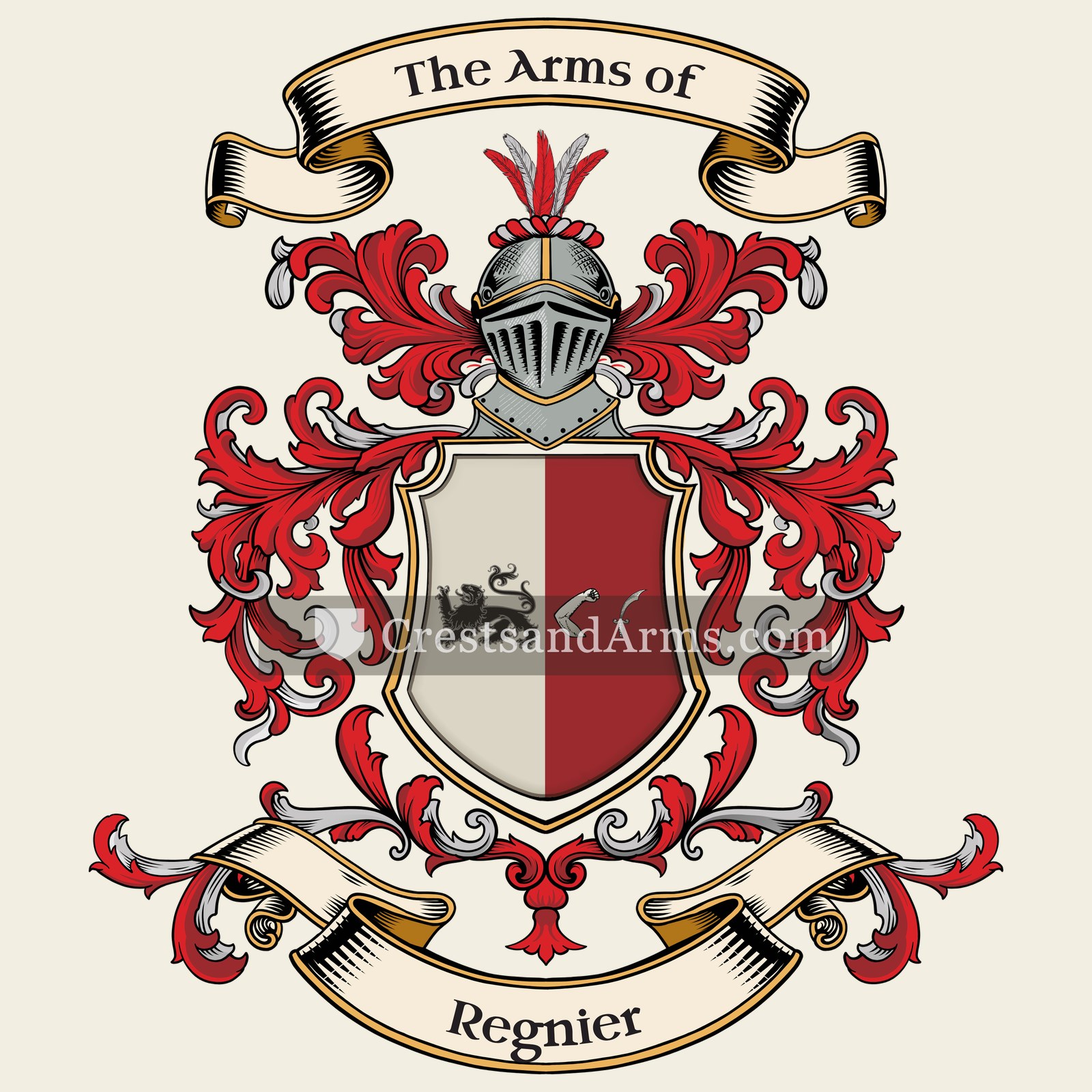
Symbols on this shield
lionCourage, strength and royalty
armA person of action, industrious and laborious
swordJustice, and military honour
Colours
Silver (Argent)Means: Peace and sincerity
Red (Gules)Means: Military strength
Black (Sable)Means: Constancy
Historical info
Source
J. B. Rietstap, Armorial Général, Gouda: G. B. van Goor Zonen, 1884–87
Blazon (the actual original written record)
“D'arg. à une balance d'or; le champ chapé-ployé, à dextre de gu. au lion de sa., à sen. d'azur à un bras arm., mouv. du flanc sen. et tenant un sabre d'arg.”
BavariaBavaria, c. 1765
Digital archive packCoat of arms PNG, gold border print PDF, vector SVG and the certificate of authenticity. Sent to your email in minutes.
Map of Germany showing where the Regnier arms are recorded
The Regnier arms were recorded in Bavaria, c. 1765.
Bavaria was a country of old landed families and walled market towns. Estates passed down the same line for centuries, and both the landowners and the leading townsmen kept arms, which is why so many Bavarian names sit in the registers.
This is where the arms were entered in the register. Families often moved to other parts of the country, so the same name can turn up in more than one region.
The body that granted and recorded arms in Germany in this period.
Francis I, Holy Roman Emperor
Sovereign of the period
Francis I, Holy Roman Emperor
1745–1765
Reigning in Belgium when the Regnier arms are first recorded.
How Arms Worked in Germany
In the Holy Roman Empire, coats of arms were often granted to individuals by the Emperor or his representatives. These arms were then passed down through the generations to all legitimate descendants of the original holder. Younger branches of a family usually kept the same shield design without needing to change it, as the arms belonged to the entire lineage.
Granting authority
The Holy Roman Emperor held the sole power to grant new coats of arms throughout his vast imperial territories.
How they got arms
Families typically obtained their coats of arms through a formal imperial grant or by proving their noble status to the authorities.
Where arms were recorded
These grants were officially recorded in the Imperial Chancery registers, which began keeping formal records of such honors during the Middle Ages.
The family's standing
Recorded among the armigerous families of Bavaria.
Origin & History of the Regnier Family in Germany
The surname Regnier is rooted in the ancient Germanic personal name Raginheri, which combines the words for advice and army. While the name is often associated with French origins, its presence in Germany highlights the deep historical connections between neighboring European regions. By 1765, records confirm that members of the Regnier family were well-established in the Bavarian region. During this era, Bavaria was a center of agricultural and craft development, and families like the Regniers were often integrated into the local village structures as skilled workers or landowners. These early ancestors likely lived through the transition from the Holy Roman Empire toward a more modern administrative state, navigating the complex social hierarchies of the eighteenth century. Their presence in the region suggests a history of stability and community involvement that allowed the family name to persist through generations of regional change.
Related Branches & Arms
Root word
Raginheri
Derived from Germanic elements meaning counsel and army or warrior.
This name
RegnierA hereditary surname signifying a wise advisor or a counselor in battle.
also spelled
Regnyer
Renye
Related arms
van Vlietsame arms
* **Belasysesimilar arms
Documented Sources
J. B. Rietstap, Armorial Général, Gouda: G. B. van Goor Zonen, 1884–87
Fauconnier, Alain. Histoire de la province de Hainaut. 1998
State Archives in Belgium, Registres paroissiaux de la province de Hainaut, 1737
Herbillon, Jules and Germain, Jean. Dictionnaire des noms de famille en Belgique romane et dans les régions limitrophes. 1996
Digital archive packCoat of arms PNG, gold border print PDF, vector SVG and the certificate of authenticity. Sent to your email in minutes.


 fessThe military belt, and readiness to serve
 hammerHonest labour, and the smith's craft
 fessThe military belt, and readiness to serve
 hammerHonest labour, and the smith's craft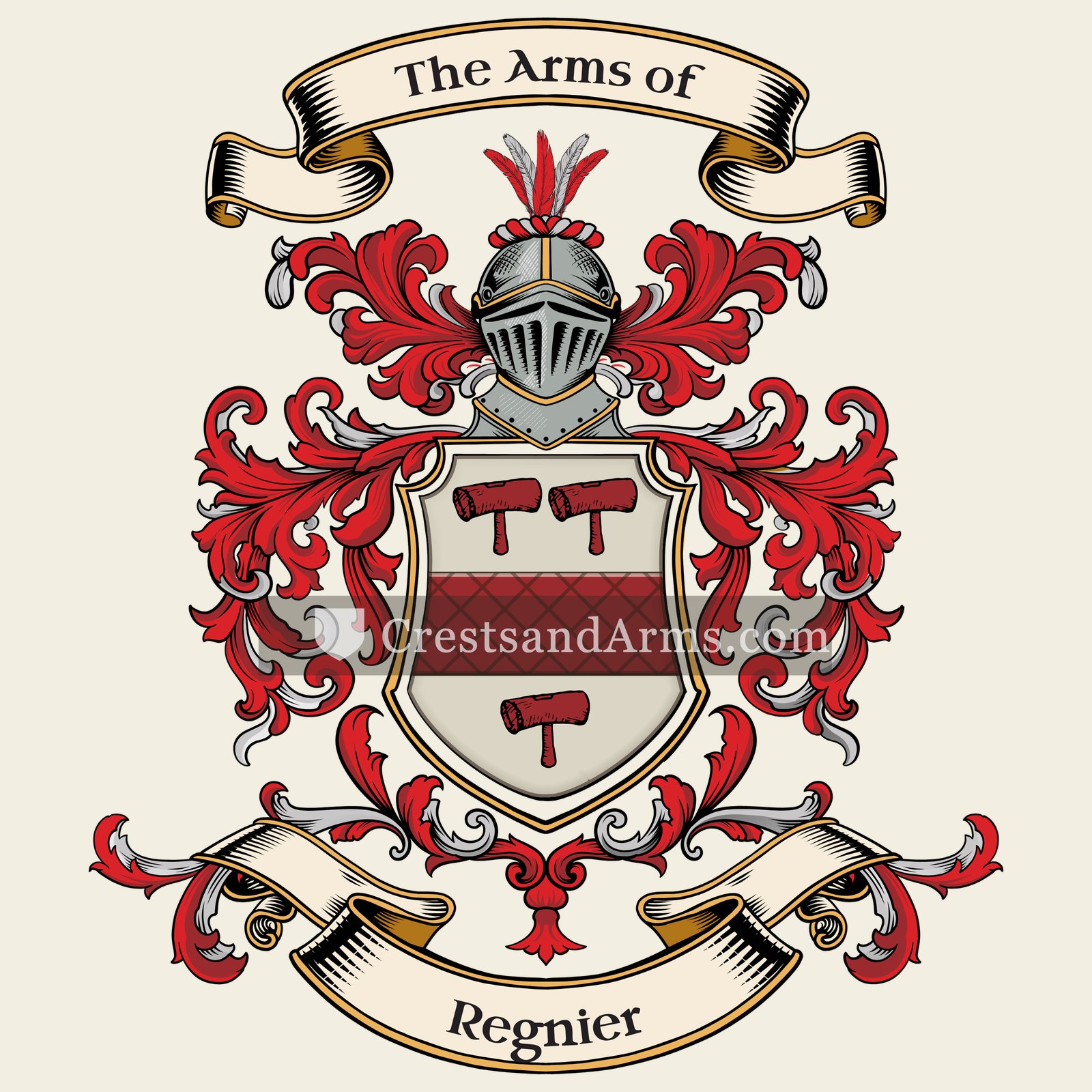


 roundelA coin, and one who has been to the crusades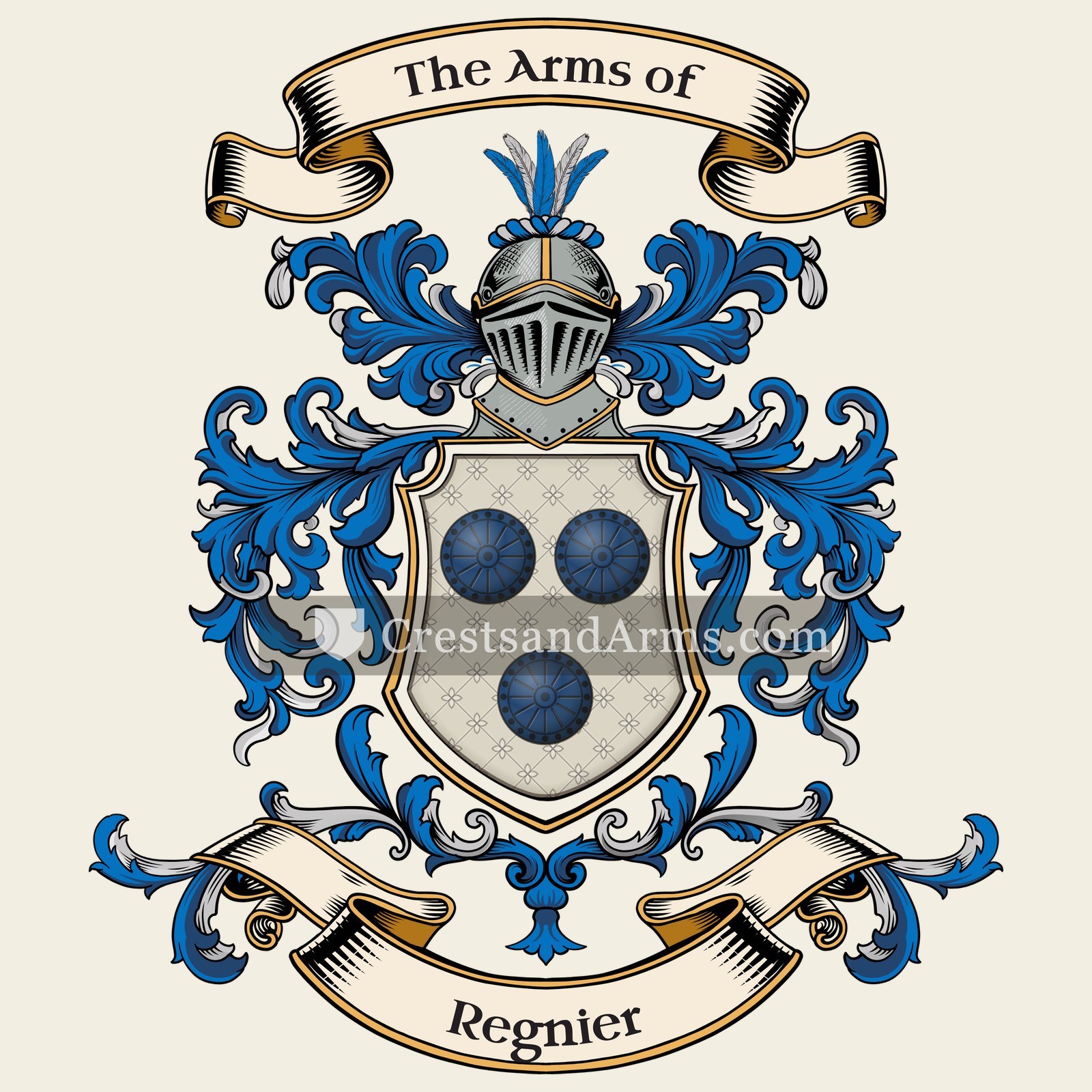


 lionCourage, strength and royalty
 armA person of action, industrious and laborious
 swordJustice, and military honour