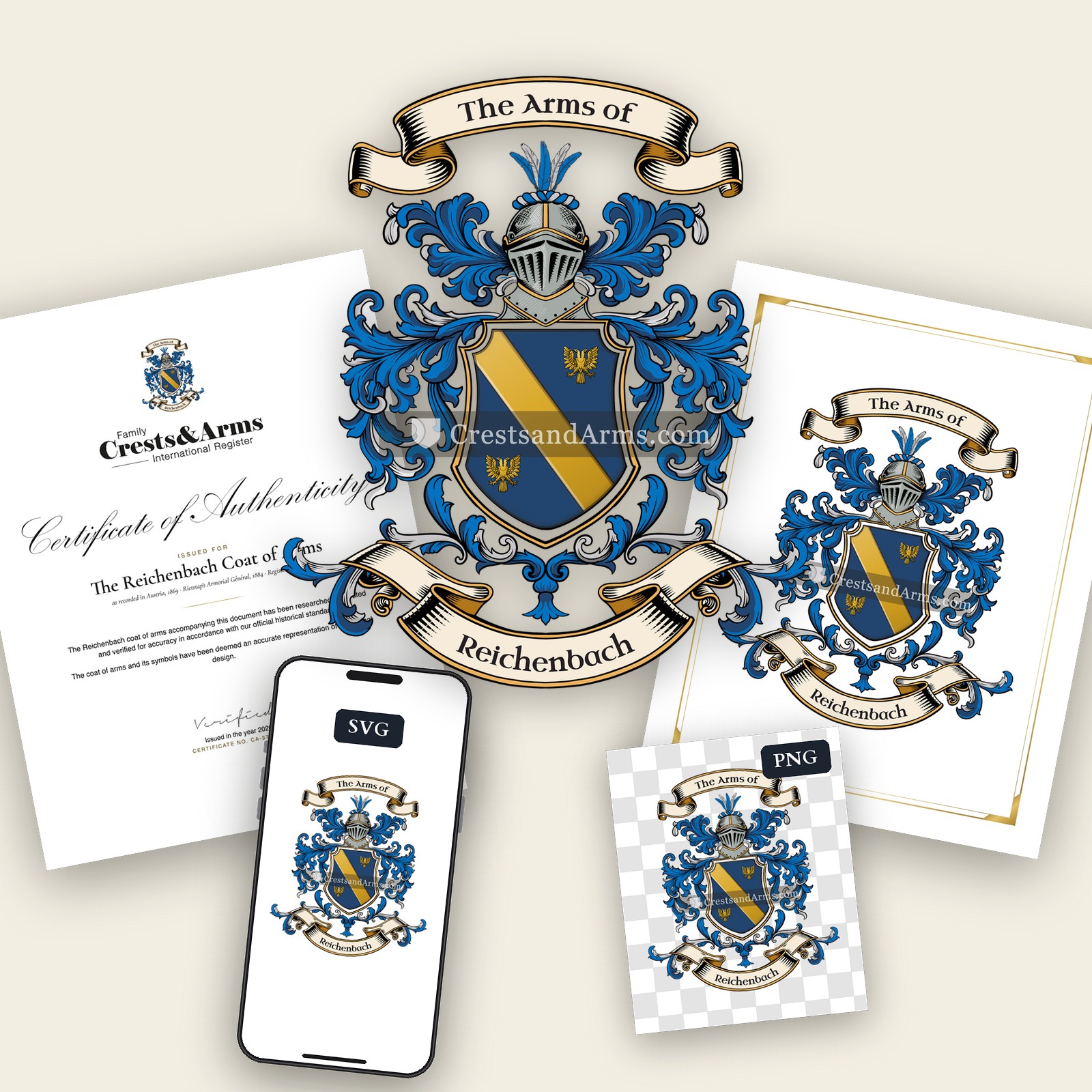
A record of documented arms, meaning and origin, researched for the Reichenbach family lines. Documented in 3 countries.
Reg. 3702 · German, P–S
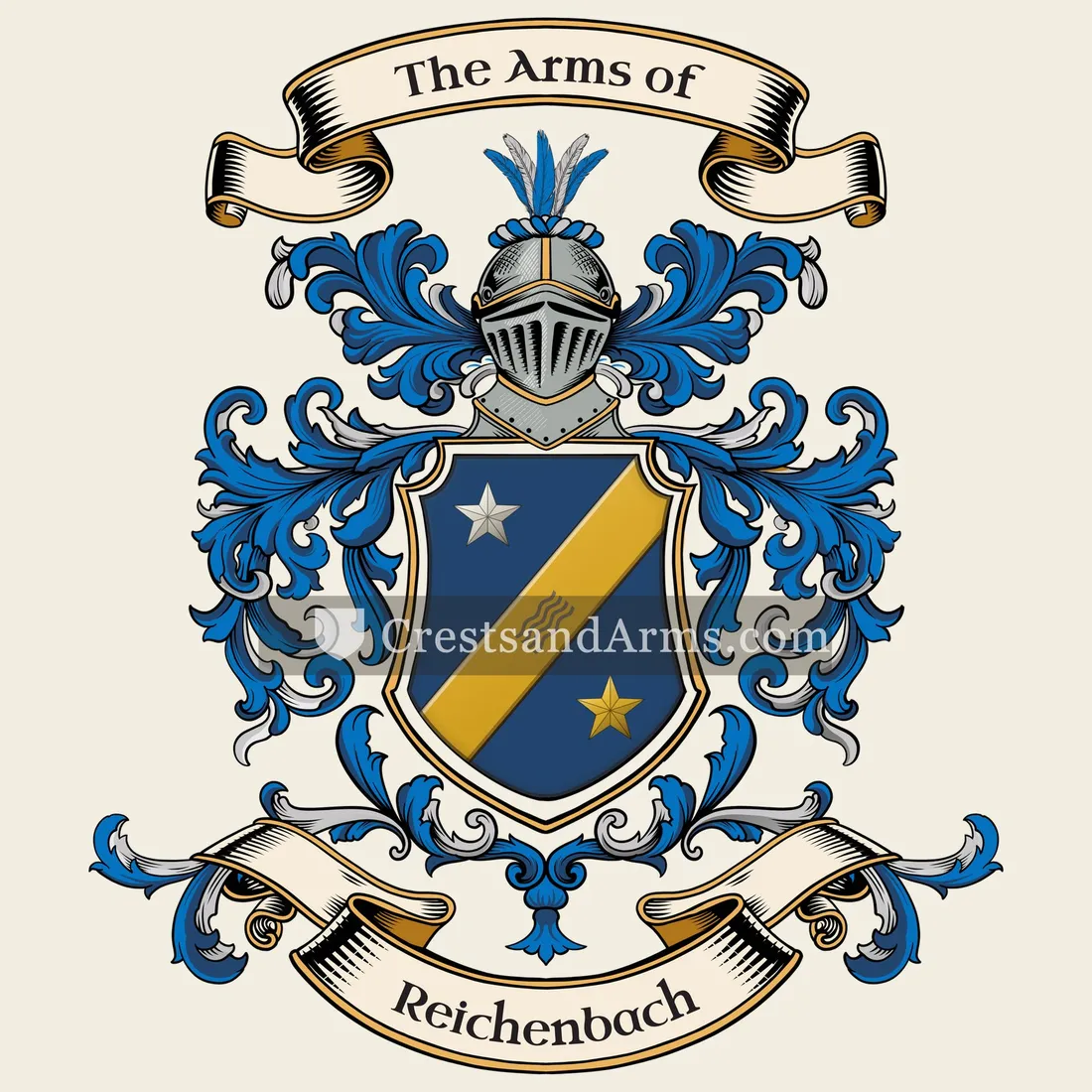
Meaning of the Reichenbach family crest colors & symbols
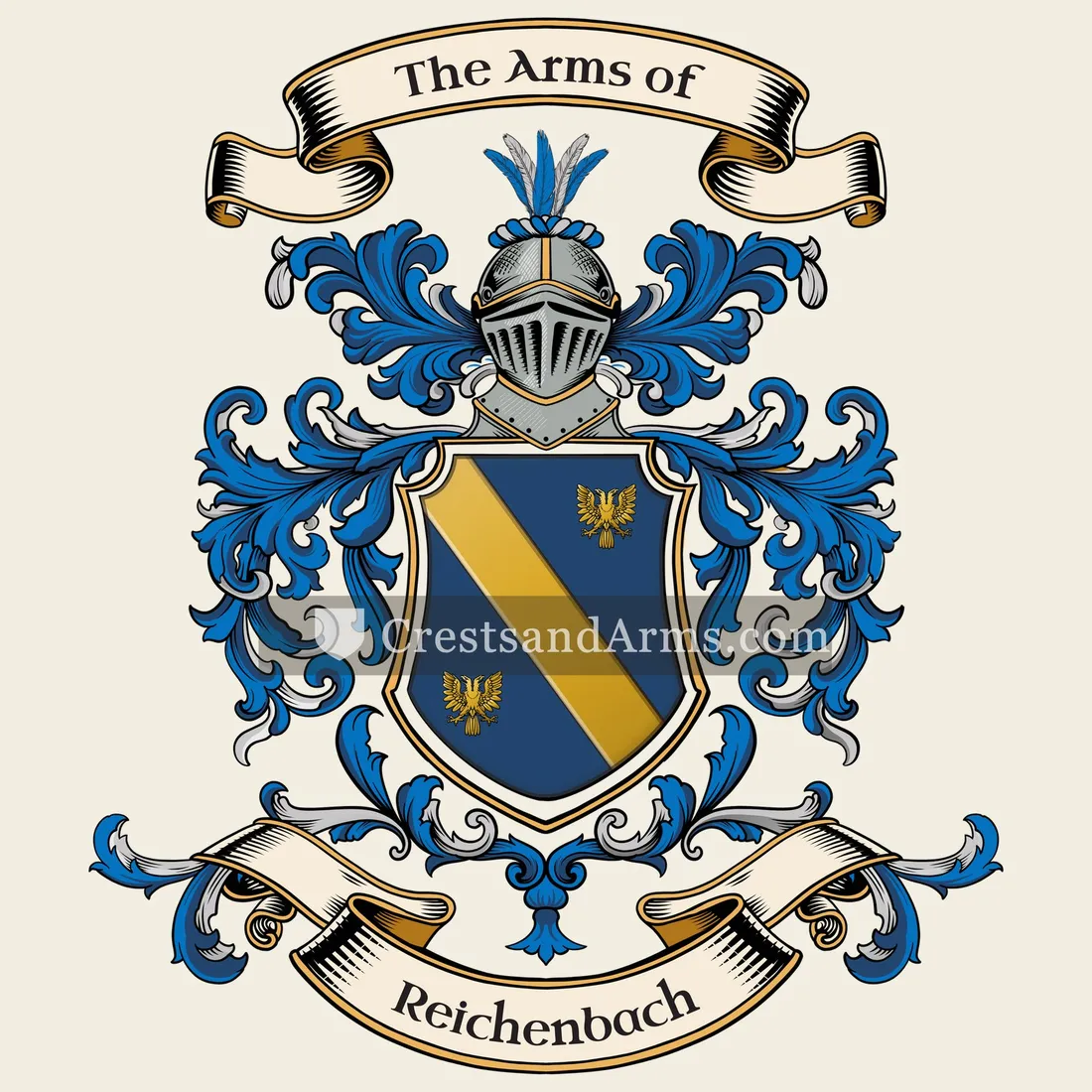
Symbols on this shield
riverThe bounds of a land, and life carried through it
mulletThe third son, and a divine quality from above
Colours
Blue (Azure)Means: Loyalty and truth
Gold (Or)Means: Generosity
Silver (Argent)Means: Peace and sincerity
Historical info
Source
J. B. Rietstap, Armorial Général, Gouda: G. B. van Goor Zonen, 1884–87
Blazon (the actual original written record)
“D'azur à la barre d'or, ch. d'une rivière au nat. et acc. de deux étoiles (5), l'une au point du chef d'arg., l'autre, au milieu de la p. de l'écu, d'or.”
BavariaBavaria, c. 1765
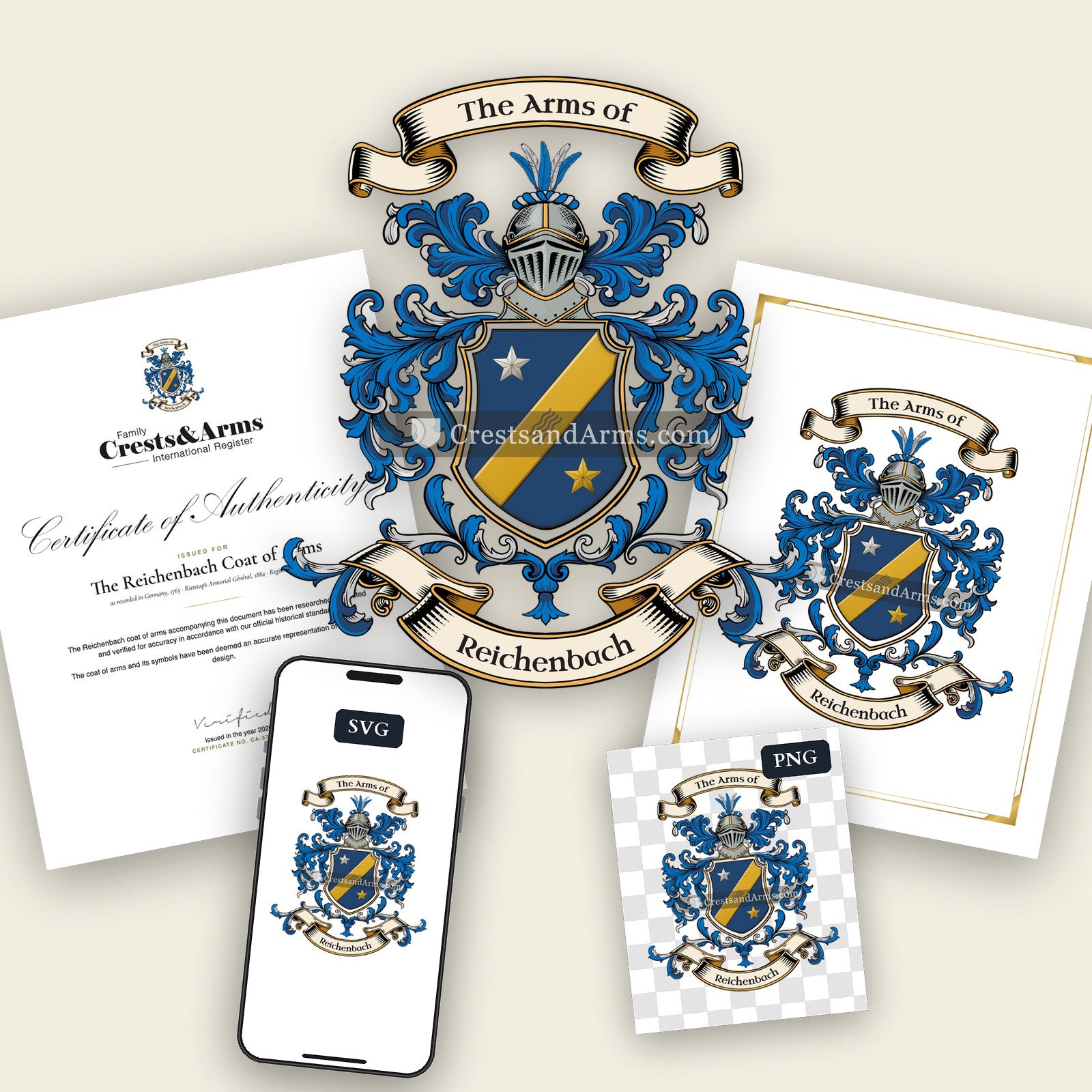
Digital archive packCoat of arms PNG, gold border print PDF, vector SVG and the certificate of authenticity. Sent to your email in minutes.
Map of Germany showing where the Reichenbach arms are recorded
The Reichenbach arms were recorded in Bavaria, c. 1765.
Bavaria was a country of old landed families and walled market towns. Estates passed down the same line for centuries, and both the landowners and the leading townsmen kept arms, which is why so many Bavarian names sit in the registers.
This is where the arms were entered in the register. Families often moved to other parts of the country, so the same name can turn up in more than one region.
The body that granted and recorded arms in Germany in this period.
Francis I, Holy Roman Emperor
Sovereign of the period
Francis I, Holy Roman Emperor
1745–1765
Reigning in Germany when the Reichenbach arms are first recorded.
How Arms Worked in Germany
In the Holy Roman Empire, coats of arms were often granted to individuals by the Emperor or his representatives. These arms were then passed down through the generations to all legitimate descendants of the original holder. Younger branches of a family usually kept the same shield design without needing to change it, as the arms belonged to the entire lineage.
Granting authority
The Holy Roman Emperor held the sole power to grant new coats of arms throughout his vast imperial territories.
How they got arms
Families typically obtained their coats of arms through a formal imperial grant or by proving their noble status to the authorities.
Where arms were recorded
These grants were officially recorded in the Imperial Chancery registers, which began keeping formal records of such honors during the Middle Ages.
The family's standing
Recorded among the armigerous families of Bavaria.
Origin & History of the Reichenbach Family in Germany
The surname Reichenbach is a classic example of a topographic name, which means it was originally derived from the physical features of the landscape where a family lived. In German, the name combines "reich," meaning rich or abundant, and "bach," meaning a stream or brook. This suggests that the earliest ancestors to carry the name likely lived near a fertile or flowing creek. By the time records place the family in Bavaria in 1765, the name had already been established for generations across various German-speaking regions. Families with this name were often associated with small rural settlements or farming communities where the local geography defined their identity. As the family grew, they became part of the social fabric of southern Germany, living through a time of significant agricultural and regional development in the Bavarian countryside.
Meaning of the Reichenbach family crest colors & symbols
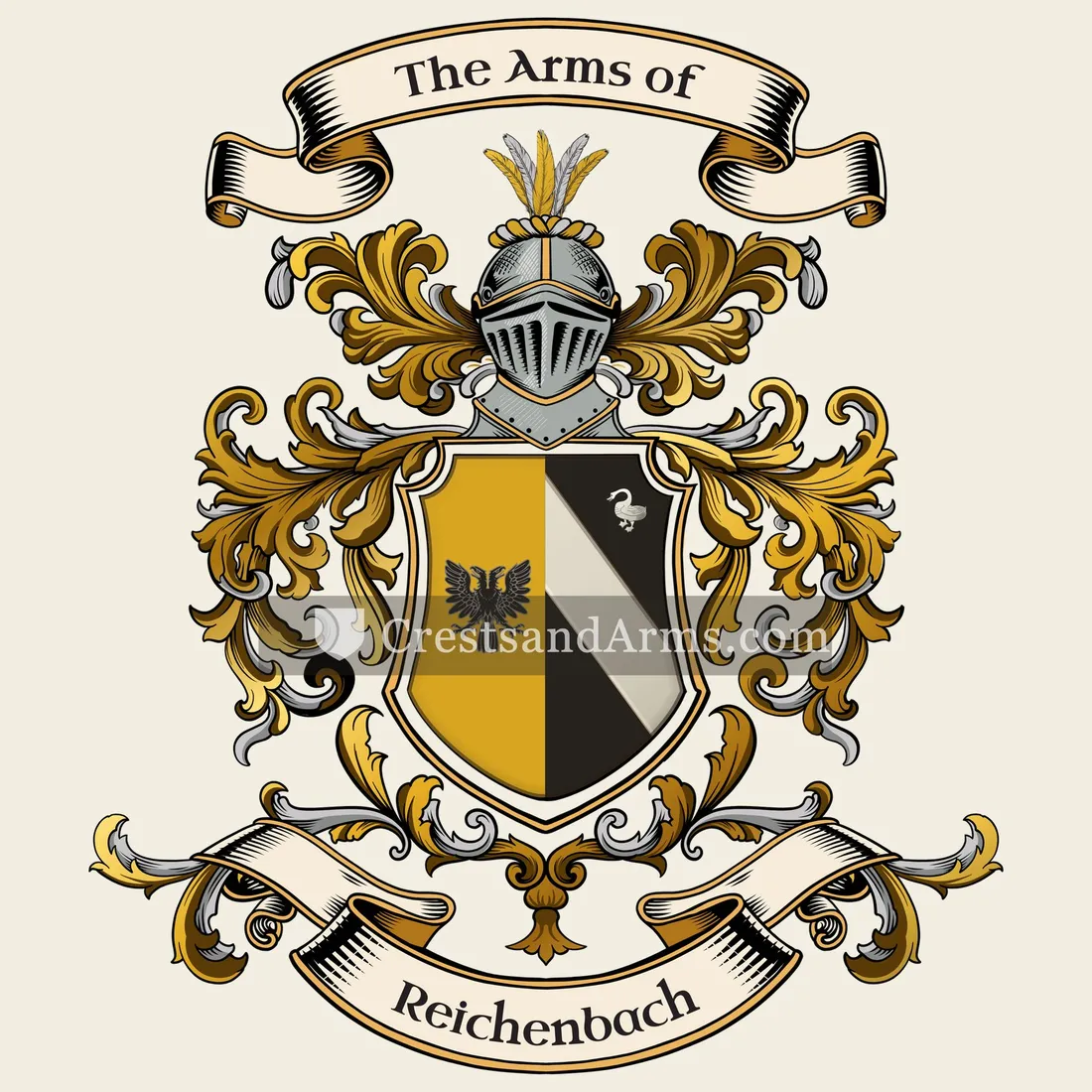
Symbols on this shield
bendDefence, and the scarf of a commander
eagleNobility, strength and a keen mind
swanGrace, light and the poet's art
Colours
Gold (Or)Means: Generosity
Black (Sable)Means: Constancy
Silver (Argent)Means: Peace and sincerity
Historical info
Source
J. B. Rietstap, Armorial Général, Gouda: G. B. van Goor Zonen, 1884–87
Blazon (the actual original written record)
“Parti: au 1 d'or à la demi-aigle de sa., mouv. du parti; au 2 de sa. à la bande ondée d'arg., acc. en chef d'un cygne du même. Cq. cour. C.: une femme iss., la tête sommée de trois pl. d'aut.”
PolandThorn Prusse, c. 1772
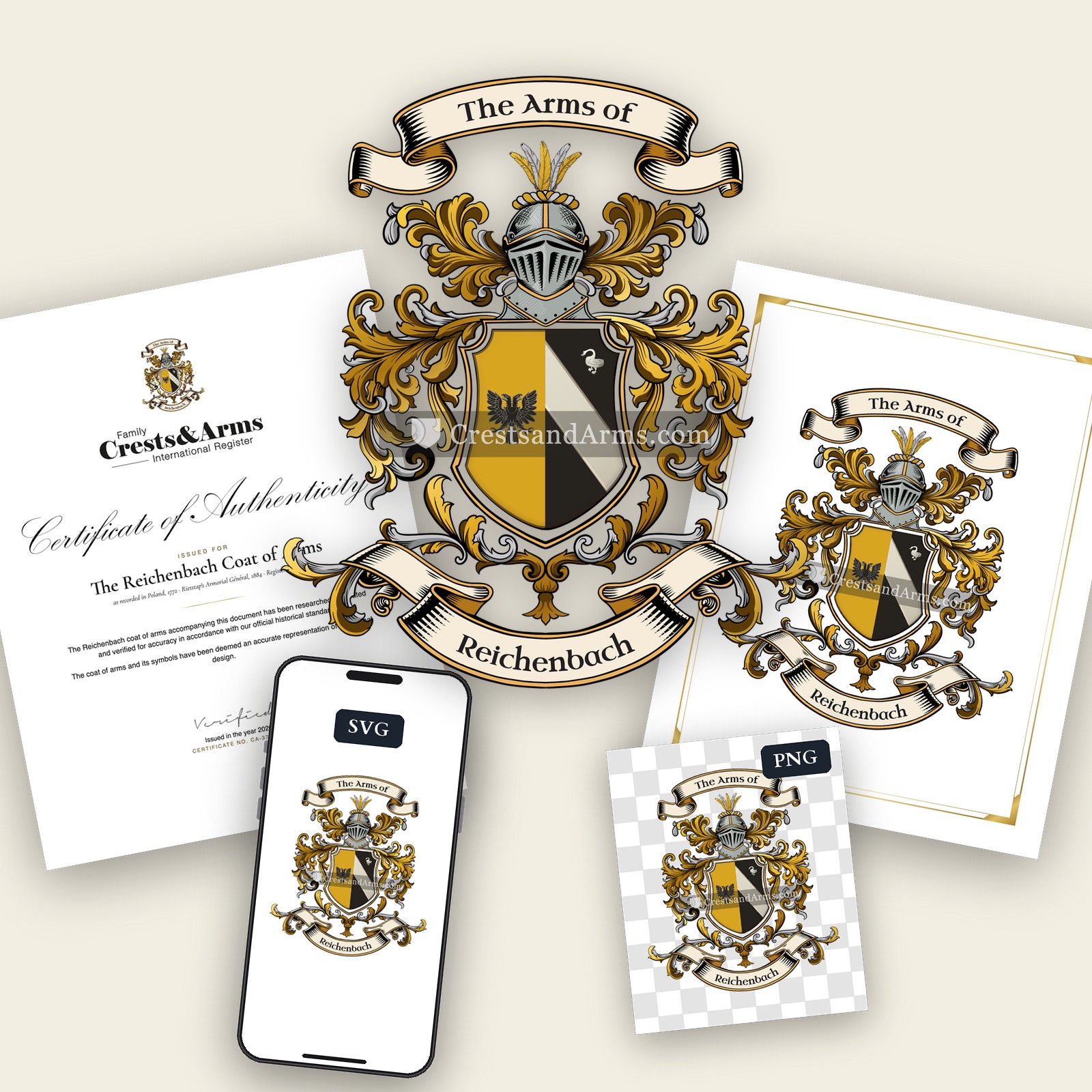
Digital archive packCoat of arms PNG, gold border print PDF, vector SVG and the certificate of authenticity. Sent to your email in minutes.
Map of Poland showing where the Reichenbach arms are recorded
The Reichenbach arms were recorded in Thorn Prusse, c. 1772.
This is where the arms were entered in the register. Families often moved to other parts of the country, so the same name can turn up in more than one region.
Region
Thorn
Town
Thorn Prusse
First recorded
1772
Granting Authority for the Reichenbach Arms
Ennoblement by the Sejm
Author: Olek Remesz · CC BY-SA 3.0
The body that granted and recorded arms in Poland in this period.
Stanisław August Poniatowski
Sovereign of the period
Stanisław August Poniatowski
1764–1795
Reigning in Germany when the Reichenbach arms are first recorded.
How Arms Worked in Poland
Polish noble families shared a single coat of arms across many different surnames, creating large clans rather than individual designs. These symbols were held collectively by all members of the clan regardless of their specific family name. When a new family joined the nobility, they were adopted into an existing clan and began using that group's established shield.
Granting authority
The Sejm, which was the Polish parliament, held the power to grant noble status and the right to bear arms.
How they got arms
Families typically received their coat of arms through a formal act of ennoblement granted by the Sejm for distinguished service.
Where arms were recorded
These grants were officially recorded in the Crown Metrica, which served as the central archive for state documents starting in the sixteenth century.
The family's standing
Recorded among the armigerous families of Poland.
Origin & History of the Reichenbach Family in Poland
The history of the Reichenbach family in Poland is deeply connected to the city of Thorn, known today as Toruń, where records confirm their presence by 1772. The name itself is of German origin, combining the words for "rich" and "brook," which suggests that the family’s earliest ancestors likely lived near a prosperous or water-abundant stream. During the late 18th century, Thorn served as a vital crossroads for trade and culture between German and Polish lands. Families like the Reichenbachs often moved into these urban centers to participate in the growing merchant class or to serve in administrative roles. As they settled in the region, they became part of the complex social fabric of West Prussia, navigating the shifting borders and political changes that defined the era. By establishing themselves in Thorn, the family secured a place in the history of a city that was then a focal point for economic exchange in Central Europe.
Meaning of the Reichenbach family crest colors & symbols
Symbols on this shield
bendDefence, and the scarf of a commander
eagleNobility, strength and a keen mind
Colours
Blue (Azure)Means: Loyalty and truth
Gold (Or)Means: Generosity
Historical info
Source
J. B. Rietstap, Armorial Général, Gouda: G. B. van Goor Zonen, 1884–87
Blazon (the actual original written record)
“D'azur à la bande ondée d'or, côtoyée de deux aigles du même. Deux cq. cour. C.: 1° un lion iss. d'or; 2° un demi-vol d'or.”
Austriac. 1869
Digital archive packCoat of arms PNG, gold border print PDF, vector SVG and the certificate of authenticity. Sent to your email in minutes.
Map of Austria showing where the Reichenbach arms are recorded
The Reichenbach arms were recorded in Austria, c. 1869.
Arms such as these were typically recorded in Tyrol.
Tyrol was mountain country in western Austria, where the valleys were held by families who had been there a very long time. Old tenure counted for more than money, and old families carried arms.
This is where the arms were entered in the register. Families often moved to other parts of the country, so the same name can turn up in more than one region.
Region
Tyrol
First recorded
1869
Granting Authority for the Reichenbach Arms
Imperial and Royal chancery
Sodacan · CC BY-SA 3.0
The body that granted and recorded arms in Austria in this period.
Franz Joseph I of Austria
Sovereign of the period
Franz Joseph I of Austria
1848–1916
Reigning in Germany when the Reichenbach arms are first recorded.
How Arms Worked in Austria
Austrian coats of arms were often linked directly to noble titles granted by the Emperor. These symbols belonged to the entire family line rather than just one individual. When a family grew, new branches kept the original design without needing to change it. This system allowed all members of a noble house to share the same identity across many generations.
Granting authority
The Imperial and Royal chancery managed all heraldic matters and controlled the official granting of arms throughout the Austrian lands.
How they got arms
Families typically received their arms through a formal imperial decree that often accompanied the elevation of a person to noble status.
Where arms were recorded
Official records of these grants were kept in the Imperial Register of Nobility which began its formal documentation process in 1453.
The family's standing
Recorded among the armigerous families of Austria.
Origin & History of the Reichenbach Family in Austria
The surname Reichenbach is a topographic name that originated from the German words for rich or bountiful and brook. This suggests that the earliest families to adopt the name likely lived near a fertile or abundant stream. While the name appears in various regions across the German-speaking world, the branch of the family established in the Tyrol region of Austria by 1869 reflects the broader movement of families seeking new opportunities in the mountainous landscapes of the Alps. During this period, the Tyrol area was a vital crossroads for trade and agriculture within the Austro-Hungarian Empire. Families like the Reichenbachs often settled in these valleys to participate in the local timber, mining, or farming industries that defined the regional economy. By integrating into these tight-knit mountain communities, the family became part of the long-standing cultural history of Western Austria, where they contributed to the development of the local villages and the preservation of Alpine traditions.
Reichenbach Meaning & Related Branches
Root word
Reich and Bach
Rich or powerful and a stream or brook.
This name
ReichenbachA topographic name for someone who lived near a rich or abundant stream.
also spelled
Reichenbak
Rykenbah
Documented Sources
J. B. Rietstap, Armorial Général, Gouda: G. B. van Goor Zonen, 1884–87
Bahlow, Hans, Deutsches Namenlexikon: Familien- und Vornamen nach Ursprung und Sinn erklärt, 1967
Heintze, Albert, Die deutschen Familien-Namen: geschichtlich, geographisch, sprachlich, 1903


 riverThe bounds of a land, and life carried through it
 mulletThe third son, and a divine quality from above
 riverThe bounds of a land, and life carried through it
 mulletThe third son, and a divine quality from above


 bendDefence, and the scarf of a commander
 eagleNobility, strength and a keen mind
 swanGrace, light and the poet's art