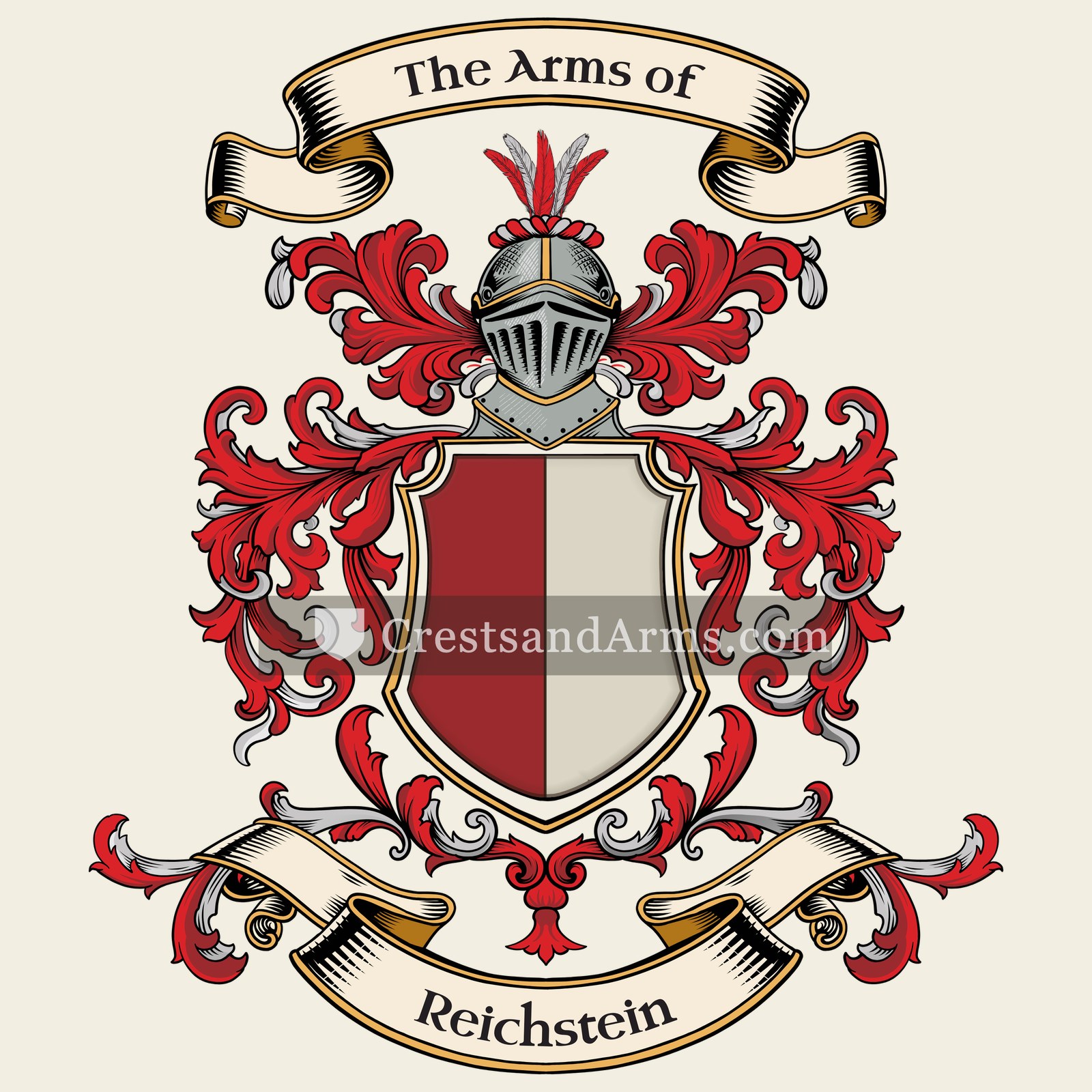
A record of documented arms, meaning and origin, researched for the Reichstein family of Germany.
Reg. 8799 · German, P–S
Coat of Arms & Family Crest Details
Colours
Red (Gules)Means: Military strength
Silver (Argent)Means: Peace and sincerity
Historical info
Source
J. B. Rietstap, Armorial Général, Gouda: G. B. van Goor Zonen, 1884–87
Blazon (the actual original written record)
“De gu.; embrassé-vivré à dextre d'arg. C.: un chapeau pyramidal d'arg., retr. d'un palé de gu. et d'arg. de huit pièces, et sommé d'un panache de plumes de coq de sa.”
Germanyc. 1725
Digital archive packCoat of arms PNG, gold border print PDF, vector SVG and the certificate of authenticity. Sent to your email in minutes.
Map of Germany showing where the Reichstein arms are recorded
The Reichstein arms were recorded in Germany, c. 1725.
Arms such as these were typically recorded in Bavaria.
Bavaria was a country of old landed families and walled market towns. Estates passed down the same line for centuries, and both the landowners and the leading townsmen kept arms, which is why so many Bavarian names sit in the registers.
This is where the arms were entered in the register. Families often moved to other parts of the country, so the same name can turn up in more than one region.
The body that granted and recorded arms in Germany in this period.
Charles VI, Holy Roman Emperor
Sovereign of the period
Charles VI, Holy Roman Emperor
1711–1740
Reigning in Germany when the Reichstein arms are first recorded.
How Arms Worked in Germany
In the Holy Roman Empire, coats of arms were often granted to individuals by the Emperor or his representatives. These arms were then passed down through the generations to all legitimate descendants of the original holder. Younger branches of a family usually kept the same shield design without needing to change it, as the arms belonged to the entire lineage.
Granting authority
The Holy Roman Emperor held the sole power to grant new coats of arms throughout his vast imperial territories.
How they got arms
Families typically obtained their coats of arms through a formal imperial grant or by proving their noble status to the authorities.
Where arms were recorded
These grants were officially recorded in the Imperial Chancery registers, which began keeping formal records of such honors during the Middle Ages.
The family's standing
Recorded among the armigerous families of Germany.
Origin & History of the Reichstein Family in Germany
The surname Reichstein is rooted in the German language and carries a meaning that suggests a connection to a specific location or property. The name is a combination of the words reich, which often referred to a kingdom or a wealthy estate, and stein, which means stone. In the early eighteenth century, the family was well established in the region of Bavaria. During this period, families with this name were often associated with the local land or trade guilds that defined village life. Because surnames were becoming more permanent during this era, the name likely helped identify the family as residents of a particular stone-built property or a rocky area within the Bavarian landscape. By 1725, members of the family were integrated into the local community, living through a time when Bavaria was undergoing significant social and agricultural changes under the rule of the Wittelsbach dynasty.
Reichstein Meaning & Related Branches
Root word
Rich and Stein
Rich or powerful and stone or rock.
This name
ReichsteinA topographic name for someone living near a prominent or wealthy stone landmark.
also spelled
Ruchsteyn
Ruchstain
Rookstein
Rukstein
Ruchstine
Documented Sources
J. B. Rietstap, Armorial Général, Gouda: G. B. van Goor Zonen, 1884–87
Bahlow, Hans, Deutsches Namenlexikon: Familien- und Vornamen nach Ursprung und Sinn erklärt, 1967