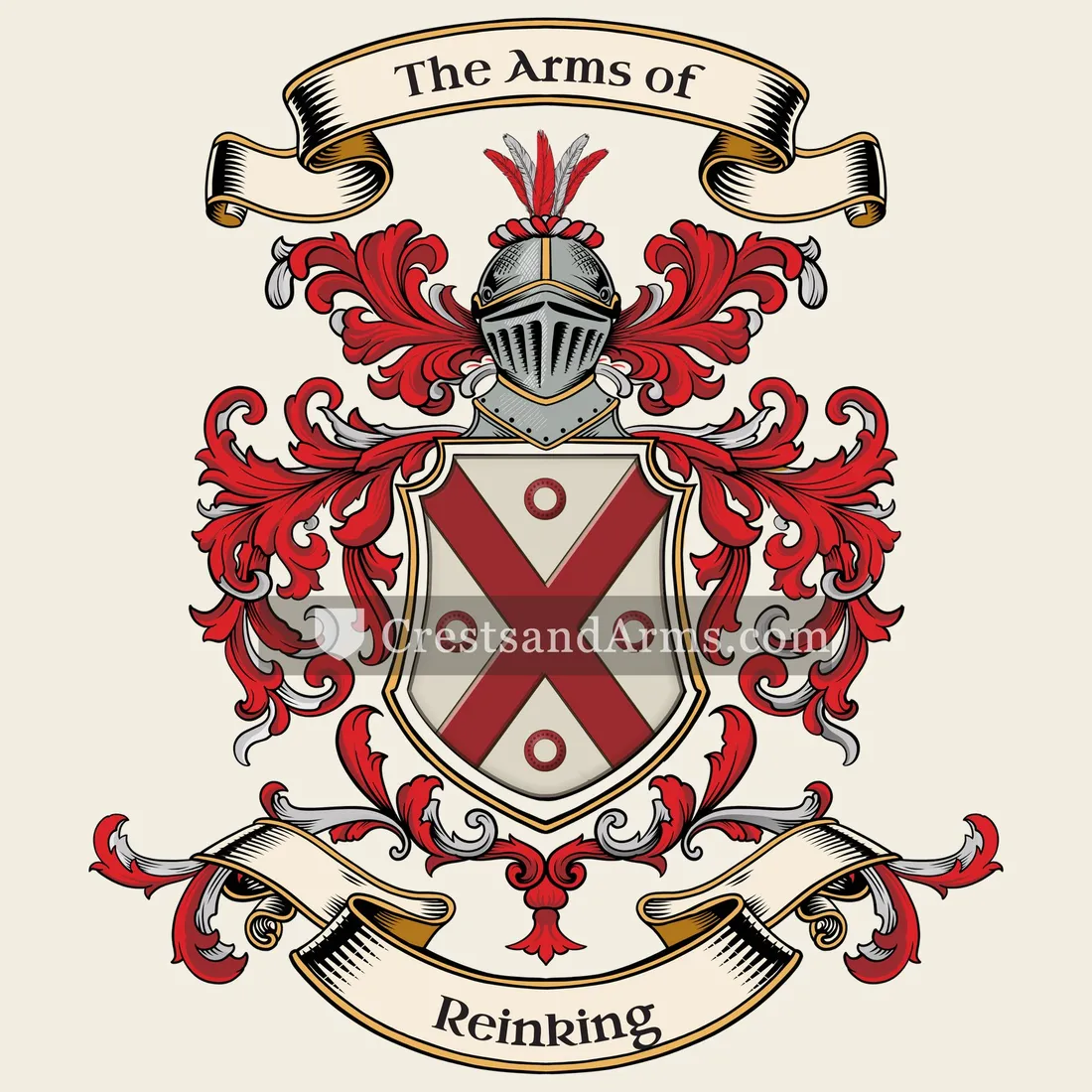
A record of documented arms, meaning and origin, researched for the Reinking family of Germany.
Reg. 6809 · German, P–S
Meaning of the Reinking family crest colors & symbols
Symbols on this shield
saltireResolution, and St Andrew's cross
ringFidelity, and a promise kept
Colours
Silver (Argent)Means: Peace and sincerity
Red (Gules)Means: Military strength
Historical info
Source
J. B. Rietstap, Armorial Général, Gouda: G. B. van Goor Zonen, 1884–87
Blazon (the actual original written record)
“D'arg. à un sautoir alésé, les extrémités arrondies (ou, deux bâtons alésés, passés en saut.), cant. de quatre annelets, le tout de gu. C.: un lion iss. de gu.; entre deux prob., coupées de gu. sur arg.; ou, le sautoir alésé; entre un vol, d'or et de gu.”
GermanyOstfrise, c. 1765
Digital archive packCoat of arms PNG, gold border print PDF, vector SVG and the certificate of authenticity. Sent to your email in minutes.
Map of Germany showing where the Reinking arms are recorded
The Reinking arms were recorded in Ostfrise, c. 1765.
This is where the arms were entered in the register. Families often moved to other parts of the country, so the same name can turn up in more than one region.
The body that granted and recorded arms in Germany in this period.
Francis I, Holy Roman Emperor
Sovereign of the period
Francis I, Holy Roman Emperor
1745–1765
Reigning in Germany when the Reinking arms are first recorded.
How Arms Worked in Germany
In the Holy Roman Empire, coats of arms were often granted to individuals by the Emperor or his representatives. These arms were then passed down through the generations to all legitimate descendants of the original holder. Younger branches of a family usually kept the same shield design without needing to change it, as the arms belonged to the entire lineage.
Granting authority
The Holy Roman Emperor held the sole power to grant new coats of arms throughout his vast imperial territories.
How they got arms
Families typically obtained their coats of arms through a formal imperial grant or by proving their noble status to the authorities.
Where arms were recorded
These grants were officially recorded in the Imperial Chancery registers, which began keeping formal records of such honors during the Middle Ages.
The family's standing
Recorded among the armigerous families of Germany.
Origin & History of the Reinking Family in Germany
The surname Reinking originates from the Low German regions of Northern Europe, where it functioned as a patronymic name derived from the given name Rein or Reinhard. In the mid-eighteenth century, historical records confirm that families bearing this name were established in the region of Ostfriesland, specifically appearing in church registers by 1765. During this period, the area was characterized by a strong agricultural economy and a unique social structure shaped by the proximity to the North Sea. Families like the Reinkings were often deeply integrated into the local parish life, which served as the primary center for community records and social organization. As the name spread through the rural villages of East Frisia, it became a marker of families who were deeply rooted in the local landscape and the traditions of the coastal lowlands.
Reinking Meaning & Related Branches
Root word
Reinko
A diminutive form of the Germanic name Reinhard meaning brave counsel.
This name
ReinkingA patronymic surname indicating descent from a person named Reinko or Reinhard.
also spelled
Reyning
Reinkink
Rinking
Documented Sources
J. B. Rietstap, Armorial Général, Gouda: G. B. van Goor Zonen, 1884–87
Bahl, Peter. Der Hof des Großen Kurfürsten: Studien zur höheren Amtsträgerschaft Brandenburg-Preußens. 2001
Niedersächsisches Landesarchiv (Aurich). Kirchenbuchduplikate der Ostfriesischen Landschaft. 1765
Zoder, Rudolf. Familiennamen in Ostfriesland. 1968
Digital archive packCoat of arms PNG, gold border print PDF, vector SVG and the certificate of authenticity. Sent to your email in minutes.


 saltireResolution, and St Andrew's cross
 ringFidelity, and a promise kept
 saltireResolution, and St Andrew's cross
 ringFidelity, and a promise kept