Map of Netherlands showing where the Reitz arms are recorded
The Reitz arms were recorded in Netherlands, c. 1815.
Arms such as these were typically recorded in Friesland.
Friesland was low, wet country on the northern coast of the Netherlands, farmed by families who had held the same land for centuries. Free landholders were unusually common there, and a free landholder could carry arms.
This is where the arms were entered in the register. Families often moved to other parts of the country, so the same name can turn up in more than one region.
Region
Friesland
First recorded
1815
Granting Authority for the Reitz Arms
Hoge Raad van Adel
Photograph made by me · CC BY-SA 3.0
The body that granted and recorded arms in Netherlands in this period.
William I of the Netherlands
Sovereign of the period
William I of the Netherlands
1815–1840
Reigning in Netherlands when the Reitz arms are first recorded.
How Arms Worked in Netherlands
In the Netherlands, coats of arms were often used by noble families and those who held specific public offices. These arms were passed down through the generations to legitimate descendants. Younger branches of a family usually kept the original design without needing to add special marks. This system ensured that the family identity remained clear and consistent over many years.
Granting authority
The Hoge Raad van Adel is the official body that regulates and manages noble titles and coats of arms in the Netherlands.
How they got arms
Families typically obtained their coats of arms through official royal grants or by proving their long-standing historical use of the symbols.
Where arms were recorded
Coats of arms are officially recorded in the registers held by the Hoge Raad van Adel, which began its work in 1814.
The family's standing
Recorded among the armigerous families of Netherlands.
Origin & History of the Reitz Family in Netherlands
The surname Reitz has deep roots in the northern regions of the Netherlands, particularly within the province of Friesland. By the early 19th century, families bearing this name were well-established in Frisian communities, a time when the region was undergoing significant social and administrative changes following the Napoleonic era. The name itself is thought to be a variation of Germanic personal names, often serving as a shortened form of names like Reitsma or other regional descriptors that identified a person by their father or their place of origin. Because the Netherlands implemented formal civil registration in 1811, the presence of the Reitz family in official records by 1815 suggests they were part of a stable, settled population that was deeply integrated into the local Frisian economy. These early ancestors likely lived as farmers or skilled tradespeople, contributing to the distinct cultural identity that has defined the Frisian people for centuries.
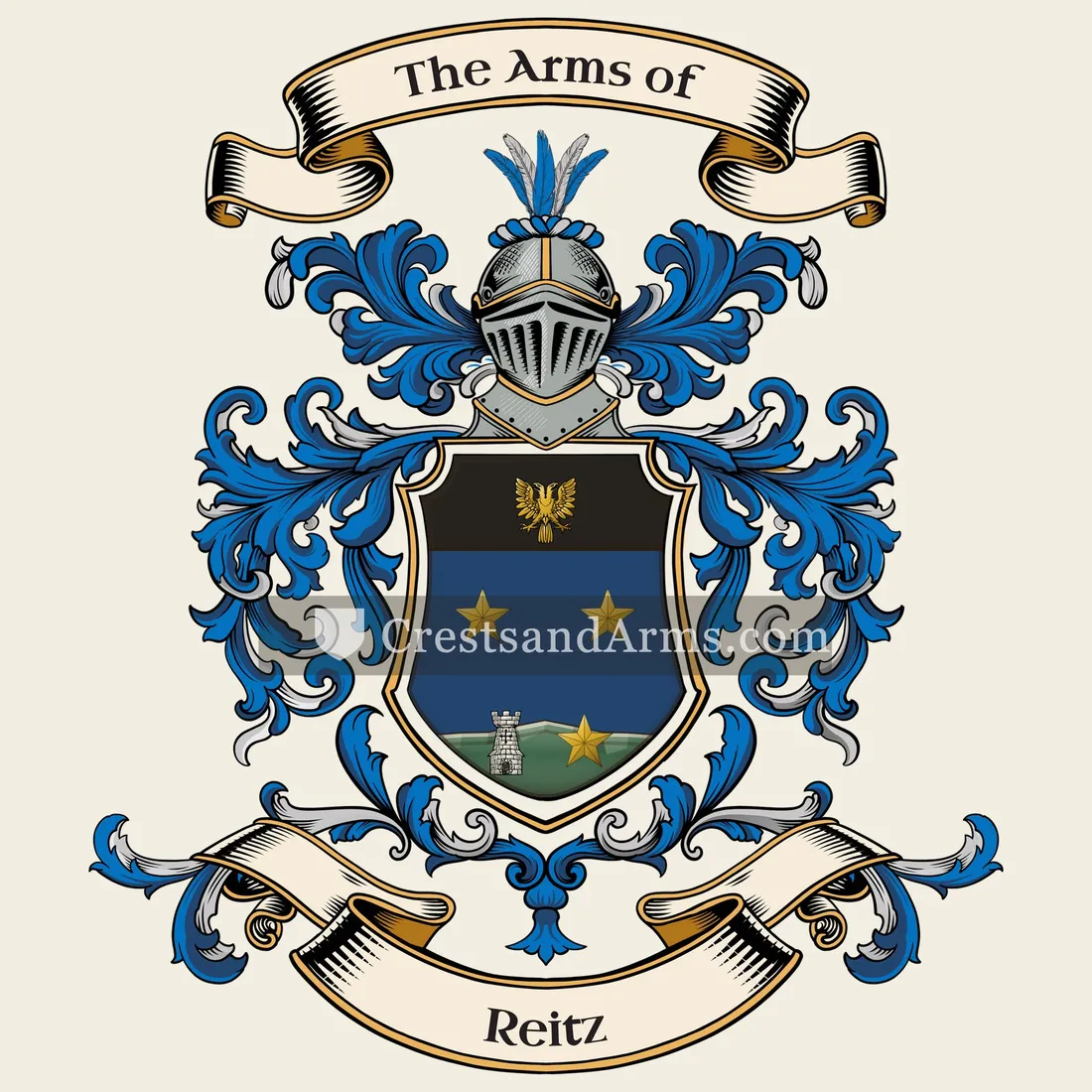
Meaning of the Reitz family crest colors & symbols
Symbols on this shield
mountThe ground held, and steadfastness upon it
chiefAuthority, wisdom and dominion
towerGrandeur and solidity, and a stronghold defended
mulletThe third son, and a divine quality from above
eagleNobility, strength and a keen mind
Colours
Blue (Azure)Means: Loyalty and truth
Black (Sable)Means: Constancy
Green (Vert)Means: Hope
Gold (Or)Means: Generosity
Historical info
Source
J. B. Rietstap, Armorial Général, Gouda: G. B. van Goor Zonen, 1884–87
Blazon (the actual original written record)
“D'azur à une tour au nat., crén. de quatre pièces, la porte fermée surm. de trois archières, ladite tour posée sur une terrasse de sin. et surm. de trois étoiles d'or; au chef de sa., ch. d'une aigle ép. iss. d'or. Deux cq. cour. C.: 1° un bras, arm. et gantelé au nat., brandissant une épée; 1. d'or et d'azur; 2° une aigle ép. iss. d'or; l. d'or et de sa.”
Austriac. 1772
Digital archive packCoat of arms PNG, gold border print PDF, vector SVG and the certificate of authenticity. Sent to your email in minutes.
Map of Austria showing where the Reitz arms are recorded
The Reitz arms were recorded in Austria, c. 1772.
Arms such as these were typically recorded in Tyrol.
Tyrol was mountain country in western Austria, where the valleys were held by families who had been there a very long time. Old tenure counted for more than money, and old families carried arms.
This is where the arms were entered in the register. Families often moved to other parts of the country, so the same name can turn up in more than one region.
Region
Tyrol
First recorded
1772
Granting Authority for the Reitz Arms
Imperial and Royal chancery
Sodacan · CC BY-SA 3.0
The body that granted and recorded arms in Austria in this period.
Joseph II, Holy Roman Emperor
Sovereign of the period
Joseph II, Holy Roman Emperor
1765–1790
Reigning in Netherlands when the Reitz arms are first recorded.
How Arms Worked in Austria
Austrian coats of arms were often linked directly to noble titles granted by the Emperor. These symbols belonged to the entire family line rather than just one individual. When a family grew, new branches kept the original design without needing to change it. This system allowed all members of a noble house to share the same identity across many generations.
Granting authority
The Imperial and Royal chancery managed all heraldic matters and controlled the official granting of arms throughout the Austrian lands.
How they got arms
Families typically received their arms through a formal imperial decree that often accompanied the elevation of a person to noble status.
Where arms were recorded
Official records of these grants were kept in the Imperial Register of Nobility which began its formal documentation process in 1453.
The family's standing
Recorded among the armigerous families of Austria.
Origin & History of the Reitz Family in Austria
The surname Reitz has deep roots in the alpine landscapes of Austria, particularly within the rugged region of Tyrol. By 1772, records confirm that members of the family were already established in these mountainous communities. The name itself likely originated as a short form of Germanic names containing the element "rad," which translates to counsel or advice. During the eighteenth century, families in Tyrol often lived in small, tight-knit villages where they worked as farmers, craftsmen, or local traders. Because the terrain was difficult to navigate, these families developed strong local ties and passed down their name through generations of mountain life. This period was a time of significant transition for the region, as the Habsburg monarchy worked to organize and document the populations living in these remote valleys. The presence of the Reitz family in Tyrol during this era reflects the broader history of families who built their lives amidst the challenging geography of the Austrian Alps.
Reitz Meaning & Related Branches
Root word
Rik
Derived from the Germanic word for ruler or powerful leader.
This name
ReitzA patronymic or nickname form indicating a descendant of a powerful ruler.
also spelled
Reiz
Reits
Ryts
Ritz
Related arms
de Rochessimilar arms
Luersmasimilar arms
Pfeufersimilar arms
Rinowichtsimilar arms
Documented Sources
J. B. Rietstap, Armorial Général, Gouda: G. B. van Goor Zonen, 1884–87
Tresoar (Fries Historisch en Letterkundig Centrum), Burgerlijke Stand van Friesland
Dijkstra, B., Friese familienamen, 1998
Nederlandse Familienamenbank, Reitz
Digital archive packCoat of arms PNG, gold border print PDF, vector SVG and the certificate of authenticity. Sent to your email in minutes.


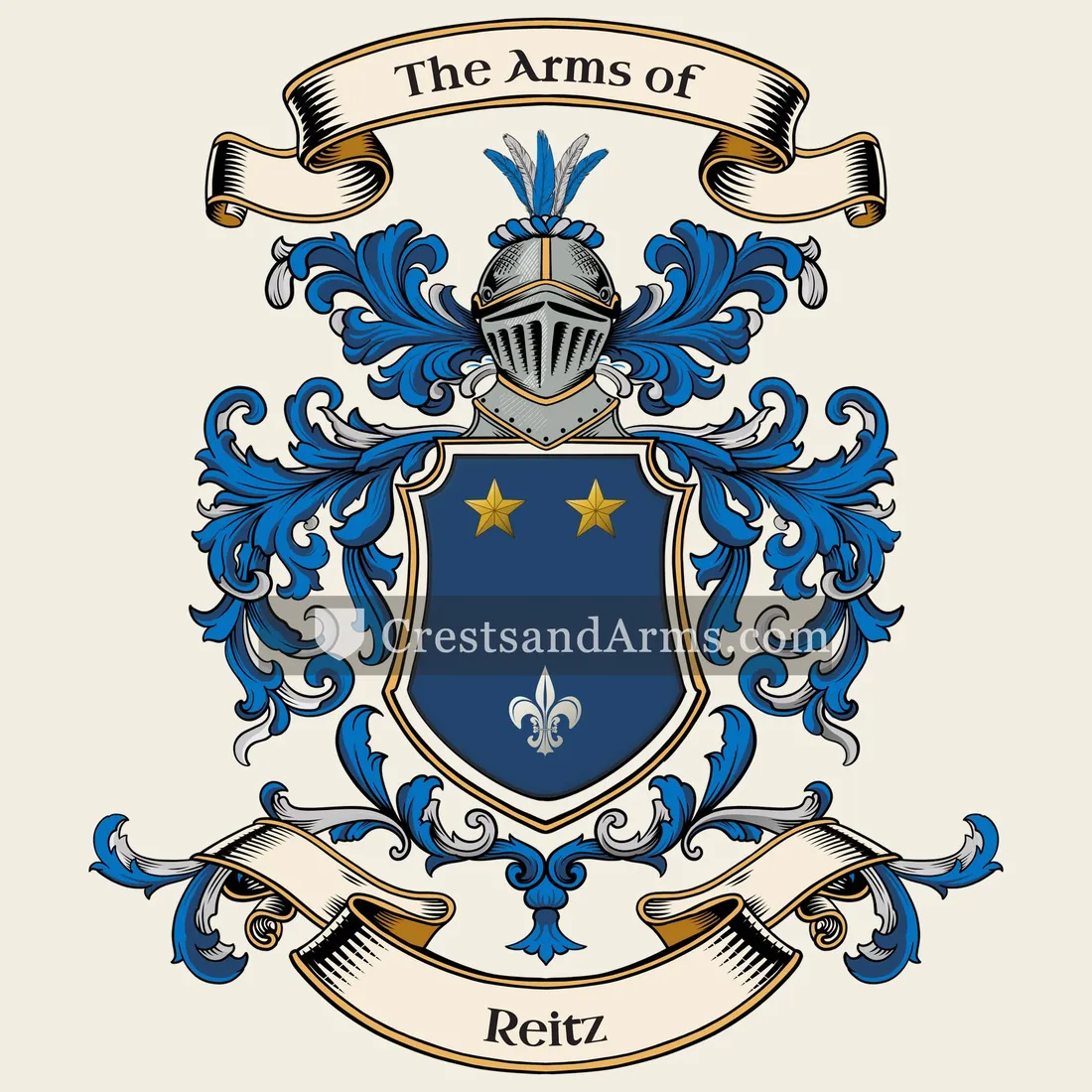
 mulletThe third son, and a divine quality from above
 fleur de lisPurity, light, and the sixth son
 mulletThe third son, and a divine quality from above
 fleur de lisPurity, light, and the sixth son


 mountThe ground held, and steadfastness upon it
 chiefAuthority, wisdom and dominion
 towerGrandeur and solidity, and a stronghold defended
 eagleNobility, strength and a keen mind