Map of Spain showing where the Resa arms are recorded
The Resa arms were recorded in Andalusia, c. 1722.
Andalusia was the last part of Spain taken back from the Moors, and the land was shared out among the men who took it. A grant of land came with a grant of arms, so the region produced a great many.
This is where the arms were entered in the register. Families often moved to other parts of the country, so the same name can turn up in more than one region.
The body that granted and recorded arms in Spain in this period.
Philip V of Spain
Sovereign of the period
Philip V of Spain
1714–1724
Reigning in Spain when the Resa arms are first recorded.
How Arms Worked in Spain
In Spain, a coat of arms was considered a form of property that belonged to the entire family line. These arms were passed down from a father to all his children equally. Younger branches of the family usually kept the original design without needing to add any special marks to distinguish their specific line.
Granting authority
The Cronista Rey de Armas was the official body that regulated and granted coats of arms throughout Spain.
How they got arms
Families often obtained their arms through royal grants or by proving their noble status to the official heraldic authority.
Where arms were recorded
Coats of arms were officially recorded in the registers of the Cronista Rey de Armas starting in 1496.
The family's standing
Recorded among the armigerous families of Andalusia.
Origin & History of the Resa Family in Spain
The family name Resa holds deep roots in the historical landscape of Andalusia, where records confirm the presence of family members as early as 1722. During this period, Andalusia was a region defined by its rich agricultural traditions and its role as a gateway for trade between Spain and the wider world. Families living in this area often identified with specific local parishes, which served as the primary centers for documenting births, marriages, and deaths. The name Resa likely emerged from the linguistic patterns of the southern Iberian Peninsula, where surnames were frequently derived from geographic features or descriptive traits of the local landscape. As the family established itself in the eighteenth century, they became part of the social fabric of the region, contributing to the local economy and the development of their community through generations of steady work and residency.
Resa Meaning & Related Branches
Root word
Resare
Latin verb meaning to harvest, reap, or mow crops.
This name
ResaA topographic surname referring to someone who lived near a harvested field.
Documented Sources
J. B. Rietstap, Armorial Général, Gouda: G. B. van Goor Zonen, 1884–87
Archivo Histórico Diocesano de Sevilla, Libros de Bautismos y Matrimonios de la Parroquia de San Lorenzo, 1722
García Carraffa, Alberto y Arturo, Diccionario heráldico y genealógico de apellidos españoles y americanos, 1952
Meyerson, Mark D., The Muslims of Valencia in the Age of Fernando and Isabel: Between Coexistence and Crusade, 1991
Digital archive packCoat of arms PNG, gold border print PDF, vector SVG and the certificate of authenticity. Sent to your email in minutes.


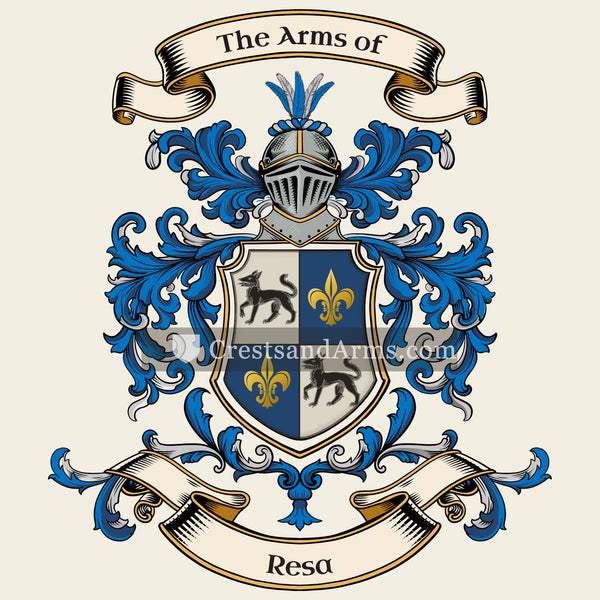
 wolfReward from long service and hard work
 fleur de lisPurity, light, and the sixth son
 wolfReward from long service and hard work
 fleur de lisPurity, light, and the sixth son