A record of documented arms, meaning and origin, researched for the Reust family lines. Documented in 3 countries.
Reg. 0716 · Swiss, P–S
Meaning of the Reust family crest colors & symbols
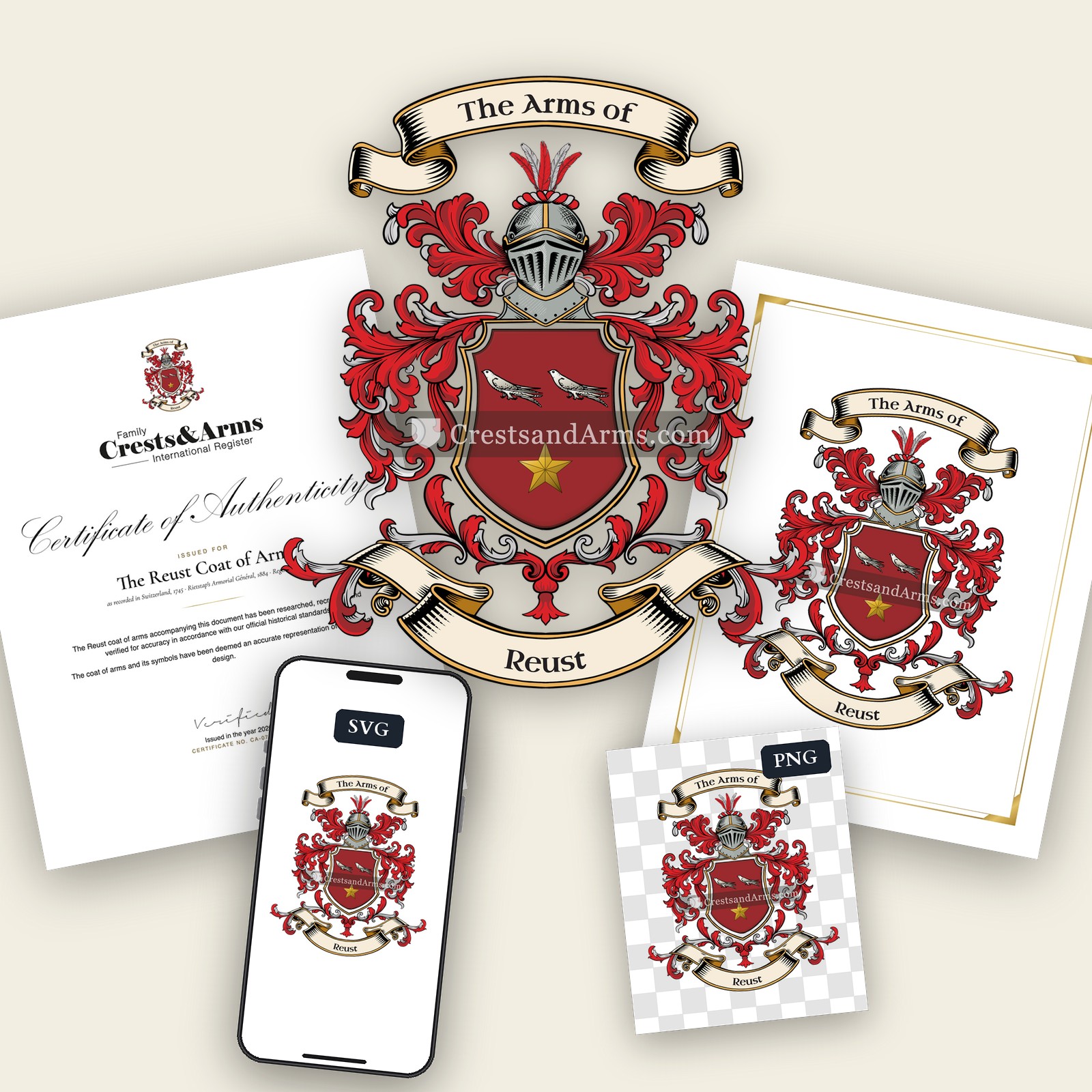
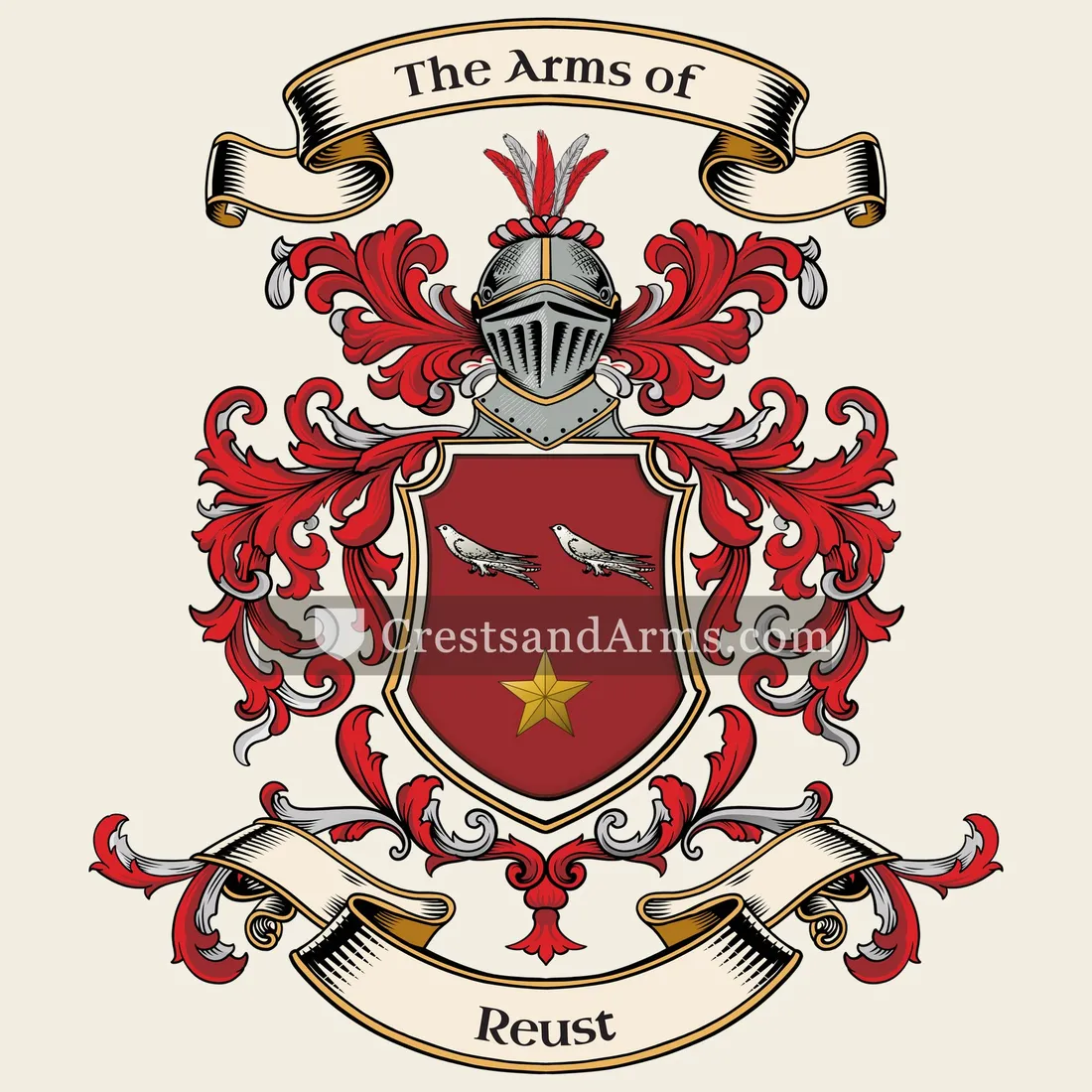
Symbols on this shield
martletA younger son, who must win his own land
mulletThe third son, and a divine quality from above
Colours
Red (Gules)Means: Military strength
Gold (Or)Means: Generosity
Historical info
Source
J. B. Rietstap, Armorial Général, Gouda: G. B. van Goor Zonen, 1884–87
Blazon (the actual original written record)
“De gu. à une marque de marchand d'arg. en forme de chev. ployé renv. alésé, soutenu d'une vergette croisée d'une traverse et terminée en accolade; les branches du chev. sommées de deux oiseaux adossés au nat.; le tout acc. en p. d'une étoile d'or. C.: une chouette au nat., posée de front sur un monticule d'arg. L.: à dextre de gu. et de sa., à sen. d'or et de sa.”
SwitzerlandSoleure, c. 1745
Digital archive packCoat of arms PNG, gold border print PDF, vector SVG and the certificate of authenticity. Sent to your email in minutes.
Map of Switzerland showing where the Reust arms are recorded
The Reust arms were recorded in Soleure, c. 1745.
This is where the arms were entered in the register. Families often moved to other parts of the country, so the same name can turn up in more than one region.
The body that granted and recorded arms in Switzerland in this period.
How Arms Worked in Switzerland
In Switzerland, coats of arms were not restricted to the nobility and were often adopted by common citizens and families. These symbols were passed down through generations to show family identity. When branches of a family grew, they often changed small details of the design to distinguish their own line from the original group.
Granting authority
Cantonal and civic authorities managed the use of coats of arms within their specific regions and local jurisdictions.
How they got arms
Families typically assumed their own coats of arms based on local custom rather than receiving them from a central monarch.
Where arms were recorded
Arms were recorded in various cantonal and civic registers starting from the fourteenth century throughout the Swiss region.
The family's standing
Recorded among the armigerous families of Switzerland.
Origin & History of the Reust Family in Switzerland
The Reust family name is deeply rooted in the historical landscape of the Swiss canton of Solothurn, where records confirm their presence as early as the mid-eighteenth century. During this period, the region was characterized by a rigid social structure where families were often tied to specific parishes and local agricultural traditions. The name likely emerged from the Alemannic linguistic traditions common to the area, potentially evolving from local nicknames or descriptions of the landscape where early ancestors lived and worked. By 1745, members of the Reust family were established residents within the canton, participating in the civic and economic life of their communities. These early generations were typically integrated into the local guild systems or farming collectives that defined Swiss life before the industrial era. Their history reflects the broader patterns of Swiss settlement, where families remained in the same geographic regions for centuries, building deep connections to the land and the evolving political structures of the Old Swiss Confederacy.
Meaning of the Reust family crest colors & symbols
Symbols on this shield
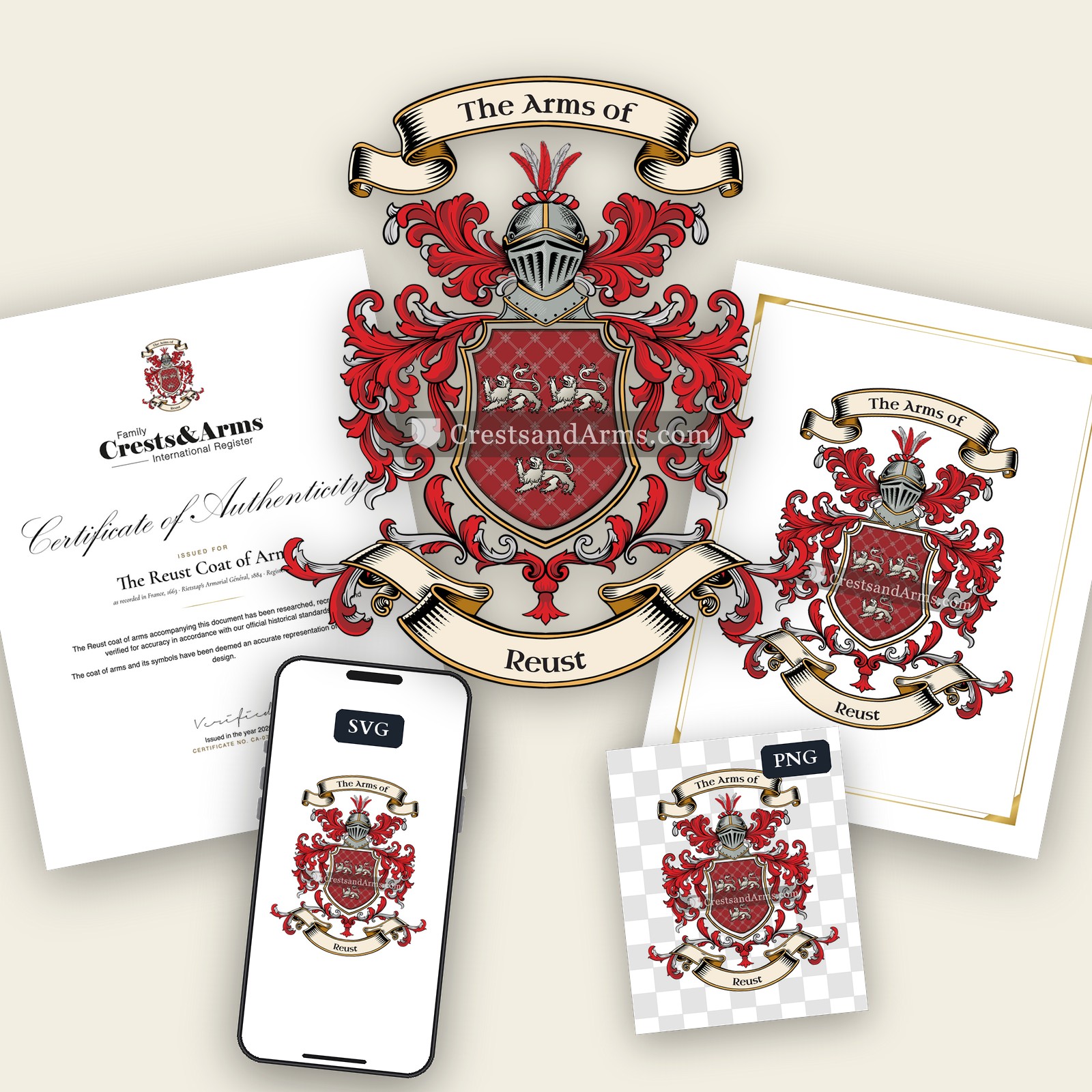
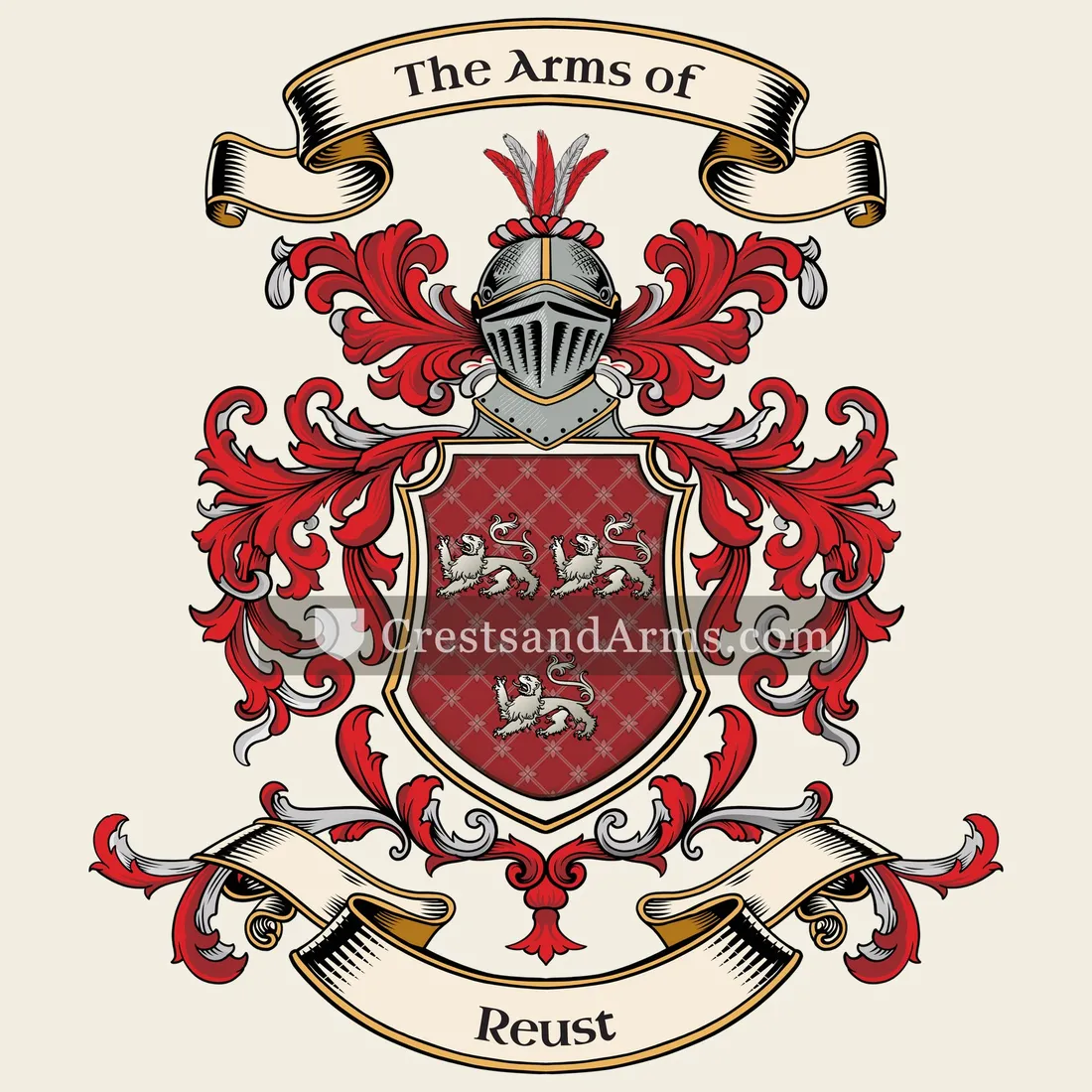
lionCourage, strength and royalty
Colours
Red (Gules)Means: Military strength
Silver (Argent)Means: Peace and sincerity
Historical info
Source
J. B. Rietstap, Armorial Général, Gouda: G. B. van Goor Zonen, 1884–87
Blazon (the actual original written record)
“De gu. à trois têtes et cols de lion d'arg., cour. d'or. Cq. cour. C.: une tête de lion de l'écu, entre deux cornes de buffle d'or [Une autre branche portait en cimier un buste de More, posé de profil, hab. de gu., coiffé d'un bonnet pointu du même, retr. d'arg., orné sur le devant d'un panache de plumes de coq de sa.]”
Francec. 1663
Digital archive packCoat of arms PNG, gold border print PDF, vector SVG and the certificate of authenticity. Sent to your email in minutes.
Map of France showing where the Reust arms are recorded
The Reust arms were recorded in France, c. 1663.
Arms such as these were typically recorded in Bretagne.
More families held coats of arms in Bretagne than anywhere else in France. The land was divided into many small estates rather than a few large ones, so far more households counted as gentry, and each needed a shield of its own to be told apart.
This is where the arms were entered in the register. Families often moved to other parts of the country, so the same name can turn up in more than one region.
The body that granted and recorded arms in France in this period.
Louis XIV of France
Sovereign of the period
Louis XIV of France
1643–1715
Reigning in Switzerland when the Reust arms are first recorded.
How Arms Worked in France
In France, a coat of arms was a mark of honor that passed down through the male line to all legitimate descendants. Families often used the same shield without changes to show their shared heritage. If a branch wanted to stand out, they could add a small mark to their shield to show their specific place in the family tree.
Granting authority
The Juge d'armes de France acted as the official authority that regulated and verified coats of arms across the country.
How they got arms
Families typically inherited their arms from ancestors, though they could also receive them through royal grants or by proving their noble status.
Where arms were recorded
Coats of arms were officially recorded in the Armorial Général de France, which began its main collection in the year 1696.
The family's standing
Recorded among the armigerous families of France.
Origin & History of the Reust Family in France
The history of the Reust family in France is deeply rooted in the rugged landscape of the Brittany region, where records confirm their presence as early as 1663. During the seventeenth century, families in this area often lived in small, tight-knit rural communities that relied heavily on agriculture and maritime trade. The name likely emerged as a way to identify individuals based on their specific location or their role within these local village structures. As the family established their roots in Brittany, they became part of the broader social fabric of the province, navigating the complex political and religious changes that defined life under the French monarchy. By maintaining a consistent presence in the region, the early members of the Reust family helped shape the local history of their parishes and contributed to the enduring cultural identity of the Breton people.
Meaning of the Reust family crest colors & symbols
Symbols on this shield
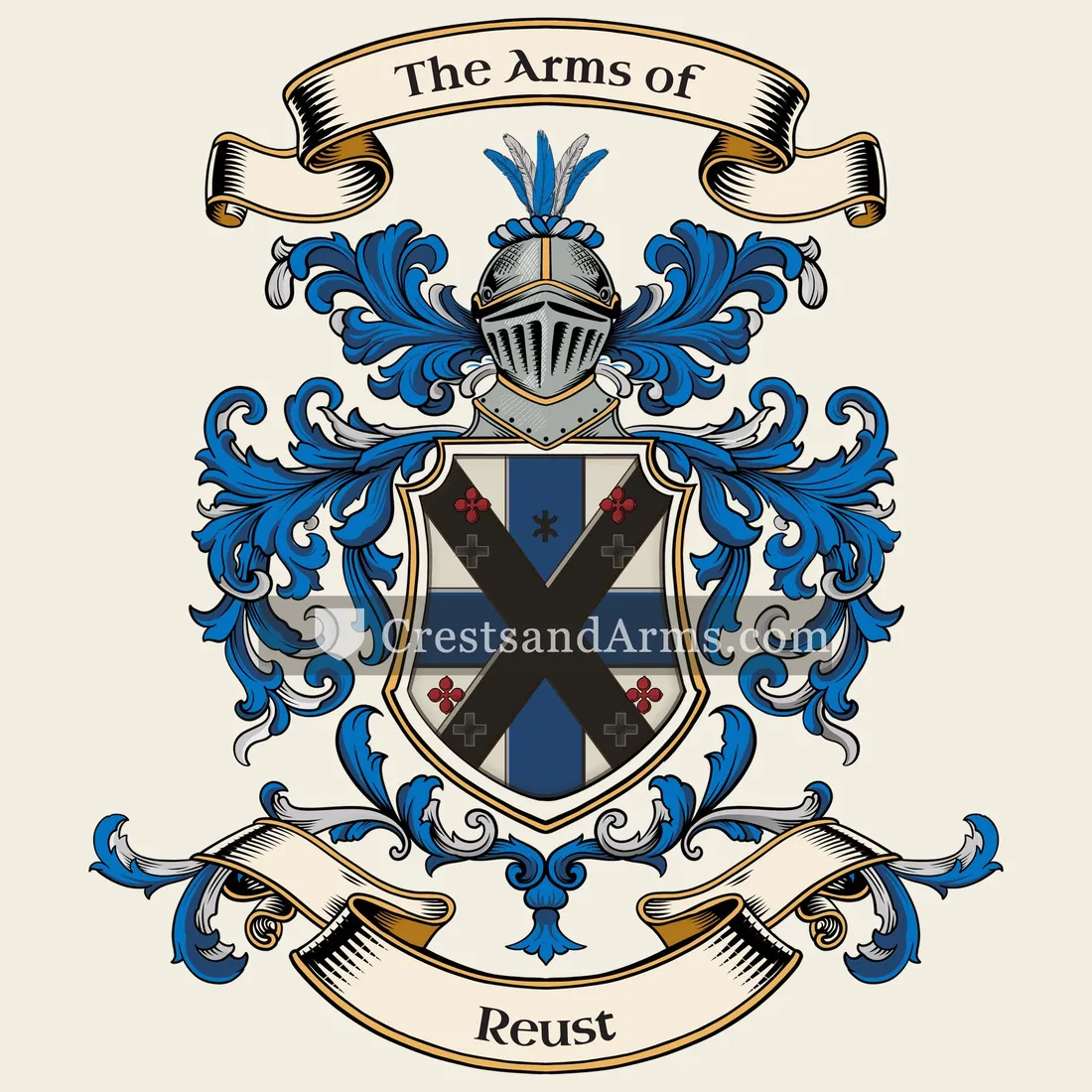
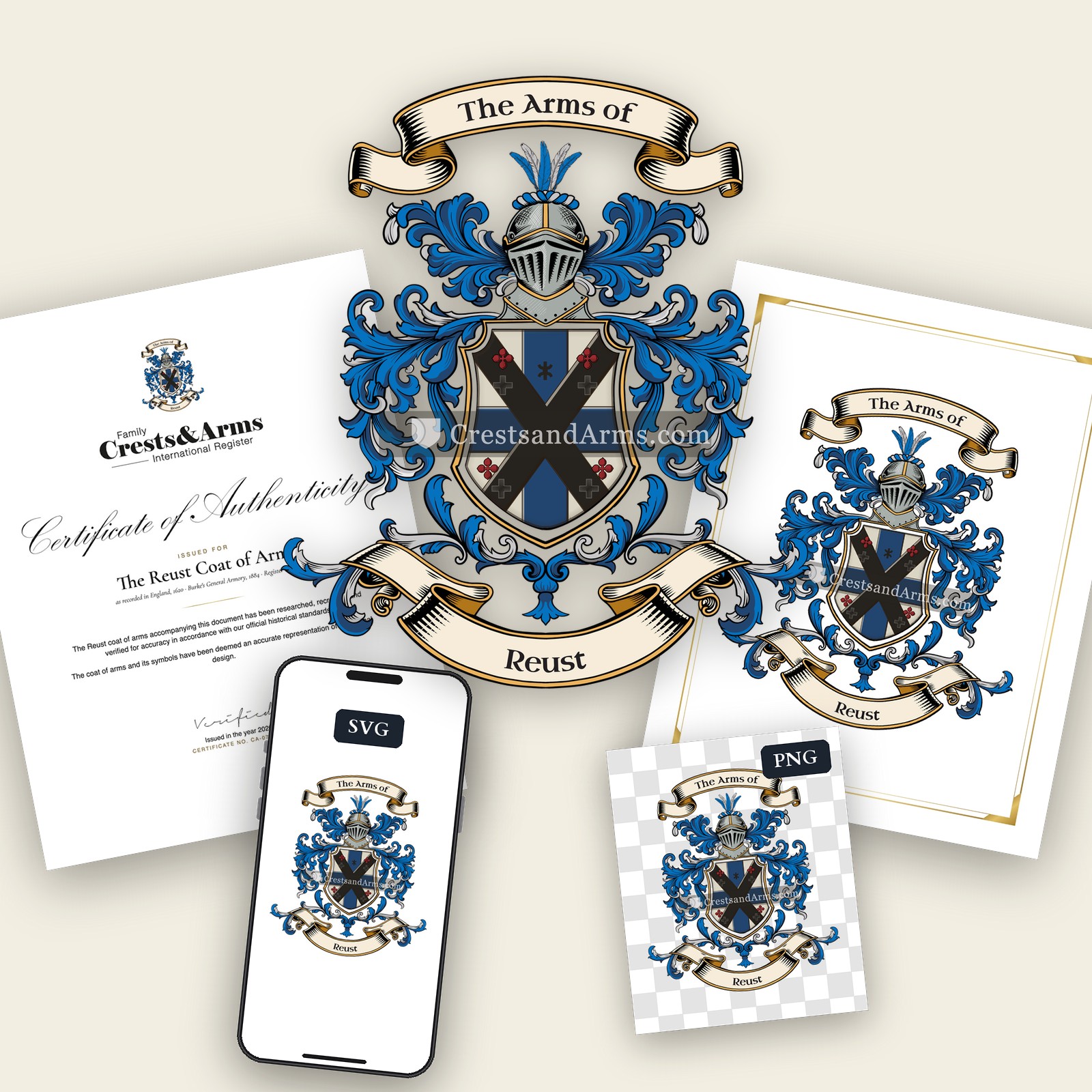
saltireResolution, and St Andrew's cross
cross symbolChristian faith and service
millrind / fer de molineThe mill's iron, and the grinding of grain
plant quatrefoilGood fortune and the fourfold gospel
Colours
Silver (Argent)Means: Peace and sincerity
Blue (Azure)Means: Loyalty and truth
Black (Sable)Means: Constancy
Red (Gules)Means: Military strength
Historical info
Source
Sir Bernard Burke, The General Armory of England, Scotland, Ireland and Wales, London: Harrison & Sons, 1884
Blazon (the actual original written record)
“Ar. a cress az. quarter pierced of the field, thereon a fer-de-moline sa. betw. four quatrefoils gu.; another, Ar. a saltire betw. four crosses crosslet fitchée sa”
Englandc. 1620
Digital archive packCoat of arms PNG, gold border print PDF, vector SVG and the certificate of authenticity. Sent to your email in minutes.
Map of England showing where the Reust arms are recorded
The Reust arms were recorded in England, c. 1620.
Arms such as these were typically recorded in York.
Yorkshire is the largest of the English counties, and it held more gentry families than any other. Land there was split among a great many households rather than a few, so a great many of them carried arms.
This is where the arms were entered in the register. Families often moved to other parts of the country, so the same name can turn up in more than one region.
The body that granted and recorded arms in England in this period.
James VI and I
Sovereign of the period
James VI and I
1603–1625
Reigning in Switzerland when the Reust arms are first recorded.
How Arms Worked in England
English heraldry allowed arms to be shared by all legitimate descendants of the original owner. These symbols were treated as personal property that moved through the generations to all children. While the eldest son kept the original design, other family members could use the same shield without needing to change it or register their own unique versions.
Granting authority
The College of Arms in London has regulated the use of coats of arms throughout England and Wales since 1484.
How they got arms
Families typically obtained their coats of arms through a formal grant from the Crown or by proving their ancient right to them.
Where arms were recorded
All official coats of arms are recorded in the registers kept at the College of Arms, which date back to the fifteenth century.
The family's standing
Recorded among the armigerous families of England.
Origin & History of the Reust Family in England
The history of the Reust family in England begins to emerge clearly in the early seventeenth century, specifically within the historic city of York. By 1620, records indicate that members of the family were established residents in this northern hub, which was then a center for trade and religious administration. The name itself likely originated from Germanic or Old English roots, possibly serving as a descriptive nickname for a person with a particular physical trait or a specific connection to a local landmark. During this period, York was recovering from the political shifts of the Elizabethan era, and families like the Reusts were part of the growing urban middle class that helped sustain the city’s economy. While the family remained relatively modest in their social standing, their presence in such a prominent city suggests they were integrated into the local community life, participating in the daily commerce and civic duties that defined life in northern England during the reign of King James I.
Reust Meaning & Related Branches
Root word
Rüest
A Middle High German term referring to a rust-colored or reddish person.
This name
ReustA descriptive surname for an individual with red hair or a ruddy complexion.
also spelled
Ruston
Rustin
Documented Sources
J. B. Rietstap, Armorial Général, Gouda: G. B. van Goor Zonen, 1884–87
Staatsarchiv des Kantons Solothurn, Taufrodel (Baptismal Records) of the Solothurn parishes
Familiennamenbuch der Schweiz, 1989
Digital archive packCoat of arms PNG, gold border print PDF, vector SVG and the certificate of authenticity. Sent to your email in minutes.


 martletA younger son, who must win his own land
 mulletThe third son, and a divine quality from above
 martletA younger son, who must win his own land
 mulletThe third son, and a divine quality from above

 lionCourage, strength and royalty


 saltireResolution, and St Andrew's cross
 cross symbolChristian faith and service
 millrind / fer de molineThe mill's iron, and the grinding of grain
 plant quatrefoilGood fortune and the fourfold gospel