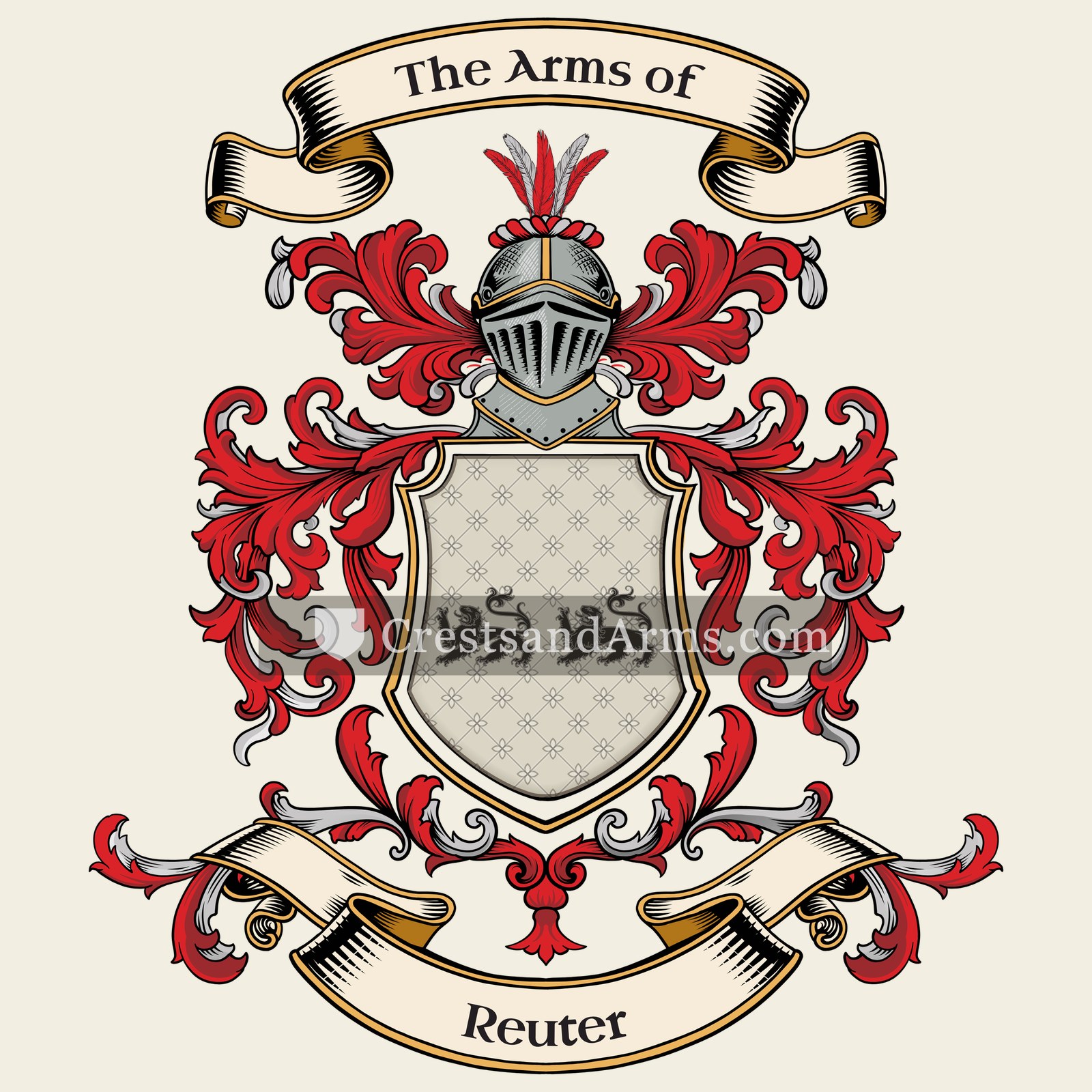
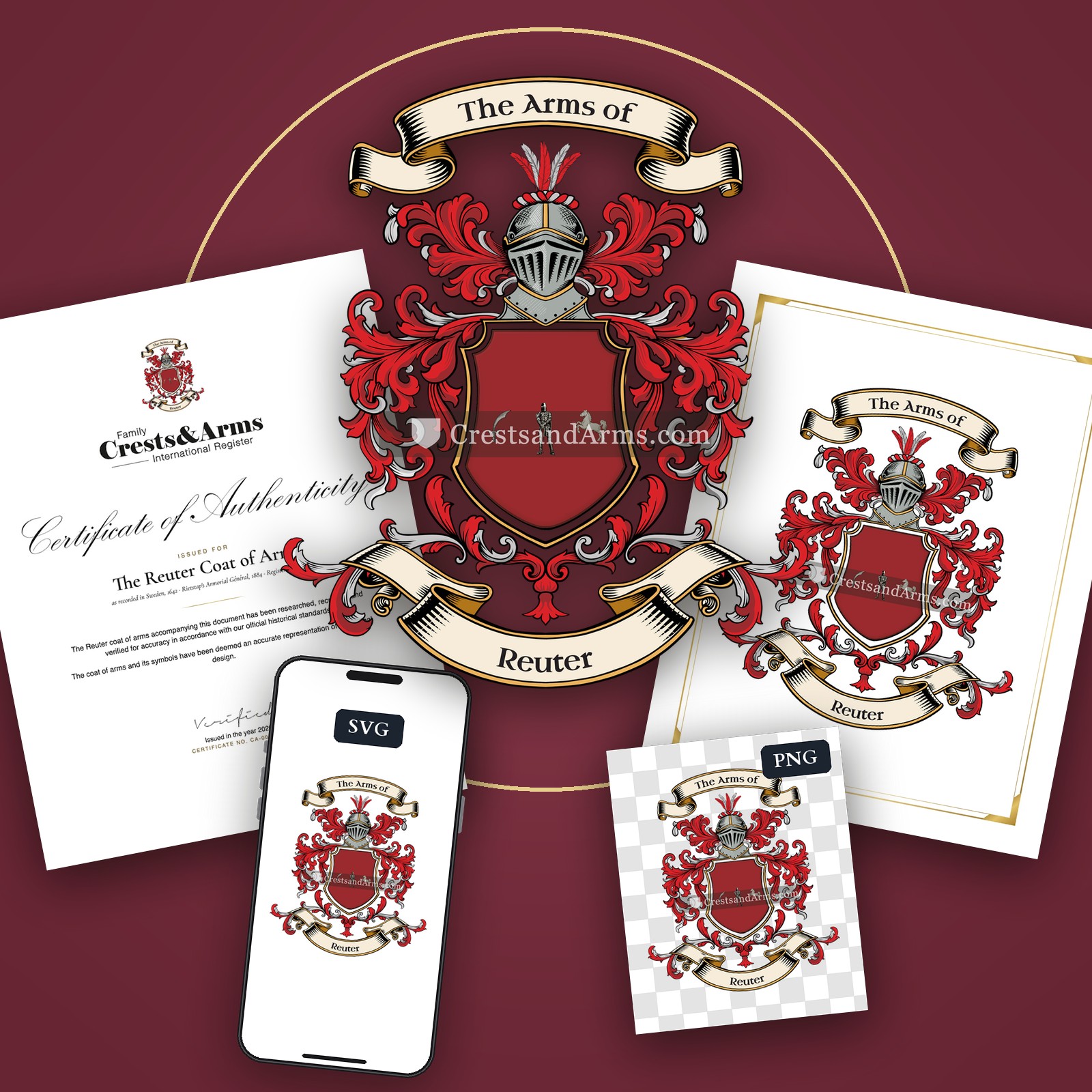
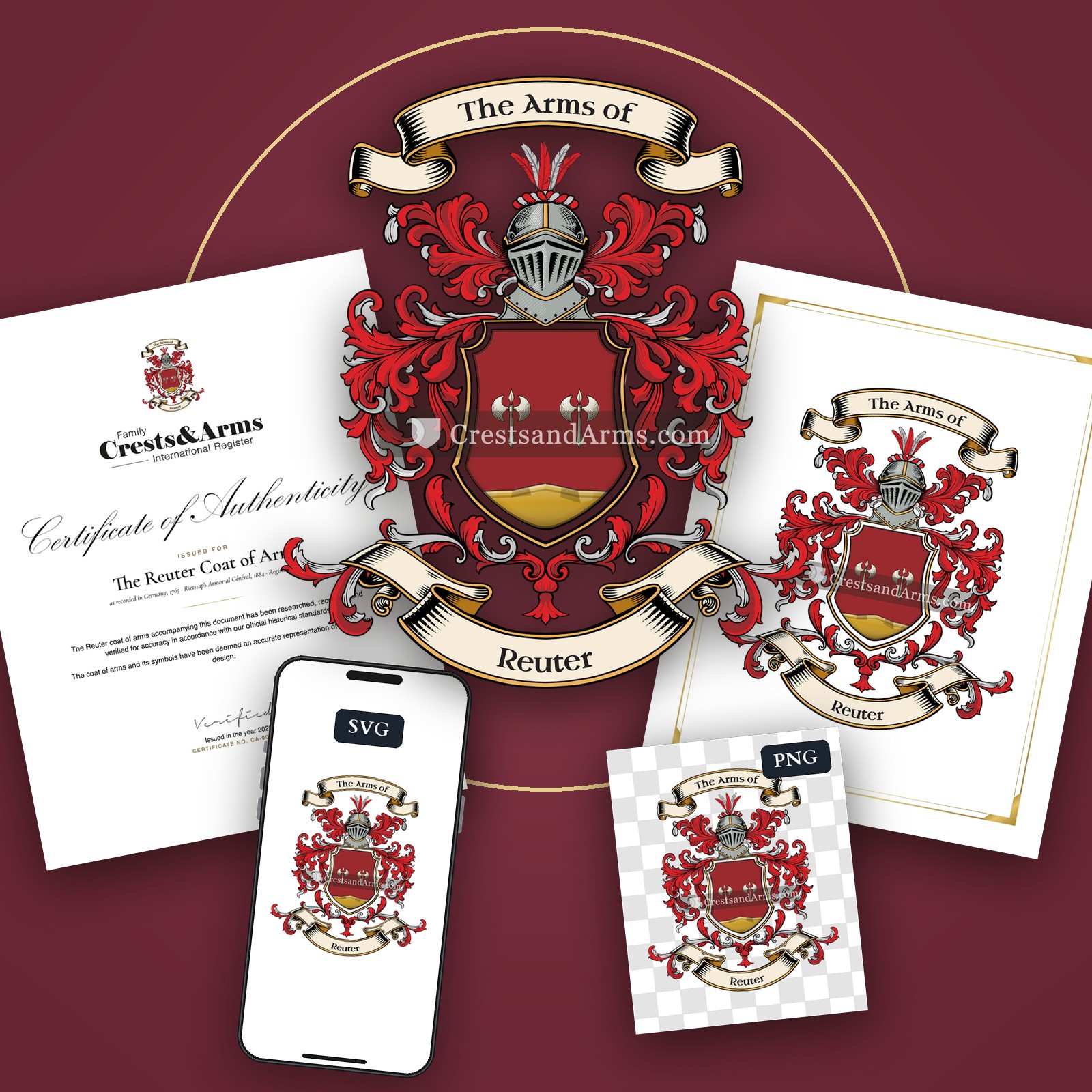
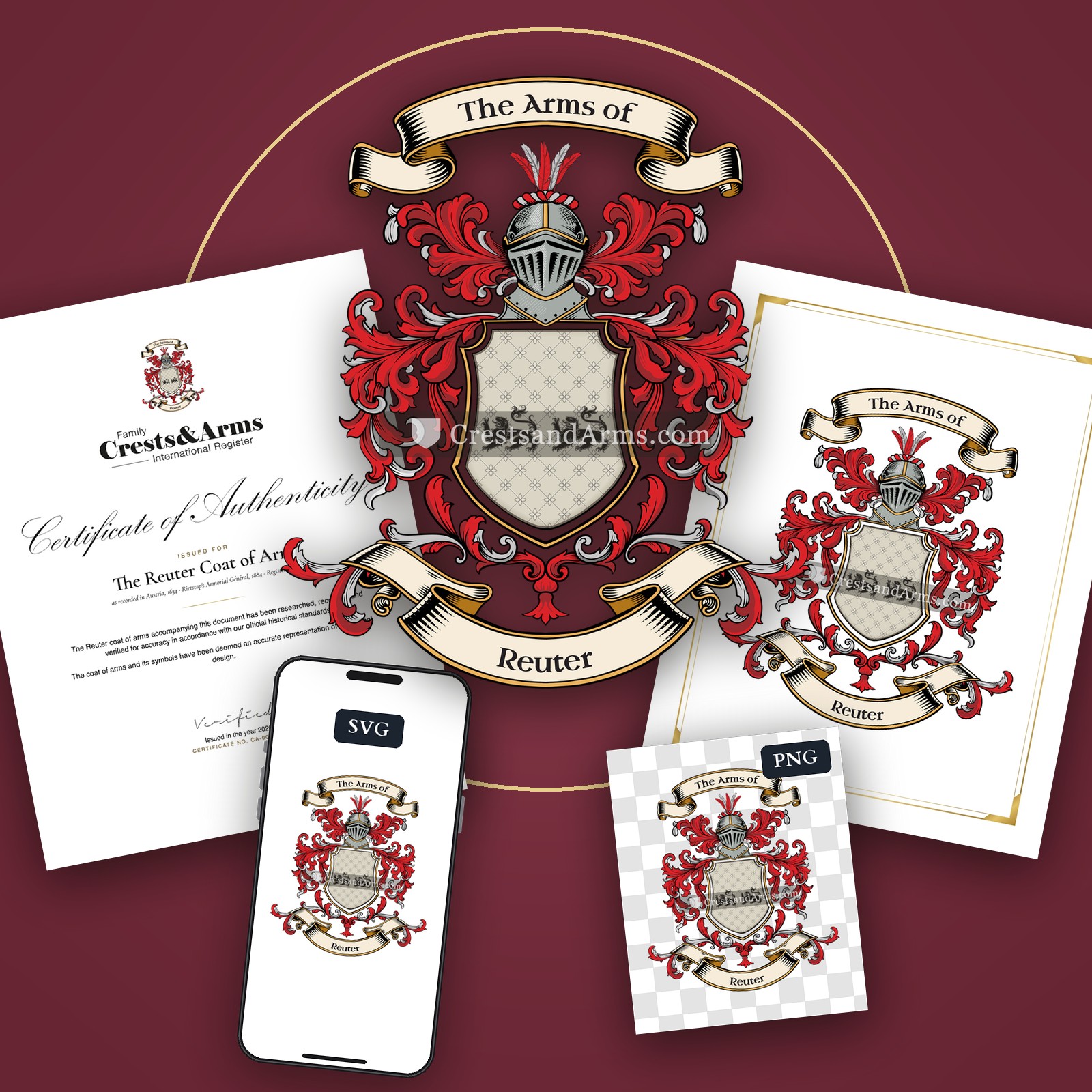
A record of documented arms, meaning and origin, researched for the Reuter family lines. Documented in 3 countries.
Reg. 0060 · Swedish, P–S
Coat of Arms & Family Crest Details
Symbols on this shield
knightChivalry and service in arms
swordJustice, and military honour
horseReadiness to serve king and country
Colours
Red (Gules)Means: Military strength
Silver (Argent)Means: Peace and sincerity
Historical info
Source
J. B. Rietstap, Armorial Général, Gouda: G. B. van Goor Zonen, 1884–87
Blazon (the actual original written record)
“De gu. à un chevalier, arm. de toutes pièces, la visière levée, brandissant une épée et monté sur un cheval blanc galopant. C.: une banderole coupée d'azur sur or, enroulée autour de sa hampe; entre six guidons, alt. d'azur et d'or.”
Swedenc. 1642
Digital archive packCoat of arms PNG, gold border print PDF, vector SVG and the certificate of authenticity. Sent to your email in minutes.
Map of Sweden showing where the Reuter arms are recorded
The Reuter arms were recorded in Sweden, c. 1642.
Arms such as these were typically recorded in Stockholm.
Stockholm held the Swedish court and the House of Nobility, where every noble family's arms were entered and kept. Families ennobled for service registered there, which is why so many are recorded around the city.
This is where the arms were entered in the register. Families often moved to other parts of the country, so the same name can turn up in more than one region.
The body that granted and recorded arms in Sweden in this period.
Christina of Sweden
Sovereign of the period
Christina of Sweden
1632–1654
Reigning in Sweden when the Reuter arms are first recorded.
How Arms Worked in Sweden
In Sweden, a coat of arms belonged to a noble family as a whole rather than just one individual. These arms were passed down through the generations to all legitimate descendants. Younger branches of the family used the same shield without needing to change it. This system ensured that the entire lineage shared the same identity and status under the law.
Granting authority
The Riddarhuset, or House of Nobility, regulated all noble coats of arms in Sweden under royal authority.
How they got arms
Families received their coats of arms through royal grants of nobility which were then officially registered with the House.
Where arms were recorded
Coats of arms were officially recorded in the Swedish House of Nobility register starting in the year 1626.
The family's standing
Recorded among the armigerous families of Sweden.
Origin & History of the Reuter Family in Sweden
The surname Reuter has deep roots in the administrative and military landscape of seventeenth-century Sweden. By 1642, members of the family were already established in Stockholm, a time when the city was rapidly expanding as the capital of a major European power. During this era, the name was often associated with individuals serving in the government or the professional classes, as the Swedish state required a growing number of educated officials to manage its affairs. Families like the Reuters were part of a social shift where surnames became more common as a way to distinguish individuals in an increasingly complex urban society. Because Stockholm was a hub for trade and diplomacy, the family likely played a role in the daily operations of the city, contributing to the development of Swedish bureaucracy during the height of the Swedish Empire.
Coat of Arms & Family Crest Details
Symbols on this shield
mountThe ground held, and steadfastness upon it
axeThe execution of military duty
Colours
Red (Gules)Means: Military strength
Gold (Or)Means: Generosity
Historical info
Source
J. B. Rietstap, Armorial Général, Gouda: G. B. van Goor Zonen, 1884–87
Blazon (the actual original written record)
“De gu. à deux hoyaux au nat., passés en saut., et un tertre d'or, mouv. de la p. de l'écu. C.: un buste d'homme, hab. de gu., coiffé d'un bonnet du même, retr. d'or. L. d'arg. et de gu.”
GermanyNördlingen Bav, c. 1765
Digital archive packCoat of arms PNG, gold border print PDF, vector SVG and the certificate of authenticity. Sent to your email in minutes.
Map of Germany showing where the Reuter arms are recorded
The Reuter arms were recorded in Nördlingen Bav, c. 1765.
This is where the arms were entered in the register. Families often moved to other parts of the country, so the same name can turn up in more than one region.
The body that granted and recorded arms in Germany in this period.
Francis I, Holy Roman Emperor
Sovereign of the period
Francis I, Holy Roman Emperor
1745–1765
Reigning in Sweden when the Reuter arms are first recorded.
How Arms Worked in Germany
In the Holy Roman Empire, coats of arms were often granted to individuals by the Emperor or his representatives. These arms were then passed down through the generations to all legitimate descendants of the original holder. Younger branches of a family usually kept the same shield design without needing to change it, as the arms belonged to the entire lineage.
Granting authority
The Holy Roman Emperor held the sole power to grant new coats of arms throughout his vast imperial territories.
How they got arms
Families typically obtained their coats of arms through a formal imperial grant or by proving their noble status to the authorities.
Where arms were recorded
These grants were officially recorded in the Imperial Chancery registers, which began keeping formal records of such honors during the Middle Ages.
The family's standing
Recorded among the armigerous families of Germany.
Origin & History of the Reuter Family in Germany
The surname Reuter has deep roots in the German language, originating as an occupational name for a person who cleared forests to create farmland. In the Middle Ages, the term was used to describe a pioneer or a settler who worked to make the wilderness productive. By the time the family was documented in the town of Nördlingen in 1765, the name had been established for centuries across various German-speaking regions. Nördlingen was a significant location during this era, serving as a bustling center for trade and craftsmanship within the Holy Roman Empire. Families like the Reuters often played vital roles in these local communities by contributing to the town’s economic life and social structure. Over time, the name became a common identifier for families who valued hard work and land development, reflecting a history tied closely to the growth of German towns and rural settlements.
Coat of Arms & Family Crest Details
Symbols on this shield
lionCourage, strength and royalty
Colours
Silver (Argent)Means: Peace and sincerity
Black (Sable)Means: Constancy
Historical info
Source
J. B. Rietstap, Armorial Général, Gouda: G. B. van Goor Zonen, 1884–87
Blazon (the actual original written record)
“D'arg. à deux lions léopardés de sa., l'un sur l'autre. C.: un lion iss. de sa.”
Austriac. 1634
Digital archive packCoat of arms PNG, gold border print PDF, vector SVG and the certificate of authenticity. Sent to your email in minutes.
Map of Austria showing where the Reuter arms are recorded
The Reuter arms were recorded in Austria, c. 1634.
Arms such as these were typically recorded in Tyrol.
Tyrol was mountain country in western Austria, where the valleys were held by families who had been there a very long time. Old tenure counted for more than money, and old families carried arms.
This is where the arms were entered in the register. Families often moved to other parts of the country, so the same name can turn up in more than one region.
Region
Tyrol
First recorded
1634
Granting Authority for the Reuter Arms
Imperial and Royal chancery
Sodacan · CC BY-SA 3.0
The body that granted and recorded arms in Austria in this period.
Ferdinand II, Holy Roman Emperor
Sovereign of the period
Ferdinand II, Holy Roman Emperor
1619–1637
Reigning in Sweden when the Reuter arms are first recorded.
How Arms Worked in Austria
Austrian coats of arms were often linked directly to noble titles granted by the Emperor. These symbols belonged to the entire family line rather than just one individual. When a family grew, new branches kept the original design without needing to change it. This system allowed all members of a noble house to share the same identity across many generations.
Granting authority
The Imperial and Royal chancery managed all heraldic matters and controlled the official granting of arms throughout the Austrian lands.
How they got arms
Families typically received their arms through a formal imperial decree that often accompanied the elevation of a person to noble status.
Where arms were recorded
Official records of these grants were kept in the Imperial Register of Nobility which began its formal documentation process in 1453.
The family's standing
Recorded among the armigerous families of Austria.
Origin & History of the Reuter Family in Austria
The surname Reuter has deep roots in the Alpine regions of Austria, particularly within the rugged landscape of Tyrol. By 1634, records confirm that members of the family were already established in this area, living among the high mountain passes and valleys. The name itself is derived from the Middle High German word "riute," which refers to a person who cleared forest land for farming. This suggests that the earliest ancestors of the family were likely industrious settlers who transformed wild, wooded terrain into productive fields. As they worked the land, these individuals became integral parts of their local mountain communities, contributing to the agricultural development of the region during a time of significant social and religious change in Central Europe.
Reuter Meaning & Related Branches
Root word
Ryd
A clearing in a forest or woodland.
This name
ReuterA topographical name for someone who lived near a forest clearing.
also spelled
Reutter
Ruyter
Reuterh
Roiter
Related arms
Reuttervariant spelling
Documented Sources
J. B. Rietstap, Armorial Général, Gouda: G. B. van Goor Zonen, 1884–87
Elgenstierna, Gustaf. Den introducerade svenska adelns ättartavlor. 1925–1936
Lundkvist, Sven. Gustav Vasa och Sverige. 1983
Riksarkivet (National Archives of Sweden), Stockholms stadsarkivs samlingar
Riksarkivet (National Archives of Sweden), Riksregistraturet
Digital archive packCoat of arms PNG, gold border print PDF, vector SVG and the certificate of authenticity. Sent to your email in minutes.


 knightChivalry and service in arms
 swordJustice, and military honour
 horseReadiness to serve king and country
 knightChivalry and service in arms
 swordJustice, and military honour
 horseReadiness to serve king and country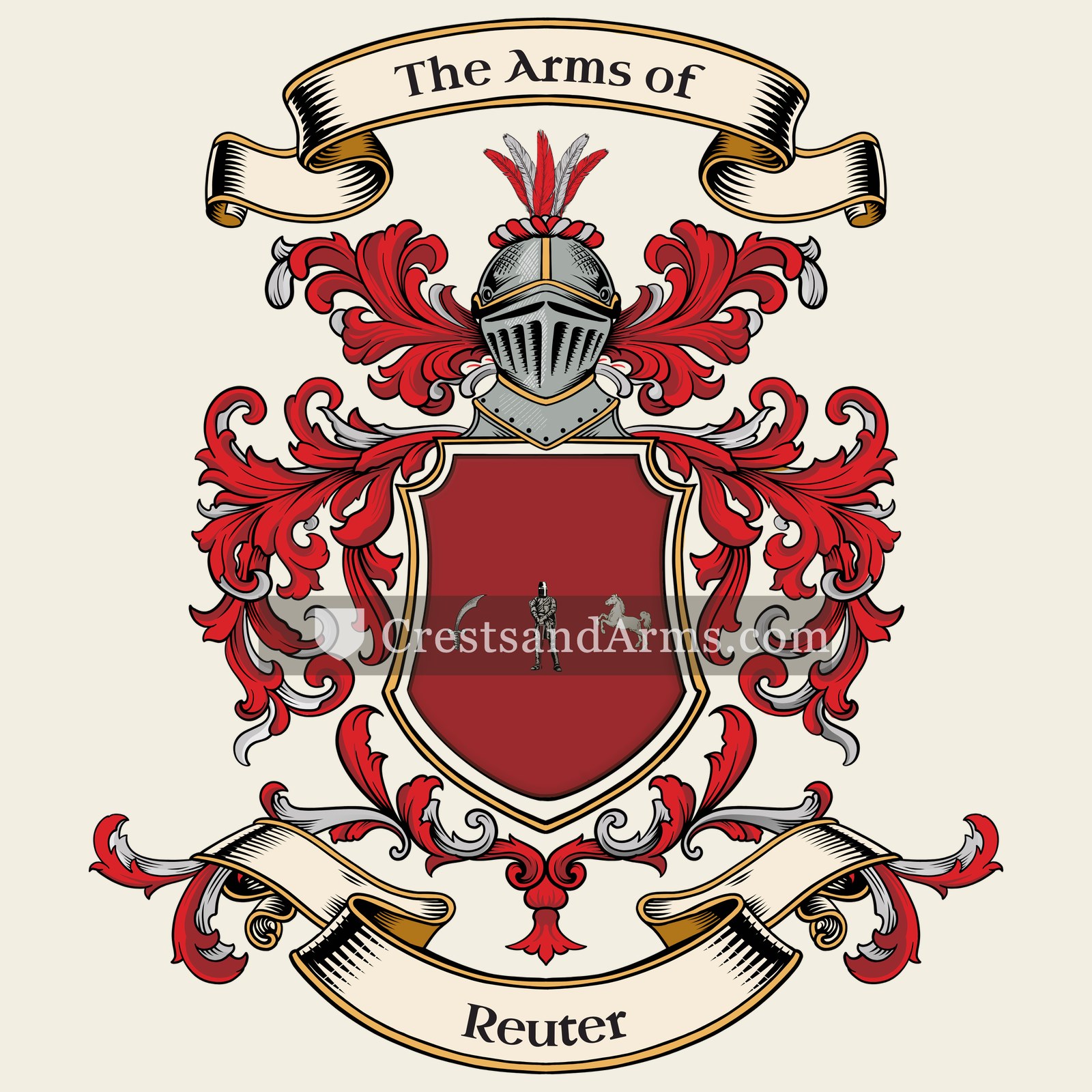


 mountThe ground held, and steadfastness upon it
 axeThe execution of military duty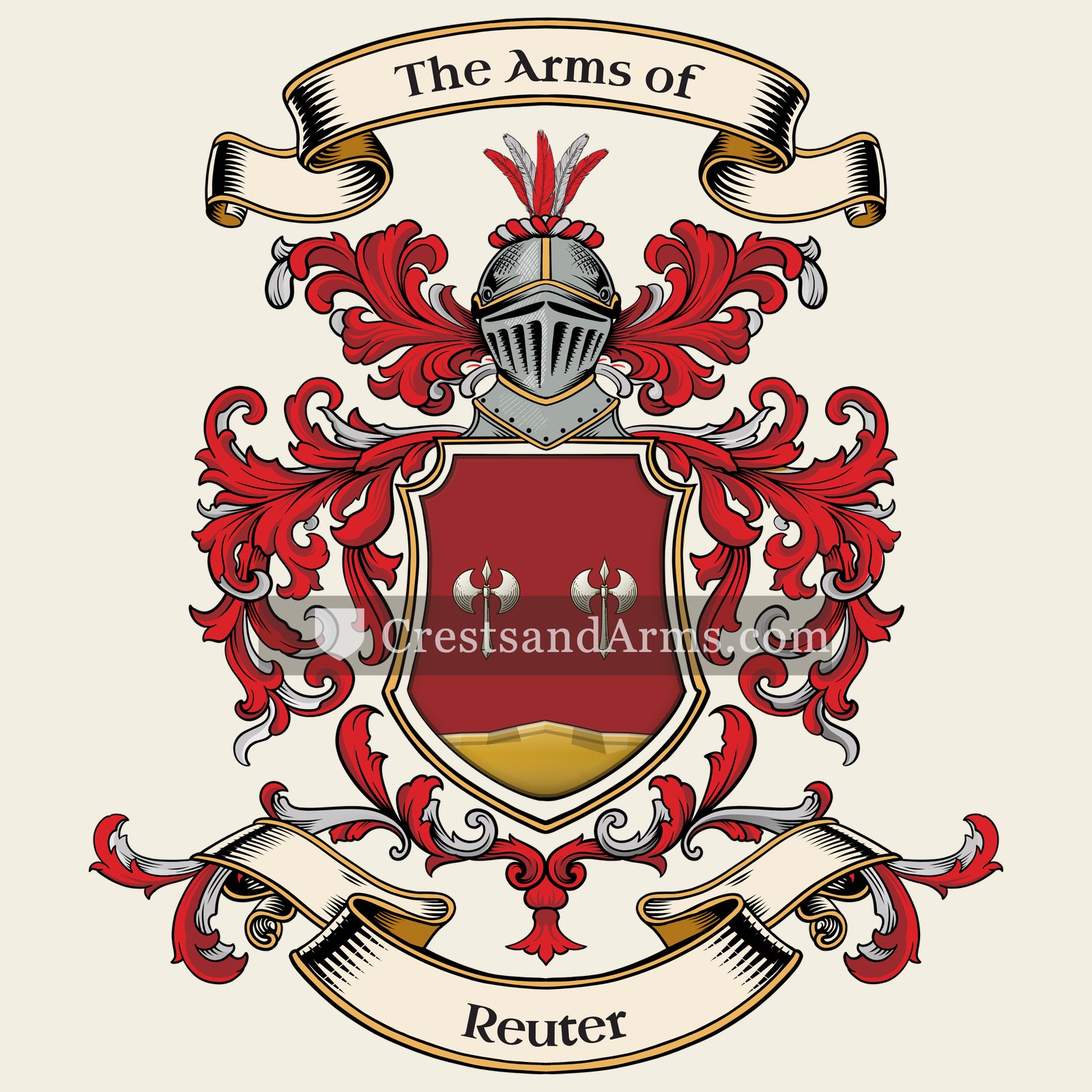


 lionCourage, strength and royalty