Map of France showing where the Rhodes arms are recorded
The Rhodes arms were recorded in Comtat-Venaissin, c. 1663.
This is where the arms were entered in the register. Families often moved to other parts of the country, so the same name can turn up in more than one region.
The body that granted and recorded arms in France in this period.
Louis XIV of France
Sovereign of the period
Louis XIV of France
1643–1715
Reigning in France when the Rhodes arms are first recorded.
How Arms Worked in France
In France, a coat of arms was a mark of honor that passed down through the male line to all legitimate descendants. Families often used the same shield without changes to show their shared heritage. If a branch wanted to stand out, they could add a small mark to their shield to show their specific place in the family tree.
Granting authority
The Juge d'armes de France acted as the official authority that regulated and verified coats of arms across the country.
How they got arms
Families typically inherited their arms from ancestors, though they could also receive them through royal grants or by proving their noble status.
Where arms were recorded
Coats of arms were officially recorded in the Armorial Général de France, which began its main collection in the year 1696.
The family's standing
Recorded among the armigerous families of France.
Origin & History of the Rhodes Family in France
The family name Rhodes has deep roots in the Comtat-Venaissin region of France, a territory that was once governed directly by the Papacy rather than the French crown. By 1663, records confirm that members of the family were well-established in this unique enclave, which served as a cultural bridge between the traditions of Provence and the influence of the Catholic Church. The name likely originated as a topographical descriptor, referring to individuals who lived near specific landmarks or clearings known as "rodes" in the local dialect. During the seventeenth century, families in this region were often deeply involved in the agricultural and administrative life of the papal lands. This setting provided a stable environment for the family to grow, allowing them to participate in the local economy while maintaining their ties to the distinctive landscape of southern France.
Coat of Arms & Family Crest Details
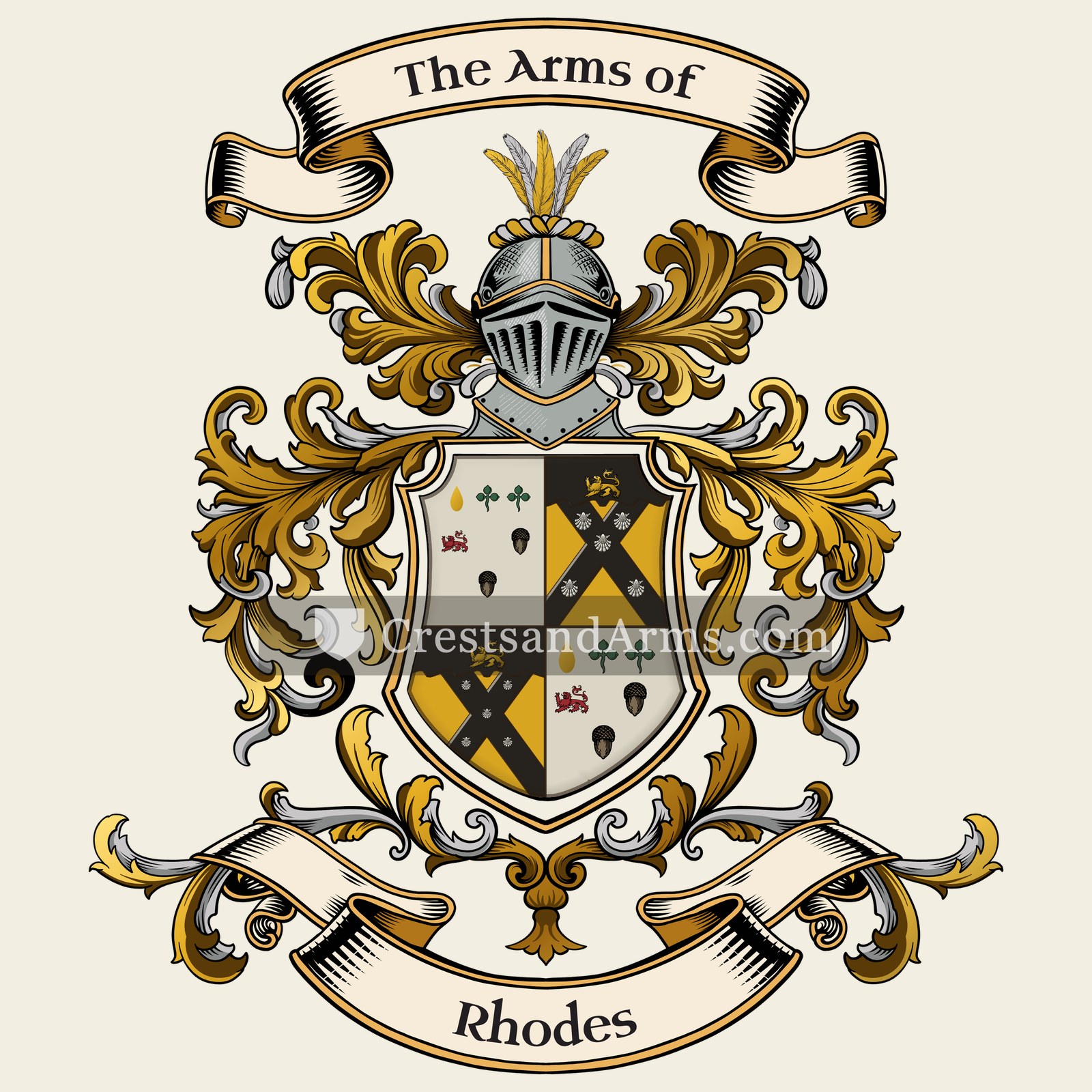
Symbols on this shield
saltireResolution, and St Andrew's cross
chiefAuthority, wisdom and dominion
dropletsTears, and grief borne with patience
trefoilPerpetuity, and the Trinity
lionCourage, strength and royalty
acornAntiquity and strength from small beginnings
escallopThe pilgrim's shell, and a long journey made
Colours
Silver (Argent)Means: Peace and sincerity
Gold (Or)Means: Generosity
Black (Sable)Means: Constancy
Green (Vert)Means: Hope
Red (Gules)Means: Military strength
Historical info
Source
J. B. Rietstap, Armorial Général, Gouda: G. B. van Goor Zonen, 1884–87
Blazon (the actual original written record)
“Ec.: aux 1 et 4 d'arg. à deux cotices nébulées de sa. semées de gouttes d'or, acc. de deux trèfles de sin., 1 en chef à sen. et 1 en p. à dextre; et entre les cotices un léopard de gu., passant en bande, et deux glands effeuillés au nat., posés chacun en bande, 1 au-dessus et 1 au-dessous du léopard (Rhodes); aux 2 et 3 parti d'arg et d'or, au saut. nebulé de sa., br. sur le parti et ch. de cinq coquilles d'arg.; et au chef de sa., br. sur le parti et ch. d'un lion léopardé d'or (Baker.) C.: 1° un avant-bras en pal, paré d'azur semé de gouttes d'or, rebr. d'arg., tenant une branche de chêne de sin. en pal, englantée d'or, entre deux trèfles de sin. (Rhodes); 2° un bras, paré d'azur, rebr. d'arg., l'azur ch. de trois annelets entrelacés d'or, 1 et 2, tenant une flèche d'arg., en barre, la pointe en bas (Baker).”
Britainc. 1776
Digital archive packCoat of arms PNG, gold border print PDF, vector SVG and the certificate of authenticity. Sent to your email in minutes.
Map of Britain showing where the Rhodes arms are recorded
The Rhodes arms were recorded in Britain, c. 1776.
Arms such as these were typically recorded in Kent.
Kent sits between London and the short crossing to Europe, and the trade passing through made it wealthy. Merchant families bought land with that money, and it was landowners who took coats of arms.
This is where the arms were entered in the register. Families often moved to other parts of the country, so the same name can turn up in more than one region.
The body that granted and recorded arms in Britain in this period.
George III of Great Britain
Sovereign of the period
George III of Great Britain
1760–1801
Reigning in France when the Rhodes arms are first recorded.
How Arms Worked in Britain
English heraldry allowed arms to be shared by all legitimate descendants of the original owner. These symbols were treated as personal property that moved through the generations to all children. While the eldest son kept the original design, other family members could use the same shield without needing to change it or register their own unique versions.
Granting authority
The College of Arms in London has regulated the use of coats of arms throughout England and Wales since 1484.
How they got arms
Families typically obtained their coats of arms through a formal grant from the Crown or by proving their ancient right to them.
Where arms were recorded
All official coats of arms are recorded in the registers kept at the College of Arms, which date back to the fifteenth century.
The family's standing
Recorded among the armigerous families of Britain.
Origin & History of the Rhodes Family in Britain
The surname Rhodes is a locative name, meaning it was originally adopted by people who lived near a clearing in a forest or a piece of cleared land. The word comes from the Old English term *rod*, which refers to a place where trees have been cut down to make room for farming or settlement. While the name appears in various parts of England, families bearing this name were well-established in the county of Kent by the late 18th century. In 1776, individuals with the name Rhodes were active participants in the local economy and social life of Kent, a region known for its rich agricultural history and proximity to the English Channel. These early family members likely worked the land or engaged in the trades that defined the rural landscape of the time. By settling in this area, they became part of a long tradition of families who defined their identity through the specific geography of their local communities.
Coat of Arms & Family Crest Details
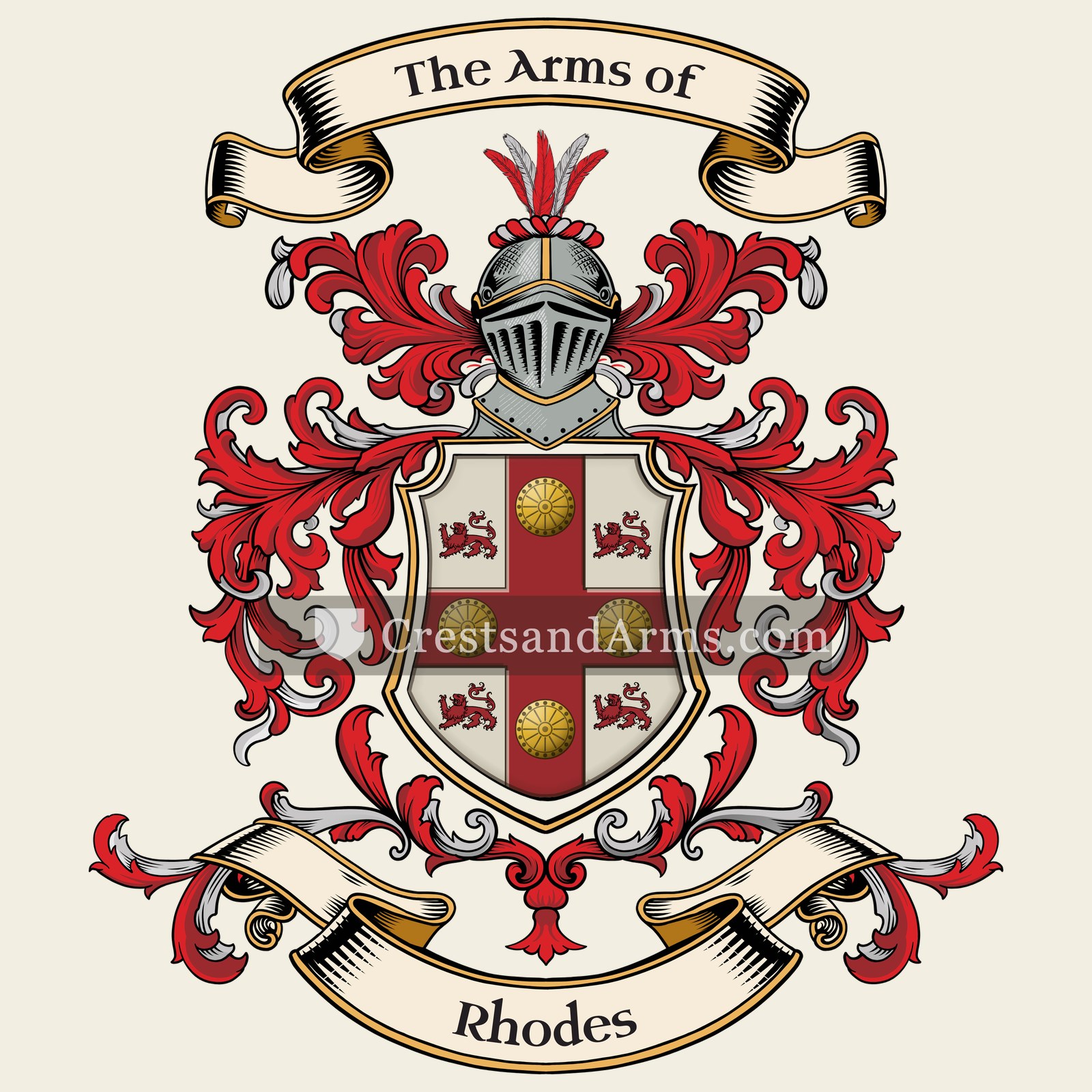
Symbols on this shield
cross symbolChristian faith and service
lionCourage, strength and royalty
roundelA coin, and one who has been to the crusades
Colours
Silver (Argent)Means: Peace and sincerity
Red (Gules)Means: Military strength
Gold (Or)Means: Generosity
Historical info
Source
Sir Bernard Burke, The General Armory of England, Scotland, Ireland and Wales, London: Harrison & Sons, 1884
Blazon (the actual original written record)
“Ar. on a cross engr. betw. four lions ramp. gu. as many bezants”
YorkKnaresborough · York, c. 1620
Digital archive packCoat of arms PNG, gold border print PDF, vector SVG and the certificate of authenticity. Sent to your email in minutes.
Map of England showing where the Rhodes arms are recorded
The Rhodes arms were recorded in York, c. 1620.
Yorkshire is the largest of the English counties, and it held more gentry families than any other. Land there was split among a great many households rather than a few, so a great many of them carried arms.
This is where the arms were entered in the register. Families often moved to other parts of the country, so the same name can turn up in more than one region.
The body that granted and recorded arms in England in this period.
James VI and I
Sovereign of the period
James VI and I
1603–1625
Reigning in France when the Rhodes arms are first recorded.
How Arms Worked in England
English heraldry allowed arms to be shared by all legitimate descendants of the original owner. These symbols were treated as personal property that moved through the generations to all children. While the eldest son kept the original design, other family members could use the same shield without needing to change it or register their own unique versions.
Granting authority
The College of Arms in London has regulated the use of coats of arms throughout England and Wales since 1484.
How they got arms
Families typically obtained their coats of arms through a formal grant from the Crown or by proving their ancient right to them.
Where arms were recorded
All official coats of arms are recorded in the registers kept at the College of Arms, which date back to the fifteenth century.
The family's standing
Recorded among the armigerous families of York.
Origin & History of the Rhodes Family in England
The surname Rhodes is a locational name that emerged in northern England, specifically derived from the Old English word *rod*, which refers to a clearing in the woods. Families who lived near these cleared areas often adopted the name to identify their place of residence. By the early 17th century, the name was well-established in the city of York, where members of the family were active participants in the local community. Historical records from 1620 confirm their presence in this region, suggesting that the family had deep roots in the landscape and economy of Yorkshire. As the family grew, they became part of the social fabric of the city, contributing to the development of northern English society during a time of significant cultural change.
Rhodes Meaning & Related Branches
Root word
Rhodon
Ancient Greek word for rose or a place where roses grow.
This name
RhodesA topographic surname for someone who lived near a clearing or a place where roses grew.
also spelled
Rhodez
Rhodeh
Rhode
Rodes
Roades
Related arms
Rodessimilar arms
Roadesvariant spelling
Roodesvariant spelling
Heathrecorded with Rhodes, same area
Documented Sources
J. B. Rietstap, Armorial Général, Gouda: G. B. van Goor Zonen, 1884–87
Archives départementales de Vaucluse, Registres paroissiaux et état civil du Comtat-Venaissin, 1663
Benoist, Stéphane, La vie quotidienne en Comtat-Venaissin au XVIIe siècle, 1998
Moulinas, René, Les Juifs du pape en France, 1981
Digital archive packCoat of arms PNG, gold border print PDF, vector SVG and the certificate of authenticity. Sent to your email in minutes.


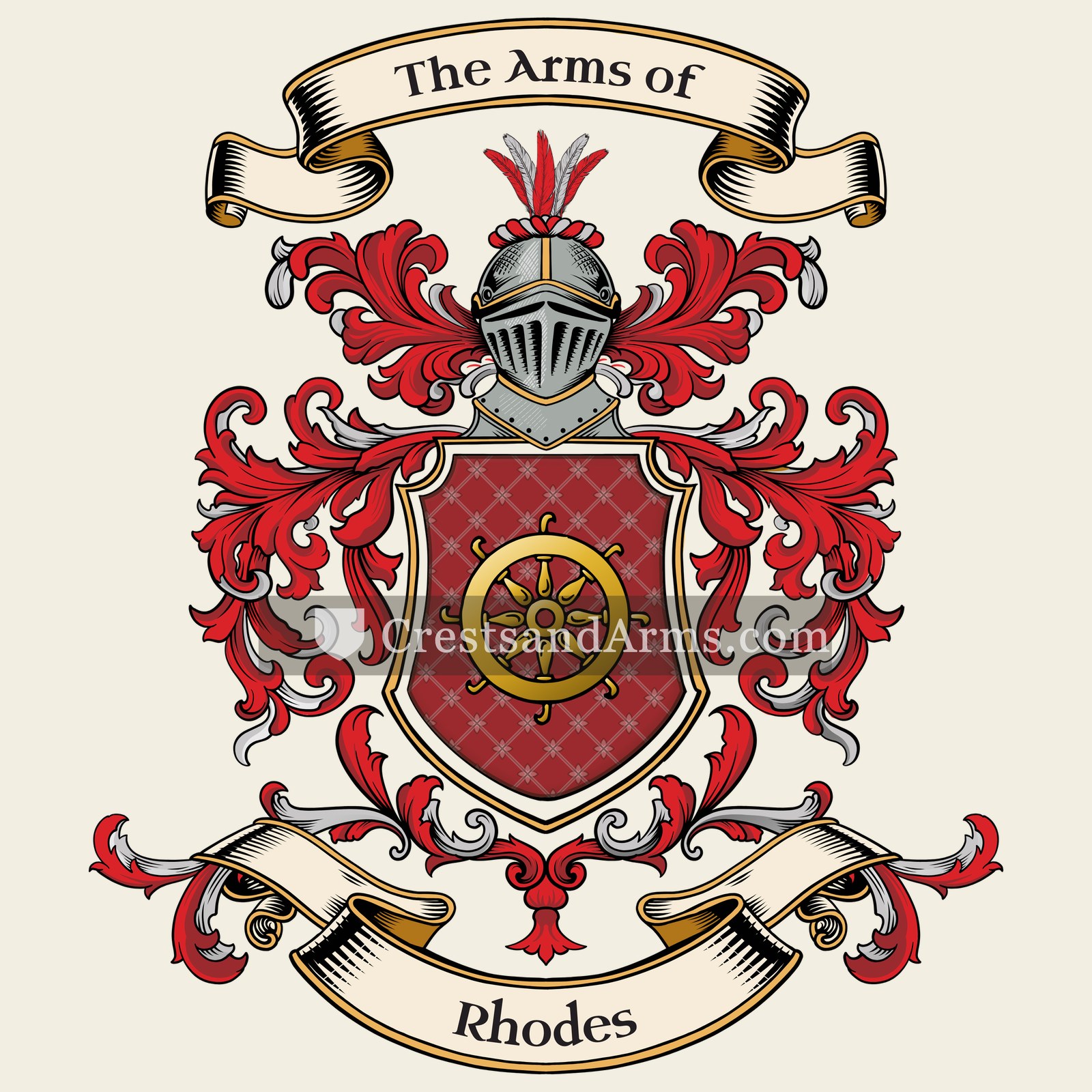
 wheelFortune's turning, and the carter's trade
 wheelFortune's turning, and the carter's trade


 saltireResolution, and St Andrew's cross
 chiefAuthority, wisdom and dominion
 dropletsTears, and grief borne with patience
 trefoilPerpetuity, and the Trinity
 lionCourage, strength and royalty
 acornAntiquity and strength from small beginnings
 escallopThe pilgrim's shell, and a long journey made


 cross symbolChristian faith and service
 roundelA coin, and one who has been to the crusades