A record of documented arms, meaning and origin, researched for the Riach family lines. Documented in 3 countries.
Reg. 7244 · Britain, P–S
Coat of Arms & Family Crest Details
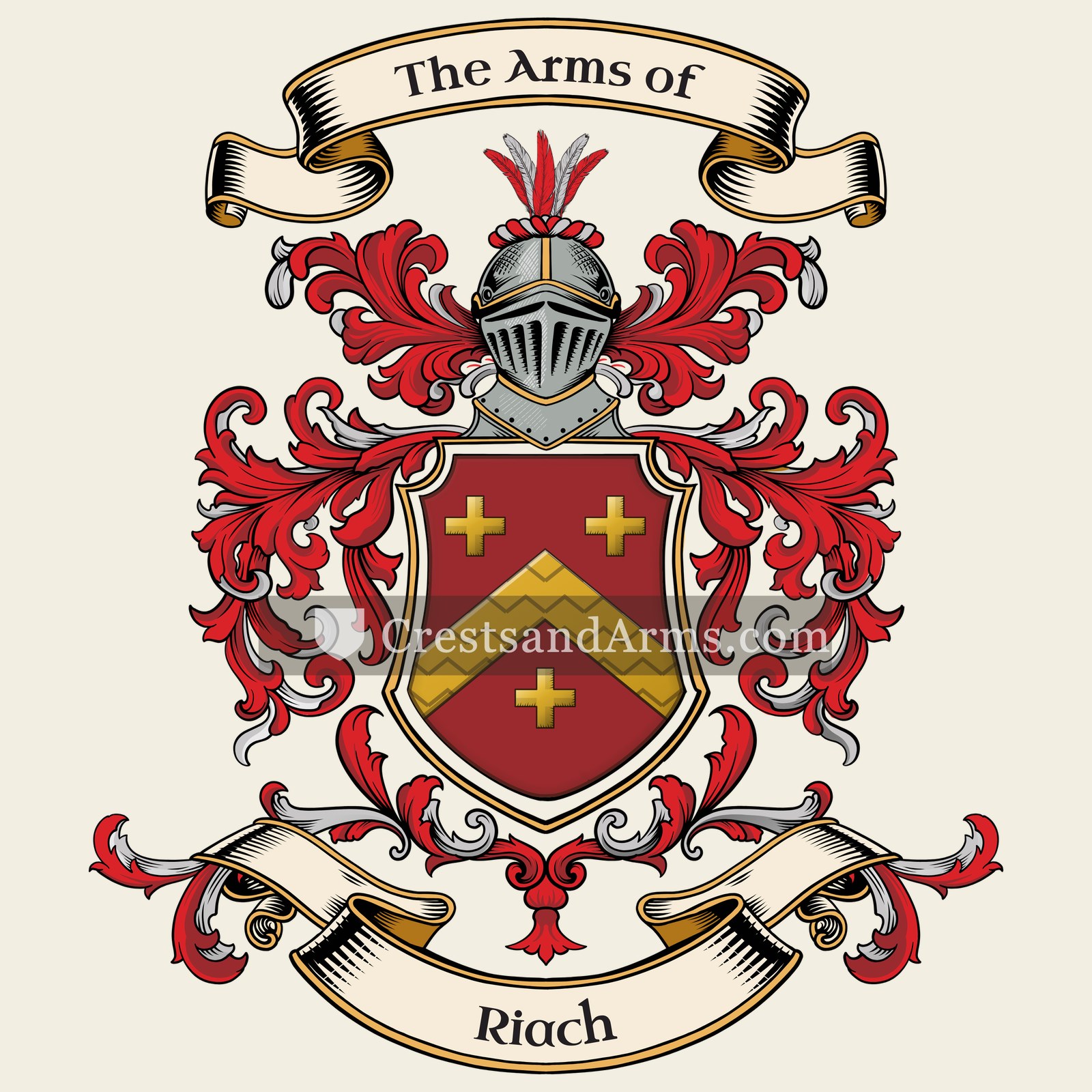
Symbols on this shield
chevronProtection, and faithful service completed
cross symbolChristian faith and service
mountThe ground held, and steadfastness upon it
Colours
Red (Gules)Means: Military strength
Gold (Or)Means: Generosity
Silver (Argent)Means: Peace and sincerity
Historical info
Source
J. B. Rietstap, Armorial Général, Gouda: G. B. van Goor Zonen, 1884–87
Blazon (the actual original written record)
“De gu. au chev. d'or, acc. de trois croix florencées d'arg. C.: un dragon ailé d'arg., posé sur un mont de sin. S.: deux cerfs, portant chacun quatre cornes, dont deux recourbées vers le bas. D.: GARDE LA FOY.”
Britainc. 1547
Digital archive packCoat of arms PNG, gold border print PDF, vector SVG and the certificate of authenticity. Sent to your email in minutes.
Map of Britain showing where the Riach arms are recorded
The Riach arms were recorded in Britain, c. 1547.
Arms such as these were typically recorded in Kent.
Kent sits between London and the short crossing to Europe, and the trade passing through made it wealthy. Merchant families bought land with that money, and it was landowners who took coats of arms.
This is where the arms were entered in the register. Families often moved to other parts of the country, so the same name can turn up in more than one region.
The body that granted and recorded arms in Britain in this period.
Henry VIII of England
Sovereign of the period
Henry VIII of England
1509–1547
Reigning in Britain when the Riach arms are first recorded.
How Arms Worked in Britain
English heraldry allowed arms to be shared by all legitimate descendants of the original owner. These symbols were treated as personal property that moved through the generations to all children. While the eldest son kept the original design, other family members could use the same shield without needing to change it or register their own unique versions.
Granting authority
The College of Arms in London has regulated the use of coats of arms throughout England and Wales since 1484.
How they got arms
Families typically obtained their coats of arms through a formal grant from the Crown or by proving their ancient right to them.
Where arms were recorded
All official coats of arms are recorded in the registers kept at the College of Arms, which date back to the fifteenth century.
The family's standing
Recorded among the armigerous families of Britain.
Origin & History of the Riach Family in Britain
The Riach family name has roots that stretch back to the mid-sixteenth century in England. Historical records confirm that members of the family were living in the county of Kent by 1547. During this era, the name was often associated with families living in rural areas where they worked as farmers or skilled tradespeople. While the name is frequently linked to later Scottish history, its presence in Kent suggests that the family was well-established in southern England during the Tudor period. Life for these early ancestors revolved around the local parish church and the seasonal cycles of agricultural work. By settling in Kent, the family became part of a region known for its trade and proximity to London, which likely provided them with opportunities to integrate into the developing economy of the time.
Coat of Arms & Family Crest Details
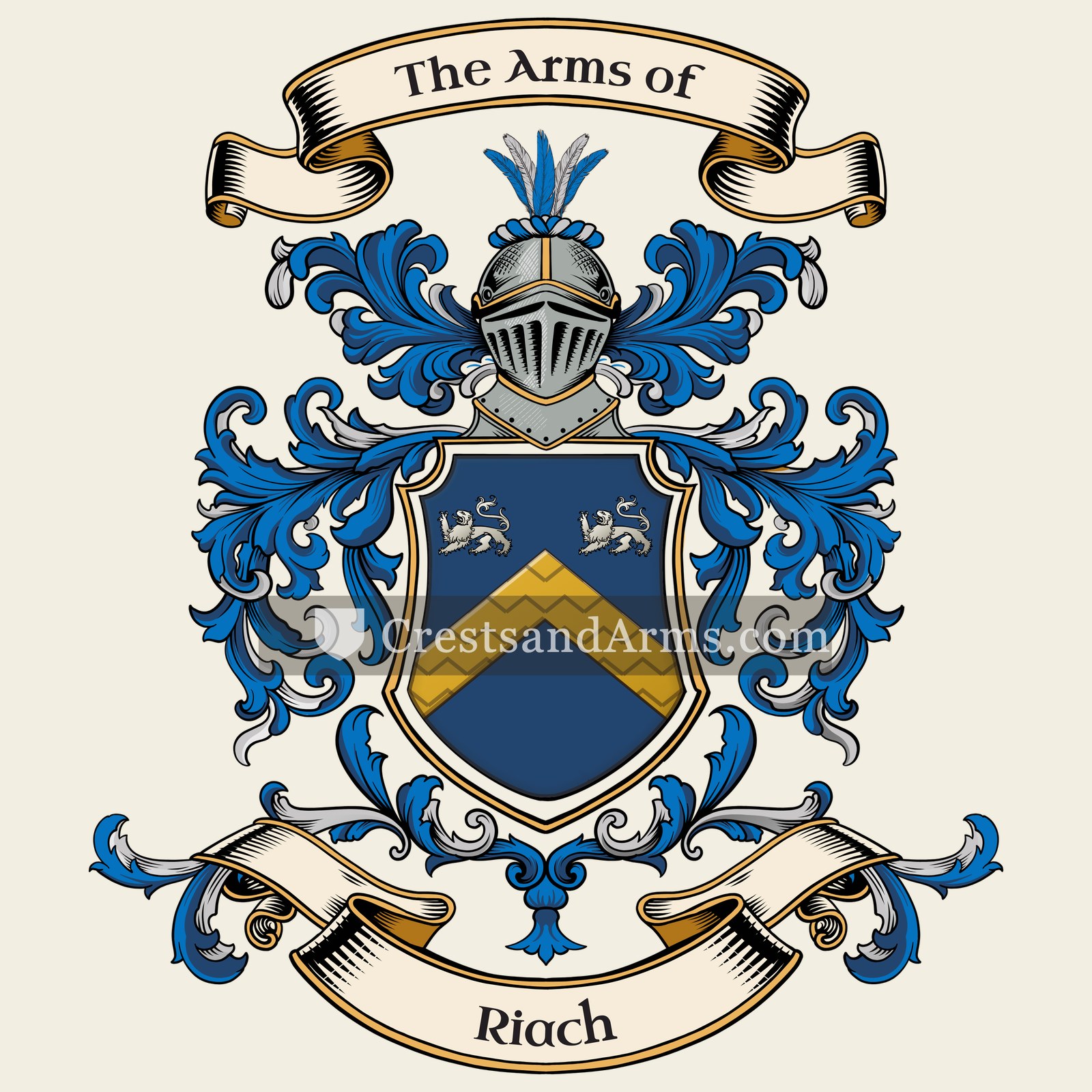
Symbols on this shield
chevronProtection, and faithful service completed
lionCourage, strength and royalty
Colours
Blue (Azure)Means: Loyalty and truth
Gold (Or)Means: Generosity
Silver (Argent)Means: Peace and sincerity
Historical info
Source
Sir Bernard Burke, The General Armory of England, Scotland, Ireland and Wales, London: Harrison & Sons, 1884
Blazon (the actual original written record)
“Az. a chev. or, betw. two lions pass. ar”
EnglandLondon, c. 1568
Digital archive packCoat of arms PNG, gold border print PDF, vector SVG and the certificate of authenticity. Sent to your email in minutes.
Map of England showing where the Riach arms are recorded
The Riach arms were recorded in London, c. 1568.
This is where the arms were entered in the register. Families often moved to other parts of the country, so the same name can turn up in more than one region.
The body that granted and recorded arms in England in this period.
Elizabeth I of England
Sovereign of the period
Elizabeth I of England
1558–1603
Reigning in Britain when the Riach arms are first recorded.
How Arms Worked in England
English heraldry allowed arms to be shared by all legitimate descendants of the original owner. These symbols were treated as personal property that moved through the generations to all children. While the eldest son kept the original design, other family members could use the same shield without needing to change it or register their own unique versions.
Granting authority
The College of Arms in London has regulated the use of coats of arms throughout England and Wales since 1484.
How they got arms
Families typically obtained their coats of arms through a formal grant from the Crown or by proving their ancient right to them.
Where arms were recorded
All official coats of arms are recorded in the registers kept at the College of Arms, which date back to the fifteenth century.
The family's standing
Recorded among the armigerous families of England.
Origin & History of the Riach Family in England
The history of the Riach family name in England begins with records of individuals living in London as early as 1568. During the sixteenth century, London was a rapidly growing center for trade and immigration, attracting people from across the British Isles and beyond. The presence of the Riach name in the city during this period suggests that early family members were part of this mobile workforce, likely moving to the capital to pursue opportunities in commerce or skilled labor. While the name is often associated with northern regions, its appearance in London archives from this era highlights how families moved through major urban hubs to establish new lives. These early settlers contributed to the diverse social fabric of Elizabethan England, leaving behind traces in parish registers and tax documents that allow us to track their integration into the city. By settling in such a prominent location, these early ancestors helped define the initial footprint of the family name within the English historical record.
Coat of Arms & Family Crest Details
Symbols on this shield
chevronProtection, and faithful service completed
cross symbolChristian faith and service
Colours
Red (Gules)Means: Military strength
Gold (Or)Means: Generosity
Historical info
Source
Sir Bernard Burke, The General Armory of England, Scotland, Ireland and Wales, London: Harrison & Sons, 1884
Blazon (the actual original written record)
“Gu. a chev. betw. three crosses botonnée or”
NetherlandsHolland, c. 1624
Digital archive packCoat of arms PNG, gold border print PDF, vector SVG and the certificate of authenticity. Sent to your email in minutes.
Map of Netherlands showing where the Riach arms are recorded
The Riach arms were recorded in Holland, c. 1624.
Arms such as these were typically recorded in Friesland.
Friesland was low, wet country on the northern coast of the Netherlands, farmed by families who had held the same land for centuries. Free landholders were unusually common there, and a free landholder could carry arms.
This is where the arms were entered in the register. Families often moved to other parts of the country, so the same name can turn up in more than one region.
Region
Friesland
Town
Holland
First recorded
1624
Granting Authority for the Riach Arms
Hoge Raad van Adel
Photograph made by me · CC BY-SA 3.0
The body that granted and recorded arms in Netherlands in this period.
How Arms Worked in Netherlands
In the Netherlands, coats of arms were often used by noble families and those who held specific public offices. These arms were passed down through the generations to legitimate descendants. Younger branches of a family usually kept the original design without needing to add special marks. This system ensured that the family identity remained clear and consistent over many years.
Granting authority
The Hoge Raad van Adel is the official body that regulates and manages noble titles and coats of arms in the Netherlands.
How they got arms
Families typically obtained their coats of arms through official royal grants or by proving their long-standing historical use of the symbols.
Where arms were recorded
Coats of arms are officially recorded in the registers held by the Hoge Raad van Adel, which began its work in 1814.
The family's standing
Recorded among the armigerous families of Netherlands.
Origin & History of the Riach Family in Netherlands
The history of the Riach family in the Netherlands begins with records of their presence in the province of Friesland as early as 1624. During this period, the region was a center for maritime trade and agricultural development, which likely influenced the movement and settlement patterns of the family. The name itself reflects the linguistic diversity of the North Sea coastal areas, where names often evolved through the blending of local Frisian dialects and the influence of neighboring Germanic and Celtic cultures. As the family established themselves in the Frisian landscape, they became part of a society that valued independent landholding and local governance. This early settlement suggests that the Riach family were integrated into the social and economic fabric of the Dutch Republic during its golden age, contributing to the local community through trade or farming. Their survival and growth in the region during the seventeenth century highlights a period of stability that allowed the family to put down deep roots in the Dutch countryside.
Related Branches & Arms
Root word
Riabhach
A Gaelic adjective meaning brindled, greyish, or streaked in color.
This name
RiachDerived from a descriptive nickname for someone with a swarthy, grey, or brindled complexion.
also spelled
Richh
Riche
Ryche
Documented Sources
J. B. Rietstap, Armorial Général, Gouda: G. B. van Goor Zonen, 1884–87
The National Archives, Kew. State Papers Domestic, Edward VI, SP 10/1
Kent History and Library Centre. Archdeaconry Court of Canterbury Wills, PRC 17
Digital archive packCoat of arms PNG, gold border print PDF, vector SVG and the certificate of authenticity. Sent to your email in minutes.


 chevronProtection, and faithful service completed
 cross symbolChristian faith and service
 mountThe ground held, and steadfastness upon it
 chevronProtection, and faithful service completed
 cross symbolChristian faith and service
 mountThe ground held, and steadfastness upon it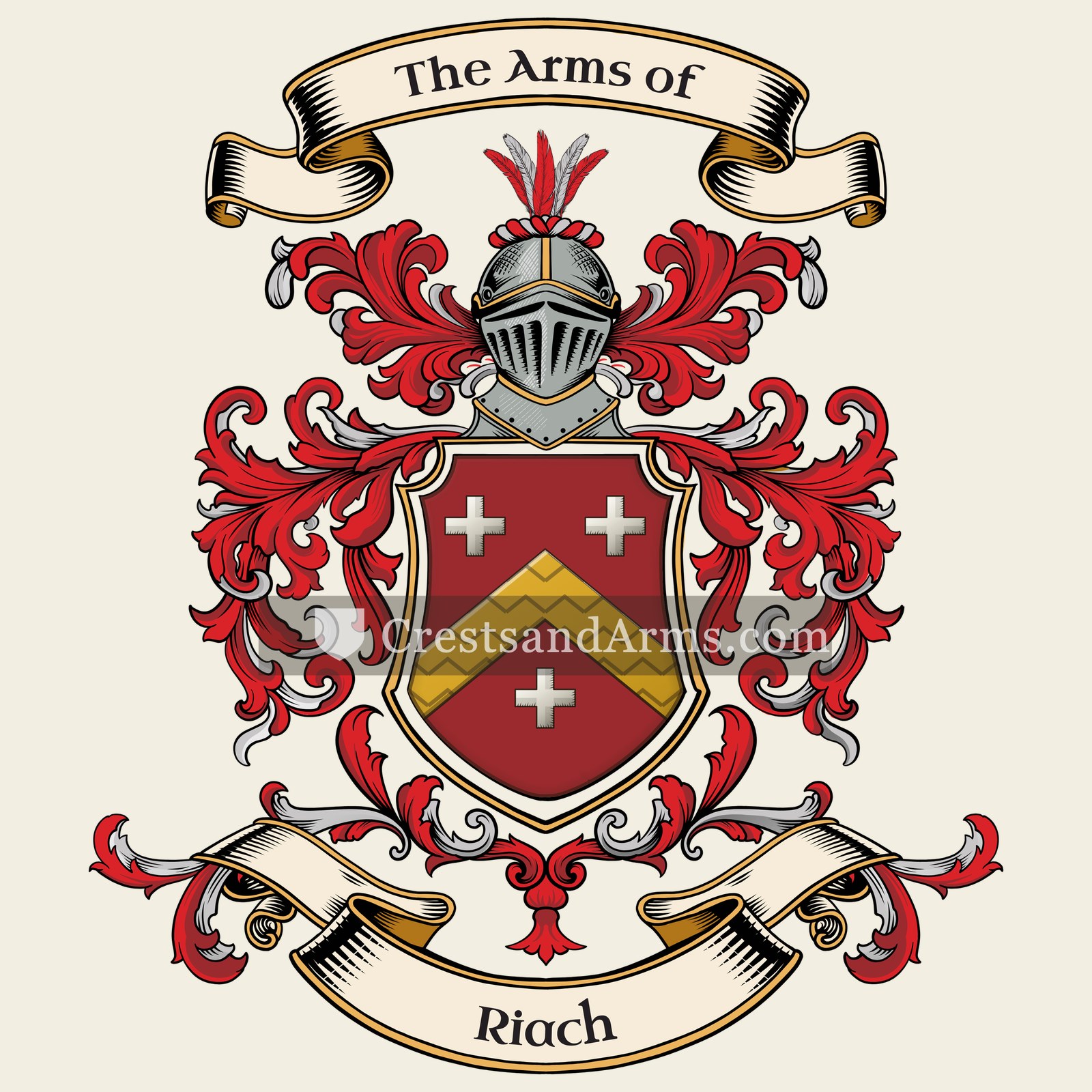


 lionCourage, strength and royalty