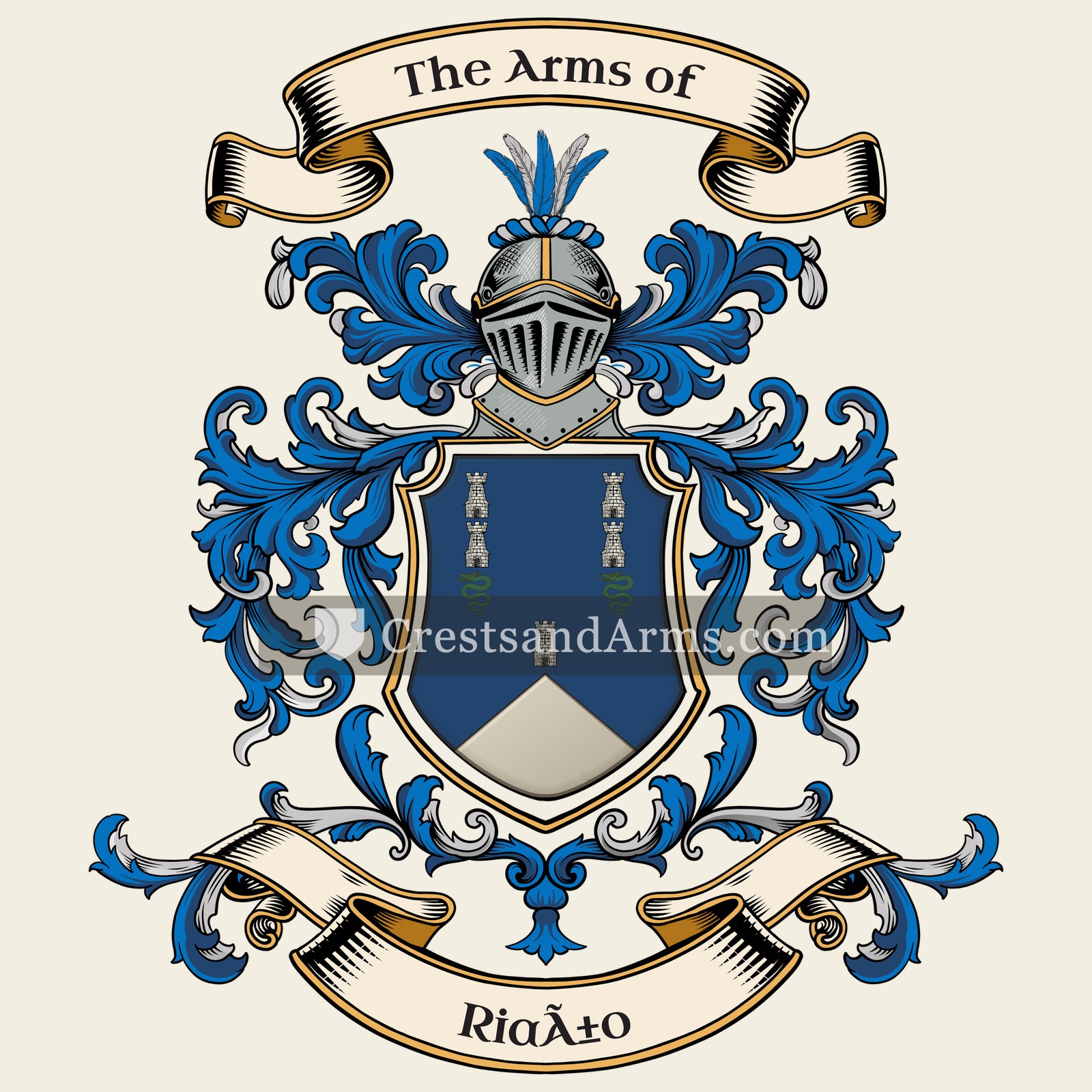
A record of documented arms, meaning and origin, researched for the Riaño family of Spain.
Reg. 3096 · Spanish, P–S
Coat of Arms & Family Crest Details
Symbols on this shield
towerGrandeur and solidity, and a stronghold defended
serpentWisdom, healing and prudence
Colours
Blue (Azure)Means: Loyalty and truth
Silver (Argent)Means: Peace and sincerity
Green (Vert)Means: Hope
Historical info
Source
J. B. Rietstap, Armorial Général, Gouda: G. B. van Goor Zonen, 1884–87
Blazon (the actual original written record)
“D'azur à cinq tours d'arg., ouv. et aj. de sa., posées 2, 1 et 2, au-dessus d'une mer d'azur, agitée d'arg., en p., de laquelle s'élèvent deux têtes et cols de serpents affr. de sin.”
SpainAsturies, c. 1722
Digital archive packCoat of arms PNG, gold border print PDF, vector SVG and the certificate of authenticity. Sent to your email in minutes.
Map of Spain showing where the Riaño arms are recorded
The Riaño arms were recorded in Asturies, c. 1722.
This is where the arms were entered in the register. Families often moved to other parts of the country, so the same name can turn up in more than one region.
The body that granted and recorded arms in Spain in this period.
Philip V of Spain
Sovereign of the period
Philip V of Spain
1714–1724
Reigning in Spain when the Riaño arms are first recorded.
How Arms Worked in Spain
In Spain, a coat of arms was considered a form of property that belonged to the entire family line. These arms were passed down from a father to all his children equally. Younger branches of the family usually kept the original design without needing to add any special marks to distinguish their specific line.
Granting authority
The Cronista Rey de Armas was the official body that regulated and granted coats of arms throughout Spain.
How they got arms
Families often obtained their arms through royal grants or by proving their noble status to the official heraldic authority.
Where arms were recorded
Coats of arms were officially recorded in the registers of the Cronista Rey de Armas starting in 1496.
The family's standing
Recorded among the armigerous families of Spain.
Origin & History of the Riaño Family in Spain
The name Riaño originates from the rugged and mountainous region of Asturias in northern Spain. It is a topographic surname, meaning it was originally used to identify people who lived near a specific geographical feature, in this case, the town of Riaño. By the early 18th century, families bearing this name were well-established within the local Asturian community. These early ancestors were likely farmers or laborers who lived in close-knit mountain villages where the landscape shaped their daily lives and traditions. Because the region was somewhat isolated by the Picos de Europa mountains, the family name remained concentrated in this area for many generations. By 1722, records show that the family was deeply rooted in the social and administrative life of the province, reflecting a long history of living and working in the distinct climate of northern Spain.
Related Branches & Arms
Root word
Rivus
Latin term referring to a stream, brook, or small river.
This name
RiañoA topographic surname denoting someone who lived near a stream or riverbank.
also spelled
Rianyo
Riano-de
Reeanyo
Documented Sources
J. B. Rietstap, Armorial Général, Gouda: G. B. van Goor Zonen, 1884–87
Canella Secades, Fermín. Geografía de Asturias. 1894
Madoz, Pascual. Diccionario geográfico-estadístico-histórico de España y sus posesiones de Ultramar. 1845
Archivo Histórico Nacional, Sección Nobleza, Expedientes de pruebas de los caballeros de la Orden de Calatrava
Digital archive packCoat of arms PNG, gold border print PDF, vector SVG and the certificate of authenticity. Sent to your email in minutes.


 towerGrandeur and solidity, and a stronghold defended
 serpentWisdom, healing and prudence
 towerGrandeur and solidity, and a stronghold defended
 serpentWisdom, healing and prudence