A record of documented arms, meaning and origin, researched for the Richwine family lines. Documented in 2 countries.
Reg. 6973 · Norwegian, P–S
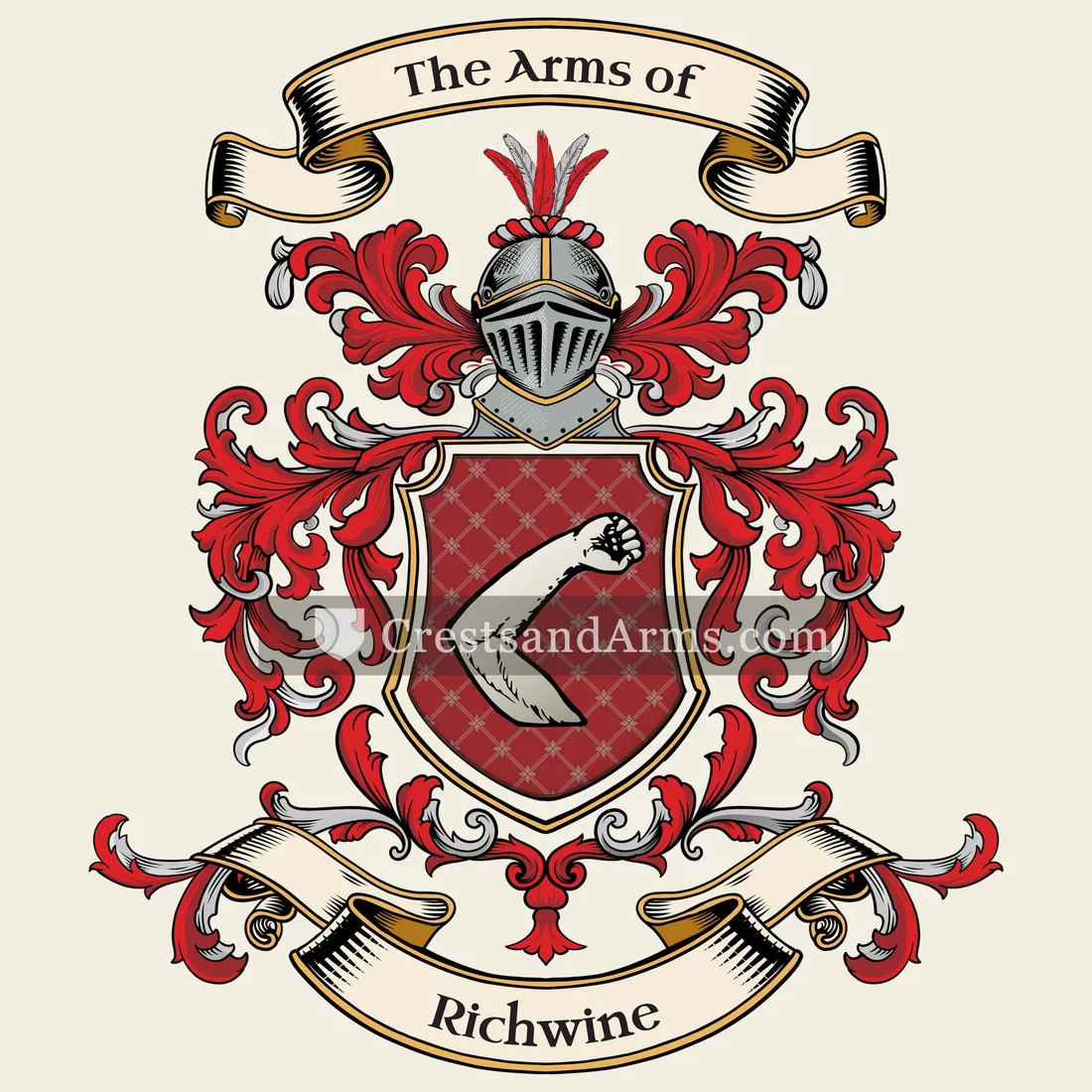
Meaning of the Richwine family crest colors & symbols
Symbols on this shield
armA person of action, industrious and laborious
Colours
Red (Gules)Means: Military strength
Historical info
Source
J. B. Rietstap, Armorial Général, Gouda: G. B. van Goor Zonen, 1884–87
Blazon (the actual original written record)
“De gu. à un senestrochère, arm. au nat., tenant une grappe de raisins au nat., la queue en bas. C.: un drapeau de gu. à la croix d'arg., entre deux bannières de gu. à la croix d'arg.”
NorwayNorvège, c. 1655
Digital archive packCoat of arms PNG, gold border print PDF, vector SVG and the certificate of authenticity. Sent to your email in minutes.
Map of Norway showing where the Richwine arms are recorded
The Richwine arms were recorded in Norvège, c. 1655.
Arms such as these were typically recorded in Oslo.
Oslo held the Norwegian court and the offices that went with it. Norway's landed families were few and most held some post under the crown, and a post of that kind was what brought a shield.
This is where the arms were entered in the register. Families often moved to other parts of the country, so the same name can turn up in more than one region.
The body that granted and recorded arms in Norway in this period.
Frederick III of Denmark
Sovereign of the period
Frederick III of Denmark
1648–1670
Reigning in Norway when the Richwine arms are first recorded.
How Arms Worked in Norway
Norwegian families often assumed their own coats of arms freely without needing official permission from the crown. These symbols functioned as personal seals for merchants and farmers rather than just marks of nobility. Families passed these designs through generations as private property. When branches split, they frequently modified the original colors or shapes to create distinct versions for their own use.
Granting authority
The Norwegian royal chancery oversaw the formal recognition of noble status and the official registration of coats of arms.
How they got arms
Most families simply adopted their own unique designs to use on seals and property, though some sought royal confirmation.
Where arms were recorded
Official records of noble arms were kept in the royal chancery archives, which began documenting these grants during the union period.
The family's standing
Recorded among the armigerous families of Norway.
Origin & History of the Richwine Family in Norway
The family name Richwine has deep roots in the urban landscape of seventeenth-century Norway, specifically within the bustling port city of Oslo. By the year 1655, records confirm that members of the family were already established residents in the city, which was then known as Christiania. During this era, Oslo was a growing center for trade and administration under the Danish-Norwegian union. Families like the Richwines often participated in the professional life of the city, working as merchants, craftsmen, or civil servants to support the expanding economy. Living in a capital city during this time meant that the family was part of a diverse social environment where they helped shape the local culture and community. Their presence in the city archives from this early date suggests they were integrated into the fabric of Norwegian society as it transitioned into a more modern administrative state.
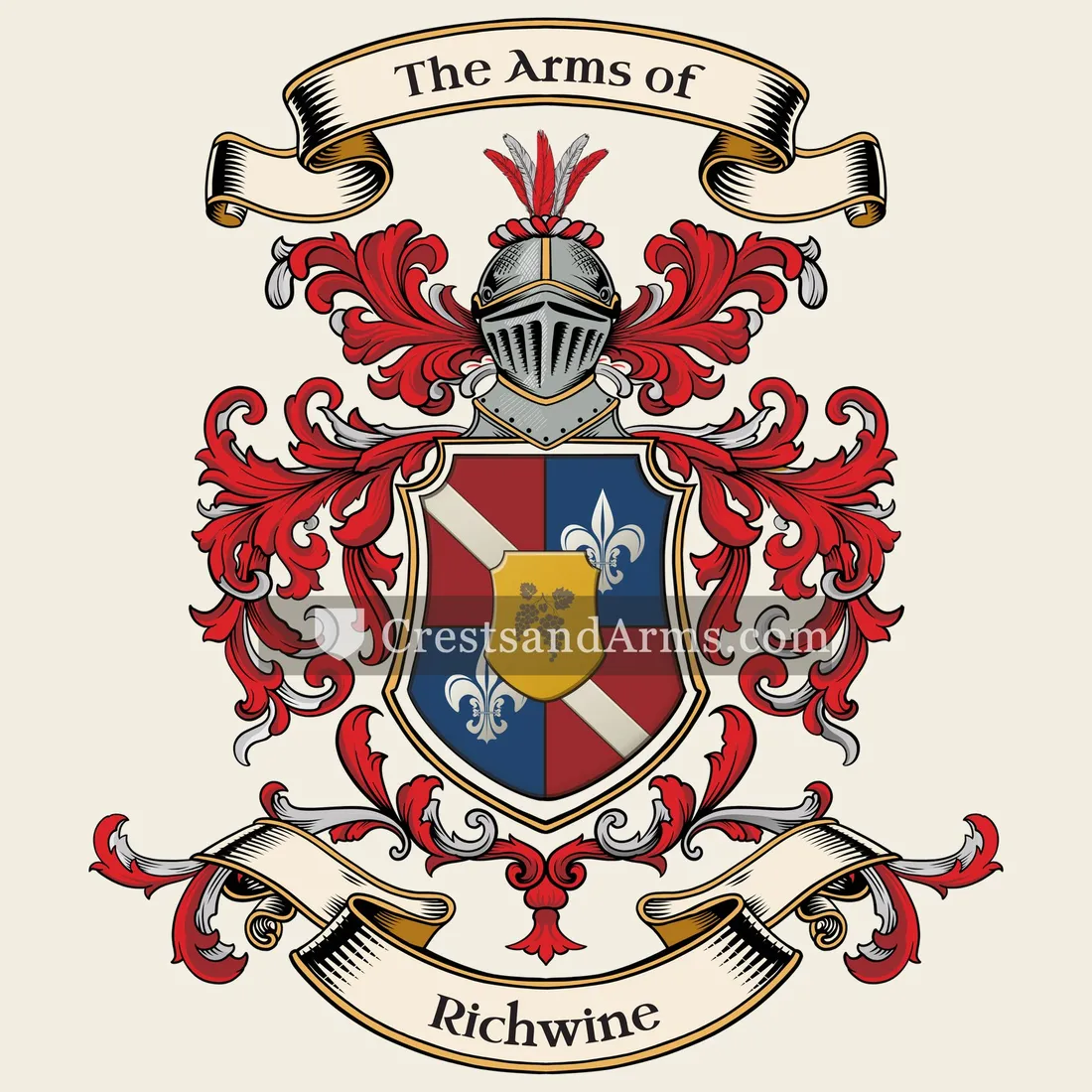
Meaning of the Richwine family crest colors & symbols
Symbols on this shield
bendDefence, and the scarf of a commander
grapesPlenty, and the labour of the vine
fleur de lisPurity, light, and the sixth son
Colours
Red (Gules)Means: Military strength
Blue (Azure)Means: Loyalty and truth
Gold (Or)Means: Generosity
Silver (Argent)Means: Peace and sincerity
Historical info
Source
J. B. Rietstap, Armorial Général, Gouda: G. B. van Goor Zonen, 1884–87
Blazon (the actual original written record)
“Ec.: aux 1 et 4 de gu. à la bande ondée d'arg.; aux 2 et 3 d'azur à une fleur-de-lis d'arg. Sur le tout d'or à une grappe de raisins au nat. Cq. cour. C.: un vol coupé d'or sur sa., l'or de chaque aile ch. d'un écusson ovale de gu. surch. d'une bande ondée d'arg. acc. de deux fleurs-de-lis du même. L. d'or et d'azur.”
BavariaBavaria, c. 1693
Digital archive packCoat of arms PNG, gold border print PDF, vector SVG and the certificate of authenticity. Sent to your email in minutes.
Map of Germany showing where the Richwine arms are recorded
The Richwine arms were recorded in Bavaria, c. 1693.
Bavaria was a country of old landed families and walled market towns. Estates passed down the same line for centuries, and both the landowners and the leading townsmen kept arms, which is why so many Bavarian names sit in the registers.
This is where the arms were entered in the register. Families often moved to other parts of the country, so the same name can turn up in more than one region.
The body that granted and recorded arms in Germany in this period.
Leopold I, Holy Roman Emperor
Sovereign of the period
Leopold I, Holy Roman Emperor
1658–1705
Reigning in Norway when the Richwine arms are first recorded.
How Arms Worked in Germany
In the Holy Roman Empire, coats of arms were often granted to individuals by the Emperor or his representatives. These arms were then passed down through the generations to all legitimate descendants of the original holder. Younger branches of a family usually kept the same shield design without needing to change it, as the arms belonged to the entire lineage.
Granting authority
The Holy Roman Emperor held the sole power to grant new coats of arms throughout his vast imperial territories.
How they got arms
Families typically obtained their coats of arms through a formal imperial grant or by proving their noble status to the authorities.
Where arms were recorded
These grants were officially recorded in the Imperial Chancery registers, which began keeping formal records of such honors during the Middle Ages.
The family's standing
Recorded among the armigerous families of Bavaria.
Origin & History of the Richwine Family in Germany
The surname Richwine is rooted in the Germanic linguistic tradition, likely evolving from the Old High German name Richwin. This name combines the elements "ric," meaning powerful or ruler, and "win," meaning friend, which together suggest a title like a powerful friend or a trusted advisor. By the late 17th century, the family was well-established in the region of Bavaria. Historical records confirm their presence there by 1693, a time when many families in southern Germany were deeply connected to the agricultural and social structures of the Holy Roman Empire. During this period, the name was often recorded in local church registers as families moved through the rural landscapes of the Bavarian countryside. These early ancestors lived through a time of significant regional rebuilding following the conflicts of the previous century, and their presence in the area reflects the broader patterns of family settlement and community growth in early modern Germany.
Richwine Meaning & Related Branches
Root word
Ric-win
Old Germanic elements meaning powerful friend or ruler and friend.
This name
RichwineA surname derived from the Germanic given name Richwin, signifying a powerful and loyal friend.
also spelled
Reichweyn
Reichweinn
Rykwine
Documented Sources
J. B. Rietstap, Armorial Général, Gouda: G. B. van Goor Zonen, 1884–87
Oslo byarkiv, Oslo magistrat, Skifteprotokoller (1655)
Arkivverket, Norske kongebrev (1655)
Dahl, Svein Tore, Embetsmenn i Midt-Norge i tiden 1536-1660 (1999)
Schia, Erik, Oslo innerst i Viken: Liv og virke i middelalderbyen (1991)
Digital archive packCoat of arms PNG, gold border print PDF, vector SVG and the certificate of authenticity. Sent to your email in minutes.


 armA person of action, industrious and laborious
 armA person of action, industrious and laborious


 bendDefence, and the scarf of a commander
 grapesPlenty, and the labour of the vine
 fleur de lisPurity, light, and the sixth son