Map of England showing where the Rickerd arms are recorded
The Rickerd arms were recorded in Nottingham, c. 1620.
Nottinghamshire had coal under it and forest across it, and both were worth money. Families who profited bought manors, and a manor was the ordinary reason for a family to take a coat of arms.
This is where the arms were entered in the register. Families often moved to other parts of the country, so the same name can turn up in more than one region.
The body that granted and recorded arms in England in this period.
James VI and I
Sovereign of the period
James VI and I
1603–1625
Reigning in England when the Rickerd arms are first recorded.
How Arms Worked in England
English heraldry allowed arms to be shared by all legitimate descendants of the original owner. These symbols were treated as personal property that moved through the generations to all children. While the eldest son kept the original design, other family members could use the same shield without needing to change it or register their own unique versions.
Granting authority
The College of Arms in London has regulated the use of coats of arms throughout England and Wales since 1484.
How they got arms
Families typically obtained their coats of arms through a formal grant from the Crown or by proving their ancient right to them.
Where arms were recorded
All official coats of arms are recorded in the registers kept at the College of Arms, which date back to the fifteenth century.
The family's standing
Recorded among the armigerous families of Nottingham.
Origin & History of the Rickerd Family in England
The family name Rickerd finds its roots in the linguistic traditions of medieval England, where it likely evolved as a variation of the Germanic name Richard. By the year 1620, historical records confirm that members of the family were firmly established in Nottingham. During this period, Nottingham was a bustling market town known for its trade in textiles and its strategic location along the River Trent. Families living in the region at this time often relied on local industries or agriculture to support their households. As the name spread through the area, it became a distinct identifier for those living within the social and economic structure of the East Midlands. The presence of the Rickerd family in Nottingham during the early seventeenth century suggests they were part of the growing demographic of local citizens who contributed to the development of the town during a time of significant social change in England.
Related Branches & Arms
Root word
Ricard
Derived from the Germanic elements meaning powerful and brave ruler.
This name
RickerdA patronymic surname indicating descent from a person named Richard, meaning strong ruler.
also spelled
Rycards
Documented Sources
Sir Bernard Burke, The General Armory of England, Scotland, Ireland and Wales, London: Harrison & Sons, 1884
Nottinghamshire Archives, Nottingham St Mary’s Parish Registers, 1620
Reaney, P.H., A Dictionary of British Surnames, 1958
Digital archive packCoat of arms PNG, gold border print PDF, vector SVG and the certificate of authenticity. Sent to your email in minutes.


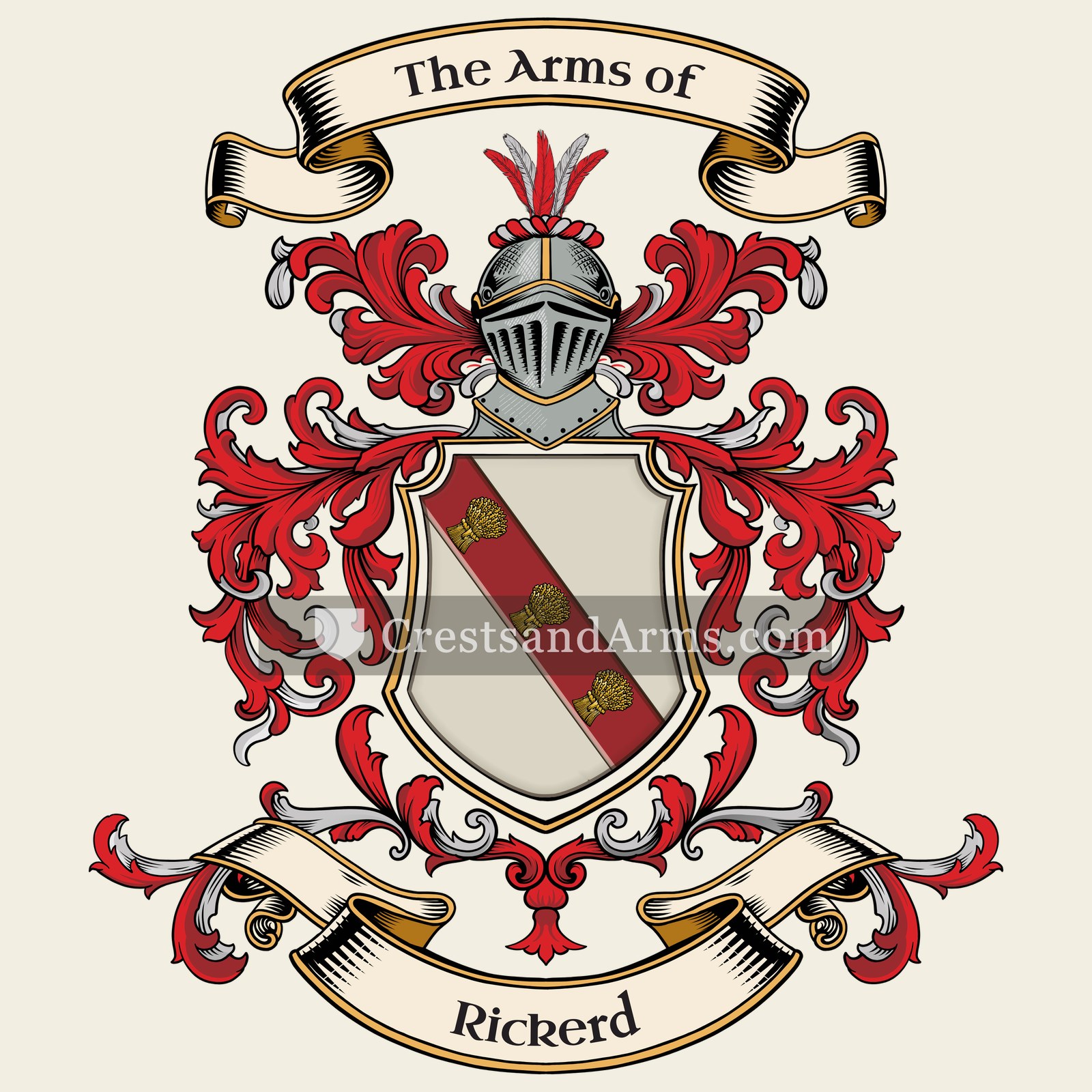
 bendDefence, and the scarf of a commander
 wheatsheafPlenty, and the harvest of one's own labour
 bendDefence, and the scarf of a commander
 wheatsheafPlenty, and the harvest of one's own labour