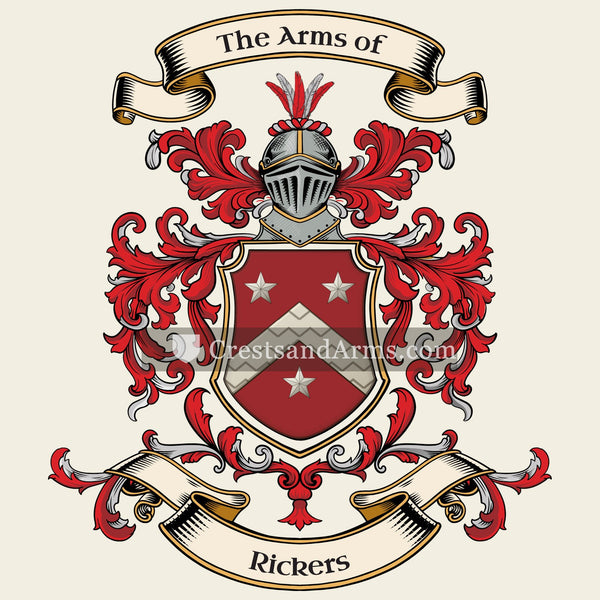
A record of documented arms, meaning and origin, researched for the Rickers family lines. Documented in 2 countries.
Reg. 4160 · Dutch, P–S
Coat of Arms & Family Crest Details
Symbols on this shield
chevronProtection, and faithful service completed
mulletThe third son, and a divine quality from above
Colours
Red (Gules)Means: Military strength
Silver (Argent)Means: Peace and sincerity
Historical info
Source
J. B. Rietstap, Armorial Général, Gouda: G. B. van Goor Zonen, 1884–87
Blazon (the actual original written record)
“De gu. au chev. d'arg., acc. de trois étoiles du même.”
Netherlandsc. 1815
Where the Rickers Arms Were Recorded
Friesland
Map of Netherlands showing where the Rickers arms are recorded
The Rickers arms were recorded in Netherlands, c. 1815.
Arms such as these were typically recorded in Friesland.
Friesland was low, wet country on the northern coast of the Netherlands, farmed by families who had held the same land for centuries. Free landholders were unusually common there, and a free landholder could carry arms.
This is where the arms were entered in the register. Families often moved to other parts of the country, so the same name can turn up in more than one region.
Region
Friesland
First recorded
1815
Granting Authority for the Rickers Arms
Hoge Raad van Adel
Photograph made by me · CC BY-SA 3.0
The body that granted and recorded arms in Netherlands in this period.
William I of the Netherlands
Sovereign of the period
William I of the Netherlands
1815–1840
Reigning in Netherlands when the Rickers arms are first recorded.
How Arms Worked in Netherlands
In the Netherlands, coats of arms were often used by noble families and those who held specific public offices. These arms were passed down through the generations to legitimate descendants. Younger branches of a family usually kept the original design without needing to add special marks. This system ensured that the family identity remained clear and consistent over many years.
Granting authority
The Hoge Raad van Adel is the official body that regulates and manages noble titles and coats of arms in the Netherlands.
How they got arms
Families typically obtained their coats of arms through official royal grants or by proving their long-standing historical use of the symbols.
Where arms were recorded
Coats of arms are officially recorded in the registers held by the Hoge Raad van Adel, which began its work in 1814.
The family's standing
Recorded among the armigerous families of Netherlands.
Origin & History of the Rickers Family in Netherlands
The surname Rickers finds its roots in the northern regions of the Netherlands, particularly within the province of Friesland. By the early nineteenth century, the name was firmly established in this area, reflecting the naming customs common to the Frisian people. The name itself is likely a patronymic, meaning it was originally derived from a father’s given name, such as Rickert or Ricker, which were popular Germanic names at the time. In 1815, the introduction of the civil registry in the Netherlands required families to adopt fixed surnames, which helped solidify the spelling and lineage of the Rickers family. During this period, many families in Friesland were deeply connected to the land through farming and maritime trade, which shaped the daily lives and social standing of those bearing the name. As the family grew, they became part of the distinct cultural fabric of the Frisian landscape, maintaining their heritage through generations of local community involvement.
Coat of Arms & Family Crest Details
Symbols on this shield
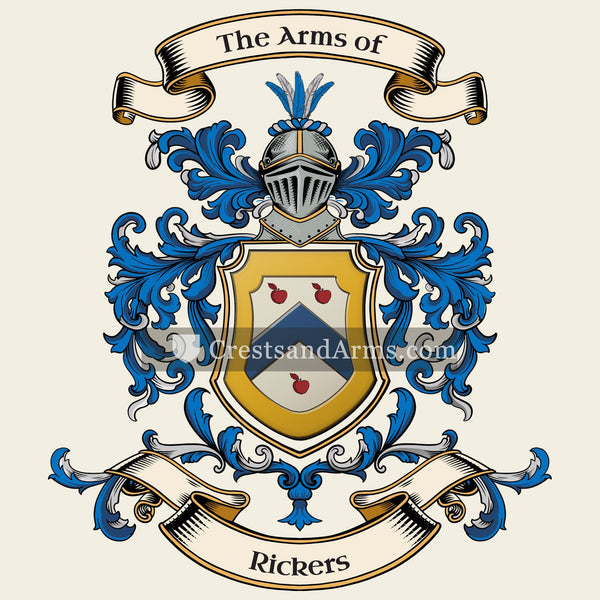
chevronProtection, and faithful service completed
applePeace, plenty and long-standing settlement
Colours
Silver (Argent)Means: Peace and sincerity
Blue (Azure)Means: Loyalty and truth
Gold (Or)Means: Generosity
Red (Gules)Means: Military strength
Historical info
Source
J. B. Rietstap, Armorial Général, Gouda: G. B. van Goor Zonen, 1884–87
Blazon (the actual original written record)
“D'arg. au chev. d'azur, acc. de trois pommes de gu., tigées et feuillées de sin., les tiges en haut. L'écu bordé d'or. Cq. cour. C.: un demi-vol, aux armes de l'écu. L. d'arg. et d'azur.”
Germanyc. 1765
Where the Rickers Arms Were Recorded
Bavaria
Map of Germany showing where the Rickers arms are recorded
The Rickers arms were recorded in Germany, c. 1765.
Arms such as these were typically recorded in Bavaria.
Bavaria was a country of old landed families and walled market towns. Estates passed down the same line for centuries, and both the landowners and the leading townsmen kept arms, which is why so many Bavarian names sit in the registers.
This is where the arms were entered in the register. Families often moved to other parts of the country, so the same name can turn up in more than one region.
The body that granted and recorded arms in Germany in this period.
Francis I, Holy Roman Emperor
Sovereign of the period
Francis I, Holy Roman Emperor
1745–1765
Reigning in Netherlands when the Rickers arms are first recorded.
How Arms Worked in Germany
In the Holy Roman Empire, coats of arms were often granted to individuals by the Emperor or his representatives. These arms were then passed down through the generations to all legitimate descendants of the original holder. Younger branches of a family usually kept the same shield design without needing to change it, as the arms belonged to the entire lineage.
Granting authority
The Holy Roman Emperor held the sole power to grant new coats of arms throughout his vast imperial territories.
How they got arms
Families typically obtained their coats of arms through a formal imperial grant or by proving their noble status to the authorities.
Where arms were recorded
These grants were officially recorded in the Imperial Chancery registers, which began keeping formal records of such honors during the Middle Ages.
The family's standing
Recorded among the armigerous families of Germany.
Origin & History of the Rickers Family in Germany
The surname Rickers is rooted in the Germanic linguistic tradition, likely evolving from the ancient personal name Richard, which combines the elements for power and strength. By the mid-eighteenth century, families bearing this name were well-established within the social fabric of Bavaria. During this period, the region was characterized by a transition from feudal agricultural life toward more structured village communities. Families like the Rickers often lived in rural parishes where their daily lives were documented in local church registers. These records tracked baptisms, marriages, and burials, serving as the primary way to preserve family history in a time before modern civil registration. As the family grew, they contributed to the local economy through farming or skilled craftsmanship, which were the standard livelihoods for many citizens in the Bavarian countryside during the late 1700s.
Related Branches & Arms
Root word
Ricard
A Germanic name composed of elements meaning powerful and brave ruler.
This name
RickersA patronymic surname indicating descent from a person named Richard or Rick.
also spelled
Riker
Ryckers
Related arms
Rikervariant spelling
Documented Sources
J. B. Rietstap, Armorial Général, Gouda: G. B. van Goor Zonen, 1884–87
Dijkstra, B., Friese familienamen, 1998
Meertens, P.J., De betekenis van de Nederlandse familienamen, 1959
Tresoar (Fries Historisch en Letterkundig Centrum), Burgerlijke Stand van Friesland
Nationaal Archief, Registers van de Burgerlijke Stand
Digital archive packCoat of arms PNG, gold border print PDF, vector SVG and the certificate of authenticity. Sent to your email in minutes.


 chevronProtection, and faithful service completed
 mulletThe third son, and a divine quality from above
 chevronProtection, and faithful service completed
 mulletThe third son, and a divine quality from above

 applePeace, plenty and long-standing settlement