Map of Germany showing where the Ried arms are recorded
The Ried arms were recorded in Saxony, c. 1765.
Saxony had mines, trade and old landed families all at once. Silver made some fortunes and land held others, and both sorts of family kept arms, which is why Saxon names appear so often in the registers.
This is where the arms were entered in the register. Families often moved to other parts of the country, so the same name can turn up in more than one region.
The body that granted and recorded arms in Germany in this period.
Francis I, Holy Roman Emperor
Sovereign of the period
Francis I, Holy Roman Emperor
1745–1765
Reigning in Germany when the Ried arms are first recorded.
How Arms Worked in Germany
In the Holy Roman Empire, coats of arms were often granted to individuals by the Emperor or his representatives. These arms were then passed down through the generations to all legitimate descendants of the original holder. Younger branches of a family usually kept the same shield design without needing to change it, as the arms belonged to the entire lineage.
Granting authority
The Holy Roman Emperor held the sole power to grant new coats of arms throughout his vast imperial territories.
How they got arms
Families typically obtained their coats of arms through a formal imperial grant or by proving their noble status to the authorities.
Where arms were recorded
These grants were officially recorded in the Imperial Chancery registers, which began keeping formal records of such honors during the Middle Ages.
The family's standing
Recorded among the armigerous families of Saxony.
Origin & History of the Ried Family in Germany
The surname Ried is a topographic name that originated in the German-speaking regions of Central Europe. It is derived from the Middle High German word "riet," which refers to a reed bed, a marsh, or swampy land. Families who adopted this name likely lived near these wet, grassy areas, using the landscape as a way to identify their home or farmstead. By the time members of the family were documented in Saxony in 1765, the name had already been established for generations as a common way to describe people living in rural, low-lying environments. As the family moved through the German states, the name remained a simple reflection of the natural geography that shaped their daily lives and agricultural practices. This connection to the land highlights how early surnames often served as practical labels to distinguish neighbors based on the specific features of the countryside they inhabited.
Meaning of the Ried family crest colors & symbols
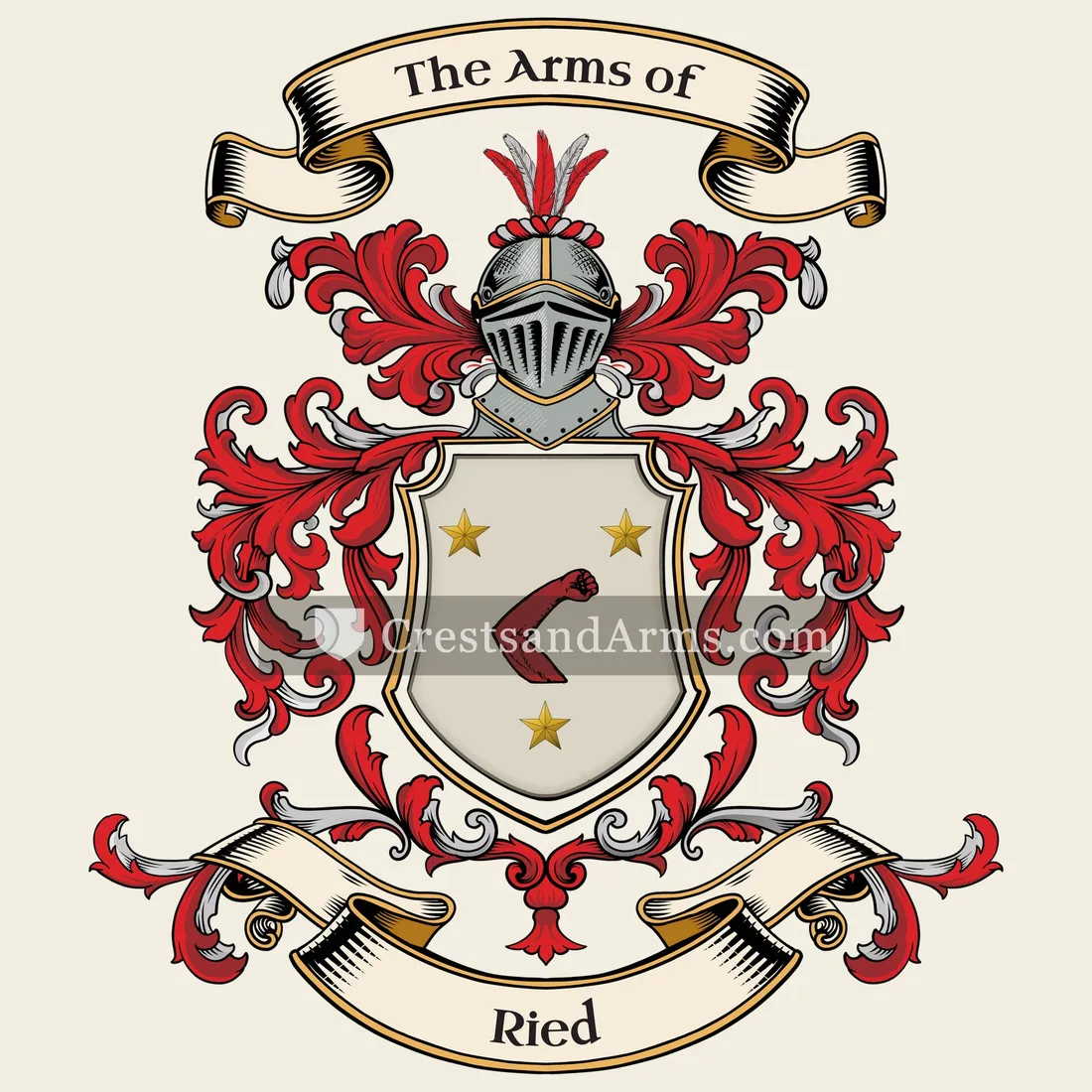
Symbols on this shield
armA person of action, industrious and laborious
mulletThe third son, and a divine quality from above
Colours
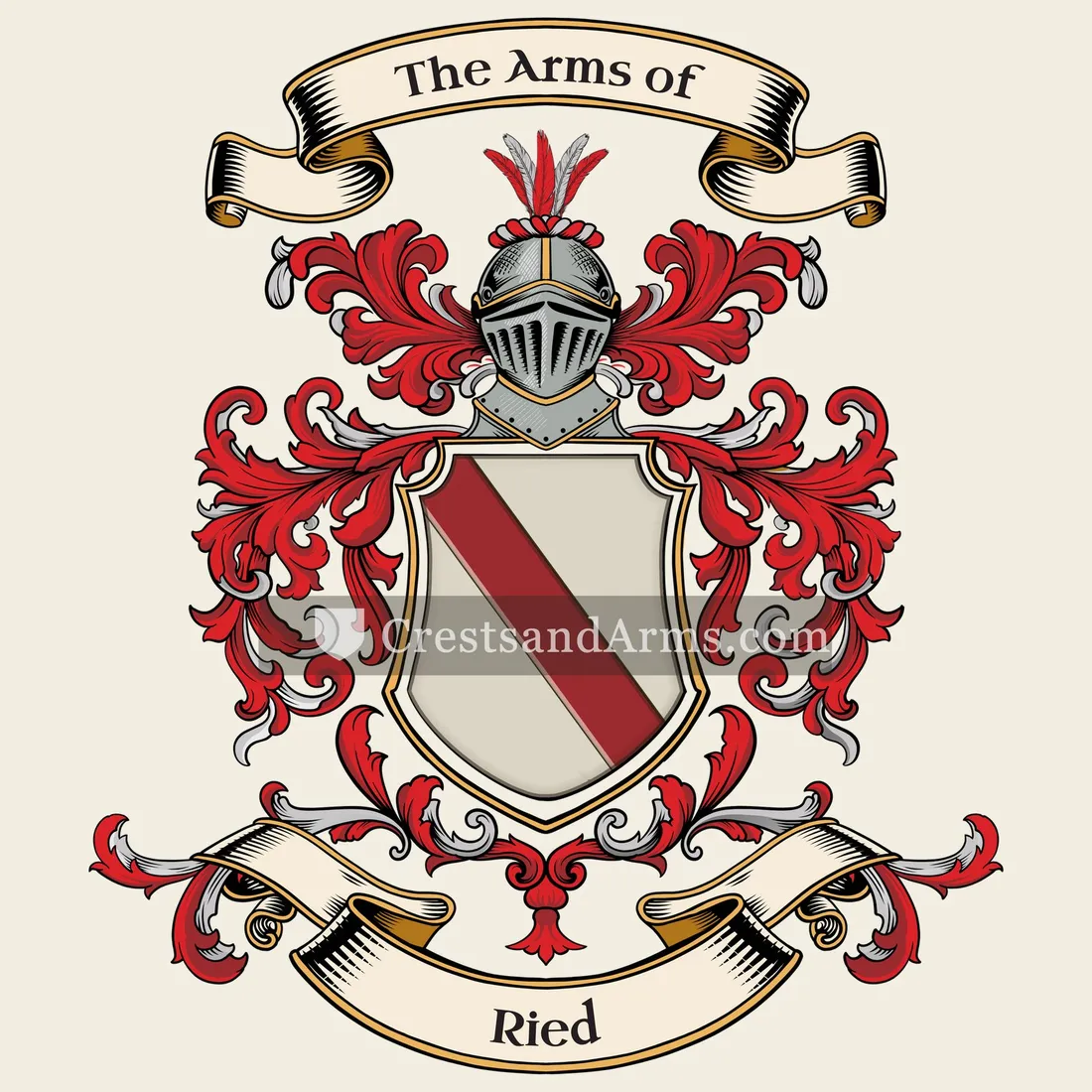
Silver (Argent)Means: Peace and sincerity
Red (Gules)Means: Military strength
Gold (Or)Means: Generosity
Historical info
Source
J. B. Rietstap, Armorial Général, Gouda: G. B. van Goor Zonen, 1884–87
Blazon (the actual original written record)
“D'arg. à un senestrochère, paré de gu., mouv. du flanc, la main de carn. tenant un trèfle de sin.; le tout acc. de trois étoiles (6) d'or, 2 en chef et 1 en p.”
Switzerlandc. 1745
Digital archive packCoat of arms PNG, gold border print PDF, vector SVG and the certificate of authenticity. Sent to your email in minutes.
Map of Switzerland showing where the Ried arms are recorded
The Ried arms were recorded in Switzerland, c. 1745.
Arms such as these were typically recorded in Bern.
Bern was the largest of the Swiss cantons and ran itself, with its own council and its own courts. Its governing families held office for generations, and office of that kind carried a shield with it.
This is where the arms were entered in the register. Families often moved to other parts of the country, so the same name can turn up in more than one region.
The body that granted and recorded arms in Switzerland in this period.
How Arms Worked in Switzerland
In Switzerland, coats of arms were not restricted to the nobility and were often adopted by common citizens and families. These symbols were passed down through generations to show family identity. When branches of a family grew, they often changed small details of the design to distinguish their own line from the original group.
Granting authority
Cantonal and civic authorities managed the use of coats of arms within their specific regions and local jurisdictions.
How they got arms
Families typically assumed their own coats of arms based on local custom rather than receiving them from a central monarch.
Where arms were recorded
Arms were recorded in various cantonal and civic registers starting from the fourteenth century throughout the Swiss region.
The family's standing
Recorded among the armigerous families of Switzerland.
Origin & History of the Ried Family in Switzerland
The surname Ried is deeply rooted in the geography of the German-speaking regions of Switzerland, where it originated as a descriptive term for people living near a marsh or a reed-covered clearing. By the mid-18th century, the family had established a notable presence in the city and canton of Bern. Historical records confirm that members of the Ried family were active residents of Bern by 1745, participating in the structured social and economic life of the city during the Old Swiss Confederacy. During this era, families in Bern were often integrated into the local guilds or agricultural networks that defined the region. As the family settled into the urban landscape of Bern, they became part of the long-standing tradition of Swiss citizenship, where local residency was tightly regulated and documented by city officials. This transition from rural origins to established city life reflects the broader movement of families seeking stability within the influential administrative centers of the Swiss cantons.
Ried Meaning & Related Branches
Root word
Ried
A clearing or a patch of reeds in a marshy area.
This name
RiedA topographic name for someone who lived near a reed bed or a marshy clearing.
also spelled
Reed
Related arms
Arquolesisimilar arms
Avenentisimilar arms
Buduasimilar arms
Rietvariant spelling
Documented Sources
J. B. Rietstap, Armorial Général, Gouda: G. B. van Goor Zonen, 1884–87
Bahlow, Hans, Deutsches Namenlexikon: Familien- und Vornamen nach Ursprung und Sinn erklärt, 1967
Gottschald, Max, Deutsche Namenkunde: Unsere Familiennamen, 1971
Sächsisches Staatsarchiv, Kirchenbücher der evangelisch-lutherischen Landeskirche Sachsens, 1765
Digital archive packCoat of arms PNG, gold border print PDF, vector SVG and the certificate of authenticity. Sent to your email in minutes.


 bendDefence, and the scarf of a commander
 bendDefence, and the scarf of a commander


 armA person of action, industrious and laborious
 mulletThe third son, and a divine quality from above