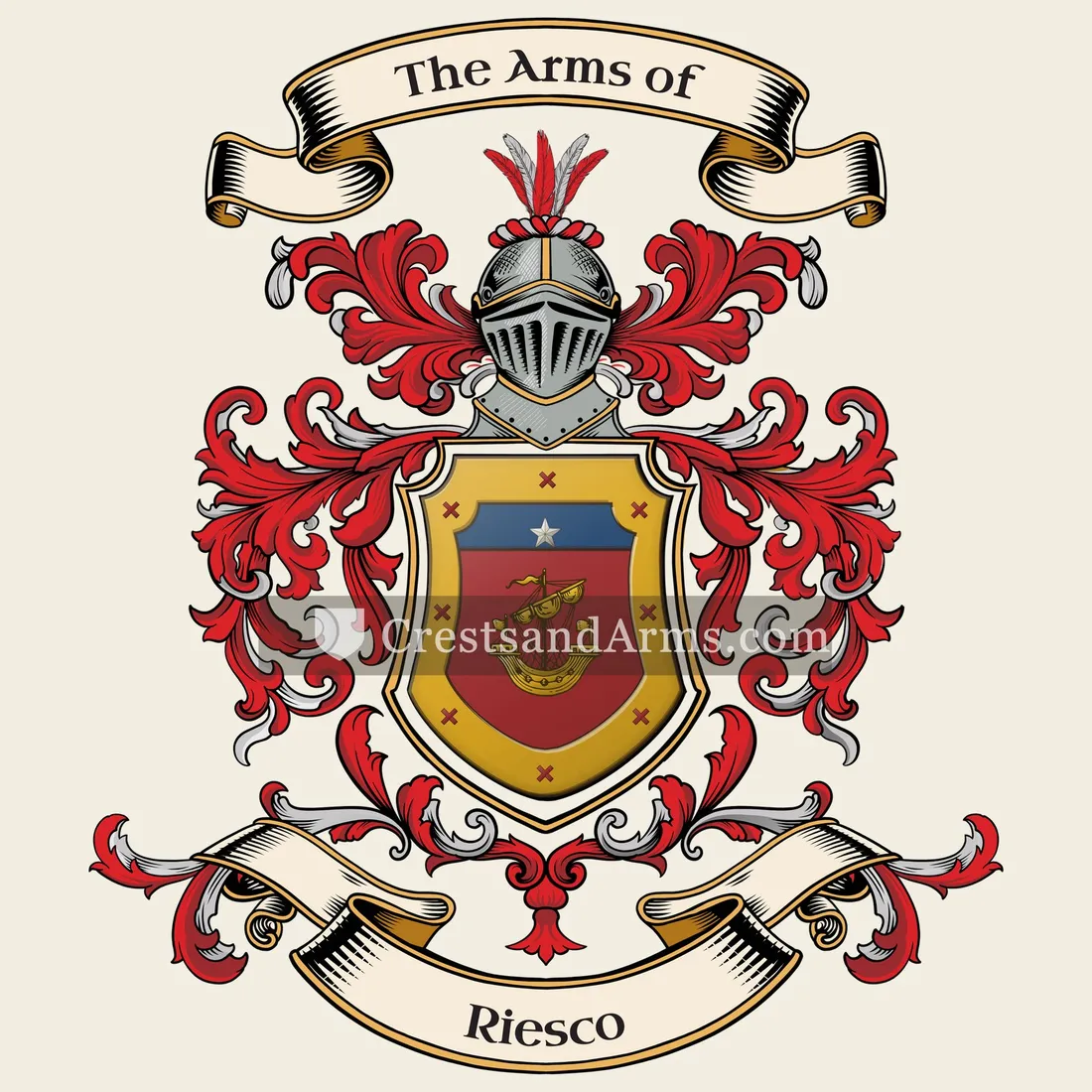
A record of documented arms, meaning and origin, researched for the Riesco family of Spain.
Reg. 6213 · Spanish, P–S
Meaning of the Riesco family crest colors & symbols
Symbols on this shield
chiefAuthority, wisdom and dominion
shipEnterprise, and a great voyage undertaken
mulletThe third son, and a divine quality from above
saltire coupedResolution, and the cross of St Andrew
Colours
Red (Gules)Means: Military strength
Blue (Azure)Means: Loyalty and truth
Gold (Or)Means: Generosity
Silver (Argent)Means: Peace and sincerity
Historical info
Source
J. B. Rietstap, Armorial Général, Gouda: G. B. van Goor Zonen, 1884–87
Blazon (the actual original written record)
“De gu. à un vaisseau d'or, hab. de trois voiles d'arg., voguant sur une mer d'azur, agitée d'arg.; au chef d'azur, ch. d'une étoile (5) d'arg. L'écu entouré d'un bord. d'or, ch. de huit flanchis de gu.”
GaliciaGalicia, c. 1722
Digital archive packCoat of arms PNG, gold border print PDF, vector SVG and the certificate of authenticity. Sent to your email in minutes.
Map of Spain showing where the Riesco arms are recorded
The Riesco arms were recorded in Galicia, c. 1722.
Galicia was eastern country of large estates and small farming villages, held by families who had been there for a very long time. Land was what entitled a family to arms, and land there rarely changed hands.
This is where the arms were entered in the register. Families often moved to other parts of the country, so the same name can turn up in more than one region.
The body that granted and recorded arms in Spain in this period.
Philip V of Spain
Sovereign of the period
Philip V of Spain
1714–1724
Reigning in Spain when the Riesco arms are first recorded.
How Arms Worked in Spain
In Spain, a coat of arms was considered a form of property that belonged to the entire family line. These arms were passed down from a father to all his children equally. Younger branches of the family usually kept the original design without needing to add any special marks to distinguish their specific line.
Granting authority
The Cronista Rey de Armas was the official body that regulated and granted coats of arms throughout Spain.
How they got arms
Families often obtained their arms through royal grants or by proving their noble status to the official heraldic authority.
Where arms were recorded
Coats of arms were officially recorded in the registers of the Cronista Rey de Armas starting in 1496.
The family's standing
Recorded among the armigerous families of Galicia.
Origin & History of the Riesco Family in Spain
The surname Riesco finds its historical roots in the rugged landscape of northern Spain, particularly within the region of Galicia. By the early 18th century, the family was firmly established in this area, where the name likely originated as a topographical descriptor. In the local dialects of the time, the term often referred to a steep or craggy piece of land, suggesting that the first people to carry the name were identified by the specific geography of their homesteads. As families in rural Galicia grew and moved through the mountain valleys, the name became a permanent marker of their lineage. These early generations were deeply connected to the agrarian life of the region, where they maintained land and participated in the local parish communities that formed the backbone of Spanish society in 1722.
Riesco Meaning & Related Branches
Root word
Riesgo
A steep cliff, precipice, or dangerous rocky terrain.
This name
RiescoA topographic surname referring to someone who lived near a steep cliff or dangerous slope.
also spelled
Riesgoh
Riesgoe
Riesg
Reesgo
Documented Sources
J. B. Rietstap, Armorial Général, Gouda: G. B. van Goor Zonen, 1884–87
García García, María José. Los apellidos en Galicia: Historia y evolución. 2005
Moll, Francesc de B. Els llinatges catalans. 1959
Archivo Histórico Diocesano de Santiago de Compostela, Libros de Bautismos y Matrimonios
Digital archive packCoat of arms PNG, gold border print PDF, vector SVG and the certificate of authenticity. Sent to your email in minutes.


 chiefAuthority, wisdom and dominion
 shipEnterprise, and a great voyage undertaken
 mulletThe third son, and a divine quality from above
 saltire coupedResolution, and the cross of St Andrew
 chiefAuthority, wisdom and dominion
 shipEnterprise, and a great voyage undertaken
 mulletThe third son, and a divine quality from above
 saltire coupedResolution, and the cross of St Andrew