Map of France showing where the Rigali arms are recorded
The Rigali arms were recorded in Bordeaux, c. 1663.
This is where the arms were entered in the register. Families often moved to other parts of the country, so the same name can turn up in more than one region.
The body that granted and recorded arms in France in this period.
Louis XIV of France
Sovereign of the period
Louis XIV of France
1643–1715
Reigning in France when the Rigali arms are first recorded.
How Arms Worked in France
In France, a coat of arms was a mark of honor that passed down through the male line to all legitimate descendants. Families often used the same shield without changes to show their shared heritage. If a branch wanted to stand out, they could add a small mark to their shield to show their specific place in the family tree.
Granting authority
The Juge d'armes de France acted as the official authority that regulated and verified coats of arms across the country.
How they got arms
Families typically inherited their arms from ancestors, though they could also receive them through royal grants or by proving their noble status.
Where arms were recorded
Coats of arms were officially recorded in the Armorial Général de France, which began its main collection in the year 1696.
The family's standing
Recorded among the armigerous families of France.
Origin & History of the Rigali Family in France
The Rigali family name has deep roots in the southwestern region of France, with documented evidence placing members of the family in the city of Bordeaux as early as 1663. During the seventeenth century, Bordeaux was a bustling center of international trade and maritime activity, which likely influenced the lives of those living there. Families in this area often played roles in the local economy, ranging from merchant activities to skilled craftsmanship, as the city served as a vital gateway for wine exports and colonial goods. The presence of the Rigali name in official records from this era suggests that the family was well-established within the social and administrative structures of the city. By participating in the daily life of such a prominent port town, the early Rigali family members were part of a vibrant period of French history that defined the culture and development of the Gironde region.
Coat of Arms & Family Crest Details
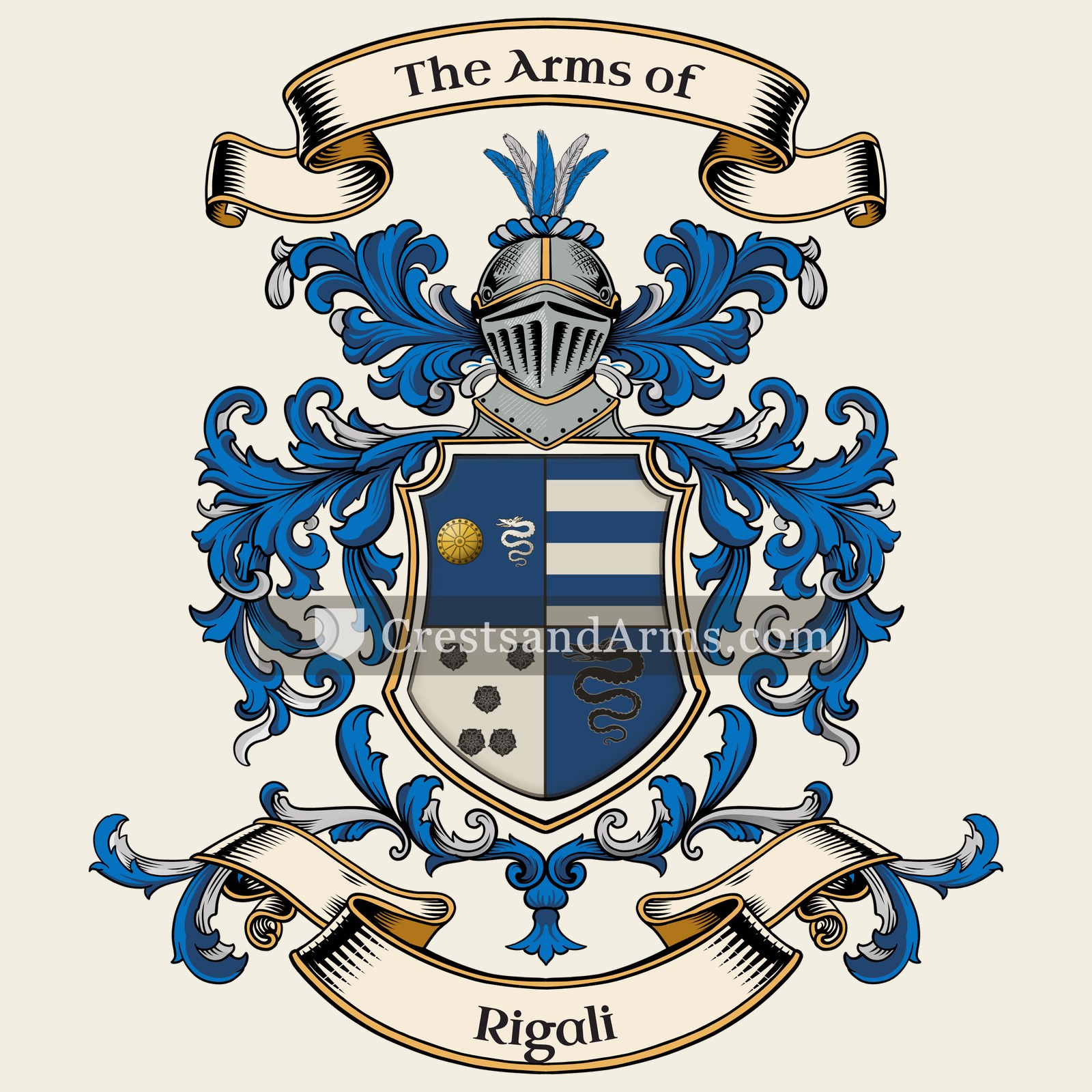
Symbols on this shield
fessThe military belt, and readiness to serve
roundelA coin, and one who has been to the crusades
serpentWisdom, healing and prudence
roseThe seventh son, and beauty with grace
Colours
Blue (Azure)Means: Loyalty and truth
Silver (Argent)Means: Peace and sincerity
Gold (Or)Means: Generosity
Black (Sable)Means: Constancy
Historical info
Source
J. B. Rietstap, Armorial Général, Gouda: G. B. van Goor Zonen, 1884–87
Blazon (the actual original written record)
“Ec.: au 1 d'azur à un miroir ovale d'or, le manche accolé d'un serpent d'arg. qui se mire dans la glace; au 2 fascé d'arg. et d'azur; au 3 de gu. à cinq roses d'arg., 2, 1 et 2; au 4 d'or à un lézard de sa., posé en bande. Cq. cour. C.: cinq pl. d'aut., celle du milieu d'or, les deux ext. d'arg., les deux autres d'azur. L.: à dextre d'or et d'azur, à sen. d'arg. et d'azur.”
Germanyc. 1808
Digital archive packCoat of arms PNG, gold border print PDF, vector SVG and the certificate of authenticity. Sent to your email in minutes.
Map of Germany showing where the Rigali arms are recorded
The Rigali arms were recorded in Germany, c. 1808.
Arms such as these were typically recorded in Bavaria.
Bavaria was a country of old landed families and walled market towns. Estates passed down the same line for centuries, and both the landowners and the leading townsmen kept arms, which is why so many Bavarian names sit in the registers.
This is where the arms were entered in the register. Families often moved to other parts of the country, so the same name can turn up in more than one region.
The body that granted and recorded arms in Germany in this period.
Frederick William III of Prussia
Sovereign of the period
Frederick William III of Prussia
1797–1840
Reigning in France when the Rigali arms are first recorded.
How Arms Worked in Germany
Prussian heraldry was strictly tied to social rank and noble status rather than being a free choice for every citizen. These symbols were treated as permanent family property that moved through the generations to all legitimate heirs. If a family branch wanted to change their design to stand out, they had to apply for official permission to alter their specific version of the shield.
Granting authority
The Prussian Heroldsamt acted as the central state office that managed and strictly controlled all noble titles and coats of arms.
How they got arms
Families usually obtained their arms through formal royal grants or by proving their long-standing noble status to the state authorities.
Where arms were recorded
All official coats of arms were kept in the rolls of the Prussian Heroldsamt, which functioned from 1706 until 1918.
The family's standing
Recorded among the armigerous families of Germany.
Origin & History of the Rigali Family in Germany
The Rigali family name traces its roots to the historical landscape of Bavaria, where records confirm the presence of family members by the year 1808. During this period, Bavaria was undergoing significant political transformation as it transitioned into a kingdom under the influence of the Napoleonic era. Families living in the region at that time were often deeply connected to the local agricultural economy or the burgeoning administrative structures of the Bavarian state. The name itself reflects the linguistic diversity of the region, as it likely evolved from older regional dialects or migration patterns that brought families into southern Germany from neighboring territories. By the early nineteenth century, the Rigali family was firmly established within the local social fabric, participating in the daily life and community development that defined this era of German history.
Related Branches & Arms
Root word
Rigal
Derived from the Old Occitan word for king or royal.
This name
RigaliA locative or occupational surname indicating a connection to royalty or a kingly estate.
also spelled
Rigail
Reegal
Rigall
Documented Sources
J. B. Rietstap, Armorial Général, Gouda: G. B. van Goor Zonen, 1884–87
Archives Départementales de la Gironde, Registres paroissiaux et d'état civil, Series E
Digital archive packCoat of arms PNG, gold border print PDF, vector SVG and the certificate of authenticity. Sent to your email in minutes.


 roundelA coin, and one who has been to the crusades
 roundelA coin, and one who has been to the crusades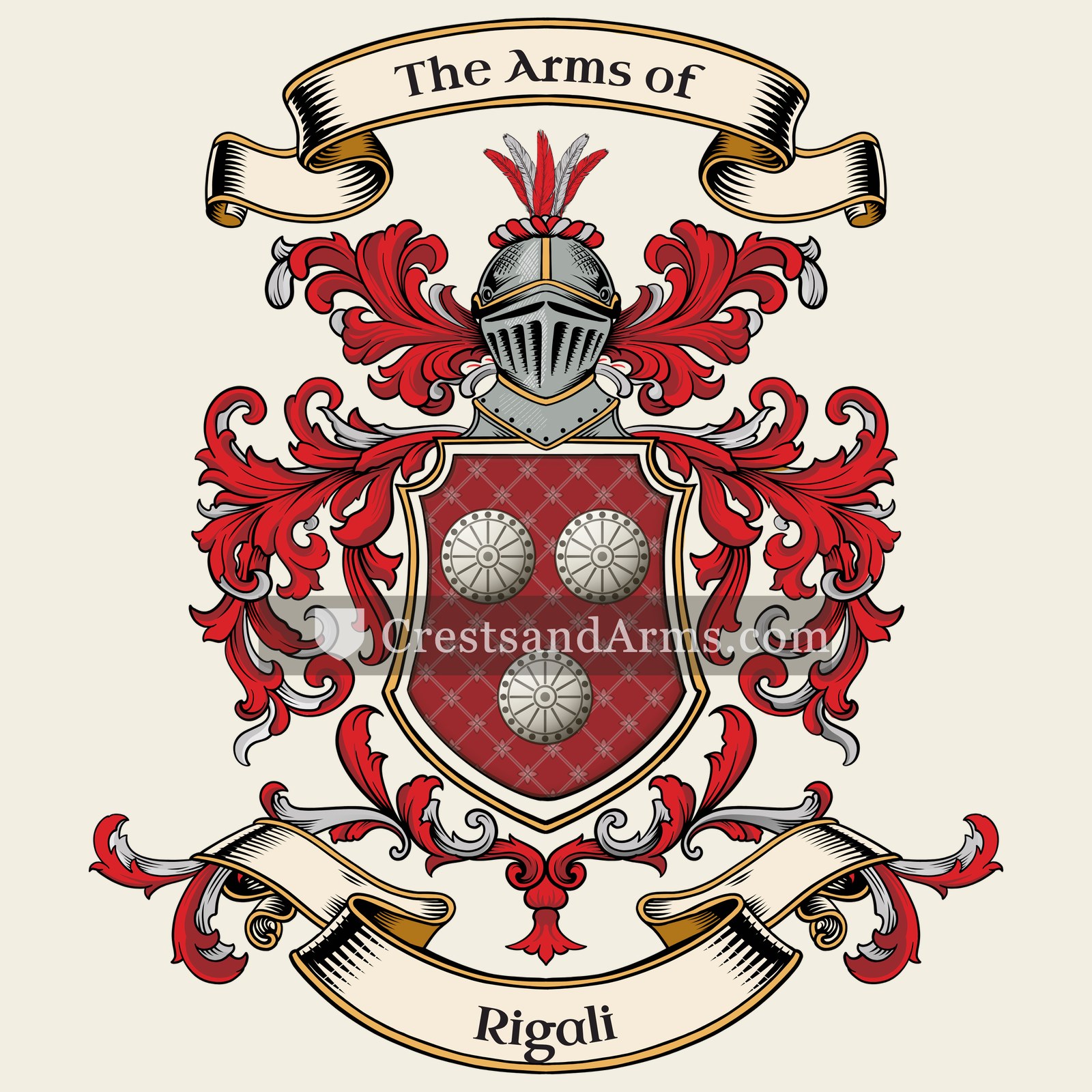


 fessThe military belt, and readiness to serve
 serpentWisdom, healing and prudence
 roseThe seventh son, and beauty with grace