A record of documented arms, meaning and origin, researched for the Righter family lines. Documented in 3 countries.
Reg. 8512 · German, P–S
Meaning of the Righter family crest colors & symbols
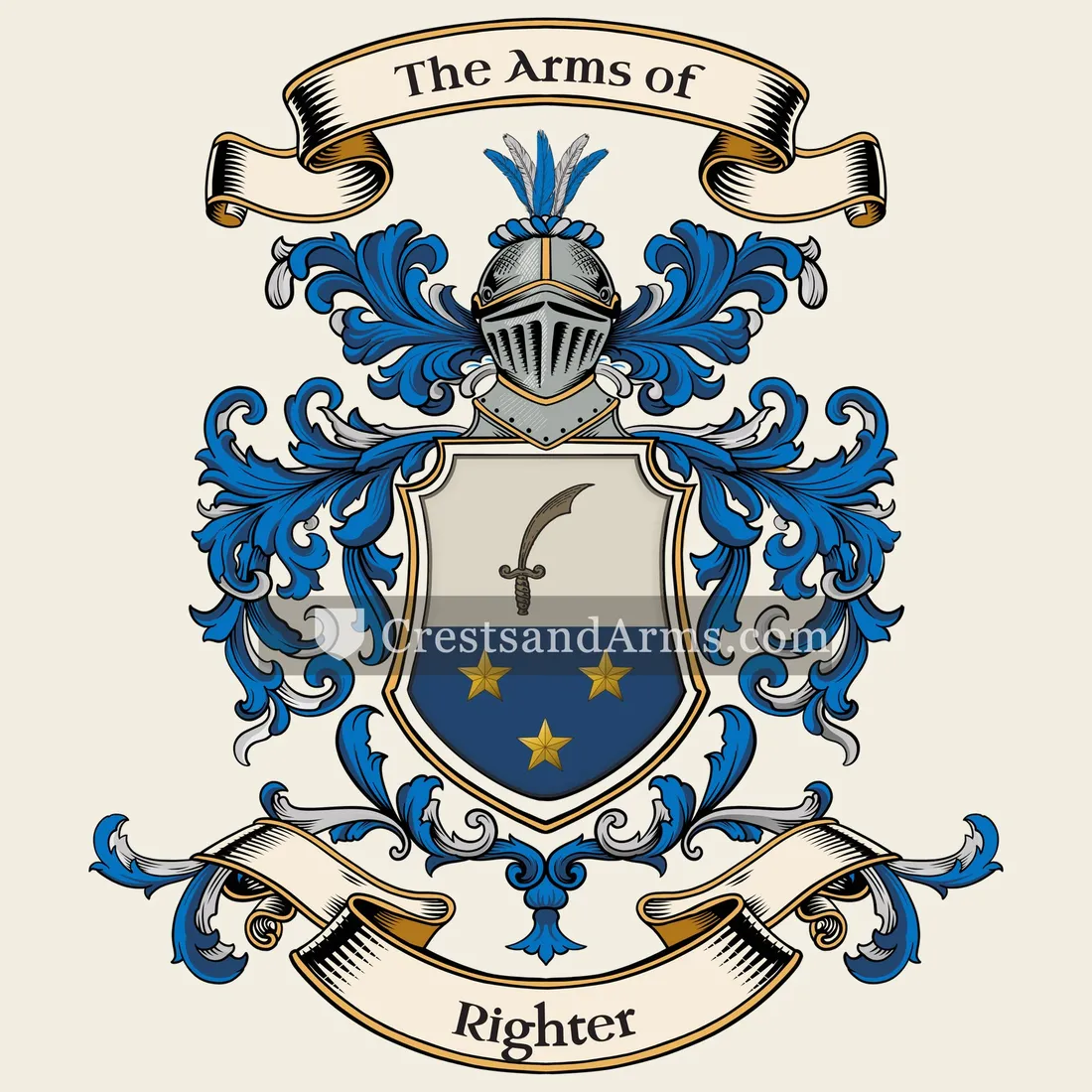
Symbols on this shield
swordJustice, and military honour
mulletThe third son, and a divine quality from above
Colours
Silver (Argent)Means: Peace and sincerity
Blue (Azure)Means: Loyalty and truth
Gold (Or)Means: Generosity
Historical info
Source
J. B. Rietstap, Armorial Général, Gouda: G. B. van Goor Zonen, 1884–87
Blazon (the actual original written record)
“Coupé: au 1 d'arg. à une jeune fille de carn., cour. d'or, hab. d'azur, recouverte d'une tunique d'arg., tenant de sa main dextre une épée au nat. et de sa sen. une balance d'or; au 2 d'azur à trois étoiles d'or. Brl. d'azur et d'arg. C.: un cygne d'arg., le vol levé, tenant de sa patte dextre une étoile d'or. L. d'arg. et d'azur.”
GermanyGörlitz, c. 1612
Digital archive packCoat of arms PNG, gold border print PDF, vector SVG and the certificate of authenticity. Sent to your email in minutes.
Map of Germany showing where the Righter arms are recorded
The Righter arms were recorded in Görlitz, c. 1612.
This is where the arms were entered in the register. Families often moved to other parts of the country, so the same name can turn up in more than one region.
The body that granted and recorded arms in Germany in this period.
Emperor Rudolf II
Sovereign of the period
Emperor Rudolf II
1576–1612
Reigning in Germany when the Righter arms are first recorded.
How Arms Worked in Germany
In the Holy Roman Empire, coats of arms were often granted to individuals by the Emperor or his representatives. These arms were then passed down through the generations to all legitimate descendants of the original holder. Younger branches of a family usually kept the same shield design without needing to change it, as the arms belonged to the entire lineage.
Granting authority
The Holy Roman Emperor held the sole power to grant new coats of arms throughout his vast imperial territories.
How they got arms
Families typically obtained their coats of arms through a formal imperial grant or by proving their noble status to the authorities.
Where arms were recorded
These grants were officially recorded in the Imperial Chancery registers, which began keeping formal records of such honors during the Middle Ages.
The family's standing
Recorded among the armigerous families of Germany.
Origin & History of the Righter Family in Germany
The surname Righter, often appearing in German records as Richter, originates from the medieval period as an occupational title. In the German language, the word *Richter* translates directly to judge or magistrate. During the Middle Ages, this title was frequently given to the head of a village or a local official who held the authority to settle legal disputes among townspeople. By the time the family was documented in the city of Görlitz in 1612, the name had transitioned from a specific job title to a hereditary surname passed down through generations. Living in a major trade hub like Görlitz suggests that these early family members were likely well-established citizens who played active roles in the social and administrative life of the region during the seventeenth century. As the family grew, they moved through different German-speaking territories, carrying the name as a reflection of their ancestors' historical role as community leaders and legal arbiters.
Meaning of the Righter family crest colors & symbols
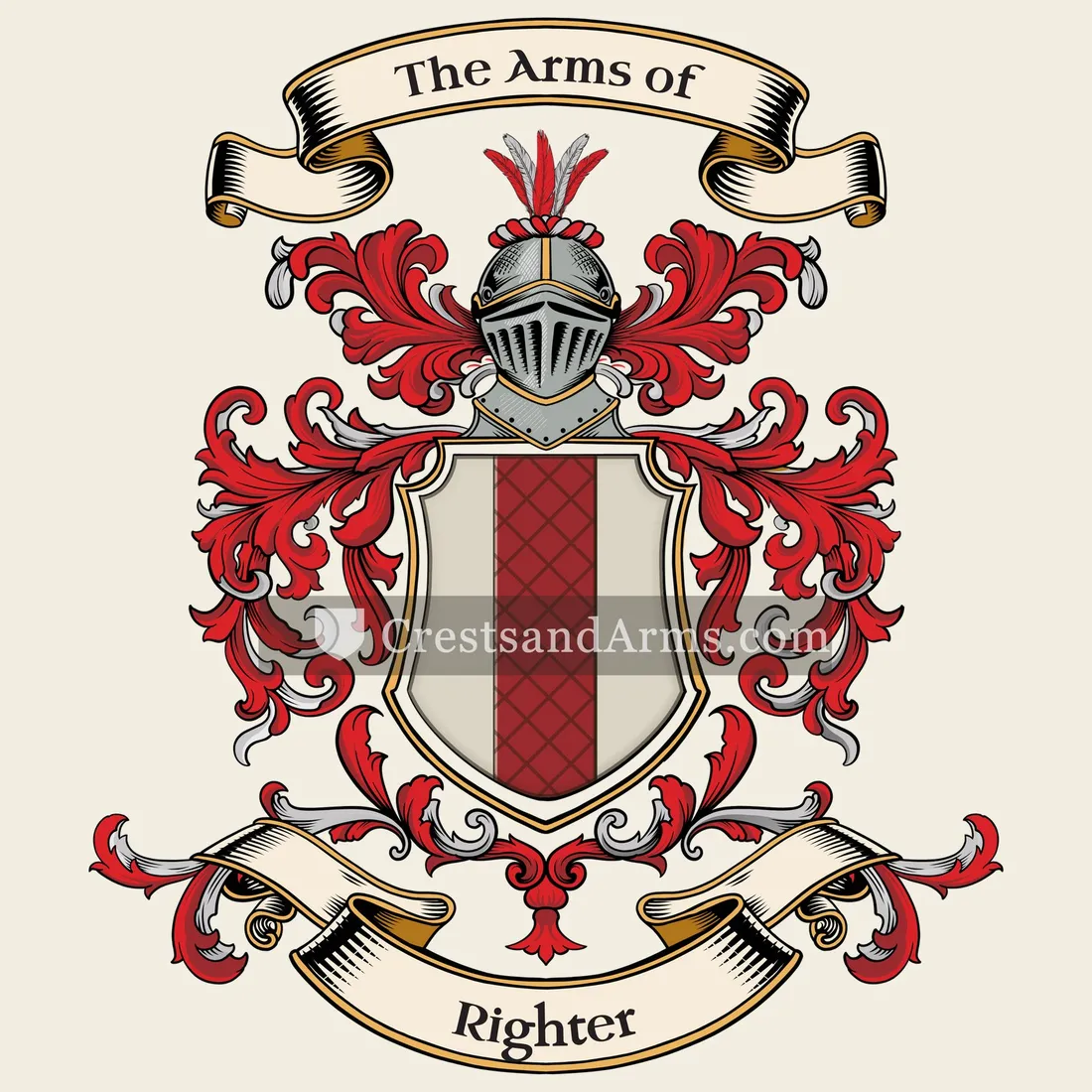
Symbols on this shield
paleMilitary strength, and a fortified defence
Colours
Silver (Argent)Means: Peace and sincerity
Red (Gules)Means: Military strength
Historical info
Source
J. B. Rietstap, Armorial Général, Gouda: G. B. van Goor Zonen, 1884–87
Blazon (the actual original written record)
“D'arg. au pal de gu., ch. d'un bâton d'arg. C.: un homme iss., hab. d'un parti de gu. et d'arg., coiffé d'un chapeau de gu., retr. d'arg., tenant un bâton d'arg.”
Francec. 1663
Digital archive packCoat of arms PNG, gold border print PDF, vector SVG and the certificate of authenticity. Sent to your email in minutes.
Map of France showing where the Righter arms are recorded
The Righter arms were recorded in France, c. 1663.
Arms such as these were typically recorded in Bretagne.
More families held coats of arms in Bretagne than anywhere else in France. The land was divided into many small estates rather than a few large ones, so far more households counted as gentry, and each needed a shield of its own to be told apart.
This is where the arms were entered in the register. Families often moved to other parts of the country, so the same name can turn up in more than one region.
The body that granted and recorded arms in France in this period.
Louis XIV of France
Sovereign of the period
Louis XIV of France
1643–1715
Reigning in Germany when the Righter arms are first recorded.
How Arms Worked in France
In France, a coat of arms was a mark of honor that passed down through the male line to all legitimate descendants. Families often used the same shield without changes to show their shared heritage. If a branch wanted to stand out, they could add a small mark to their shield to show their specific place in the family tree.
Granting authority
The Juge d'armes de France acted as the official authority that regulated and verified coats of arms across the country.
How they got arms
Families typically inherited their arms from ancestors, though they could also receive them through royal grants or by proving their noble status.
Where arms were recorded
Coats of arms were officially recorded in the Armorial Général de France, which began its main collection in the year 1696.
The family's standing
Recorded among the armigerous families of France.
Origin & History of the Righter Family in France
The family name Righter, while often associated with later migrations, finds its early roots in the historical records of the Bretagne region of France during the mid-seventeenth century. By 1663, members of the family were established within this coastal province, a time when the region was defined by a strong sense of local identity and a unique cultural heritage distinct from the rest of the French kingdom. Families in this area often lived in small, tight-knit rural communities where surnames were frequently adapted to reflect the local Breton language or the specific trades practiced by ancestors. As the Righter name appeared in these early parish registers, it likely functioned as a way to distinguish the family within the complex social hierarchy of the village. These early ancestors lived through a period of significant regional transition, navigating the challenges of agricultural life and the shifting political landscape of western France. Their presence in the archives from this era provides a rare glimpse into the lives of families who helped shape the local history of Bretagne long before the name spread to other parts of the world.
Meaning of the Righter family crest colors & symbols
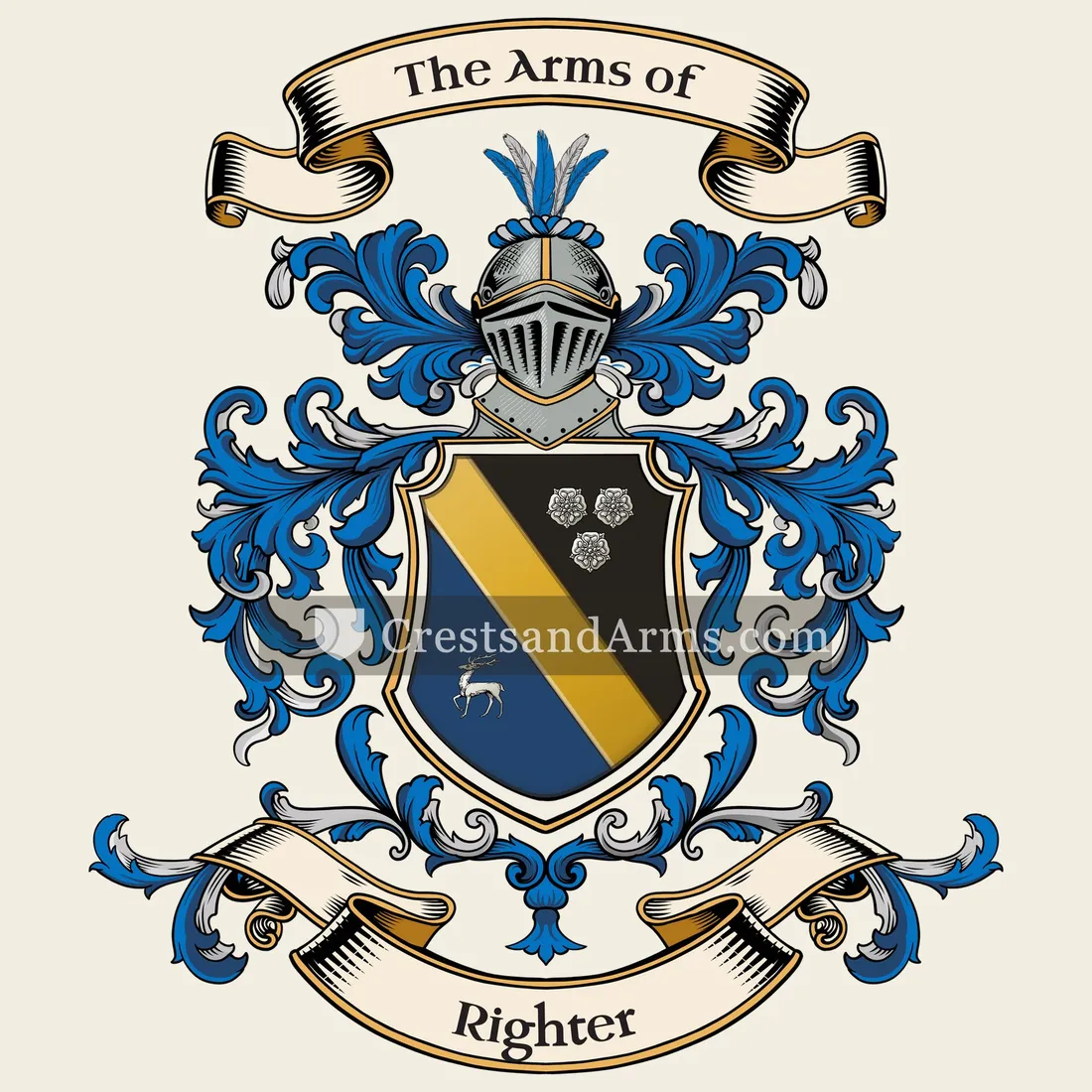
Symbols on this shield
bendDefence, and the scarf of a commander
stagPeace and harmony, and one who will not fight unprovoked
roseThe seventh son, and beauty with grace
Colours
Blue (Azure)Means: Loyalty and truth
Black (Sable)Means: Constancy
Gold (Or)Means: Generosity
Silver (Argent)Means: Peace and sincerity
Historical info
Source
J. B. Rietstap, Armorial Général, Gouda: G. B. van Goor Zonen, 1884–87
Blazon (the actual original written record)
“Tranché: au 1 d'azur à une tête et col cerf au nat., ramée d'or; au 2 de sa. à trois roses d'arg., rangées en demi-orle. A la bande d'or, br. sur le tranché. Cq. cour. C.: une branche de rosier de sa., sans feuilles, fleurie de trois roses mal-ordonnées d'arg.; entre une ramure de cerf d'or. L.: à dextre d'or et d'azur, à sen. d'arg. et de sa.”
RussiaEsthonie, c. 1569
Digital archive packCoat of arms PNG, gold border print PDF, vector SVG and the certificate of authenticity. Sent to your email in minutes.
Map of Russia showing where the Righter arms are recorded
The Righter arms were recorded in Esthonie, c. 1569.
Arms such as these were typically recorded in Moscow.
Moscow held the Russian court, and rank there came from service rather than land. Families who served the Tsar were entered in the registers of nobility, and that entry is where their arms are recorded.
This is where the arms were entered in the register. Families often moved to other parts of the country, so the same name can turn up in more than one region.
The body that granted and recorded arms in Russia in this period.
Ivan the Terrible
Sovereign of the period
Ivan the Terrible
1547–1584
Reigning in Germany when the Righter arms are first recorded.
How Arms Worked in Russia
Russian heraldry was strictly tied to the nobility and the state service system. Families proved their ancient status or earned new rank to receive an official grant from the Tsar. These symbols were then inherited by all legitimate children of the noble line. If a family lacked proof of their status, they were often excluded from the official records entirely.
Granting authority
The Herald Master's Office acted as the central state body that strictly regulated and verified all noble heraldic symbols.
How they got arms
Families typically received their arms through a formal state grant or by proving their noble status to the government authorities.
Where arms were recorded
All approved coats of arms were officially recorded in the General Armorial of the Noble Families of the Russian Empire starting in 1797.
The family's standing
Recorded among the armigerous families of Russia.
Origin & History of the Righter Family in Russia
The history of the Righter family in Russia begins during a period of significant political upheaval in the sixteenth century. By 1569, members of the family were established in Moscow, a time when the city served as the center of the Oprichnina under the rule of Ivan the Terrible. Because the name suggests a connection to trade or administrative roles, it is likely that these early ancestors were part of the growing class of merchants or foreign specialists invited to serve the Russian state. Living in the capital during this era meant the family witnessed the rapid expansion of the Russian Tsardom as it consolidated power over neighboring territories. Their presence in Moscow during such a turbulent time indicates that they held a stable position within the urban social structure, allowing them to survive the intense political purges that defined the late reign of the Tsar. Over the following decades, the family name became integrated into the local administrative fabric, marking their transition from newcomers to established residents of the Russian heartland.
Righter Meaning & Related Branches
Root word
Recht
German word meaning right, law, or justice.
This name
RighterAn occupational surname for a judge, a legal official, or someone who administered justice.
also spelled
Rychter
Righter
Rikter
Documented Sources
J. B. Rietstap, Armorial Général, Gouda: G. B. van Goor Zonen, 1884–87
Bahlow, Hans, Deutsches Namenlexikon: Familien- und Vornamen nach Ursprung und Sinn erklärt, 1967
Heintze, Albert, Die deutschen Familien-Namen: geschichtlich, geographisch, sprachlich, 1903
Stadtarchiv Görlitz, Bürgerbuch der Stadt Görlitz, 1612
Digital archive packCoat of arms PNG, gold border print PDF, vector SVG and the certificate of authenticity. Sent to your email in minutes.


 swordJustice, and military honour
 mulletThe third son, and a divine quality from above
 swordJustice, and military honour
 mulletThe third son, and a divine quality from above


 paleMilitary strength, and a fortified defence


 bendDefence, and the scarf of a commander
 stagPeace and harmony, and one who will not fight unprovoked
 roseThe seventh son, and beauty with grace