Map of England showing where the Risden arms are recorded
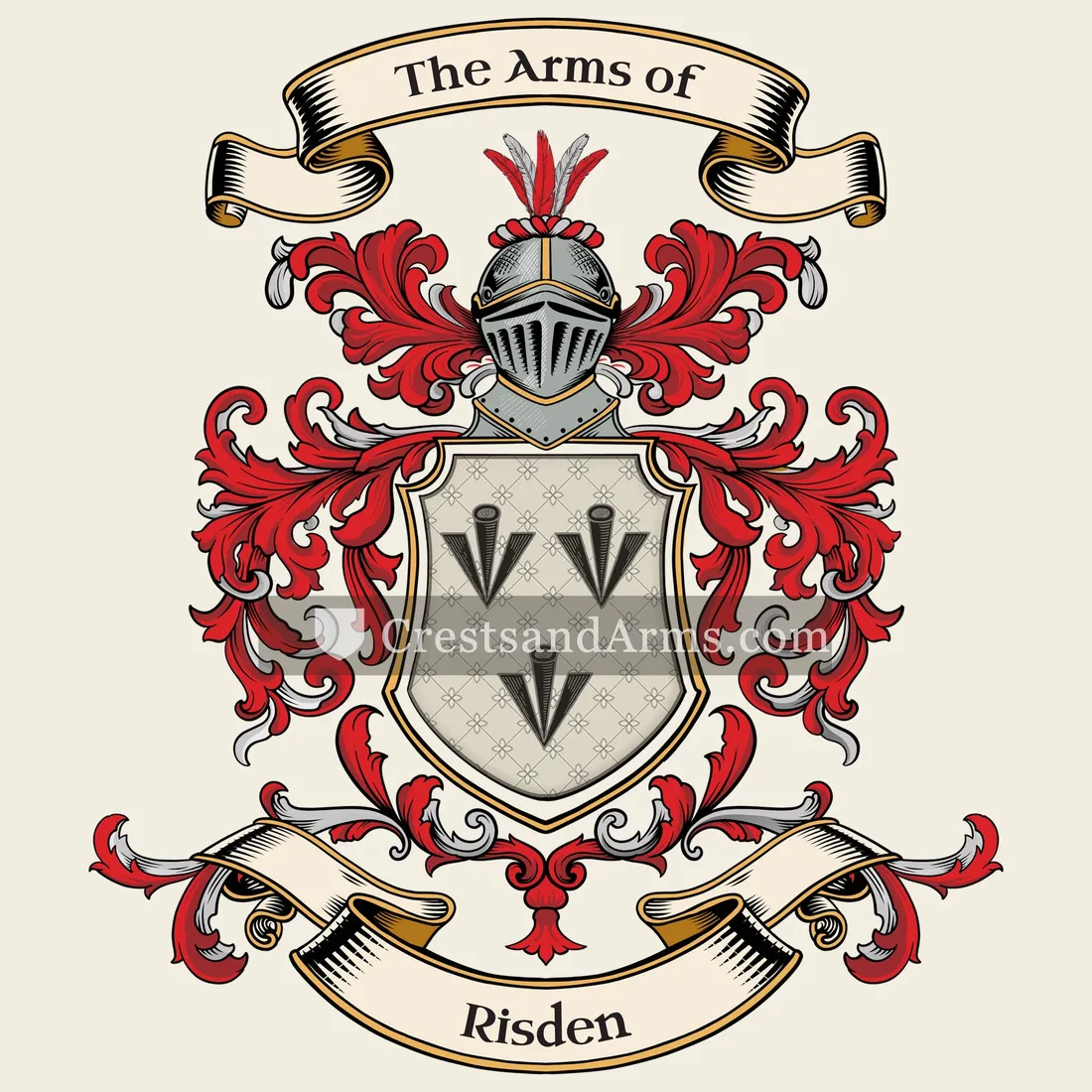
The Risden arms were recorded in Devon, c. 1620.
Devon was a county of small manors and seafaring families. Its gentry were spread thickly across the countryside, and money made at sea often bought an estate, which in turn brought a coat of arms.
This is where the arms were entered in the register. Families often moved to other parts of the country, so the same name can turn up in more than one region.
The body that granted and recorded arms in England in this period.
James VI and I
Sovereign of the period
James VI and I
1603–1625
Reigning in England when the Risden arms are first recorded.
How Arms Worked in England
English heraldry allowed arms to be shared by all legitimate descendants of the original owner. These symbols were treated as personal property that moved through the generations to all children. While the eldest son kept the original design, other family members could use the same shield without needing to change it or register their own unique versions.
Granting authority
The College of Arms in London has regulated the use of coats of arms throughout England and Wales since 1484.
How they got arms
Families typically obtained their coats of arms through a formal grant from the Crown or by proving their ancient right to them.
Where arms were recorded
All official coats of arms are recorded in the registers kept at the College of Arms, which date back to the fifteenth century.
The family's standing
Recorded among the armigerous families of Devon.
Origin & History of the Risden Family in England
The surname Risden is rooted in the landscape of Devon, England, where the family established a notable presence by the early seventeenth century. The name is locational in origin, likely derived from an old estate or a specific patch of land known as a "den" or valley belonging to a person named Risa. By 1620, members of the Risden family were well-integrated into the local social fabric of the region. They were often associated with the landed gentry and the professional classes of the era, frequently appearing in parish registers and legal documents as landowners or participants in local governance. This connection to the Devon countryside suggests that the family had been rooted in the area for generations before the seventeenth century, living as part of the stable rural population that defined the West Country during the late medieval and early modern periods.
Risden Meaning & Related Branches
Root word
Hris-denu
Old English for brushwood or thicket valley.
This name
RisdenDerived from a topographic location describing a valley overgrown with brushwood or dense thickets.
also spelled
Rysdon
Risden
Documented Sources
Sir Bernard Burke, The General Armory of England, Scotland, Ireland and Wales, London: Harrison & Sons, 1884
Pole, William. Collections Towards a Description of the County of Devon. 1791
Vivian, J. L. The Visitations of the County of Devon: Comprising the Herald's Visitations of 1531, 1564, & 1620. 1895
The National Archives, Kew. Prerogative Court of Canterbury and Related Probate Jurisdictions: Will Registers, PROB 11
Digital archive packCoat of arms PNG, gold border print PDF, vector SVG and the certificate of authenticity. Sent to your email in minutes.


 arrowReadiness for battle, and affliction endured
 arrowReadiness for battle, and affliction endured